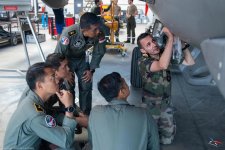
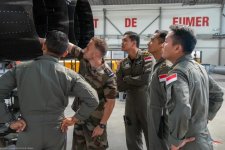
Indonesian Air Force

How far has this project reached and what will Indonesia get out of it? How many fighter jets?

At least 200 engineers get experience during design phase, the next phase is to improve system integration capability when KF21 5th prototype is sent to Indonesia for independent development and also during production of IFX inshaAllah.

---------------------

3. Explanation from PT Dirgantara Indonesia


PT Dirgantara Indonesia provided clarification regarding the Indonesia–South Korea cooperation on the KF-21 Boramae project. A group of PT DI engineers has indeed been sent to South Korea in rotation since September 2016, but their involvement was limited to certain aspects of design and analysis.


"The cooperation between Indonesia and the ROKG (Republic of South Korea Government), in which PT DI was appointed for industrial participation by the government through the Ministry of Defense," said PT Dirgantara Indonesia spokesperson Kerry Apriawan on July 26, 2022.


4. Overview of the Presence of Indonesian KF-21 Boramae Engineers in Korea


It was mentioned that as of July 2022, PT DI had sent a total of around 200 engineers to Korea Aerospace Industries (KAI) for technology transfer (ToT). The deployment was temporarily halted during the Covid-19 pandemic. "They returned in March 2020 and only departed again in August 2021," said PT Dirgantara Indonesia spokesperson Kerry Apriawan at that time.


Previously, the first KF-21 Boramae prototype was only used for speed testing. The second prototype was used to evaluate the aircraft’s structural load capacity.


He added that, at the same time, there were 39 engineers currently at KAI: "Consisting of 37 PT DI engineers and 2 test pilots from the Indonesian Air Force (TNI AU)."

 
At least 200 engineers get experience during design phase, the next phase is to improve system integration capability when KF21 5th prototype is sent to Indonesia for independent development and also during production of IFX

---------------------

3. Explanation from PT Dirgantara Indonesia


PT Dirgantara Indonesia provided clarification regarding the Indonesia–South Korea cooperation on the KF-21 Boramae project. A group of PT DI engineers has indeed been sent to South Korea in rotation since September 2016, but their involvement was limited to certain aspects of design and analysis.


"The cooperation between Indonesia and the ROKG (Republic of South Korea Government), in which PT DI was appointed for industrial participation by the government through the Ministry of Defense," said PT Dirgantara Indonesia spokesperson Kerry Apriawan on July 26, 2022.


4. Overview of the Presence of Indonesian KF-21 Boramae Engineers in Korea


It was mentioned that as of July 2022, PT DI had sent a total of around 200 engineers to Korea Aerospace Industries (KAI) for technology transfer (ToT). The deployment was temporarily halted during the Covid-19 pandemic. "They returned in March 2020 and only departed again in August 2021," said PT Dirgantara Indonesia spokesperson Kerry Apriawan at that time.


Previously, the first KF-21 Boramae prototype was only used for speed testing. The second prototype was used to evaluate the aircraft’s structural load capacity.


He added that, at the same time, there were 39 engineers currently at KAI: "Consisting of 37 PT DI engineers and 2 test pilots from the Indonesian Air Force (TNI AU)."


So your not gonna purchase it?
 
So your not gonna purchase it?

Man, we have already had production line in Indonesian Aerospace

How many purchase ? It could be 100, 200 and possibly this project will create opportunity for Indonesian Aerospace to develop Stealth Wing Man Drone for IFX

At start, 48 plane inshaAllah

To view this content we will need your consent to set third party cookies.
For more detailed information, see our cookies page.


To view this content we will need your consent to set third party cookies.
For more detailed information, see our cookies page.
 
To view this content we will need your consent to set third party cookies.
For more detailed information, see our cookies page.
 
Today, 22 Years Ago, Indonesian Air Force F-16s Nearly “Dogfight” with F/A-18 Hornets Over Bawean
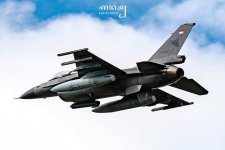
1752068604452.jpeg


03/07/2025

Many netizens may have forgotten that on this date, July 3, twenty-two years ago, a historic event occurred in the world of Indonesia’s air defense. On July 3, 2003, there was a near aerial duel between F-16s from Air Squadron 3, Iswahjudi Air Base, Madiun, and a group of F/A-18 Hornets from the nuclear aircraft carrier USS Carl Vinson (CVN-70).


The incident, which took place over the Java Sea northwest of Bawean Island, later became known as the Bawean Incident. At that time, two Indonesian Air Force F-16s faced off against nine US Navy F/A-18 Hornets. The event began when the aircraft carrier USS Carl Vinson, accompanied by two frigates and a destroyer, sailed from Singapore toward Australia via the Karimata Strait (ALKI I) and into the Java Sea. As the formation passed Bawean’s waters, the F/A-18s, part of the carrier’s air wing, conducted routine flight training and maneuvers that were deemed dangerous to civil air traffic within Indonesian airspace.
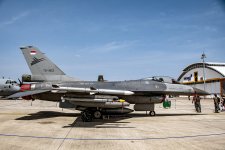
1752069432352.jpeg

Detection of this unauthorized flight was first reported at 11:41 AM Western Indonesian Time (WIB). The Sector Operations Center (Posek) Hanudnas II in Makassar received a report from the Military Civil Coordination (MCC) in Ngurah Rai, Bali, about unidentified flights over Bawean Island. Five aircraft were detected at altitudes between 15,000 and 35,000 feet, flying at approximately 450 knots with squawk number (IFF mode 3/A) 1200.


There was no communication heard between these five unidentified aircraft and Air Traffic Control (ATC) in Bali or Surabaya. The information was then forwarded to the National Air Defense Operations Center (Popunas) in Jakarta for monitoring. Posek Hanudnas II instructed MCC Rai and MCC Juanda to keep tracking the flights and requested confirmation from Popunas on whether security clearance had been issued for the aircraft involved.


Two hours later, at 2:50 PM WIB, a number of unidentified aircraft reappeared near Bawean. Commander of Sector Operations II, Air Commodore Panji Utama, immediately reported the incident to the National Air Defense Commander, Air Vice Marshal Wresniwiro, who ordered visual identification using F-16 interceptor jets on standby at Iswahjudi Air Base. This marked the start of what became known as the Bawean Incident.

To view this content we will need your consent to set third party cookies.
For more detailed information, see our cookies page.


At 3:40 PM WIB, Lieutenant Colonel Tatang Harlyansyah, Commander of Air Squadron 3, was instructed to prepare F-16s for visual identification along radial bearings of 340–015 degrees, flight levels 15,500–25,000 feet, at distances of 113–135 nautical miles from Surabaya (the Bawean area). At 3:53 PM, the National Air Defense Commander reported the operation plan to the Chief of General Staff and Air Force Chief of Staff, Air Chief Marshal Chappy Hakim.
1752069022131.jpeg

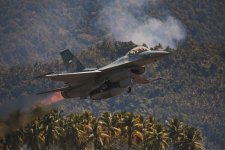
By 4:40 PM WIB, the pilots had started the engines of the two twin-seat F-16s. Falcon 1 (TS-1603) was crewed by Captain Ian Fuadi and Captain Fajar Adriyanto, while Falcon 2 (TS-1602) was crewed by Captain Tonny Haryono and Captain Satriyo Utomo. At 5:04 PM, both F-16s (Falcon Flight), each armed with two AIM-9P4 missiles and 450 rounds of 20mm ammunition, took off.


At 5:16 PM WIB, Falcon Flight appeared on Surabaya radar and was monitored by MCC Rai. Two minutes later, Falcon Flight made contact on the SBY Director frequency, acting as Ground Controlled Intercept (GCI), and received information on the positions and number of unidentified aircraft. Four minutes after that, Falcon Flight was informed that two other planes were quickly approaching them.


At 5:22 PM WIB, Falcon Flight made radar contact with the targets. At this point, both sides’ radar ECCM (electronic counter-countermeasures) systems began jamming each other, with each side’s electronic warfare equipment broadcasting radio waves in an attempt to disrupt the other. Both F-16s activated their anti-jamming systems and set them to auto mode, making the F/A-18s’ jamming attempts ineffective. According to the F-16s’ radar warning receivers (RWR), Falcon 1 was locked onto by the radar and missiles of an F/A-18.


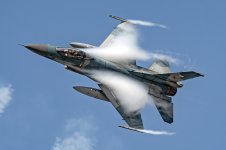
At 5:25 PM WIB, Falcon 1 visually identified an F/A-18 and both jets engaged in mutual turning maneuvers, with Falcon 1 positioning itself behind the F/A-18. Falcon 2 immediately took a supporting position but was chased by another F/A-18. To indicate that the Indonesian F-16s were not hostile, Falcon 2 rocked its wings—a standard “no threat” signal.
1752069157752.jpeg


Cockpit recordings from Falcon 2 (TS-1602, with Captain Tonny and Captain Satriyo) showed Falcon 1 executing a hard bank, nearly 90 degrees, while closely tailed by Hornet 1. Meanwhile, the second Hornet shadowed its partner. Falcon 2 also had a tactical advantage over Hornet 2, so if the encounter had escalated, Captain Tonny and Captain Satriyo could have assisted Falcon 1. While maneuvering sharply to avoid a potential Sidewinder missile, Captain Fajar managed to spot a US Navy destroyer below and immediately reported it.


Both Indonesian F-16s came very close to a dogfight with the Hornets but refrained from offensive action. Their orders were strictly to intercept and visually identify—finding out the aircraft type, nationality, and the purpose of their maneuvers.


The Indonesian Falcon Flight leader then informed the US Navy F/A-18s that they were in Indonesian airspace, explained the F-16s were on visual ID patrol, and instructed the F/A-18s to contact the local ATC, as Bali Control (responsible for the area’s air traffic) was unaware of their presence.


At 5:22 PM WIB, the Hornets turned away while Falcon Flight returned to Iswahjudi Air Base, landing safely at 6:15 PM. Sector Operations II continued monitoring under the supervision of Popunas. MCC Rai reported to Popunas that after the F-16s’ visual identification, the F/A-18s finally established contact with Ngurah Rai Airport ATC as directed by the Indonesian pilots.


(Gilang Perdana – Quoted from the book “Incident Over Bawean” by Air Vice Marshal Wresniwiro)

 
1752069787181.jpeg
1752069607388.jpeg
1752069757034.jpeg
1752069825069.jpeg
To view this content we will need your consent to set third party cookies.
For more detailed information, see our cookies page.
 
1752150774770.jpeg
To view this content we will need your consent to set third party cookies.
For more detailed information, see our cookies page.


To view this content we will need your consent to set third party cookies.
For more detailed information, see our cookies page.
 
Halim Perdana Kusuma Airfield Base, East Jakarta

To view this content we will need your consent to set third party cookies.
For more detailed information, see our cookies page.


To view this content we will need your consent to set third party cookies.
For more detailed information, see our cookies page.
 
Before, we have both F16 and Su27/30 Aerobatic team. Now, all fighters are focused on real operation, while aerobatic is done by propeller plane

To view this content we will need your consent to set third party cookies.
For more detailed information, see our cookies page.


To view this content we will need your consent to set third party cookies.
For more detailed information, see our cookies page.


To view this content we will need your consent to set third party cookies.
For more detailed information, see our cookies page.


To view this content we will need your consent to set third party cookies.
For more detailed information, see our cookies page.
 
F16

To view this content we will need your consent to set third party cookies.
For more detailed information, see our cookies page.


To view this content we will need your consent to set third party cookies.
For more detailed information, see our cookies page.


Su27/30

To view this content we will need your consent to set third party cookies.
For more detailed information, see our cookies page.
 
The Ministry of Defense reaffirms its commitment to modernizing military equipment and strengthening the independence of the national defense industry through strategic contributions to the KF-21 Boramae fighter jet development program.

To view this content we will need your consent to set third party cookies.
For more detailed information, see our cookies page.


One of the significant milestones was marked by the success of Colonel Pnb Ferrel Rigonald, a test pilot of
@_TNIAU
, who occupied the front seat in the inaugural flight of the KF-21 prototype in Sacheon, South Korea, on Friday (27/6). Accompanied by Korea Aerospace Industries (KAI) pilot Koh Hwi Seok, this mission took place for one hour at an altitude of approximately 20,000 feet.

This participation affirms Indonesia's active role in the flight test phase of the 4.5 generation fighter aircraft, while also serving as a concrete manifestation of technology transfer and the development of defense human resources.

To view this content we will need your consent to set third party cookies.
For more detailed information, see our cookies page.


-------------------

To view this content we will need your consent to set third party cookies.
For more detailed information, see our cookies page.


To view this content we will need your consent to set third party cookies.
For more detailed information, see our cookies page.


To view this content we will need your consent to set third party cookies.
For more detailed information, see our cookies page.
 
key points in the report:

  • Lack of stealth (VLO) is a key handicap. French forces may be relegated to a supporting role in coalitions, relying on allies with stealth fighters.
  • The Rafale struggles against 5th-gen stealth fighters in exercises; its sensors are insufficient for parity
  • only ~30 of ~ 200 Rafales would be available for sustained high-intensity combat

https://www.ifri.org/sites/default/files/2025-01/ifri_gorremans_avenir_superiorite_aerienne_2025.pdf

 
To view this content we will need your consent to set third party cookies.
For more detailed information, see our cookies page.


To view this content we will need your consent to set third party cookies.
For more detailed information, see our cookies page.
 
Indonesian Air Force Strengthens Rafale Personnel Readiness in France
August 11, 2025

1754925680713.jpeg

The Indonesian Air Force (TNI AU) continues to strengthen its readiness for the arrival of the latest-generation Rafale fighter jets through the Pilot Training Batch 1 program and the Organizational Level of Maintenance (OLM) Technical program.

1754925647885.jpeg

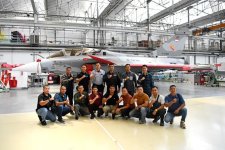
The program is attended by 16 selected personnel, consisting of 4 pilots and 12 technicians, all in good health and ready to carry out all stages of training. The Batch 1 training team is led by Kasiopslat Disops Lanud Supadio, Lieutenant Colonel (Pnb) Binggi Nobel, M.S.S., who serves as the Team Leader.

1754925612476.jpeg


This training is part of the Indonesian Air Force’s strategic efforts to develop human resources that are adaptive, modern, professional, excellent, and human-centered. It also aligns with one of the Air Force’s priority programs — the modernization of defense and security equipment (alpalhankam) — aimed at strengthening the nation’s air defense deterrence.

1754925585057.jpeg

This effort also underscores Indonesia’s readiness to face the spectrum of modern threats, which demand rapid adaptation, mastery of advanced technology, and the integration of combat capabilities.


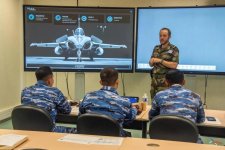
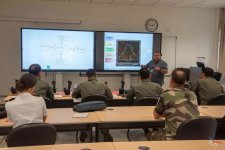
Within this framework, the technicians study both general materials and specializations according to their respective fields — Vector, Avionics, and Armament. The learning process takes place in classrooms and hangars, followed by on-the-job training at operational squadrons in France. Meanwhile, the pilots deepen their knowledge of Rafale systems and operating procedures before proceeding to the simulator phase and flight training.

1754925544899.jpeg

Starting August 20, the pilots are scheduled to continue their training at Saint-Dizier Air Base until December, to fully master mission simulations and flight exercises. This stage is key to ensuring optimal combat capability when the Rafale officially joins Indonesia’s air defense forces.


With well-planned and integrated preparations, the Indonesian Air Force reaffirms its commitment to building a modern air power, supported by highly skilled personnel ready to operate the latest-generation defense systems to safeguard the sovereignty of the nation’s airspace.

Source : Indonesian Air Force
 
To view this content we will need your consent to set third party cookies.
For more detailed information, see our cookies page.
 

Users who are viewing this thread

Pakistan Defence Latest

Country Watch Latest

Latest Posts

Back
Top