Apple Sales in China Plunge 50%, Huawei Back on Top – Fortune

Beijingwalker

VIP Member
Joined
Nov 4, 2011
Messages
92,509
Reaction score
113,175
Reputation
2,078.8
Country of Origin
Country of Residence

Apple Sales in China Plunge 50%, Huawei Back on Top – Fortune

May 14, 2025

Huawei, which slumped for several years after being hit with US sanctions, has managed to regain its dominant position in the Chinese smartphone market​

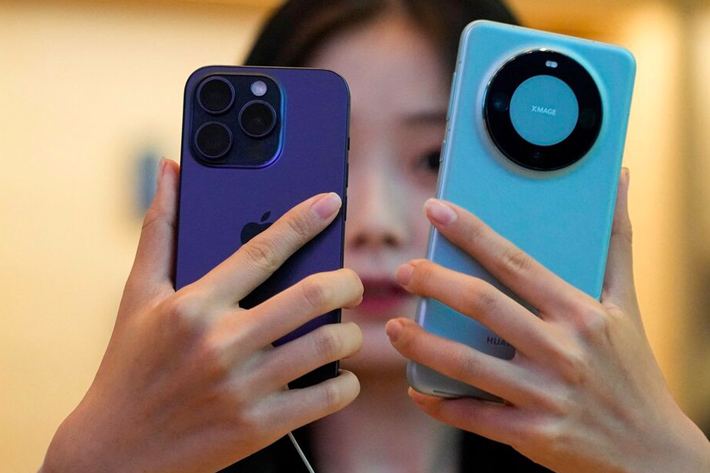
A woman looks at a new iPhone 15 Pro and a Huawei Mate 60 Pro as Apple's new iPhone 15 officially goes on sale across China, at an Apple store in Shanghai, China
A woman looks at a new iPhone 15 Pro and a Huawei Mate 60 Pro, at an Apple store in Shanghai, China. Photo: Reuters

Sales of American smartphone giant Apple plunged nearly 50% in China as the iPhone-maker faced increasing competition from domestic players — most notably, Huawei — according to a report by Fortune India.

Apple’s shipments sank to 1.89 million units, down from 3.75 million one year ago, translating to a 49.6% drop in sales, the Forbes report said, citing data from think-tank China Academy of Information and Communications Technology.

Foreign-branded smartphones now account for just 8% of China’s smartphone market — the largest in the world, the report added. That is half of their 16% share a year ago.

Meanwhile, US-sanctioned smartphone maker Huawei, which, for years, had been teetering on the edge of collapse, managed to regain its dominant position in the market, accounting for more than 19% of its share. That’s an outcome that analysts had been predicting since last year, on the back of Huawei launching its Mate 60 and Mate 70 smartphone series.

Sales of those devices had been so strong that they managed to spark a turnaround in the Chinese smartphone market in 2023 after several quarters of slowdown.

Huawei’s role in developing China’s first homegrown advanced semiconductor, with state-backed chipmaker Semiconductor Manufacturing International Corporation (SMIC), has played a key role in charting the smartphone maker’s return to the market. That breakthrough sparked huge patriotic backing for the tech giant from Chinese consumers, which has also fuelled the fall in Apple’s market share in China.

Meanwhile, Apple’s inability so far to roll out its AI services in China has also hit demand for its phones in the country.
 
Apple closes first China store while Huawei reclaims smartphone market leadership

July 30, 2025
  • Apple’s market share in China faces pressure as company closes first mainland store.
  • Huawei captures 18% of Q2 smartphone sales.

  • Apple sees 4% shipment increase, but fifth behind Chinese competitors in the world’s largest market.
The symbolic weight of Apple shuttering its first mainland China store in 17 years cannot be understated – it marks a reversal of fortune for a company that once epitomised Western tech dominance in the world’s largest consumer market.

As Apple’s market share in China faces pressure from resurgent local competitors, the closure of its Dalian outlet coincides with Huawei’s return to smartphone market leadership, signalling a shift in the competitive landscape that extends beyond quarterly sales figures.

The numbers behind Huawei’s comeback​

The data tells a story of corporate resurrection. According to the latest research from Canalys, Huawei shipped 12.2 million smartphones in the second quarter of 2025, capturing an 18% market share with a robust 15% year-on-year growth. The achievement is particularly remarkable, given that the company’s smartphone business was severely crippled by US sanctions a few years ago.

Huawei’s strategic pivot to ecosystem independence has been central to this recovery. “Huawei launched the Nova 14 series, its first Nova lineup to feature HarmonyOS 5.0. The move is expected to accelerate the expansion of its independent ecosystem’s user base, while also placing greater demands on system compatibility and user experience,” said Lucas Zhong, an analyst at Canalys.

Apple’s paradoxical position: Growing yet declining​

The irony of Apple’s current predicament lies in its simultaneous growth and marginalisation. Despite achieving its first quarterly growth in China since late 2023, with 10.1 million smartphone shipments representing a 4% year-over-year increase, the company has slipped to fifth place in the market hierarchy.

The growth required significant concessions. Apple “strategically adjusted its pricing for the iPhone 16 series in China,” according to Canalys, while Chinese e-commerce platforms offered substantial discounts during the quarter. Apple also increased trade-in prices for older iPhone models – moves that boosted volume but helped undermine its premium positioning.

Physical retreat: The end of an era in Dalian​

The closure of Apple’s Dalian Parkland Mall store on August 9 represents a retail adjustment and the first time the company has shuttered a directly-managed outlet since establishing its China presence in 2008. The symbolic weight extends beyond the 7.5 million Dalian residents who will lose direct access to Apple’s premium retail experience.

“Given the departure of several retailers at the Parkland Mall, we have decided to close our store,” Brian Bumbery, an Apple spokesman, told The New York Times, framing the closure as a response to broader mall difficulties rather than company-specific challenges.

The broader battleground: Beyond hardware to ecosystems​

The competition has evolved beyond traditional hardware specifications to encompass complete technological ecosystems. Huawei’s rollout of HarmonyOS 5 in devices positions it as a direct challenger to both Google’s Android and Apple’s iOS, while Chinese brands invest heavily in proprietary technologies that reduce dependence on foreign platforms.

Xiaomi’s unveiling of its in-house XRing O1 chipset exemplifies this trend toward technological sovereignty. Meanwhile, Vivo’s staggered product releases in multiple series demonstrate market segmentation strategies that Apple’s more limited product range struggles to match.

The overall Chinese smartphone market declined 4% year-on-year in Q2 2025, yet this contraction masks underlying resilience. “The Q2 correction is mainly a result of reshaped seasonality driven by the national subsidy programme in early 2025,” explained Amber Liu, practice leader at Canalys.

First-half shipments increased slightly year-on-year, suggesting that Apple’s challenges stem from competitive positioning rather than market deterioration.
 
Apple is no longer innovative.

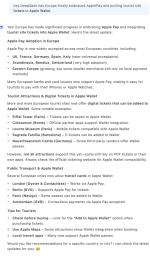
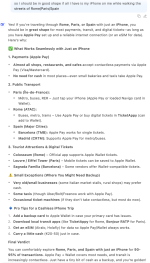
All I know is I'll be going to Europe in a few days and almost every place takes ApplePay and many of the tourist places that required me to buy tickets automatically put them in my wallet app so i don't need a paper ticket.

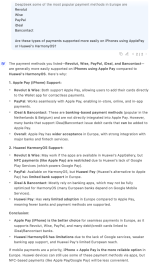
ApplPayEU.png
golden.png


wallet-iphone-final2_en.jpg

To view this content we will need your consent to set third party cookies.
For more detailed information, see our cookies page.
 
Last edited:

:ROFLMAO: :ROFLMAO: :ROFLMAO:

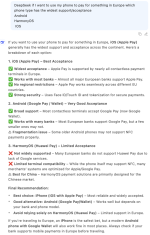
europeApplepay.png

:ROFLMAO::ROFLMAO::ROFLMAO::ROFLMAO:

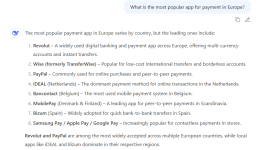
I happen to have a Revolut Debit card loaded in ApplePay and ready if needed (has wide acceptance with no fees for getting cash)

To view this content we will need your consent to set third party cookies.
For more detailed information, see our cookies page.

✅ How To Connect Revolut Debit Card To Apple Pay Wallet 🔴


To view this content we will need your consent to set third party cookies.
For more detailed information, see our cookies page.

How To Use Wise Card With Apple Pay​


To view this content we will need your consent to set third party cookies.
For more detailed information, see our cookies page.

How Do i Add PayPal to Apple Pay | Link PayPal to Apple Wallet​

widestAcceptance.png

 
Last edited:
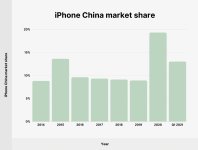
Before Huawei got sanctioned Apple occupied >5th place in China sales and dropped to something like ~5% market share. Today Apple has >10% market share in China, which is among the Top 5. No matter how these kinds of articles spin it, Apple today is EVEN GREATER than the Apple of the past in 2019 in the Chinese market!

EDIT: here I dug up the past for y'all 2 C!

Apple.jpg

Obviously ppl in China loved iphones more than ever since 2019 as their market share is now over 10% in 2025!

Sooo.. Huawei regained the crown my rear end. Apple also upended the Chinese market to garner more loyal hanjians!
 
Last edited:
Before Huawei got sanctioned Apple occupied >5th place in China sales and dropped to something like ~5% market share. Today Apple has >10% market share in China, which is among the Top 5. No matter how these kinds of articles spin it, Apple today is EVEN GREATER than the Apple of the past in 2019 in the Chinese market!

Apple breaks records in China with high iPhone 17 preorders​


Apple breaks records in China with high iPhone 17 preorders​

Huawei chips don't even work for AI training, that's why the new Deepseek model was delayed.

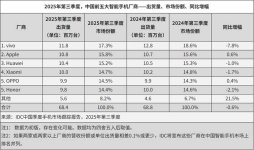
Huawei is a grossly over-rated company, whose main sales drive is nationalistic sentiments. These guys actually on many occasions deliver very subpar consumer products. That's y Apple even beat them in the latest quarterly (Q3) China sales:


IDC-img.jpg

You can see (from my post history) I rarely come here to post anymore. This site is driven by crazed Huawei fanboi posters whose consciousness live in la-la-land that is very far apart from reality...

I always thought China is a meritocratic society. Basically any (Chinese) company should be exalted based on the quality and excellence of their products. Apparently not so with Huawei, they could produce utter crap (as evidenced by how suck their AI chips are that caused Deepseek to fall further behind the West) and a few weirdos would still buy them up in China.
 
Last edited:
Apparently not so with Huawei, they could produce utter crap (as evidenced by how suck their AI chips are that caused Deepseek to fall further behind the West) and a few weirdos would still buy them up in China.

Huawei's latest ADAS system using LiDAR failed to do as well Tesla's FREE standard 2019 AutoPilot in those DCAR tests a few months ago. This wasn't even against Tesla's AI based FSD or Enhanced Autopilot. It was their complete junk Autopilot.

To view this content we will need your consent to set third party cookies.
For more detailed information, see our cookies page.

tesla.png

China's Car Safety Test Went SO Wrong!​

 
Last edited:
Huawei's latest ADAS system using LiDAR failed to do as well Tesla's FREE standard 2019 AutoPilot in those DCAR tests a few months ago. This wasn't even against Tesla's AI based FSD or Enhanced Autopilot. It was their complete junk Autopilot.

To view this content we will need your consent to set third party cookies.
For more detailed information, see our cookies page.

China's Car Safety Test Went SO Wrong!​


Lol, you fake propaganda doesn't even stop you fellow American consumers now.

搜狗截图20251017201628.png
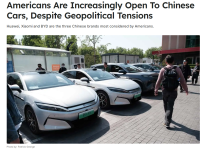
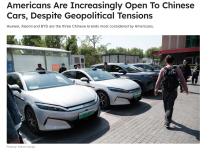
Nevertheless, Americans are becoming more aware of and open to Chinese car brands. A recent study published by the market analysis firm AutoPacific shows that the perception of Chinese cars and brands only continues to improve, despite tariff woes and geopolitical tensions putting the U.S.-China relationship on shaky ground.

According to the study, people are becoming more familiar with Chinese brands. Compared to last year, 65% of participants are familiar with some Chinese brands. This is up from 52% last year. On top of that, the portion of buyers willing to consider a Chinese brand is up a fair amount too, from 41% in 2024 to 52% in 2025.

Interestingly, Huawei led the pack as the most considered brand by those surveyed. Twenty-seven percent of respondents familiar with Huawei would consider buying one of its cars. Xiaomi took second place with 23% and BYD claimed third with 19%. Great Wall Motors came in at 16%, Geely at 13% and Nio in the rear with 13% of those familiar willing to buy one of its cars.

 
Lol, you fake propaganda
Fake propaganda? :ROFLMAO: Sure by your crooked government media I guess.
It was made by CCTV.

Tesla beats Chinese rivals in some driving assisted tests, say China state media, Bytedance​

Billionaire Elon Musk's Tesla (TSLA.O), opens new tab outperformed Chinese rivals including BYD, Xiaomi and Huawei in a test of assisted driving technologies on China's highways, according to results published by TikTok owner Bytedance's auto unit Dcar.
State television CCTV and Dcar jointly tested the level 2 advanced driving assistance systems (ADAS) from more than 20 electric vehicle brands in China and rated their performance in a series of scenarios with higher risks of accidents on highways and urban traffics.

China Central Television (CCTV) is the national television broadcaster of China, established in 1958. CCTV is operated by the National Radio and Television Administration, which reports to the Publicity Department of the Chinese Communist Party.


Americans Are Increasingly Open To Chinese Cars, Despite Geopolitical Tensions​

Now you are just showing desperation and the usual smokescreening by trying to change the topic.
 
Last edited:

Users who are viewing this thread

Pakistan Defence Latest

Latest Posts

Back
Top