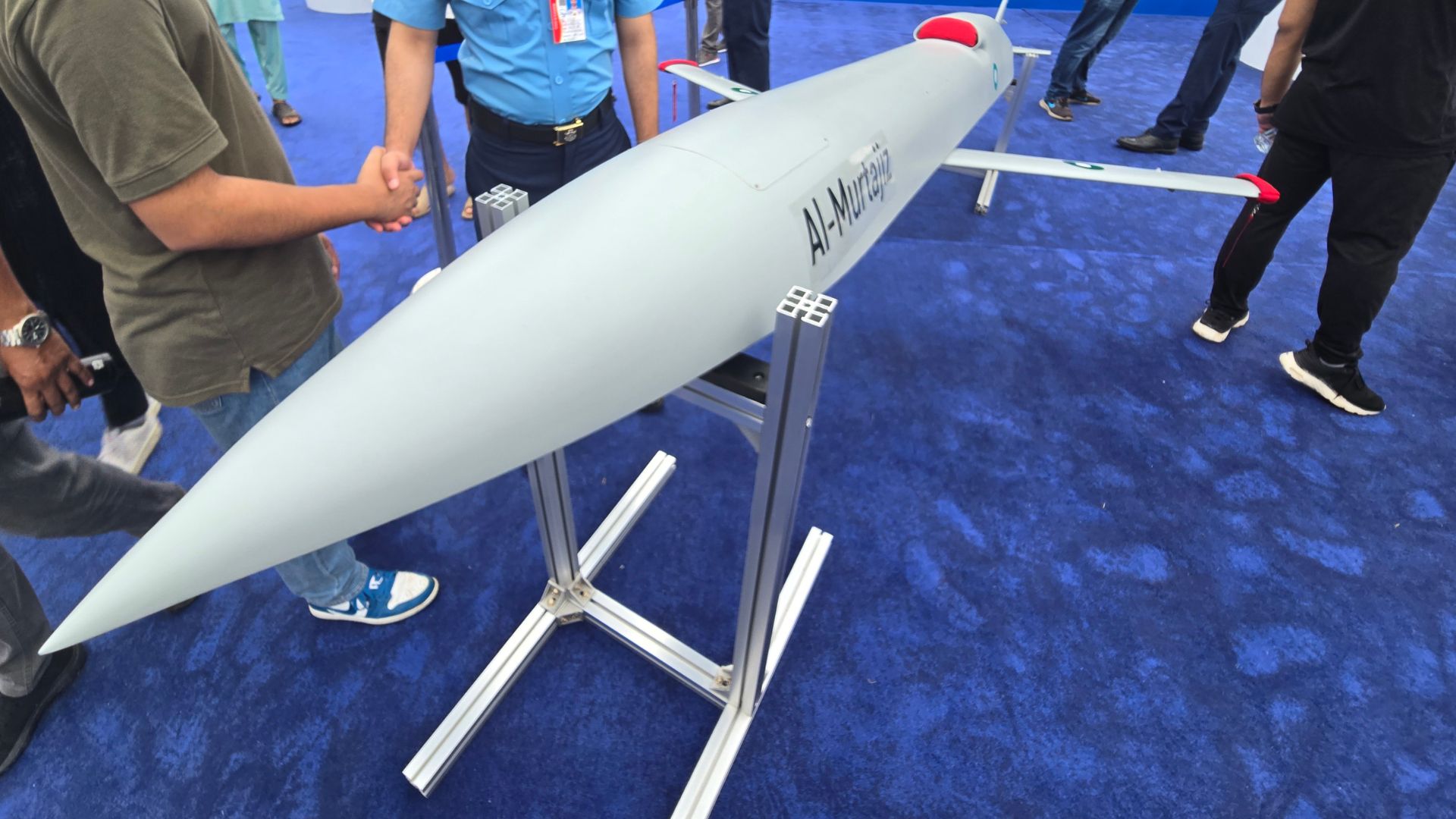
Al- Murtajiz : Another August Surprise

Well that's disappointing

Only in Pakistan can you get imaginary vapourware where such a project itself doesn't even exist.

This is essentially a toy on a show piece really
Not quite, where there's smoke , it's not a case of Sheikh Rasheed lighting up a cigar
I have seen posters giving specifications of this weapon earlier.
 
So what's the purpose of having this random mock-up when no real program related to it exists? 😭
The program exists, but this mock-up isn't an accurate reflection of it. Rather, it's a very vague idea of one part of the program.

Program = MUM-T = it's called 'Al-Murtajiz.'

Al Murtajiz = multiple systems, each playing a role, including loitering munitions/long-range cruise missile, decoy drone, jamming drone, and in time, a loyal wingman UCAV. This concept was likely shown to reflect the decoy or LM side of it, but the mock-up itself is far from an accurate representation of what the final system will be.
 
This thing is vapourwave, im sure @JamD will rip it apart when hes on, but i see a couple of issues here!

Not much LO about the empennage and otherwise
Seems like another “Get something ready quick to show!”

Well that's disappointing

Only in Pakistan can you get imaginary vapourware where such a project itself doesn't even exist.

This is essentially a toy on a show piece really


As Oscar so often mentions, this is Rasheed Model Maker's interpretation of a stealth drone. Anyone with even basic aircraft design experience can immediately tell that this is not a real aircraft. The horizontal and vertical tails are way too small and the rudder is even smaller. This is not even a toy.

However, as @Quwa has said, this might just be a representation of a desire to have a program, which is of course nice. But I strongly feel NESCOM should lead the airframe development, while NASTP can focus on the avionics and AI pilot stuff.
 
Skip to contentSkip to footer
Quwa


Al-Murtajiz-Loitering-Munition-or-Drone.jpg

Pakistan Air Force Reveals Al-Murtajiz – A Glimpse of its Manned-Unmanned Teaming Plans​

Pakistan Air Force News by Bilal Khan

Bilal Khan​

As part of its showcase for the special event commemorating the 14th of August, the Pakistan Air Force (PAF) showcased what appeared to be a drone or loitering munition called the “Al-Murtajiz.”

The mock-up was not accompanied by any specifications, though PAF personnel told Quwa’s on-site correspondent that Al-Murtajiz was a ground-launched drone designed for multiple purposes, including point-interception against air-to-surface munitions – including subsonic cruise missiles – and kamikaze strike operations. Overall, the PAF personnel at the event were not at liberty to elaborate, however, and the Al-Murtajiz model was removed from the display.

One could only speculate, but a cursory examination of the display indicates that the model was basically a low-fidelity mock-up. The model showcased an air inlet, indicating that it would use a miniature turbojet engine for propulsion, flip-out narrow-chord wings, and low-observable (LO) airframe design.

In Quwa’s assessment, the Al-Murtajiz model shown at the event was likely a representation of the PAF’s broader manned-unmanned teaming (MUM-T) initiative. MUM-T is essentially a term explaining the new doctrine of executing combat operations using both manned and unmanned combat assets, leveraging or drawing out the strengths of each to maximize overall combat effectiveness. For example, under MUM-T, one could use drones to enter high-risk environments laden with dense enemy air defence systems as a way to absorb losses (from enemy surface-to-air missile fire) before crewed fighters reach the vicinity (or entirely negate the need of sending those fighters deep into enemy territory at all).

The PAF both officially and unofficially confirmed that it was working towards building a MUM-T capability, and this was to be expected seeing it is the general trend of all other major air arms.

In an analysis from March 2025 on the PAF’s MUM-T work, Quwa stated:

Several factors will drive the PAF to expand its UAS fleet into jet-powered UCAVs of various size and capability classes.

First, there is – or soon will be – an actual requirement. “Second to None,” a semi-official publication of the PAF, stated that the PAF’s future UAS vision involves using drones for air-to-air operations, manned-unmanned teaming (MUM-T), and “stealth operations.” The latter will involve drones, including high-altitude long-endurance (HALE) “stealth UAS with strike capabilities.”

Second, it is the most economical way to expand air power, especially in terms of offensive warfighting capability. It is not feasible to entirely rely on crewed next-generation fighter aircraft (NGFA). In fact, the emerging trend across other major air forces is to use crewed NGFAs as a focal node that would manage UCAVs in integrated air operations. This is the same model that the PAF’s primary vendor, i.e., China, is building towards; it is unlikely that the PAF will deviate from this core methodology.


Regarding the Al-Murtajiz; while it is unclear if this specific design will materialize, its presence at the event confirms that the PAF is now actively seeking a multipurpose drone capable of decoy, loitering munitions, and special mission – e.g., electronic countermeasures (ECM) – operations.

Looking closely, one will notice that the PAF is nurturing the key ingredients of a MUM-T capability in clear, sequential fashion: small ‘smart munitions’, loitering munitions, and, now, apparently a decoy drone. In an earlier analysis, Quwa stated that a decoy drone was likely on the development roadmap, and, crucially, it would be the next natural step from the work the PAF had already done up to this point.

The PAF’s entry into next-generation MUM-T could involve the acquisition – or, potentially, the development – of jet-powered attritable decoy drones. Following loitering munitions, decoy drones would likely be the lightest and lowest cost pieces of a future MUM-T deployment.

Interestingly, there appears to be a sequential order to how MUM-T is being developed in other parts of the world, including the West. It starts with a ‘smart munitions’ stack that leans on small lightweight cruise missiles and/or glide bombs.
 
One eye-catching weapon put on display by Pakistan military was model of this new missile called Al-Murajiz, it appears a cruise missile with little known details.View attachment 140895

View attachment 140892


To view this content we will need your consent to set third party cookies.
For more detailed information, see our cookies page.


from the looks of it,
it is a prototype.
See the rudder and servo arm extension.
 
To view this content we will need your consent to set third party cookies.
For more detailed information, see our cookies page.
 
One eye-catching weapon put on display by Pakistan military was model of this new missile called Al-Murajiz, it appears a cruise missile with little known details.View attachment 140895

View attachment 140892


To view this content we will need your consent to set third party cookies.
For more detailed information, see our cookies page.


You beat me on posting this! This thing has very futuristic capability and in a year we'll hear about it.
 
You beat me on posting this! This thing has very futuristic capability and in a year we'll hear about it.
I can assure you that it is not representative of what the actual real concept is and that is still very much a concept.

This is just a خالی جگہ پَر کریں
 
now lets use on enemy countries!! there are 2 that come to mind for spreading terrorism in Pakistan! Time to use em
 
I can assure you that it is not representative of what the actual real concept is and that is still very much a concept.

This is just a خالی جگہ پَر کریں

That's what I was saying in my post.........this is a future concept and will evolve a lot. You repeated that in the above :)
 
The unveiling of "Al-Murtajiz" is a significant development for Pakistan and will strengthen its offensive capabilities by representing a strategic shift in military doctrine and technology.

Benefits for Pakistan:

1. A Move from Imported to Indigenous Production:

For a long time, Pakistan's drone program has relied on a mix of indigenous designs (like the Burraq and Shahpar) and imported platforms, primarily from China and Turkey (like the Wing Loong II and Bayraktar TB2).

The public showcasing of "Al-Murtajiz" as a new, Pakistan-developed capability indicates a growing maturity in its domestic defense industry. This lessens Pakistan's dependency on foreign suppliers, granting it more autonomy and flexibility in its military planning and operations.

It suggests that Pakistan can now design and mass-produce advanced, expendable loitering munitions, a key component of modern warfare.

2. Asymmetric Advantage and Cost-Effectiveness:

Modern, conventional military forces are often equipped with highly expensive, high-tech air defense systems designed to counter manned aircraft and advanced missiles. "Al-Murtajiz," as a relatively low-cost, expendable drone, presents a significant asymmetric advantage.

A swarm of these drones could be launched in a saturation attack to overwhelm and degrade an adversary's air defenses, a tactic seen in recent conflicts. This forces a high-tech opponent to use multi-million-dollar missiles to shoot down a much cheaper threat, creating a favorable cost-exchange ratio for Pakistan.

3. Enhancing "Full Spectrum Deterrence":

Pakistan's military doctrine of "Full Spectrum Deterrence" aims to maintain a credible deterrent at all levels of conflict, from conventional to nuclear.

The addition of "Al-Murtajiz" fills a crucial gap in the conventional spectrum. It provides a new tool for precision strikes against high-value targets without putting valuable fighter jets or their pilots at risk. This allows for more surgical, low-risk, and deniable operations.

4. Manned-Unmanned Teaming (MUM-T):

The potential for "Al-Murtajiz" to work in concert with manned aircraft is a game-changer. It is a concept known as Manned-Unmanned Teaming (MUM-T).

For example, a manned fighter jet could serve as a command-and-control platform, directing a swarm of "Al-Murtajiz" drones to scout ahead, jam enemy radar, or attack targets. This dramatically extends the reach, survivability, and lethality of the manned aircraft, allowing it to operate more safely and effectively against a well-defended adversary.

5. Tactical and Strategic Flexibility:

The loitering capability of this new munition offers unparalleled tactical flexibility. It can be used for a variety of missions, including:

- Suppression of Enemy Air Defenses (SEAD): "Al-Murtajiz" could be used to attack and destroy an adversary's radar and air defense systems, clearing the way for manned aircraft or other assets.

- Precision Strikes: It can be used to take out specific targets on the battlefield, like tanks, artillery, or command vehicles, that might be difficult to hit with traditional weapons.

- Psychological Warfare: The persistent, loitering threat of a kamikaze drone can create a significant psychological burden on enemy forces, forcing them to remain constantly on high alert.

Potential Strengths and Why It Could Be Effective:

Asymmetric Warfare:

"Al-Murtajiz" is a good example of an "asymmetric" weapon. It is likely to be far cheaper and simpler to produce and operate than the sophisticated air defense systems and fighter jets used by a high-tech adversary. A swarm of these low-cost drones could overwhelm an expensive air defense system, forcing the enemy to expend valuable resources to counter a cheap threat.

Precision and Targeting:

The ability to "loiter" allows it to wait for the perfect moment to strike. This is a significant advantage over conventional missiles, especially for hitting mobile or time-sensitive targets like enemy command vehicles, air defense radars, or troop concentrations. It can also be used to target specific, high-value individuals, as is common with drone strikes.

Electronic Warfare Capability:

The reported "electronic attack system" is a key element. If "Al-Murtajiz" can jam enemy radar and communications, it would make it even more difficult to detect and shoot down. This would allow it to blind the adversary's defenses before a strike, increasing its chances of success.

Reduced Risk for Operators:

By using uncrewed systems, Pakistan can carry out strikes without risking the lives of its pilots. This changes the risk calculus in a conflict and allows for more aggressive tactics.

Potential Weaknesses and Countermeasures:

Vulnerability to Air Defense:

While a single drone might be hard to detect, modern, integrated air defense systems are specifically designed to counter these types of threats. They can use a combination of radar, electro-optical sensors, and electronic warfare to detect, track, and disable or destroy incoming drones.

Electronic Countermeasures:

The same electronic attack system that "Al-Murtajiz" may use can also be a weakness. A sophisticated adversary can use its own electronic warfare systems to jam the drone's control signals, disrupt its GPS navigation, or "spoof" its sensors, causing it to lose its way or miss its target.

Limited Payload and Range:

As a loitering munition, it is likely to have a smaller warhead and a more limited range than a cruise missile or a manned aircraft. This restricts its use to certain types of targets and tactical situations. It may not be effective against hardened bunkers or well-protected military infrastructure.

The Human Factor:

While the system is described as having autonomous capabilities, a human operator is still needed to make the final decision to strike. The enemy can counter this by exploiting the drone's communication link with the operator, or by hiding and using camouflage to make it difficult for the human to identify a target.

"Al-Murtajiz" represents a significant step in Pakistan's development of modern, asymmetric warfare capabilities. Its effectiveness will largely depend on the specific tactical situation and the adversary's defensive capabilities.

It is not a "silver bullet," but it could be a highly effective and disruptive tool, particularly when used against targets that are not well-defended or in conjunction with other military assets.

In conclusion, "Al-Murtajiz" is not just another drone; it represents a strategic investment in a new type of warfare. By developing an indigenous, low-cost, and versatile loitering munition, Pakistan is significantly strengthening its offensive capabilities and adapting to the realities of modern conflict, where drones and asymmetric tactics are becoming increasingly decisive.

Pakistan needs to enhance and coordinate it's defensive and offensive capabilities. The additional creation of Pakistan's recently created the Army Rocket Force Command (ARFC) to organise and improve its conventional missile and rocket systems. "Al-Murtajiz" fits perfectly into this new group.

A Tactical Force Multiplier:

While the ARFC's big missiles are great for hitting large, strategic targets, "Al-Murtajiz" can be used for smaller, more precise strikes. It can take out a single tank, a radar dish, or a command vehicle—targets that are too small or not worth using a multi-million-pound missile on.

Blinding the Enemy:

A key role for this drone would be to "suppress enemy air defences." Before a big rocket strike, a swarm of these drones could fly ahead to find and destroy enemy radar and missile systems. By "blinding" the enemy, they pave the way for a more successful rocket attack.

Is There a Team Effort Between the Pakistan Army and Pakistan Air Force?

Absolutely. The creation of the new rocket force is all about getting the Army and Air Force to work together more effectively.

Unified Command:

The new command is designed to prevent a situation where the Army's rockets and the Air Force's planes are in the same area without knowing it. This unified command ensures they work together safely and effectively.

"Sensor-to-Shooter" Integration:

The Pakistan Air Force has advanced planes and surveillance systems that can spot targets. The new system will allow the Air Force to instantly share that information with the Army's rocket force. This means a target spotted from the air can be struck by a rocket or a drone like "Al-Murtajiz" almost immediately, giving the enemy no time to react.

As more information becomes available, it does indicate that despite it's limited resources/defence budgets that Pakistan is becoming stronger each day and will make it harder for any adversary/enemies.
 
I can assure you that it is not representative of what the actual real concept is and that is still very much a concept.

This is just a خالی جگہ پَر کریں
ٹرک کی بتی
 
ٹرک کی بتی
ٹرک کی بتی تب ہوتی اگر بنانے والے دعویٰ کرتے ک اس سے بجلی پیدا ہو گی یا اس سے تیل نکل آئے گا یا یہ پی آئ اے کا متبادل ہے
ہم کو تو اتنا بھی نہیں پتہ ک سکردو میں کون مہمان کس لیے آیا تھا
 
I can assure you that it is not representative of what the actual real concept is and that is still very much a concept.

This is just a خالی جگہ پَر کریں
question is, Khali jaga kabhi pur ho gi bhi ya nai ?
 
ٹرک کی بتی تب ہوتی اگر بنانے والے دعویٰ کرتے ک اس سے بجلی پیدا ہو گی یا اس سے تیل نکل آئے گا یا یہ پی آئ اے کا متبادل ہے
ہم کو تو اتنا بھی نہیں پتہ ک سکردو میں کون مہمان کس لیے آیا تھا
Every new weapon prototype and proof of concept shall remain "Truck ki Bati" unless there's a established production line in PAC which can churn out several hundreds of them per year.

I want to see that more than everyone. It'll be really sad day for me if I don't see 4x AZB-81LR SDB on dual racks or any at all on our jets.
 

Users who are viewing this thread

Pakistan Defence Latest

Country Watch Latest

Latest Posts

Back
Top