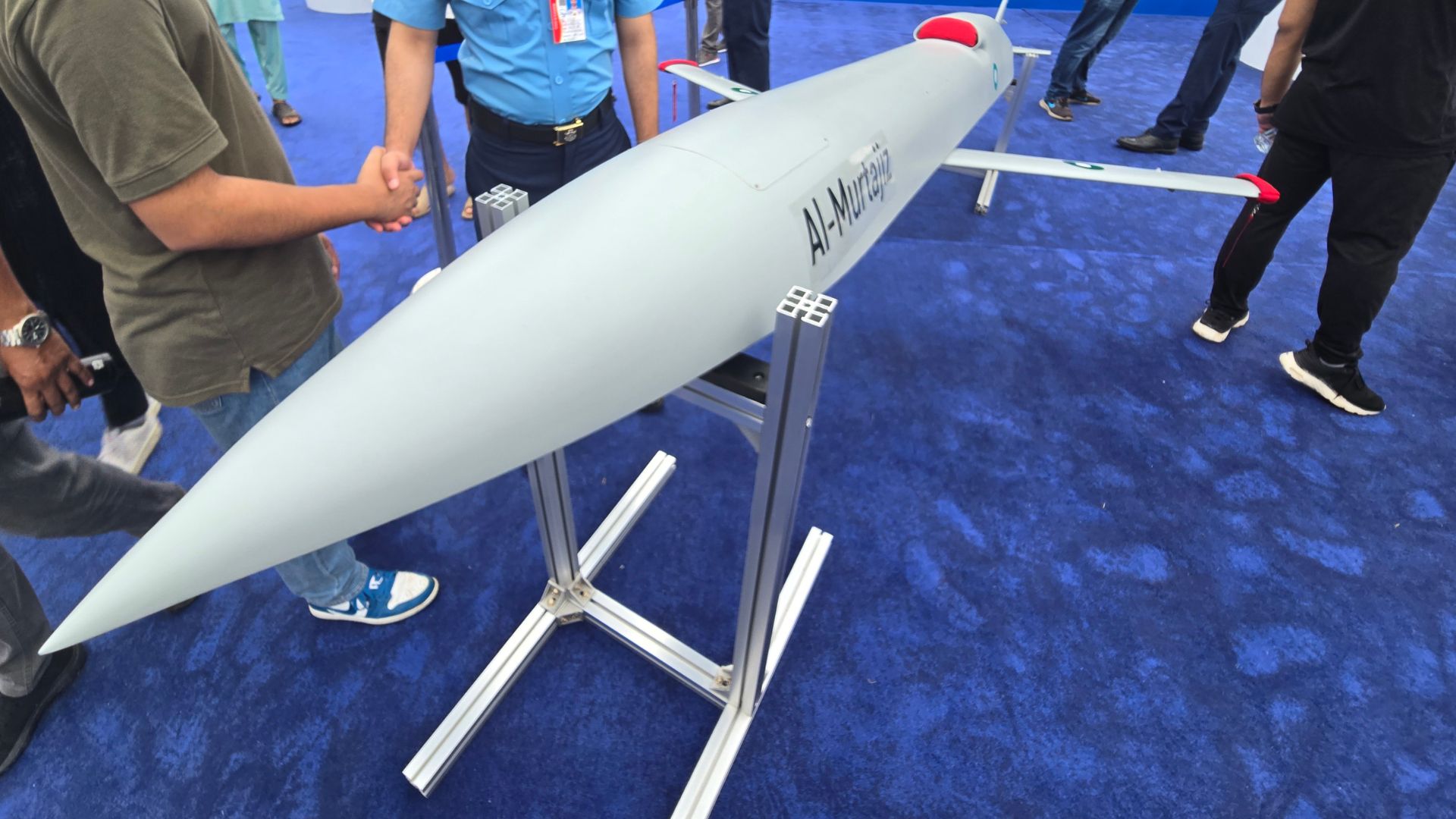
The unveiling of "Al-Murtajiz" is a significant development for Pakistan and will strengthen its offensive capabilities by representing a strategic shift in military doctrine and technology.
Benefits for Pakistan:
1. A Move from Imported to Indigenous Production:
For a long time, Pakistan's drone program has relied on a mix of indigenous designs (like the Burraq and Shahpar) and imported platforms, primarily from China and Turkey (like the Wing Loong II and Bayraktar TB2).
The public showcasing of "Al-Murtajiz" as a new, Pakistan-developed capability indicates a growing maturity in its domestic defense industry. This lessens Pakistan's dependency on foreign suppliers, granting it more autonomy and flexibility in its military planning and operations.
It suggests that Pakistan can now design and mass-produce advanced, expendable loitering munitions, a key component of modern warfare.
2. Asymmetric Advantage and Cost-Effectiveness:
Modern, conventional military forces are often equipped with highly expensive, high-tech air defense systems designed to counter manned aircraft and advanced missiles. "Al-Murtajiz," as a relatively low-cost, expendable drone, presents a significant asymmetric advantage.
A swarm of these drones could be launched in a saturation attack to overwhelm and degrade an adversary's air defenses, a tactic seen in recent conflicts. This forces a high-tech opponent to use multi-million-dollar missiles to shoot down a much cheaper threat, creating a favorable cost-exchange ratio for Pakistan.
3. Enhancing "Full Spectrum Deterrence":
Pakistan's military doctrine of "Full Spectrum Deterrence" aims to maintain a credible deterrent at all levels of conflict, from conventional to nuclear.
The addition of "Al-Murtajiz" fills a crucial gap in the conventional spectrum. It provides a new tool for precision strikes against high-value targets without putting valuable fighter jets or their pilots at risk. This allows for more surgical, low-risk, and deniable operations.
4. Manned-Unmanned Teaming (MUM-T):
The potential for "Al-Murtajiz" to work in concert with manned aircraft is a game-changer. It is a concept known as Manned-Unmanned Teaming (MUM-T).
For example, a manned fighter jet could serve as a command-and-control platform, directing a swarm of "Al-Murtajiz" drones to scout ahead, jam enemy radar, or attack targets. This dramatically extends the reach, survivability, and lethality of the manned aircraft, allowing it to operate more safely and effectively against a well-defended adversary.
5. Tactical and Strategic Flexibility:
The loitering capability of this new munition offers unparalleled tactical flexibility. It can be used for a variety of missions, including:
- Suppression of Enemy Air Defenses (SEAD): "Al-Murtajiz" could be used to attack and destroy an adversary's radar and air defense systems, clearing the way for manned aircraft or other assets.
- Precision Strikes: It can be used to take out specific targets on the battlefield, like tanks, artillery, or command vehicles, that might be difficult to hit with traditional weapons.
- Psychological Warfare: The persistent, loitering threat of a kamikaze drone can create a significant psychological burden on enemy forces, forcing them to remain constantly on high alert.
Potential Strengths and Why It Could Be Effective:
Asymmetric Warfare:
"Al-Murtajiz" is a good example of an "asymmetric" weapon. It is likely to be far cheaper and simpler to produce and operate than the sophisticated air defense systems and fighter jets used by a high-tech adversary. A swarm of these low-cost drones could overwhelm an expensive air defense system, forcing the enemy to expend valuable resources to counter a cheap threat.
Precision and Targeting:
The ability to "loiter" allows it to wait for the perfect moment to strike. This is a significant advantage over conventional missiles, especially for hitting mobile or time-sensitive targets like enemy command vehicles, air defense radars, or troop concentrations. It can also be used to target specific, high-value individuals, as is common with drone strikes.
Electronic Warfare Capability:
The reported "electronic attack system" is a key element. If "Al-Murtajiz" can jam enemy radar and communications, it would make it even more difficult to detect and shoot down. This would allow it to blind the adversary's defenses before a strike, increasing its chances of success.
Reduced Risk for Operators:
By using uncrewed systems, Pakistan can carry out strikes without risking the lives of its pilots. This changes the risk calculus in a conflict and allows for more aggressive tactics.
Potential Weaknesses and Countermeasures:
Vulnerability to Air Defense:
While a single drone might be hard to detect, modern, integrated air defense systems are specifically designed to counter these types of threats. They can use a combination of radar, electro-optical sensors, and electronic warfare to detect, track, and disable or destroy incoming drones.
Electronic Countermeasures:
The same electronic attack system that "Al-Murtajiz" may use can also be a weakness. A sophisticated adversary can use its own electronic warfare systems to jam the drone's control signals, disrupt its GPS navigation, or "spoof" its sensors, causing it to lose its way or miss its target.
Limited Payload and Range:
As a loitering munition, it is likely to have a smaller warhead and a more limited range than a cruise missile or a manned aircraft. This restricts its use to certain types of targets and tactical situations. It may not be effective against hardened bunkers or well-protected military infrastructure.
The Human Factor:
While the system is described as having autonomous capabilities, a human operator is still needed to make the final decision to strike. The enemy can counter this by exploiting the drone's communication link with the operator, or by hiding and using camouflage to make it difficult for the human to identify a target.
"Al-Murtajiz" represents a significant step in Pakistan's development of modern, asymmetric warfare capabilities. Its effectiveness will largely depend on the specific tactical situation and the adversary's defensive capabilities.
It is not a "silver bullet," but it could be a highly effective and disruptive tool, particularly when used against targets that are not well-defended or in conjunction with other military assets.
In conclusion, "Al-Murtajiz" is not just another drone; it represents a strategic investment in a new type of warfare. By developing an indigenous, low-cost, and versatile loitering munition, Pakistan is significantly strengthening its offensive capabilities and adapting to the realities of modern conflict, where drones and asymmetric tactics are becoming increasingly decisive.
Pakistan needs to enhance and coordinate it's defensive and offensive capabilities. The additional creation of Pakistan's recently created the Army Rocket Force Command (ARFC) to organise and improve its conventional missile and rocket systems. "Al-Murtajiz" fits perfectly into this new group.
A Tactical Force Multiplier:
While the ARFC's big missiles are great for hitting large, strategic targets, "Al-Murtajiz" can be used for smaller, more precise strikes. It can take out a single tank, a radar dish, or a command vehicle—targets that are too small or not worth using a multi-million-pound missile on.
Blinding the Enemy:
A key role for this drone would be to "suppress enemy air defences." Before a big rocket strike, a swarm of these drones could fly ahead to find and destroy enemy radar and missile systems. By "blinding" the enemy, they pave the way for a more successful rocket attack.
Is There a Team Effort Between the Pakistan Army and Pakistan Air Force?
Absolutely. The creation of the new rocket force is all about getting the Army and Air Force to work together more effectively.
Unified Command:
The new command is designed to prevent a situation where the Army's rockets and the Air Force's planes are in the same area without knowing it. This unified command ensures they work together safely and effectively.
"Sensor-to-Shooter" Integration:
The Pakistan Air Force has advanced planes and surveillance systems that can spot targets. The new system will allow the Air Force to instantly share that information with the Army's rocket force. This means a target spotted from the air can be struck by a rocket or a drone like "Al-Murtajiz" almost immediately, giving the enemy no time to react.
As more information becomes available, it does indicate that despite it's limited resources/defence budgets that Pakistan is becoming stronger each day and will make it harder for any adversary/enemies.