Jinnah Class Frigate | Updates & Discussion

As evidenced by ASFAT’s proposed low-RCS 124 m, 3,600-tonne frigate “AS3600,” which features a two × 32-cell VLS layout.

Since the Jinnah-class frigate is influenced by this design, incorporating a two × 16-cell VLS configuration on the 3,300-tonne Jinnah-class is entirely feasible.


View attachment 141960
issue is you dont know what adjustments have been made below deck for this, or otoh, it could be a vls thing. I know for a fact though space is very tight down there
 
issue is you dont know what adjustments have been made below deck for this, or otoh, it could be a vls thing. I know for a fact though space is very tight down there

True, space below deck is always a major constraint, and unless details of the exact adjustments made are shared, it’s hard to know what trade-offs were involved.

That said, the AS3600 (design concept) on which the Jinnah-class is influenced, features two 32-cell VLS, demonstrating that a larger layout is feasible on a platform of similar size.

In that context, a two × 16-cell configuration for the Jinnah-class remains entirely reasonable.
 
True, space below deck is always a major constraint, and unless details of the exact adjustments made are shared, it’s hard to know what trade-offs were involved.

That said, the AS3600 on which the Jinnah-class is based, carries two 32-cell VLS, which shows the platform can accommodate larger layouts.

In that context, a two × 16-cell configuration for the Jinnah-class is entirely reasonable.
again, it would have taken significant below deck redesign, because in the original hull cfg its not possible. One of my friends was an xo on the ada class so we had a chat about this
 
again, it would have taken significant below deck redesign, because in the original hull cfg its not possible. One of my friends was an xo on the ada class so we had a chat about this

I understand, and input from someone serving on an ADA-class ship is certainly valuable.

The notion of my earlier post is that the AS3600 concept design, with two 32-cell VLS on a similarly sized hull, demonstrates structural feasibility.

Given that the ADA-class is a 2,900-tonne ship while the Jinnah-class is 3,300 tonnes, accommodating a two × 16-cell VLS on the Jinnah-class remains quite reasonable.
 
I understand, and input from someone serving on an ADA-class ship is certainly valuable.

The notion of my earlier post is that the AS3600 concept design, with two 32-cell VLS on a similarly sized hull, demonstrates structural feasibility.

Given that the ADA-class is a 2,900-tonne ship while the Jinnah-class is 3,300 tonnes, accommodating a two × 16-cell VLS on the Jinnah-class remains quite reasonable.
remember, its all additional hull blocks
 
I understand, and input from someone serving on an ADA-class ship is certainly valuable.

The notion of my earlier post is that the AS3600 concept design, with two 32-cell VLS on a similarly sized hull, demonstrates structural feasibility.

Given that the ADA-class is a 2,900-tonne ship while the Jinnah-class is 3,300 tonnes, accommodating a two × 16-cell VLS on the Jinnah-class remains quite reasonable.
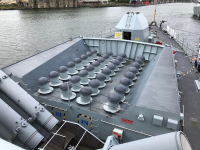
Not to mention the fact that CAMM-ER VLS take up significantly less space than MIDLAS or other conventional VLS. These are 32 cell CAMM cannisters on the Type 23 frigate for reference.1755697425142.png
 
Although this is assuming PN goes for the cannisters instead of a VLS system. If they go for a VLS then 16 is not bad at all.
 
Not to mention the fact that CAMM-ER VLS take up significantly less space than MIDLAS or other conventional VLS. These are 32 cell CAMM cannisters on the Type 23 frigate for reference.View attachment 142000
Yes the CAMM-ER VLS is a smaller footprint because the missile is narrow diameter allowing its firing from these GWS.35 vls. Its one of the reasons that it was chosen by PN (and i have been the biggest proponent of it for years). But each cell carries only 1 missile. While its footprint allows more cells (roughly 2 or 3 :1 cells vs a larger VLS like Sylver A50 or Mk41 or MDAS) that means a larger vls as above may be 12-16 cells. Those VLS cells however are large enouth to quad-pack CAMM-ER Which would enable 48-64 CAMM-ER which is a far cry better than the GSW.35.
-----------
PN likely went with GWS.35 for babur because of factors of cost and expedience. Firstly only a handful of launchers are currently used for the CAMM-ER. Its own GWS.35 varient, the American VLSs (ExLs, Mk41 and Mk57) and Sylver (specifically A50). The French and American options arent available to Pakistan (Mk41 was even denied for Turkey leading to MDAS development). So that only left GWS.35. Beyond this, PN didnt have opportunity to really wait for MDAS which itself is not certified for CAMM-ER as of yet (if it ever would be - although dimensions would allow it for sure). In the future it is possible that PN pushes for it to be integrated to MDAS but as @arslank01 points out, the MDAS itself is not likely to be cheap. That said, i would still push for that if im PN. Given it dramatically improves the missile capacity for Baburs, Yarmooks, and Possibly F-22P in a future MLU (likely there exists the space below deck for a VLS given the Thai Naresuan class got 8 cell Mk41 VLS in the location of the the F-22Ps deck for FM-90.)

Baburs Yarmook B2s (YB2) could likely fit two 4 cell units (total 8 cells) in the locations of their 12 cell GWS.35s which would increase their potential load outs of CAMM-ER from 12 to 32. The F-22P could probably fit a similar number of cells of MDAS (8).

Additional constraints may be the cost of that many missiles for a full load out (nearly tripling the missile capacity is pretty expensive, though less than a repairing or replacing a severly damaged warship, and PN doesnt need to quad load them for peacetime missions).

I personally think such an option (MDAS) is likely being considered. One also needs to question that YB2s came without VLS Cells installed. The Baburs left port with the protective mushroom caps over their VLS cells. YB2s did not come with any such cells installed. The thing is the caps can be used for protection of the cell when not in use (or empty) and are removed when ready to fire. As such i suspect there are no cells in the Yb2s mission bays. I would imagine it would have been cheaper to have these cells installed at the time of construction rather than later, leading me to think PN may have a different launch solution in mind for YB2s. Most logically given future collabs with Turkiey likely, it would be MDAS. (pure speculation on my part).
 
Last edited:
remember, its all additional hull blocks
I understand, and yes, additional hull blocks are involved, that’s part of the trade-off in such designs. But that in itself doesn’t make the concept unrealistic.

The AS3600 design, which incorporates two × 32-cell VLS on a similar-sized hull, shows that with proper integration it is structurally feasible.

Considering the Jinnah-class is 3,300 tonnes compared to the 2,900-tonne ADA-class, accommodating two × 16-cell VLS remains entirely reasonable.
 
Not to mention the fact that CAMM-ER VLS take up significantly less space than MIDLAS or other conventional VLS. These are 32 cell CAMM cannisters on the Type 23 frigate for reference.
Good point, the smaller footprint of CAMM-ER VLS compared to MIDLAS or other conventional systems makes integration even more practical.

If a Type 23 can carry 32 CAMM cells within a relatively tight space, then with the AS3600 concept showing two × 32-cell VLS on a similar hull and the JCF having a 400-tonne advantage over the ADA-class, a two × 16-cell layout on Jinnah-class looks all the more reasonable.
 
Yes the CAMM-ER VLS is a smaller footprint because the missile is narrow diameter allowing its firing from these GWS.35 vls. Its one of the reasons that it was chosen by PN (and i have been the biggest proponent of it for years). But each cell carries only 1 missile. While its footprint allows more cells (roughly 2 or 3 :1 cells vs a larger VLS like Sylver A50 or Mk41 or MDAS) that means a larger vls as above may be 12-16 cells. Those VLS cells however are large enouth to quad-pack CAMM-ER Which would enable 48-64 CAMM-ER which is a far cry better than the GSW.35.
-----------
PN likely went with GWS.35 for babur because of factors of cost and expedience. Firstly only a handful of launchers are currently used for the CAMM-ER. Its own GWS.35 varient, the American VLSs (ExLs, Mk41 and Mk57) and Sylver (specifically A50). The French and American options arent available to Pakistan (Mk41 was even denied for Turkey leading to MDAS development). So that only left GWS.35. Beyond this, PN didnt have opportunity to really wait for MDAS which itself is not certified for CAMM-ER as of yet (if it ever would be - although dimensions would allow it for sure). In the future it is possible that PN pushes for it to be integrated to MDAS but as @arslank01 points out, the MDAS itself is not likely to be cheap. That said, i would still push for that if im PN. Given it dramatically improves the missile capacity for Baburs, Yarmooks, and Possibly F-22P in a future MLU (likely there exists the space below deck for a VLS given the Thai Naresuan class got 8 cell Mk41 VLS in the location of the the F-22Ps deck for FM-90.)

Baburs Yarmook B2s (YB2) could likely fit two 4 cell units (total 8 cells) in the locations of their 12 cell GWS.35s which would increase their potential load outs of CAMM-ER from 12 to 32. The F-22P could probably fit a similar number of cells of MDAS (8).

Additional constraints may be the cost of that many missiles for a full load out (nearly tripling the missile capacity is pretty expensive, though less than a repairing or replacing a severly damaged warship, and PN doesnt need to quad load them for peacetime missions).

I personally think such an option (MDAS) is likely being considered. One also needs to question that YB2s came without VLS Cells installed. The Baburs left port with the protective mushroom caps over their VLS cells. YB2s did not come with any such cells installed. The thing is the caps can be used for protection of the cell when not in use (or empty) and are removed when ready to fire. As such i suspect there are no cells in the Yb2s mission bays. I would imagine it would have been cheaper to have these cells installed at the time of construction rather than later, leading me to think PN may have a different launch solution in mind for YB2s. Most logically given future collabs with Turkiey likely, it would be MDAS. (pure speculation on my part).

That’s a very solid breakdown, and I agree CAMM-ER’s footprint through GWS.35 makes sense for PN from both cost and availability angles.

The limitation, of course, is that each cell only carries one missile, whereas larger VLS like MIDLAS, Sylver A50, or Mk41 can quad-pack CAMM-ER, giving far greater density.

This is exactly why the AS3600 concept with two × 32-cell VLS is worth noting; it demonstrates that larger layouts are structurally feasible on comparable hulls. With JCF at 3,300 tonnes versus ADA’s 2,900, a two × 16-cell configuration remains a practical and balanced approach for PN while leaving room for future growth paths such as MIDLAS.

As a forward-looking option, PN could also explore acquiring Sylver A50 through Italian influence, given the growing defense ties in the form of AW139s, CAMM-ER, and ongoing talks around the S1000 (SSP).

This would not only expand future VLS integration possibilities but also open the door for PN to consider CAMM-MR, further enhancing long-range air defense capability.

Equipping the F22Ps and Yarmooks with such systems, along with the additional tubes on Babur-class corvettes as suggested would be an excellent force multiplier, exactly as I emphasized in my initial post.
 
Last edited:
Yes the CAMM-ER VLS is a smaller footprint because the missile is narrow diameter allowing its firing from these GWS.35 vls. Its one of the reasons that it was chosen by PN (and i have been the biggest proponent of it for years). But each cell carries only 1 missile. While its footprint allows more cells (roughly 2 or 3 :1 cells vs a larger VLS like Sylver A50 or Mk41 or MDAS) that means a larger vls as above may be 12-16 cells. Those VLS cells however are large enouth to quad-pack CAMM-ER Which would enable 48-64 CAMM-ER which is a far cry better than the GSW.35.
-----------
PN likely went with GWS.35 for babur because of factors of cost and expedience. Firstly only a handful of launchers are currently used for the CAMM-ER. Its own GWS.35 varient, the American VLSs (ExLs, Mk41 and Mk57) and Sylver (specifically A50). The French and American options arent available to Pakistan (Mk41 was even denied for Turkey leading to MDAS development). So that only left GWS.35. Beyond this, PN didnt have opportunity to really wait for MDAS which itself is not certified for CAMM-ER as of yet (if it ever would be - although dimensions would allow it for sure). In the future it is possible that PN pushes for it to be integrated to MDAS but as @arslank01 points out, the MDAS itself is not likely to be cheap. That said, i would still push for that if im PN. Given it dramatically improves the missile capacity for Baburs, Yarmooks, and Possibly F-22P in a future MLU (likely there exists the space below deck for a VLS given the Thai Naresuan class got 8 cell Mk41 VLS in the location of the the F-22Ps deck for FM-90.)

Baburs Yarmook B2s (YB2) could likely fit two 4 cell units (total 8 cells) in the locations of their 12 cell GWS.35s which would increase their potential load outs of CAMM-ER from 12 to 32. The F-22P could probably fit a similar number of cells of MDAS (8).

Additional constraints may be the cost of that many missiles for a full load out (nearly tripling the missile capacity is pretty expensive, though less than a repairing or replacing a severly damaged warship, and PN doesnt need to quad load them for peacetime missions).

I personally think such an option (MDAS) is likely being considered. One also needs to question that YB2s came without VLS Cells installed. The Baburs left port with the protective mushroom caps over their VLS cells. YB2s did not come with any such cells installed. The thing is the caps can be used for protection of the cell when not in use (or empty) and are removed when ready to fire. As such i suspect there are no cells in the Yb2s mission bays. I would imagine it would have been cheaper to have these cells installed at the time of construction rather than later, leading me to think PN may have a different launch solution in mind for YB2s. Most logically given future collabs with Turkiey likely, it would be MDAS. (pure speculation on my part).

Could be US option is available soon?

Still, there are ambitions in Islamabad to lock in gains — notably access to American defence kit from attack helicopters to naval hardware. “We can’t go back to the golden years of the 1950s,” said former ambassador Masood Khan, “but we can build a paradigm that benefits both the United States and Pakistan.”
 
It wouldn't matter that much tbh....a simple gatling class AIP sub of sweden got through the defences of a carrier battle group of USN and reached within torpedo ranges of the carrier..it too had multiple ASW ships and helis....
 
Could be US option is available soon?

Still, there are ambitions in Islamabad to lock in gains — notably access to American defence kit from attack helicopters to naval hardware. “We can’t go back to the golden years of the 1950s,” said former ambassador Masood Khan, “but we can build a paradigm that benefits both the United States and Pakistan.”
Maybe option for redundant systems such as attack helos (for which PA has recently inducted WZ-10ME and will soon once again have option of Turkish choppers with the coming domestic engine) or with upgrades to systems already in place (ie new AMRAAMS and V upgrades for F-16s), but not a good idea for centrally important systems such as a vls for the defense of PN ships. Not when friendly Turkish and chinese alternatives exist.
 
That’s a very solid breakdown, and I agree CAMM-ER’s footprint through GWS.35 makes sense for PN from both cost and availability angles.

The limitation, of course, is that each cell only carries one missile, whereas larger VLS like MIDLAS, Sylver A50, or Mk41 can quad-pack CAMM-ER, giving far greater density.

This is exactly why the AS3600 concept with two × 32-cell VLS is worth noting; it demonstrates that larger layouts are structurally feasible on comparable hulls. With JCF at 3,300 tonnes versus ADA’s 2,900, a two × 16-cell configuration remains a practical and balanced approach for PN while leaving room for future growth paths such as MIDLAS.

As a forward-looking option, PN could also explore acquiring Sylver A50 through Italian influence, given the growing defense ties in the form of AW139s, CAMM-ER, and ongoing talks around the S1000 (SSP).

This would not only expand future VLS integration possibilities but also open the door for PN to consider CAMM-MR, further enhancing long-range air defense capability.

Equipping the F22Ps and Yarmooks with such systems, along with the additional tubes on Babur-class corvettes as suggested would be an excellent force multiplier, exactly as I emphasized in my initial post.
When designing warships, the primary consideration is tactical missions, followed by the range of available technologies, and finally cost considerations.

Tactical missions.
The more powerful a nation is, the simpler the tactical mission of a single warship becomes. It possesses extremely strong capabilities in a single mission but is weak in other areas. They require other warships to complement them, thereby forming a powerful and comprehensive combat capability.
Weaker nations cannot afford a large naval fleet. Therefore, their individual warships must undertake multiple tactical missions. These warships have multi-mission capabilities, but none of these capabilities are particularly strong.

The difference between the PLA Navy version and the Pakistani Navy version of the Type 054 frigate lies in the completely different tactical mission assignments assigned to it by the two navies.

How many VLS does the Jinnah-class frigate need?
This depends on the PN's tactical mission positioning for it.
 

Users who are viewing this thread

Pakistan Defence Latest

Country Watch Latest

Latest Posts

Back
Top