Israel’s Genocide in Gaza | 2023- till present

Status
Not open for further replies.
1) "Urgent | Yedioth Ahronoth citing military sources: Hamas fighters injured days ago the deputy commander of the battalion of the Armored Brigade in the Zeitoun neighborhood"

To view this content we will need your consent to set third party cookies.
For more detailed information, see our cookies page.


"Urgent | Yedioth Ahronoth citing military sources: Our forces in Al-Zaytun neighborhood were surprised by the extent of Hamas fighters' skill in planting explosive devices"
To view this content we will need your consent to set third party cookies.
For more detailed information, see our cookies page.


"Urgent | Yedioth Ahronoth citing military sources: Hamas fighters attacked a few days ago an Israeli force belonging to the Armored Brigade in the Zeitoun neighborhood"
To view this content we will need your consent to set third party cookies.
For more detailed information, see our cookies page.


"Urgent | Yedioth Ahronoth citing military sources: Hamas fighters in Al-Zaytun neighborhood continuously attack the temporary positions of the Israeli army"
To view this content we will need your consent to set third party cookies.
For more detailed information, see our cookies page.


"Urgent | Israeli Channel 12 quoting soldiers fighting in the Al-Zaytoun neighborhood: Hamas's battalion has not been defeated here, and it has tunnels, and its fighters are well-prepared."
To view this content we will need your consent to set third party cookies.
For more detailed information, see our cookies page.
 
Last edited:
To view this content we will need your consent to set third party cookies.
For more detailed information, see our cookies page.
 
"Urgent | Smotrich: Water, electricity, and food must be cut off from the Gaza Strip, and those who do not die by bullets will die of hunger."

To view this content we will need your consent to set third party cookies.
For more detailed information, see our cookies page.


Divine punishment awaits these evil Zionists.

Bastards are in Cyprus, Georgia, Bosnia etc hiding in Hotels.
 

Muslim States (Sickening) Inaction on Gaza​

The inaction of Muslim-majority states regarding the ongoing conflict in Gaza is attributed to a complex interplay of geopolitical, economic, and political factors. Despite widespread condemnation and the existence of a shared Islamic and Arab identity, the collective response has been characterized by symbolic gestures rather than concrete action, leading to accusations of moral failure and complicity.

The primary reasons include deep-seated economic dependencies on Western powers, particularly the United States, which provides military and political support to Israel, thereby deterring Muslim states from taking actions that could jeopardize these alliances. Furthermore, many Muslim-majority nations are entangled in political alliances and trade deals that prioritize stability and economic gain over moral or religious solidarity, making it "inconvenient" to speak out against Israel.

The decline of pan-Arab and pan-Islamic identities in favor of national and sub-national identities has also weakened the sense of collective responsibility towards the Palestinian cause. This is compounded by the suppression of civil society and organized political movements, such as the Muslim Brotherhood, which were once key drivers of regional activism but are now outlawed in several countries, leaving no strong institutional force to mobilize public opinion.

The fear of domestic unrest and the desire to maintain political stability further discourage governments from taking bold stances. Additionally, some states have engaged in contradictory actions, such as supporting reconstruction plans while simultaneously undermining them through backchannel diplomacy with the United States, highlighting a deep-seated duplicity. This silence is not merely a lack of awareness but a deliberate choice driven by a lack of political and moral will, with the international community's double standards further enabling this inaction.

  • Muslim-majority states are economically and militarily dependent on the United States, which provides billions in annual aid to Israel and vetoes critical resolutions at the United Nations, creating a significant deterrent against taking decisive action.
  • The decline of pan-Arab and pan-Islamic identities in favor of national and sub-national identities has diminished the sense of solidarity with the Palestinian cause, reducing public and governmental motivation to act.
  • Civil society and organized political movements, which were once central to regional activism, have been suppressed or outlawed in many countries, leaving no effective institutional force to demand action.
  • The fear of domestic instability and the desire to maintain political control lead governments to suppress protests and avoid actions that could provoke backlash, even when public sentiment is sympathetic to Palestine.
  • Some states engage in contradictory behavior, such as publicly endorsing Palestinian reconstruction plans while working behind the scenes to sabotage them, demonstrating a lack of genuine commitment.
  • The international community's double standards, where powerful nations remain silent on Israel's actions while condemning others for human rights violations, further erode the credibility of Muslim leaders and justify their passive stance.
AI-generated answer. Please verify critical facts.
 
Egypt knows Israel wants to Ethnically cleanse the Palestinians out of Gaza and out of Palestine

We all blame the Arabs and rightly so, they deserve the humiliation thrown on them

But I want to be clear the GCC and Arabs are playing a game that in their heads is strategic and long term and aimed at victory

In their heads it took 100 years to defeat the crusaders and it took time and planning and cunning and that's what they think they are doing

And they are angry hamas and Iran got in the way and is making them look like cowards


Ultimately the Arabs know the biggest weakness Israel has is the Palestinians/Arab population that will grow far far faster then the Jewish population


The Arab world, understood Israel was protected by the U.S/West

So even if they threw everything in and hurt Israel badly to the point of defeat the U.S and West would just step in and the Arab world and economies would face damage with Arabs dying

So their idea was to disarm Israel and the west through trade

Take advantage of Jew Influence in the west and to make investments and deals in the west to start exerting control

Agreements with Egypt, Jordan and GCC would make it difficult for Israel to harm Palestinians at the rate they wanted and the Arab population would just keep increasing and surpass the Jews population


I could go on, in essence the plan will still.workk
Similar to the crusader state the new state will not survive in a Muslim middle east where the Arab-muslim Pop is increasing in Israel and Palestine

But the Arabs are angry that hamas and to them Iran has put them in this situation

For all the destruction Israel has condemned itself and won't survive this


Egypt and the Arabs know that Israel wants to remove the Palestinian population and they absolutely won't allow that
Trump with his 'plan' even alluded to this

So the Egyptian military is there to ensure, the Palestinians remain in place
How Egyptians can watch starving Palestinians across the fence and not be moved to action is truly astonishing. Even US and British soldiers had the humanity to disobey orders where they felt it was criminal.

The sight of starving Palestinians just across Egypt’s border in Gaza raises profound moral and historical questions. For an Islamic nation that shares deep cultural, religious, and historical ties with the Palestinian people, the lack of visible large-scale action is striking. Egypt, after all, has long positioned itself as a regional leader in the Arab world and as a champion of Palestinian rights in international forums. Yet, when faced with a humanitarian catastrophe on its very doorstep, its restraint appears morally troubling if not sickening. The shameless Egyptians soldiers cold bloodedly watch women and children with outstretched hands begging for food and water within an arms length of bread and water but the soldiers look the other way. Are these soldiers Coptic Christians or Jews in disguise , what has taken away the Islamic and human values from them?


Hungry Children, Silent Soldiers

How can Egyptian soldiers stand and watch as Palestinian children starve across a fence at Rafah? The Egyptian army says it is not that they lack humanity—it is that they are bound by orders, by politics, and by fear. But history will not remember the chain of command; it will remember the silence. Islam does not recognize orders that are horrifically evil and cruel against fellow Muslims. How come Egyptians have lost the plot?

Egypt has long called itself the heart of the Arab world, a champion of Palestine. Yet when food and medicine could be passed by hand to the desperate, soldiers are told to hold their ground. Cairo cites treaties, regional stability, and pressure from allies. But can such calculations justify watching a child waste away just meters from safety?

Even in the Kafir rigid militaries, there have been moments when conscience outweighed obedience—when soldiers refused to enforce what they knew in their bones to be criminal. That spark of humanity shamed entire systems into change. Today, at Rafah, the absence of such defiance is glaring. Why has Egypt and the Egyptian army failed in its Islamic duty to fellow Muslims and failed in such a dastardly way?

Egyptian soldiers are not the architects of this policy. But their silence enforces it. And every day they obey, the world sees not only starving Palestinians, but also a fence where Islamic compassion trashed and humanity handcuffed by sickening politics.

History’s verdict will be harsh: when children were starving within arm’s reach, Egypt kept its arms folded and looked the other way. Allah has dealt with those types of Egyptians in the past but they never learn their lessons.
 
Look at the evil bombs they are dropping on unarmed women and children:

To view this content we will need your consent to set third party cookies.
For more detailed information, see our cookies page.
 

Houthi prime minister ‘killed’ in Israeli strike​

Story by Paul Nuki
• 12h•
3 min read

Ahmed al-Rahawi reportedly killed in strikes that also targeted a large gathering of Houthi military leaders - MOHAMMED HUWAIS/AFP

Ahmed al-Rahawi reportedly killed in strikes that also targeted a large gathering of Houthi military leaders - MOHAMMED HUWAIS/AFP
The Houthi prime minister is said to have been killed in a series of Israeli air strikes that hit the Yemeni capital Sanaa on Thursday.

Ahmed al-Rahawi was killed in an apartment along with others, according to reports in local media.

Mr al-Rahawi was a politician, rather than a military figure, who served as prime minister of the Houthi-led government from Aug 10 last year.


call to action icon


He was a member of the General People’s Congress party and has previously served on the Supreme Political Council.

The Israel air strikes on Thursday reportedly also targeted a large gathering of Houthi military leaders.

It is still unclear whether those strikes were successful.

Social media accounts showed images of explosions in and around the Sanaa area, and the Qatari news outlet Al Araby said the Israeli strikes had targeted top Houthi officials.

Israeli intelligence learned at around 1pm that 10 Houthi ministers, including the minister of defense, and senior officials had gathered outside Sanaa to hear a speech by the group’s leader, Abdul Malik al-Houthi, the Times of Israel reported, citing unnamed Israeli security officials.

The IDF then launched a strike targeting the meeting. It remains unclear if the Houthi chief of staff, Muhammad al-Ghamari, was present or whether the strikes were successful in killing other Houthi leaders.


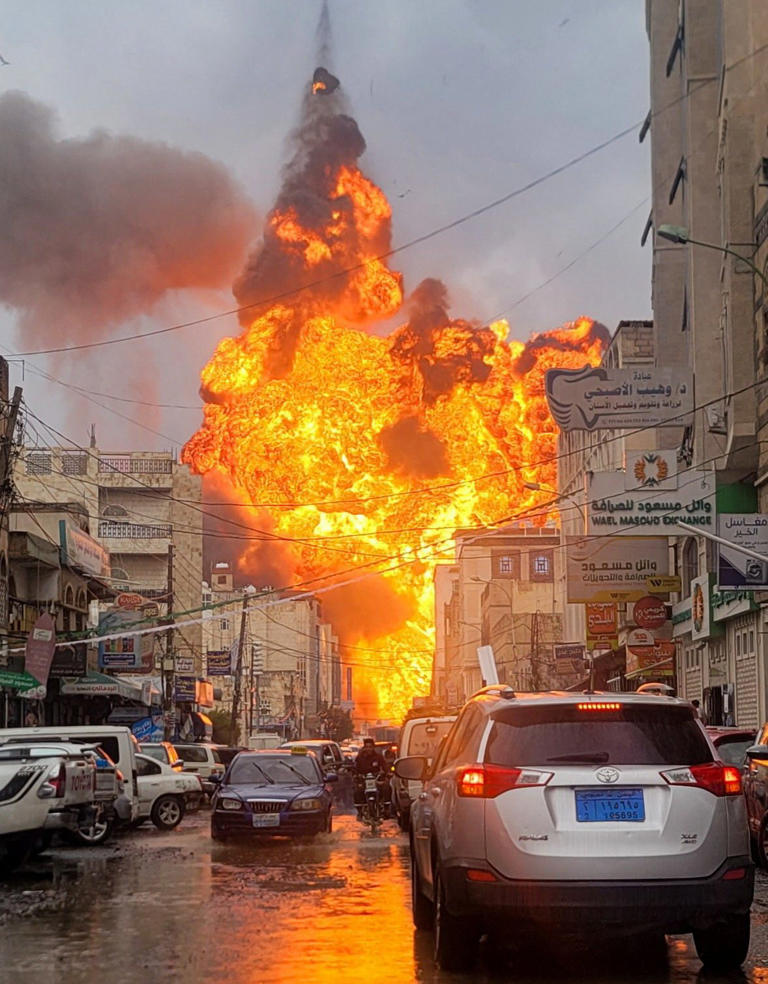
A fire ball rises from the site of an Israeli air strike in Sanaa on Aug 24 - Reuters

A fire ball rises from the site of an Israeli air strike in Sanaa on Aug 24 - Reuters
Israeli intelligence provided real-time details of the gathering, enabling the strike, which was carried out despite heavy air defences in the area.

Israel has cast previous strikes on the Houthis in dramatic terms but with limited obvious impact on the terrorist group’s ability or willingness to strike Israel.


Related video: Israeli air strikes hit Yemen’s capital Sanaa, Houthi-run media say (Euronews (English))
There were no immediate reports of casualties.


Israeli air strikes hit Yemen’s capital Sanaa, Houthi-run media say

Thursday’s strike comes in the wake of a Houthi missile strike on Israel last week using a new missile which carries multiple war heads and cluster bombs.

The missile was shot down but the use of the munition presents a new challenge for Israel.

An Israeli air force official told The Telegraph that an initial operational review of the Houthi missile fired last Friday had determined that it “most likely contained several sub-munitions which were intended to be detonated upon impact”.

The new multi-headed missile poses a serious challenge to Israel’s air defence systems because of the need for more interceptors to shoot it down.

“Yemen has previously served as a testing ground for Iranian weaponry,” said an Israeli defence expert with detailed knowledge of Friday’s strike.

“In this case, [the] warhead was composed of submunitions: three warheads ... alongside another component in the warhead consisting of dozens of cluster bombs that disperse upon impact with the target.”


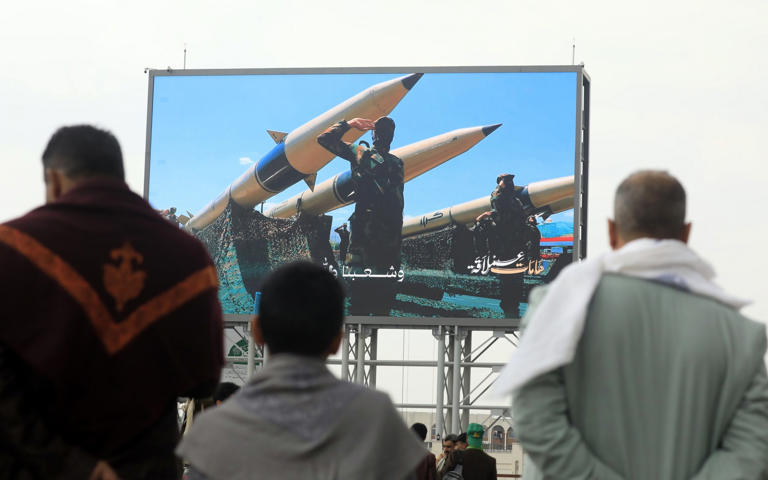
Houthi fighters next to their missiles appear on a billboard in Sanaa - YAHYA ARHAB/EPA/Shutterstock

Houthi fighters next to their missiles appear on a billboard in Sanaa - YAHYA ARHAB/EPA/Shutterstock
They added: “This is a game-changing weapon in the context of the conflict with Israel, where the primary challenge is penetrating the air defence system.

“Typically, intercepting a ballistic missile requires at least two interceptors. In the case of a missile with a separable warhead, Israel would need to launch approximately eight interceptors to destroy an Iranian warhead that has split”.


call to action icon


The IDF carried out Thursday’s strike after two interceptions of Houthi drones earlier in the day.

“Whoever raises a hand against Israel, his hand will be cut off,” said Israel Katz, the defence minister, in a statement earlier on Thursday.

The strikes came after Israeli forces conducted an overnight airborne raid on a site near the Syrian capital of Damascus after bombing it several times.

Israeli jets had struck the site near Kisweh on Tuesday, killing six Syrian soldiers according to the foreign ministry, and bombed it again on Wednesday night.

Israeli troops were then flown into the area where they carried out the raid, the Syrian Arab News Agency reported.

Israel did not confirm the raid, but Israel Katz, the defence minister, said its forces operate “in all combat zones” to ensure the country’s security.

The Syrian Observatory for Human Rights reported that the site contained weapons belonging to the Iran-backed Lebanese militant group Hezbollah, a former ally of ousted president Bashar al-Assad, which has largely been defeated by Israel.
 
To view this content we will need your consent to set third party cookies.
For more detailed information, see our cookies page.
 
The Israeli army declares Gaza City a dangerous combat zone, bombing it fiercely, demolishing homes relentlessly, and attacking it mercilessly.

More than a million people are in extreme danger before your eyes.

To view this content we will need your consent to set third party cookies.
For more detailed information, see our cookies page.
 
Well, and people said Trump is not going to fall stooges of Israel

To view this content we will need your consent to set third party cookies.
For more detailed information, see our cookies page.


This would never have happened when I was in the Military, like this Top said, I took an oath to serve and protect the United States of America, not to Israel.
 
To view this content we will need your consent to set third party cookies.
For more detailed information, see our cookies page.
 
How Egyptians can watch starving Palestinians across the fence and not be moved to action is truly astonishing. Even US and British soldiers had the humanity to disobey orders where they felt it was criminal.

The sight of starving Palestinians just across Egypt’s border in Gaza raises profound moral and historical questions. For an Islamic nation that shares deep cultural, religious, and historical ties with the Palestinian people, the lack of visible large-scale action is striking. Egypt, after all, has long positioned itself as a regional leader in the Arab world and as a champion of Palestinian rights in international forums. Yet, when faced with a humanitarian catastrophe on its very doorstep, its restraint appears morally troubling if not sickening. The shameless Egyptians soldiers cold bloodedly watch women and children with outstretched hands begging for food and water within an arms length of bread and water but the soldiers look the other way. Are these soldiers Coptic Christians or Jews in disguise , what has taken away the Islamic and human values from them?


Hungry Children, Silent Soldiers

How can Egyptian soldiers stand and watch as Palestinian children starve across a fence at Rafah? The Egyptian army says it is not that they lack humanity—it is that they are bound by orders, by politics, and by fear. But history will not remember the chain of command; it will remember the silence. Islam does not recognize orders that are horrifically evil and cruel against fellow Muslims. How come Egyptians have lost the plot?

Egypt has long called itself the heart of the Arab world, a champion of Palestine. Yet when food and medicine could be passed by hand to the desperate, soldiers are told to hold their ground. Cairo cites treaties, regional stability, and pressure from allies. But can such calculations justify watching a child waste away just meters from safety?

Even in the Kafir rigid militaries, there have been moments when conscience outweighed obedience—when soldiers refused to enforce what they knew in their bones to be criminal. That spark of humanity shamed entire systems into change. Today, at Rafah, the absence of such defiance is glaring. Why has Egypt and the Egyptian army failed in its Islamic duty to fellow Muslims and failed in such a dastardly way?

Egyptian soldiers are not the architects of this policy. But their silence enforces it. And every day they obey, the world sees not only starving Palestinians, but also a fence where Islamic compassion trashed and humanity handcuffed by sickening politics.

History’s verdict will be harsh: when children were starving within arm’s reach, Egypt kept its arms folded and looked the other way. Allah has dealt with those types of Egyptians in the past but they never learn their lessons.

Because they have become shameless

The Arab world is making excuses for not acting
 
#Breaking @qudsn
correspondent #Gaza:
Martyr & several wounded after the Israeli occupation's shelling that targeted the courtyard of the Al-Astal family's home in Al-Istable Street in western Khan Yunis
To view this content we will need your consent to set third party cookies.
For more detailed information, see our cookies page.

#Palestine
📹."What we can report is only the tip of the iceberg of mountains and mountains of cases and evidence of the spread of malnutrition"
Hani Mahmoud reporting from Gaza City on the spread of starvation.
 

Muslim States (Sickening) Inaction on Gaza​

The inaction of Muslim-majority states regarding the ongoing conflict in Gaza is attributed to a complex interplay of geopolitical, economic, and political factors. Despite widespread condemnation and the existence of a shared Islamic and Arab identity, the collective response has been characterized by symbolic gestures rather than concrete action, leading to accusations of moral failure and complicity.

The primary reasons include deep-seated economic dependencies on Western powers, particularly the United States, which provides military and political support to Israel, thereby deterring Muslim states from taking actions that could jeopardize these alliances. Furthermore, many Muslim-majority nations are entangled in political alliances and trade deals that prioritize stability and economic gain over moral or religious solidarity, making it "inconvenient" to speak out against Israel.

The decline of pan-Arab and pan-Islamic identities in favor of national and sub-national identities has also weakened the sense of collective responsibility towards the Palestinian cause. This is compounded by the suppression of civil society and organized political movements, such as the Muslim Brotherhood, which were once key drivers of regional activism but are now outlawed in several countries, leaving no strong institutional force to mobilize public opinion.

The fear of domestic unrest and the desire to maintain political stability further discourage governments from taking bold stances. Additionally, some states have engaged in contradictory actions, such as supporting reconstruction plans while simultaneously undermining them through backchannel diplomacy with the United States, highlighting a deep-seated duplicity. This silence is not merely a lack of awareness but a deliberate choice driven by a lack of political and moral will, with the international community's double standards further enabling this inaction.

  • Muslim-majority states are economically and militarily dependent on the United States, which provides billions in annual aid to Israel and vetoes critical resolutions at the United Nations, creating a significant deterrent against taking decisive action.
  • The decline of pan-Arab and pan-Islamic identities in favor of national and sub-national identities has diminished the sense of solidarity with the Palestinian cause, reducing public and governmental motivation to act.
  • Civil society and organized political movements, which were once central to regional activism, have been suppressed or outlawed in many countries, leaving no effective institutional force to demand action.
  • The fear of domestic instability and the desire to maintain political control lead governments to suppress protests and avoid actions that could provoke backlash, even when public sentiment is sympathetic to Palestine.
  • Some states engage in contradictory behavior, such as publicly endorsing Palestinian reconstruction plans while working behind the scenes to sabotage them, demonstrating a lack of genuine commitment.
  • The international community's double standards, where powerful nations remain silent on Israel's actions while condemning others for human rights violations, further erode the credibility of Muslim leaders and justify their passive stance.
AI-generated answer. Please verify critical facts.
Even a non military action like stopping abraham accords process by signed countries would create pressure on israel and later on after a change of netenyahu government trials can begin on responsibles of atrocities on Palestinians that includes netenyahu but also contains many other responsibles in the military-political hierarchy. Before that diplomatic normalisation process like abr accords should not begin. And it should not gain pace until Palestinians get solid rights and satisfied in their demands. But even that requires some level of independant decision making from Usa. Unfortunately even that does not seem to happen.
 
Status
Not open for further replies.

Users who are viewing this thread

Country Watch Latest

Latest Posts

Back
Top