Houthi prime minister ‘killed’ in Israeli strike
Story by Paul Nuki
• 12h•
3 min read
Ahmed al-Rahawi reportedly killed in strikes that also targeted a large gathering of Houthi military leaders - MOHAMMED HUWAIS/AFP
The Houthi prime minister is said to have been killed in a series of Israeli air strikes that hit the Yemeni capital Sanaa on Thursday.
Ahmed al-Rahawi was killed in an apartment along with others, according to reports in local media.
Mr al-Rahawi was a politician, rather than a military figure, who served as prime minister of the Houthi-led government from Aug 10 last year.
He was a member of the General People’s Congress party and has previously served on the Supreme Political Council.
The Israel air strikes on Thursday reportedly also targeted a large gathering of Houthi military leaders.
It is still unclear whether those strikes were successful.
Social media accounts showed images of explosions in and around the Sanaa area, and the Qatari news outlet Al Araby said the Israeli strikes had targeted top Houthi officials.
Israeli intelligence learned at around 1pm that 10 Houthi ministers, including the minister of defense, and senior officials had gathered outside Sanaa to hear a speech by the group’s leader, Abdul Malik al-Houthi, the Times of Israel reported, citing unnamed Israeli security officials.
The IDF then launched a strike targeting the meeting. It remains unclear if the Houthi chief of staff, Muhammad al-Ghamari, was present or whether the strikes were successful in killing other Houthi leaders.
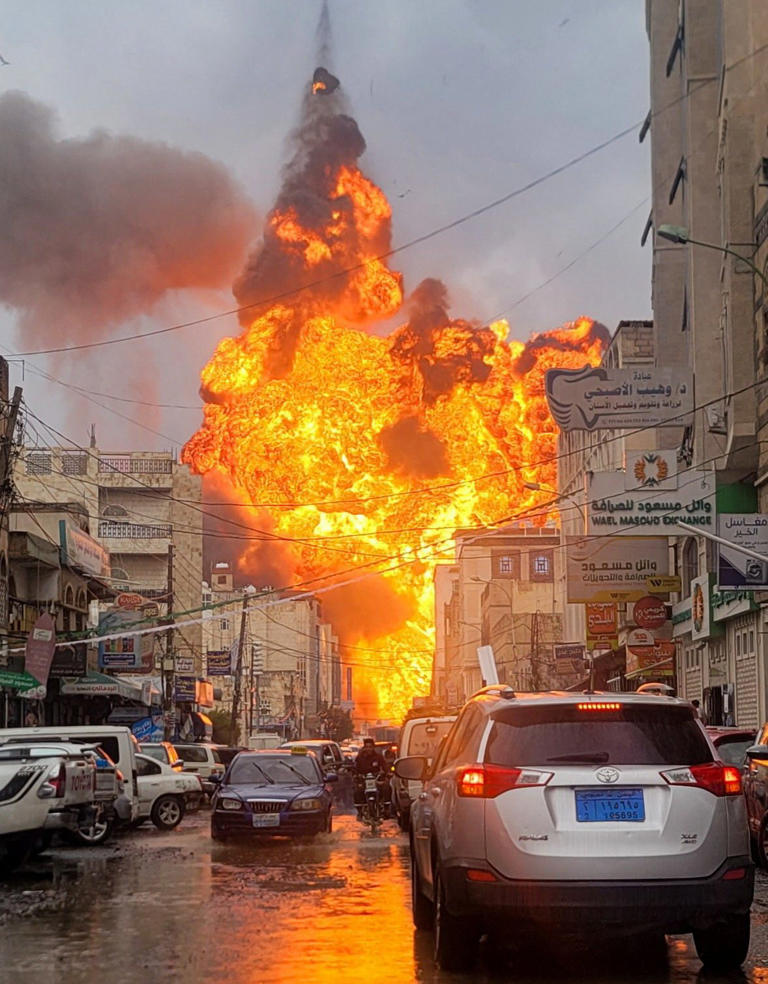
A fire ball rises from the site of an Israeli air strike in Sanaa on Aug 24 - Reuters
Israeli intelligence provided real-time details of the gathering, enabling the strike, which was carried out despite heavy air defences in the area.
Israel has cast previous strikes on the Houthis in dramatic terms but with limited obvious impact on the terrorist group’s ability or willingness to strike Israel.
 Related video: Israeli air strikes hit Yemen’s capital Sanaa, Houthi-run media say (Euronews (English))
There were no immediate reports of casualties.
Israeli air strikes hit Yemen’s capital Sanaa, Houthi-run media say
Thursday’s strike comes in the wake of a Houthi missile strike on Israel last week using a new missile which carries multiple war heads and cluster bombs.
The missile was shot down but the use of the munition presents a new challenge for Israel.
An Israeli air force official told The Telegraph that an initial operational review of the Houthi missile fired last Friday had determined that it “most likely contained several sub-munitions which were intended to be detonated upon impact”.
The new multi-headed missile poses a serious challenge to Israel’s air defence systems because of the need for more interceptors to shoot it down.
“Yemen has previously served as a testing ground for Iranian weaponry,” said an Israeli defence expert with detailed knowledge of Friday’s strike.
“In this case, [the] warhead was composed of submunitions: three warheads ... alongside another component in the warhead consisting of dozens of cluster bombs that disperse upon impact with the target.”
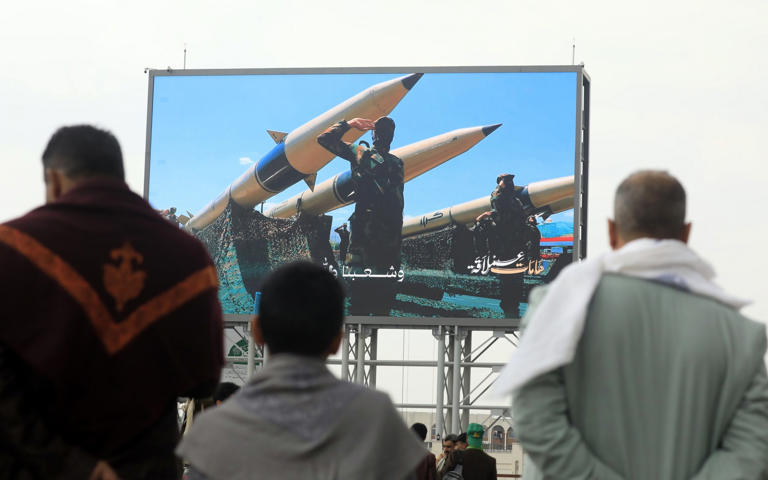
Houthi fighters next to their missiles appear on a billboard in Sanaa - YAHYA ARHAB/EPA/Shutterstock
They added: “This is a game-changing weapon in the context of the conflict with Israel, where the primary challenge is penetrating the air defence system.
“Typically, intercepting a ballistic missile requires at least two interceptors. In the case of a missile with a separable warhead, Israel would need to launch approximately eight interceptors to destroy an Iranian warhead that has split”.
The IDF carried out Thursday’s strike after two interceptions of Houthi drones earlier in the day.
“Whoever raises a hand against Israel, his hand will be cut off,” said Israel Katz, the defence minister, in a statement earlier on Thursday.
The strikes came after Israeli forces conducted an overnight airborne raid on a site near the Syrian capital of Damascus after bombing it several times.
Israeli jets had struck the site near Kisweh on Tuesday, killing six Syrian soldiers according to the foreign ministry, and bombed it again on Wednesday night.
Israeli troops were then flown into the area where they carried out the raid, the Syrian Arab News Agency reported.
Israel did not confirm the raid, but Israel Katz, the defence minister, said its forces operate “in all combat zones” to ensure the country’s security.
The Syrian Observatory for Human Rights reported that the site contained weapons belonging to the Iran-backed Lebanese militant group Hezbollah, a former ally of ousted president Bashar al-Assad, which has largely been defeated by Israel.




 ."What we can report is only the tip of the iceberg of mountains and mountains of cases and evidence of the spread of malnutrition"


