India Economy Thread

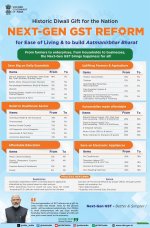
What Will Be Cheaper Under India’s New GST Rates?​

India has rolled out a major GST overhaul—often referred to as GST 2.0—effective September 22, 2025. The tax structure is now simplified to include two primary slabs: 5% and 18%, along with a new 40% luxury/sin goods rate. ReutersFinancial Times

Items Made Cheaper (Reduced GST Rates):​

  • Daily essentials & packaged goods like biscuits, soaps, noodles, coffee, butter — 5% GST (previously 10–15% higher) The Economic TimesThe Times of India
  • Basic foods such as roti, paratha, paneer, and some milk products — now at 0% GST (NIL) mintThe Times of India
  • Skin & hygiene products including shampoo, talcum powder, toothpaste — now taxed at 5% ReutersIndiatimes
  • Medicines and life-saving drugs — many are now tax-exempt (0%) Indiatimesmint
  • Individual life and health insurance premiums — now fully exempt from GST ReutersFinancial Times
  • Electronics & appliances (TVs, ACs, dishwashers, refrigerators, washing machines) — now taxed at 18% (down from 28%) The Times of IndiaReuters
  • Small cars and three-wheelers — GST reduced from around 28% to 18% ReutersNavbharat Times
  • Hotel rooms (up to ₹7,500 per night) — 5% GST (down from 12%) Navbharat Times
  • Restaurant meals — taxed at just 5% (down from 12–18%) Navbharat Times
  • Economy-class flight tickets — GST cut to 5%; business class to 12% (from 18%) Navbharat Times
  • Fertilizers & tractors — GST lowered to benefit farmers Reuters
  • Electric vehicles (EVs) — GST maintained at 5% to continue promoting green adoption ReutersThe Times of India

Summary:​

Everyday essential items and services—like groceries, health products, public transport, home appliances, and small vehicles—have become more affordable. Consumers are expected to save significantly during the upcoming festive season, with relief ranging from 10–15% on essentials. The Economic TimesThe Times of IndiaIndiatimes

Items That May Become More Expensive​

  • Apparel costing over ₹2,500 — GST increased to 18% (from 12%) Reuters
  • Luxury and sin goods — Now taxed at 40%. This includes high-end cars, tobacco products, gunas, carbonated drinks, and big motorcycles ReutersJagranjosh.com

Quick Overview​

CategoryNew GST RateImpact
Essentials & packaged food0% or 5%Much cheaper for consumers
Medicines & insurance0% (exempt)Cost-saving for healthcare needs
Electronics, cars, appliances18%Easier access/cost reduction
Services (hotels, restaurants, flights)5–12%More affordable travel & dining
Luxury & sin goods (tobacco, high-end cars)40%Higher expenses, discourages use
 
Great news for Indians—now many things are going to become cheaper for us. As a middle-class person, I am really happy.
 
  • Simplification: The GST structure is now streamlined to two standard rates (5% and 18%) plus a luxury/sin slab (40%). This replaces the previous multi-tier approach, which caused classification challenges and compliance complexity.
  • Beneficiaries: Daily essentials, electronics, small vehicles, healthcare, and household items become significantly cheaper. Sectors like FMCG, rural producers, and budget automakers are likely to benefit from boosted demand.
  • Targeted Taxation: The luxury/”sin” slab ensures higher-targeted taxation for high-end consumption without broadly increasing GST across all categories.
  • Fiscal Trade-off: While the reform reduces government revenue in the short term, it’s expected to spur consumption and efficiency in GST administration.
 

What Will Be Cheaper Under India’s New GST Rates?​

India has rolled out a major GST overhaul—often referred to as GST 2.0—effective September 22, 2025. The tax structure is now simplified to include two primary slabs: 5% and 18%, along with a new 40% luxury/sin goods rate. ReutersFinancial Times

Items Made Cheaper (Reduced GST Rates):​

  • Daily essentials & packaged goods like biscuits, soaps, noodles, coffee, butter — 5% GST (previously 10–15% higher) The Economic TimesThe Times of India
  • Basic foods such as roti, paratha, paneer, and some milk products — now at 0% GST (NIL) mintThe Times of India
  • Skin & hygiene products including shampoo, talcum powder, toothpaste — now taxed at 5% ReutersIndiatimes
  • Medicines and life-saving drugs — many are now tax-exempt (0%) Indiatimesmint
  • Individual life and health insurance premiums — now fully exempt from GST ReutersFinancial Times
  • Electronics & appliances (TVs, ACs, dishwashers, refrigerators, washing machines) — now taxed at 18% (down from 28%) The Times of IndiaReuters
  • Small cars and three-wheelers — GST reduced from around 28% to 18% ReutersNavbharat Times
  • Hotel rooms (up to ₹7,500 per night) — 5% GST (down from 12%) Navbharat Times
  • Restaurant meals — taxed at just 5% (down from 12–18%) Navbharat Times
  • Economy-class flight tickets — GST cut to 5%; business class to 12% (from 18%) Navbharat Times
  • Fertilizers & tractors — GST lowered to benefit farmers Reuters
  • Electric vehicles (EVs) — GST maintained at 5% to continue promoting green adoption ReutersThe Times of India

Summary:​

Everyday essential items and services—like groceries, health products, public transport, home appliances, and small vehicles—have become more affordable. Consumers are expected to save significantly during the upcoming festive season, with relief ranging from 10–15% on essentials. The Economic TimesThe Times of IndiaIndiatimes

Items That May Become More Expensive​

  • Apparel costing over ₹2,500 — GST increased to 18% (from 12%) Reuters
  • Luxury and sin goods — Now taxed at 40%. This includes high-end cars, tobacco products, gunas, carbonated drinks, and big motorcycles ReutersJagranjosh.com

Quick Overview​

CategoryNew GST RateImpact
Essentials & packaged food0% or 5%Much cheaper for consumers
Medicines & insurance0% (exempt)Cost-saving for healthcare needs
Electronics, cars, appliances18%Easier access/cost reduction
Services (hotels, restaurants, flights)5–12%More affordable travel & dining
Luxury & sin goods (tobacco, high-end cars)40%Higher expenses, discourages use
India does have a very weird definition of high-end cars. An entry level car in developed markets, like Honda City, is considered a high-end car in India.
 
India does have a very weird definition of high-end cars. An entry level car in developed markets, like Honda City, is considered a high-end car in India.
Still, it's better, bro, because we are paying 47% for all the cars, almost.

Car GST Before vs After Reform


Earlier (Pre–GST 2.0):
  • Cars (small, mid-size, SUVs) → 28% GST + Cess (ranging 1%–22%).
  • Effective tax burden → ~40–47% depending on category.
  • Example: A small hatchback could be taxed ~43%, and a luxury SUV ~47% or more.

Now (GST 2.0 from Sept 22, 2025):
  • Small cars / entry vehicles / 3-wheelers18% flat GST.
  • Luxury cars, big SUVs, premium bikes, sin/luxury goods40% flat GST.
 

What Will Be Cheaper Under India’s New GST Rates?​

India has rolled out a major GST overhaul—often referred to as GST 2.0—effective September 22, 2025. The tax structure is now simplified to include two primary slabs: 5% and 18%, along with a new 40% luxury/sin goods rate. ReutersFinancial Times

Items Made Cheaper (Reduced GST Rates):​

  • Daily essentials & packaged goods like biscuits, soaps, noodles, coffee, butter — 5% GST (previously 10–15% higher) The Economic TimesThe Times of India
  • Basic foods such as roti, paratha, paneer, and some milk products — now at 0% GST (NIL) mintThe Times of India
  • Skin & hygiene products including shampoo, talcum powder, toothpaste — now taxed at 5% ReutersIndiatimes
  • Medicines and life-saving drugs — many are now tax-exempt (0%) Indiatimesmint
  • Individual life and health insurance premiums — now fully exempt from GST ReutersFinancial Times
  • Electronics & appliances (TVs, ACs, dishwashers, refrigerators, washing machines) — now taxed at 18% (down from 28%) The Times of IndiaReuters
  • Small cars and three-wheelers — GST reduced from around 28% to 18% ReutersNavbharat Times
  • Hotel rooms (up to ₹7,500 per night) — 5% GST (down from 12%) Navbharat Times
  • Restaurant meals — taxed at just 5% (down from 12–18%) Navbharat Times
  • Economy-class flight tickets — GST cut to 5%; business class to 12% (from 18%) Navbharat Times
  • Fertilizers & tractors — GST lowered to benefit farmers Reuters
  • Electric vehicles (EVs) — GST maintained at 5% to continue promoting green adoption ReutersThe Times of India

Summary:​

Everyday essential items and services—like groceries, health products, public transport, home appliances, and small vehicles—have become more affordable. Consumers are expected to save significantly during the upcoming festive season, with relief ranging from 10–15% on essentials. The Economic TimesThe Times of IndiaIndiatimes

Items That May Become More Expensive​

  • Apparel costing over ₹2,500 — GST increased to 18% (from 12%) Reuters
  • Luxury and sin goods — Now taxed at 40%. This includes high-end cars, tobacco products, gunas, carbonated drinks, and big motorcycles ReutersJagranjosh.com

Quick Overview​

CategoryNew GST RateImpact
Essentials & packaged food0% or 5%Much cheaper for consumers
Medicines & insurance0% (exempt)Cost-saving for healthcare needs
Electronics, cars, appliances18%Easier access/cost reduction
Services (hotels, restaurants, flights)5–12%More affordable travel & dining
Luxury & sin goods (tobacco, high-end cars)40%Higher expenses, discourages use
Well thought out
 
Still its better bro because-

Car GST Before vs After Reform


Earlier (Pre–GST 2.0):
  • Cars (small, mid-size, SUVs) → 28% GST + Cess (ranging 1%–22%).
  • Effective tax burden → ~40–47% depending on category.
  • Example: A small hatchback could be taxed ~43%, and a luxury SUV ~47% or more.

Now (GST 2.0 from Sept 22, 2025):
  • Small cars / entry vehicles / 3-wheelers18% flat GST.
  • Luxury cars, big SUVs, premium bikes, sin/luxury goods40% flat GST.
Has the definition of luxury cars changed, do you know ? Or is anything with more than a 1200 cc petrol engine still considered a luxury car ?

There is also registration and road taxes and customs duty is just crazy. Cars are ridiculously overpriced in India and domestic manufacturers like Tata and Mahindra have been protected for far too long.

Let us see how much of these tax cuts are passed on to the customers. Overall, the GST rationalisation and reduction is a good step at the right time. If India can maintain a 7%+ GDP growth rate in the next couple of quarters, it will provide strong leverage during trade negotiations.
 
Has the definition of luxury cars changed, do you know ? Or is anything with more than a 1200 cc petrol engine still considered a luxury car ?

There is also registration and road taxes and customs duty is just crazy. Cars are ridiculously overpriced in India and domestic manufacturers like Tata and Mahindra have been protected for far too long.

Let us see how much of these tax cuts are passed on to the customers. Overall, the GST rationalisation and reduction is a good step at the right time. If India can maintain a 7%+ GDP growth rate in the next couple of quarters, it will provide strong leverage during trade negotiations.

That depends. I don’t believe most Indians are wealthy enough to buy cars above 1200 cc. For the middle class, cars like the Altroz, Punch, Hyundai i10/i20/Exter, and compact sedans such as the Dzire, Amaze, Aura, and Tigor—all within the ≤1200 cc category—are more than sufficient.

For the upper middle class, those who want larger cars with more features can afford to pay the 40% tax. In that sense, it seems perfectly reasonable

Even so ; they need to.pay atleast 7% less than at present day
 
Last edited:
That depends. I don’t believe most Indians are wealthy enough to buy cars above 1200 cc. For the middle class, cars like the Altroz, Punch, Hyundai i10/i20/Exter, and compact sedans such as the Dzire, Amaze, Aura, and Tigor—all within the ≤1200 cc category—are more than sufficient.

For the upper middle class, those who want larger cars with more features can afford to pay the 40% tax. In that sense, it seems perfectly reasonable
A car like Suzuki Ertiga or even Honda City is hardly a luxury car. I don't think any American-made or even European-made , car would meet the definition of a non-luxury car in India. Plus, the 1200cc/4 metre length rule is also a huge non-tariff barrier. Many lower end cars from foreign markets become overpriced in India just because they have a slightly higher than 1199 cc engine or slightly longer than 4 metre length. Ultimately the Indian consumer suffers.
 
Long overdue. Wish Modi had done it in the 2023 budget itself, would have saved a lot of losses in 2024 GE. To compensate for loss in revenue they could have increased corporate tax rate back from 25 to 30% (originally it was 35%)- the corporates havent kept their bargain by investing anyway.

Regards
 
Long overdue. Wish Modi had done it in the 2023 budget itself, would have saved a lot of losses in 2024 GE. To compensate for loss in revenue they could have increased corporate tax rate back from 25 to 30% (originally it was 35%)- the corporates havent kept their bargain by investing anyway.

Regards
This is a good time to make the tax cut. Festive shopping season is coming up and this will offset the hit the GDP will take from the US tariffs.
 
We are going to consumption Maxx this Bois. Income Tax cut upto 12L and now consumer taxes going down. Did govt hit a jackpot or something lol!
 
India does have a very weird definition of high-end cars. An entry level car in developed markets, like Honda City, is considered a high-end car in India.
Its about dimension and capacity.
Any thing more than 4 mt of length and 1200/1500 Cc engine has higher pradesh..
 

Users who are viewing this thread

Latest Posts

Back
Top