Indonesia Economy and Industry

Indonesia Targets Shadow Economy to Lift $145 Billion in 2026 Tax Revenue​


Prisma Ardianto, Heru Andriyanto
August 20, 2025 | 5:15 am

3–4 minutes


A pile of imported used clothes is seen at Senen Market in Jakarta on March 11, 2023. (Beritasatu Photo/Herman)

Jakarta. Indonesia is stepping up efforts to widen its tax base and tap into the shadow economy as it seeks to raise Rp 2,357.7 trillion ($145.6 billion) in tax revenues by 2026. The target marks a 13.5 percent increase -- or Rp 280.8 trillion -- from projected 2025 collections of Rp 2,076.9 trillion.

The shadow economy -- also known as the underground or informal economy -- refers to unreported or underreported business activities that operate outside official oversight. These include cash-based transactions, unregistered businesses, and illicit trade. While difficult to measure, the shadow economy often accounts for a substantial portion of GDP in developing countries, depriving governments of billions in tax revenue while leaving workers and firms outside regulatory protection.

According to the government’s 2026 budget plan and financial report, authorities will focus surveillance on high-risk sectors such as retail trade, food and beverages, gold trading, and fisheries. Active “canvassing” investigations will be carried out to identify and register previously untaxed entities.


The government has also appointed foreign entities as value-added tax (VAT) collectors for cross-border e-commerce transactions, strengthening supervision of the fast-growing digital economy. In addition, tax authorities are compiling fiscal data on unregistered businesses operating on digital platforms to improve oversight and compliance.

Warnings Over Ambitious Targets
Earlier this week, the Centre for Strategic and International Studies (CSIS) cautioned that the government’s ambitious targets could push it toward tougher tax collection measures and rapid expansion of the taxpayer base.

“The figures suggest the government will intensify its tax collection drive next year. In the past five years, taxes have risen from 77 percent to 86 percent of state revenue,” said Deni Friawan, senior researcher at CSIS.

Indonesia’s tax base remains shallow. Out of 145 million working-age people, only around 17 million consistently file or pay taxes. Untapped potential in the informal sector and underground economy has left a wide gap in collections, while reliance on global commodity cycles continues to expose state finances to external shocks.

Finance Minister Sri Mulyani Indrawati dismissed concerns that the government may resort to heavy-handed collection tactics. Instead, she prioritized ongoing reforms, tighter compliance oversight, and digital tools as the backbone of revenue growth.

Key measures include strengthening the “core tax” administration system, expanding data sharing across government agencies, taxing digital transactions, and launching joint audit and enforcement initiatives.

“Data integration and the new core tax system will be pushed harder. We still have room to raise revenue without inventing new taxes,” Sri Mulyani said.

 
8 priority programs

To view this content we will need your consent to set third party cookies.
For more detailed information, see our cookies page.


Central Bank Rate

To view this content we will need your consent to set third party cookies.
For more detailed information, see our cookies page.
 

FL Technics Ponders Asia-Pacific Expansion​


Victoria Moores
August 22, 2025

1756114701430.jpeg
Credit: FL Technics


FL Technics Indonesia is looking to more than double its MRO footprint in Jakarta by adding another six-bay hangar, two painting bays, plus an engine shop and a wheels and brakes shop.

FL Technics Indonesia’s current facility is 16,000 m2 (approximately 172,000 ft.2) and the company is looking to expand to as much as 45,000 m2 through an approximately €50 million ($58 million) investment. FL Technics hopes to open the new facilities in late 2026.

“It’s a significant investment,” FL Technics Indonesia CEO Martynas Grigas tells Aviation Week Network. “Combined with our existing facilities, we will probably be the biggest in Southeast Asia for narrowbody MRO. With our Bali facility, it will be for sure the biggest.”

The planned expansion comes in response to robust demand. The Southeast Asia region is home to thousands of aircraft, with a strong aircraft delivery pipeline over the next five years. Grigas says airlines from the Middle East, India and across Asia are already requesting maintenance visits for 10 days at a time, rather than 1-3 days, because they have substantial fleets.

“There will be huge demand. We can feel already that now,” Grigas says. “We [are] already fully booked. What’s stopping our growth is a lack of space, so that’s why it’s natural to expand.”

If the expansion goes ahead, FL Technics Indonesia will add three new core capabilities: top-case engine maintenance, wheels and brakes, and painting. FL Technics already offers top case engine maintenance at its Lithuanian facilities, and Grigas says this style of quick turnaround, light-fix engine hospital work is a “much-needed” service in Southeast Asia.

“There are a lot of players around with wheels and brakes shops, but all of them are dedicated to their own airlines, like AirAsia or Garuda. There are not many for the other airlines,” he says. “And we’re bringing painting facilities, which are also very in-demand.

There are very few painting facilities in Southeast Asia.”

FL Technics Indonesia has no plans to enter the engine overhaul or widebody markets. “Never say never, but not now, for sure. That’s a totally different business,” he says. “Our strength and focus is in narrowbody airframes and other shops.”

The Jakarta facility opened in December 2016. It can accommodate 8-10 narrowbodies simultaneously, covering all Airbus A320 and Boeing 737 variants, including Neos and MAXs. FL Technics Indonesia also has a series of shops, including batteries, sheet metal work and non-destructive testing.

The company opened a new high-tech hangar in Bali in November 2024, which has capacity for eight aircraft. “It’s a totally new, high-end facility,” Grigas says. “There is no other facility like that in Southeast Asia.”

Together, the Jakarta and Bali facilities employ around 900 staff.

The Jakarta expansion will add another 400 jobs, growing the site’s existing 500-strong workforce. FL Technics’ MRO activities in Jakarta and Bali are certified by various authorities, including Australia, Indonesia, the Philippines, Thailand and the U.S. Grigas says the company is working toward European Union Aviation Safety Agency (EASA) certification, which it hopes to get by the end of 2025 or in early 2026.

Beyond this, FL Technics has been exploring the idea of creating additional MROs in Thailand, the Philippines and other Southeast Asian countries. Further sites in Indonesia—which has 37 airports—are also under consideration, including sites to the north of the country, which are closer to Thailand and the Philippines. “So far, we see that Indonesia is one of the best markets to develop our MRO business,” Grigas says.

“To develop an MRO, there are three main components. One is the box—the facility or hangar itself—which is the easy part,” Grigas says. “The more difficult part is logistics. The logistics network should be very well developed to get daily parts. And third, the most important component is people. If we don’t have engineers at that airport, there is no business. But Indonesia is a very good area for that. They produce a lot of engineers. There are literally hundreds, if not thousands, of engineers available in the market.”


Thailand is moving from FAA- to EASA-style regulations, and Grigas believes the new U-Tapao International Airport has potential to be a good MRO center. “Still, there is a lot of work to do for Thailand to develop MROs. The Philippines is another option, but it is already dense with MRO companies,” he says.

If any of these projects goes ahead, it would be a large facility. “In our business, we need scale,” Grigas says, noting that Jakarta has grown from a small project into a major facility. While Grigas would love to expand further in Bali, its island location is a natural size-limiter.

FL Technics is part of Avia Solutions Group, which has dozens of air operators’ certificates around the world. While the bulk of FL Technics’ work is for third-party airlines, it also performs MRO for the group’s expanding portfolio of wet lease airlines, including BBN Airlines Indonesia and Thai SmartLynx.

 
Here’s a structured briefing of FL Technics Indonesia’s planned expansion and its implications:


FL Technics Indonesia – Expansion Overview


Current Operations​


  • Facility Size: 16,000 m² in Greater Jakarta (≈172,000 ft²).
  • Opened: December 2016.
  • Capacity: 8–10 narrowbodies simultaneously (Airbus A320 & Boeing 737 variants, including Neos & MAX).
  • Capabilities: Batteries, sheet metal, non-destructive testing (NDT).
  • Workforce: ~500 in Greater Jakarta; ~400 more in Bali (total ~900).
  • Certifications: Australia, Indonesia, Philippines, Thailand, U.S. → Targeting EASA approval by late 2025/early 2026.
  • Recent Expansion: New high-tech hangar in Bali (Nov 2024), capacity for 8 aircraft.


Planned Greater Jakarta Expansion


  • Scope:
    • Additional 6-bay hangar
    • 2 painting bays
    • Engine shop (top-case maintenance / light-fix “hospital” work)
    • Wheels & brakes shop
  • Size: Growth to 45,000 m² (from 16,000 m²).
  • Investment: ~€50 million ($58 million).
  • Timeline: Target late 2026 opening.
  • Jobs: +400 new positions (Greater Jakarta workforce to grow from 500 → 900).


Strategic Positioning


  • Regional Leadership: Combined Jakarta + Bali = largest narrowbody MRO in Southeast Asia.
  • New Capabilities:
    • Top-case engine maintenance – light, quick turnaround, critical for regional airlines.
    • Wheels & brakes – filling a market gap, as most shops (e.g., Garuda, AirAsia) serve only their own fleets.
    • Aircraft painting – scarce capacity in Southeast Asia, high demand.
  • Focus: Narrowbody aircraft only. No plans for engine overhauls or widebody MRO.


Market Drivers


  • High Demand:
    • Southeast Asia has thousands of aircraft with a strong delivery pipeline (2025–2030).
    • Airlines increasingly seek 10-day MRO slots vs. 1–3 days, reflecting larger fleets.
    • Jakarta facility already fully booked, expansion constrained by space.
  • Talent & Logistics:
    • Indonesia produces large numbers of engineers, ensuring workforce supply.
    • Logistics and supply chain development are crucial for scaling.


Future Outlook


  • Regional Expansion: Evaluating Thailand (U-Tapao Airport, moving to EASA standards) and Philippines (already dense MRO market).
  • Domestic Expansion: Considering additional sites across Indonesia (37 airports), especially north Indonesia (closer to Thailand & Philippines).
  • Parent Group: Avia Solutions Group (multiple AOCs worldwide). MRO work includes third-party airlines + group’s wet lease operators (e.g., BBN Airlines Indonesia, Thai SmartLynx).


✅ Key Takeaway:
By late 2026, FL Technics Indonesia aims to triple its Greater Jakarta footprint, fill critical service gaps (painting, wheels & brakes, quick engine fixes), and cement its status as the largest narrowbody MRO provider in Southeast Asia, backed by strong demand and workforce availability.


Do you want me to also compare this expansion with competitors like GMF AeroAsia to see how FL Technics’ strategy positions it in Indonesia’s and Southeast Asia’s MRO market?
 
1756171421935.webp

Forbes Asia 100 To Watch 2025​

By Forbes Asia Team,

Forbes Staff.

Aug 25, 2025, 05:45pm EDT
Updated Aug 25, 2025, 08:25pm EDT

Asia-Pacific’s small companies and startups on the rise.


Our fifth annual Forbes Asia 100 to Watch list provides a window into the vibrant world of startups and small companies in the Asia-Pacific region. It’s a constantly evolving ecosystem, which is increasingly focusing on AI and deep tech to innovate and thrive.


The promising news is that VC funding in the region, which had fallen to a ten-year low at the end of 2024, has seen an uptick in some countries this year. According to a recent KPMG report, India, Japan and Singapore are drawing more risk capital this year, a trend this compendium also reflects. A total of 16 countries and territories are represented on our list and India leads the pack with 18 companies, followed by Singapore and Japan (14 each), China (9), Indonesia and South Korea (8 each) and Australia (7).


Investors also favor fast-rising sectors such as biotechnology, spacetech and green tech, and our list is well-populated by companies in those fields—from enterprises developing gene-editing therapies for cancer treatments to those producing new anode material for lithium-ion batteries or building novel propulsion systems for spacecraft. They are grouped under ten industry categories with the largest cohort (18) in biotechnology and healthcare followed by enterprise technology and robotics (16). Overall, the 100 companies on the list have drawn nearly $3 billion in funding to date, compared with $2 billion raised by last year’s group.


Edited by Rana Wehbe Watson


Assistant editors: Catherine Wang and Yue Wang


Research and reporting: Jonathan Burgos, John Kang, Yessar Rosendar, Ian Sayson, James Simms, Jennifer Wells and Ardian Wibisono
 
2026 State Budget (8 Priority Programs in detail )

To view this content we will need your consent to set third party cookies.
For more detailed information, see our cookies page.
 

McKinsey: Indonesia could reach high-income status by boosting its productivity​


03 September 2025
Consultancy.asia

1757002172314.jpeg

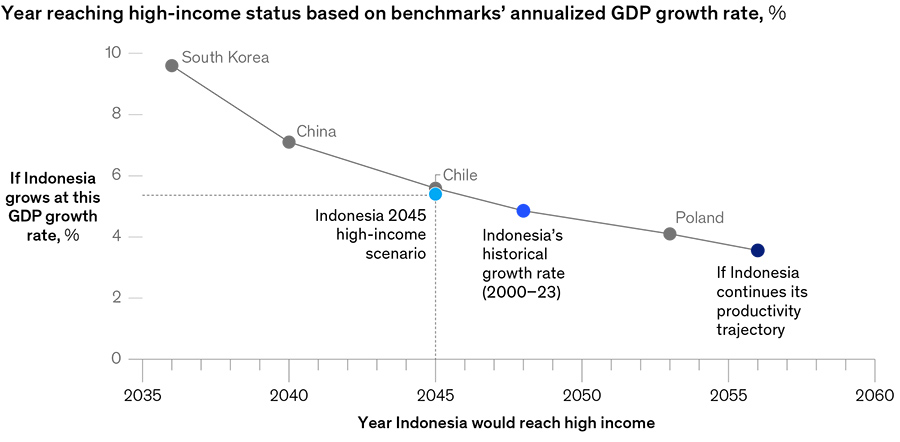
Indonesia has the potential to become a high-income nation by 2045, but this requires a significant acceleration in productivity growth and the expansion of larger companies.


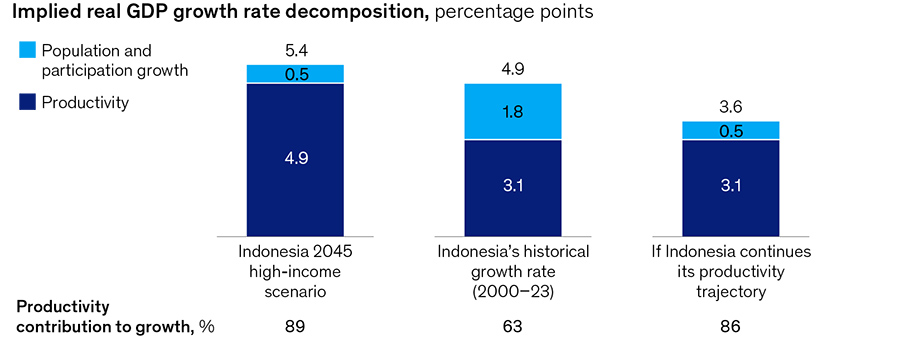
Achieving this goal would necessitate annual GDP growth of about 5.4%, with productivity playing a much larger role than it has in the past. That is according to a detailed new report from McKinsey & Company, which explores the ways in which Indonesia could become high-income.


A country is considered ‘high-income’ – a metric defined by the World Bank – when it has a gross national income per capita of $14,005 or more. Countries that have joined the ranks of the high-income include the US, Australia, Russia, and most of Western Europe.


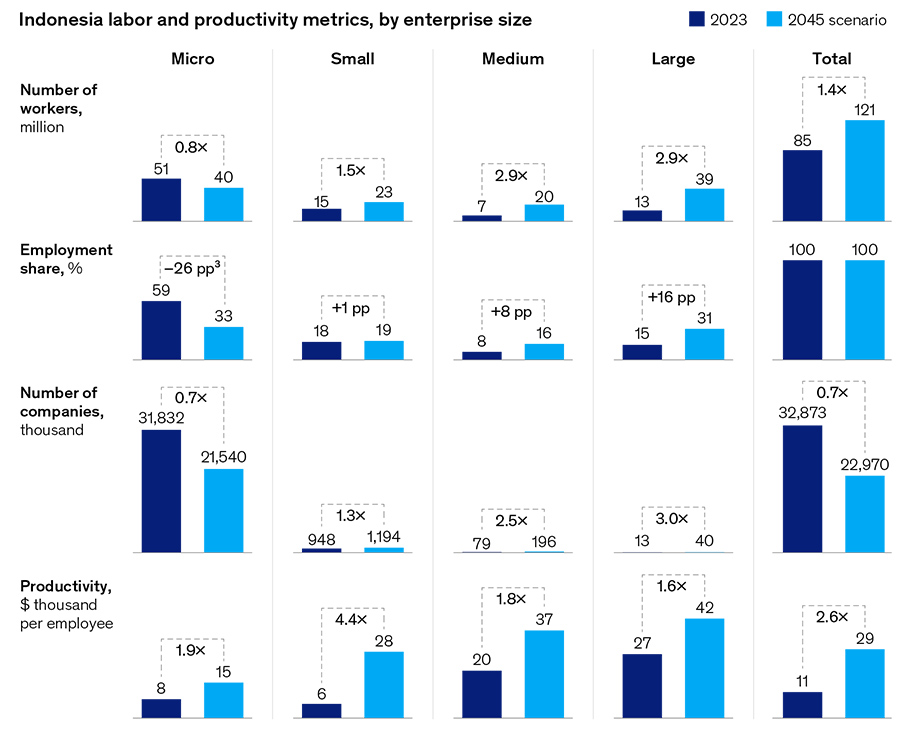
McKinsey’s report highlights that Indonesia’s economy is currently dominated by small, informal businesses, many of which operate in the ‘grey market’. To reach high-income status, the country needs a radical increase in investment, tripling the number of medium-sized and large companies to boost capital per worker and wages.


Year reaching high-income status based on benchmarks’ annualized GDP growth rate

Source: Oxford Economics; World Bank; McKinsey Global Institute

Drawing comparisons with other nations that have successfully made this transition suggests that Indonesia needs half of its non-agricultural workforce to be employed in companies with over 50 employees, a substantial increase from the current quarter.


While all sectors would need to contribute to this growth, services are projected to contribute the largest share, around 70%. Indonesia can expand its services sector by further leveraging its tourist attractions, modernizing operations, and developing skills.


The manufacturing sector could also be significantly boosted by capitalizing on global supply chain shifts and growing domestic demand. If Indonesia manages to make cities more sustainable and livable, it could facilitate the movement of 40 million more people into formal, productive urban jobs.


Implied real GDP growth rate decomposition


Source: Oxford Economics; World Bank; McKinsey Global Institute

Indonesia has a huge population, and its large cities could become more productive if managed better. Urban challenges are significant. Jakarta, for instance, is so severely overcrowded that the government has opted to build an entirely new capital city on a different island.


Roadmap to high-income​


The report identifies five key forms of capital that need to be unleashed in a synchronized way: financial, human, institutional, infrastructural, and entrepreneurial.


By transforming its ability to attract, grow, and deploy these forms of capital, Indonesia can increase productivity, scale businesses, foster new enterprises, and enable companies to pay higher wages, ultimately paving the way to a high-income economy.


Indonesia labor and productivity metrics, by enterprise size


.


Indonesia labor and productivity metrics, by enterprise size

Source: BPS-Statistics Indonesia; McKinsey Global Institute analysis

“For Indonesia to meet an ambition of becoming a high-income economy by 2045, it would need to create the right conditions for productivity growth and to enable larger companies to thrive,” notes the report.


“Other economies have trodden this path to high-income status from comparable levels of per capita GDP as Indonesia today. For Indonesia to match their trajectory would require it to triple the number of medium-size and large companies and, by doing so, increase capital stock per worker in a process of rapid capital deepening. Pulling this off would need the full range of productivity enablers to be in place.”

 
Absolutely, let’s break it down into analysis and then a summary for quick reference.


🔎 Analysis of the Report​


1.​

  • Target: Become a high-income country by 2045 (the nation’s 100th independence anniversary, “Golden Indonesia 2045” vision).
  • Benchmark: $14,005 GNI per capita (World Bank definition).
  • Required growth: 5.4% GDP annually, which is higher than Indonesia’s recent average (~5%).

2.​

  • Small and informal businesses dominate → limits productivity and wage growth.
  • Grey market activity → weak tax base, low efficiency.
  • Only 25% of the non-agricultural workforce is in medium or large companies (vs. 50% needed).
  • Urban congestion (Jakarta overcrowding), lack of sustainable cities.

3.​

  • Tripling medium and large enterprises → more capital per worker, higher wages, better productivity.
  • Services sector → expected to deliver 70% of future growth, through tourism, modernization, and skills.
  • Manufacturing sector → capture global supply chain shifts and domestic demand growth.
  • Urban transformation → enabling 40 million workers to shift into formal jobs.

4.​

  1. Financial capital – investment, banking, and funding for expansion.
  2. Human capital – education, skills, and workforce productivity.
  3. Institutional capital – governance, regulations, ease of doing business.
  4. Infrastructural capital – transport, digital infrastructure, sustainable cities.
  5. Entrepreneurial capital – innovation, scaling enterprises, fostering new businesses.

5.​

  • Productivity growth is slower than needed.
  • If large companies don’t scale, wages stagnate.
  • Urban problems could undermine competitiveness.
  • Requires coordinated policy reforms and private sector dynamism.


📌 Summary (Short Version)​


McKinsey projects that Indonesia could achieve high-income status by 2045 if it sustains 5.4% annual GDP growth with productivity as the main driver. The economy is currently dominated by small, informal businesses; to transition, Indonesia must triple its medium and large companies, employ at least half its workforce in firms with 50+ employees, and boost investment.


The services sector will lead growth (70%), while manufacturing and urban transformation can provide additional gains, shifting 40 million workers into formal jobs. Success depends on harnessing five forms of capital—financial, human, institutional, infrastructural, and entrepreneurial—in a synchronized manner.


Without these changes, Indonesia risks falling short of its 2045 high-income ambition.
 

Purbaya’s First Move: Rp200 Trillion Transferred to Banks to Boost Lending​


Vinnilya Huanggrio

September 10, 2025 | 3:39 pm


Jakarta. Newly appointed Finance Minister Purbaya Yudhi Sadewa has made his first move by transferring Rp200 trillion from central bank reserves into commercial banks to stimulate lending and revive economic growth.

The measure comes as bank credit growth has slowed sharply, reaching just 7.03 percent year-on-year (yoy) in July, marking a five-month decline since March.

“There are around Rp 430 trillion ($26.1 billion) in government funds sitting in Bank Indonesia, inaccessible to banks,” Purbaya said Wednesday after a parliamentary working meeting at the Nusantara I complex. “I will transfer Rp200 trillion into the banking system so the money can circulate and the economy can start moving again.”

The funds are being placed in government accounts at commercial banks, forcing financial institutions to manage the money more actively to expand credit and reinvigorate economic activity.

“This is the first trial. We will continue until we see a significant impact on the system,” Purbaya said, adding that liquidity --not just interest rates, is critical for recovery. “Even during crises when interest rates were pushed to zero, economic activity did not rebound. With sufficient liquidity, the economy has a much higher chance of picking up.”

Bank Indonesia Governor Perry Warjiyo confirmed the slowdown in credit despite ample liquidity and monetary easing. “Bank credit in July 2025 grew by 7.03 percent yoy, down from 7.77 percent yoy in June,” Perry said during a press briefing following the central bank’s Board of Governors meeting in late August.

He noted that banks have tended to invest excess liquidity in securities rather than lending, even as public deposits rose 7 percent yoy in July. Credit demand has been supported mainly by export-oriented sectors such as mining, plantations, transport, industry, and social services, while domestic business borrowing remains weak.

Investment loans saw the highest growth at 12.42 percent yoy, followed by consumer credit at 8.11 percent yoy and working capital loans at 3.08 percent yoy. Lending to micro, small, and medium enterprises (MSMEs) remained sluggish at 1.28 percent yoy.

The government’s liquidity injection aims to complement these trends, encouraging banks to expand credit, particularly for sectors that can drive broader economic growth. Bank Indonesia projects total credit growth in 2025 will reach 8–11 percent yoy.

“This is about ensuring liquidity reaches where it is most needed,” Purbaya said. “With banks actively lending, we can revive the flow of money in the economy, help businesses grow, and ultimately improve public welfare.”


Purbaya’s First Move: Rp200 Trillion Transferred to Banks to Boost Lending​


Vinnilya Huanggrio

September 10, 2025 | 3:39 pm


Jakarta. Newly appointed Finance Minister Purbaya Yudhi Sadewa has made his first move by transferring Rp200 trillion from central bank reserves into commercial banks to stimulate lending and revive economic growth.

The measure comes as bank credit growth has slowed sharply, reaching just 7.03 percent year-on-year (yoy) in July, marking a five-month decline since March.

“There are around Rp 430 trillion ($26.1 billion) in government funds sitting in Bank Indonesia, inaccessible to banks,” Purbaya said Wednesday after a parliamentary working meeting at the Nusantara I complex. “I will transfer Rp200 trillion into the banking system so the money can circulate and the economy can start moving again.”

The funds are being placed in government accounts at commercial banks, forcing financial institutions to manage the money more actively to expand credit and reinvigorate economic activity.

“This is the first trial. We will continue until we see a significant impact on the system,” Purbaya said, adding that liquidity --not just interest rates, is critical for recovery. “Even during crises when interest rates were pushed to zero, economic activity did not rebound. With sufficient liquidity, the economy has a much higher chance of picking up.”

Bank Indonesia Governor Perry Warjiyo confirmed the slowdown in credit despite ample liquidity and monetary easing. “Bank credit in July 2025 grew by 7.03 percent yoy, down from 7.77 percent yoy in June,” Perry said during a press briefing following the central bank’s Board of Governors meeting in late August.

He noted that banks have tended to invest excess liquidity in securities rather than lending, even as public deposits rose 7 percent yoy in July. Credit demand has been supported mainly by export-oriented sectors such as mining, plantations, transport, industry, and social services, while domestic business borrowing remains weak.

Investment loans saw the highest growth at 12.42 percent yoy, followed by consumer credit at 8.11 percent yoy and working capital loans at 3.08 percent yoy. Lending to micro, small, and medium enterprises (MSMEs) remained sluggish at 1.28 percent yoy.

The government’s liquidity injection aims to complement these trends, encouraging banks to expand credit, particularly for sectors that can drive broader economic growth. Bank Indonesia projects total credit growth in 2025 will reach 8–11 percent yoy.

“This is about ensuring liquidity reaches where it is most needed,” Purbaya said. “With banks actively lending, we can revive the flow of money in the economy, help businesses grow, and ultimately improve public welfare.”


How can he do it ? Through state owned banks that dominate banking system in Indonesia

---------------------

Indonesia: Financial Sector Assessment Program-Financial System Stability Assessment​

Publication Date:

August 8, 2024

Electronic Access:

Free Download. Use the free Adobe Acrobat Reader to view this PDF file

Summary:

The financial system appears to be broadly resilient, has strong capital and liquidity buffers but remains relatively small and dominated by banks, especially few state-owned banks. Household and corporate indebtedness and public debt are low.

The macroprudential policy framework features both financial stability and development objectives. The recently passed Financial Sector Omnibus Law (FSOL) will make notable reforms to the financial sector.


“Purbaya Effect! State-Owned Bank Shares Rally”

By mkh

11 September 2025 09:22

To view this content we will need your consent to set third party cookies.
For more detailed information, see our cookies page.


Jakarta, CNBC Indonesia — Shares of state-owned banks surged in trading on Thursday (September 11, 2025), following a statement by Finance Minister Purbaya Yudhi Sadewa about withdrawing Rp 200 trillion from Bank Indonesia (BI) and channeling it back into the economy.


As of 09:16 a.m. local time (WIB), BTN (BBTN) led the rally, jumping 7.45% to 1,370. It was followed by BNI (BBNI), up 5.12% to 4,310, and BRI (BBRI), rising 4.38% to 4,050. Bank Mandiri (BMRI) also climbed 2.27% to 4,500.


The government plans to withdraw Rp 200 trillion that has been parked at BI and redirect it to the banking system. The move is aimed at spurring faster economic circulation.


Finance Minister Purbaya announced the decision at the Presidential Palace in Jakarta on Wednesday (September 10, 2025), adding that it had received approval from President Prabowo Subianto.


“It’s done, it’s approved,” Purbaya affirmed.

He explained that the funds are part of the state treasury. The transfer to banks will not be in the form of loans but rather additional liquidity to accelerate credit distribution.


“It’s not like I’m giving loans to banks. Think of it more like placing a deposit. The distribution will be up to the banks. But if I need the funds, I can take them back,” he clarified.

However, Purbaya reminded banks not to use the funds to buy government bonds (SBN) or Bank Indonesia Rupiah Securities (SRBI).


“The money must truly circulate within the real economy so that growth can move forward,” he emphasized.

Purbaya also dismissed concerns that the liquidity injection would trigger inflation. He argued that Indonesia’s economy is still performing below its potential, estimated at 6.5%, meaning there is still room for higher growth.


“We’re still far from inflation. So if I inject stimulus into the economy while growth is still at 5%, it shouldn’t cause inflation,” he said.

(mkh/mkh)

 
1760012336482.jpeg
 

Indonesia’s Tax Office Receives 12.33 Million Individual Tax Returns and 941,602 Corporate Filings​

Aurora K. M. Simanjuntak


JAKARTA
— Indonesia’s Directorate General of Taxes (DJP) has received a total of 13.27 million annual income tax returns (SPT Tahunan PPh 2025) as of May 17, 2026.

The total filings consist of:

  • 12.33 million individual tax returns
  • 941,602 corporate tax returns
Corporate tax filings accounted for approximately 7.09% of all annual tax returns received by the DJP.

“Annual income tax return submissions up to May 17, 2026, reached 13.27 million filings,” said DJP Director of Counseling, Services, and Public Relations Inge Diana Rismawanti on Monday (May 18, 2026).
Inge explained that the filings included:

  • 10.86 million employee individual taxpayers
  • 1.47 million non-employee individual taxpayers
Meanwhile, corporate filings consisted of:

  • 909,039 corporate taxpayers using rupiah denomination
  • 1,518 corporate taxpayers using US dollars
In addition, annual tax returns were also submitted by 241 oil and gas taxpayers, using either rupiah or US dollar denominations.

As additional information, corporate taxpayers can still utilize the annual tax return filing relaxation period until May 31, 2026.

During this relaxation period, the DJP is waiving administrative sanctions for annual tax returns submitted no later than May 31, 2026, under regulation KEP-71/PJ/2026.

The relaxation policy also applies to late payment and/or remittance of Article 29 Income Tax (PPh Pasal 29). Administrative sanctions are likewise waived for the settlement of underpaid Article 29 Income Tax related to 2025 annual tax returns granted filing extensions (SPT Y).

Under the policy, sanctions are waived by not issuing tax collection letters (STP). If an STP has already been issued, the head of the regional DJP office is authorized to remove the administrative sanctions automatically.

Starting from the 2025 tax year, annual tax return filing is conducted online through Indonesia’s new Coretax system.

Before accessing the Coretax platform, taxpayers must first activate their respective Coretax accounts.

As of now, a total of 19.25 million taxpayers have activated their Coretax accounts, consisting of:

  • 18.04 million individual taxpayers
  • 1.11 million corporate taxpayers
  • 91,620 government institutions
  • 232 electronic commerce operators (PMSE).


Indonesia’s Fiscal Outlook in a Period of Divergent Signals​


How to make sense of a number of apparently contradictory outlooks on the country’s economic and fiscal health.

By Larry Luckey

May 12, 2026


To view this content we will need your consent to set third party cookies.
For more detailed information, see our cookies page.


Indonesia is not in a fiscal crisis. Instead, it is facing a different challenge, one that is harder to interpret and potentially more important: a divergence in perception.

At a time when parts of the international market are beginning to question Indonesia’s fiscal trajectory, others continue to describe it as one of the more resilient and stable economies in the emerging market universe. More than a marginal disagreement, this represents a fundamental divide in how Indonesia is being assessed.

For investors, this creates a familiar but uncomfortable dynamic. When the signals diverge, confidence weakens, not necessarily because the fundamentals have deteriorated, but because the narrative around them has fractured.

The question, therefore, is not simply whether Indonesia’s fiscal position is strong or weak. It is whether the growing divergence in external views reflects a real underlying risk or different ways of assessing an economy in transition. To answer that, one must first return to the fundamentals.

At a headline level, those fundamentals remain relatively stable. Public debt is still moderate at roughly 40 percent of GDP, the fiscal deficit is limited by a statutory ceiling of 3 percent, and tax revenues, while structurally low at around 10 percent of GDP, continue to provide the core funding base. These constraints define both the resilience of the system and the limits within which policy must operate.

From February to April of this year, several distinct assessments of Indonesia’s fiscal health have emerged.

The first of these assessments is cautionary. Both Moody’s Investors Service and Fitch Ratings have revised Indonesia’s outlook from stable to negative. This signals that while Indonesia remains investment grade, the margin for error is narrowing. The concern is whether the country’s current policy direction can be executed without placing pressure on its credit profile. These agencies are therefore focused on how their policy trajectory may shape their credit profile going forward.

The second assessment is more positive. S&P Global Ratings has maintained a stable outlook, reflecting confidence that Indonesia’s long-standing fiscal discipline and macroeconomic management remain intact. In effect, this suggests that, in S&P’s view, the current policy trajectory remains broadly consistent with maintaining credit stability.

The third is more negative, and arguably the most impactful. In late January, the investment research firm MSCI stated that Indonesia’s market is concentrated in a few large, tightly held companies, with limited free float, making it less liquid and harder to price. This has effectively limited a key channel of capital inflows through index eligibility and weighting constraints linked to market accessibility, pending improvements in Indonesia’s trading conditions. In a market structurally reliant on portfolio flows, even marginal changes in index accessibility can have disproportionate effects on capital allocation and the cost of funding.

Set against these external assessments is a more constructive view from the multilaterals, the International Monetary Fund (IMF) and the World Bank. Both continue to describe Indonesia as a relative outperformer, projecting steady growth, manageable inflation, and adherence to fiscal rules that many peers have struggled to maintain. Recent engagements with the IMF in Washington have reinforced this view, with Indonesian policymakers emphasizing that existing fiscal and external buffers remain sufficient.

These various assessments reflect the different mandates of those making them, rather than a direct contradiction. The rating agencies are asking a downside question: What happens if execution falters? The multilaterals are asking a structural question: What happens if reforms succeed?


From Divergence to Drivers

The divergence results from the fact that Indonesia is being evaluated through both lenses at the same time. As a result, much of the discussion around Indonesia’s fiscal outlook becomes unnecessarily complicated. In reality, the fiscal drivers are concentrated in a few key areas.


On the revenue side, taxation – primarily income tax and VAT – provides the bulk of revenue, with non-tax revenues from natural resources acting as a key swing factor, and the new state investment fund Danantara playing an increasingly important role. The upshot of this is that Indonesia’s fiscal strength ultimately rests on its ability to expand and stabilize its tax base.

On the expenditure side, a large portion of spending is effectively fixed. Transfers to regions, interest payments, and personnel costs consume a significant share of the budget before policy choices are even made. Within this, rising global interest rates and exchange rate movements increase sensitivity in borrowing and refinancing costs, particularly given Indonesia’s reliance on foreign investor participation in its local currency bond market.

What remains is driven by a relatively concentrated set of variables – principally tax revenue performance on one side, and energy and social spending on the other – which together shape a large share of fiscal outcomes, while remaining materially exposed to commodity price cycles and financing conditions.

The government is not without a plan. In fact, the current reform agenda is among the most ambitious in recent decades.

The rollout of the CoreTax system is central to this effort. By integrating data, automating reporting, and reducing the scope for non-compliance, it is designed to fundamentally reshape tax administration. If successful, it aims to lift Indonesia’s structurally low tax-to-GDP ratio from around 10 percent to as high as 16 percent, which is more consistent with regional peers. This will not be an immediate fix. The system is still in its early stages of development, and while initial results are encouraging, it will take time before it translates into sustained revenue expansion.


Albeit less in effect, a similar revenue dynamic exists in the energy and state-owned sectors. Indonesia is sitting on a pipeline of large-scale gas developments, which include ENI’s East Kalimantan Kutei projects, Mubadala’s South Andaman project, Inpex’s Masela project and British Petroleum’s Tangguh Ubadari/CCUS project that could materially reshape its fiscal and external position. The question here is about timing. These projects are capital-intensive and multi-year in nature, and are unlikely to bring short-term relief.

Danantara represents an even more fundamental shift. By consolidating state-owned enterprises into a single investment platform, the government is attempting to move from a budget-constrained growth model toward one driven by asset optimization.

In theory, this creates significant upsides, including higher returns on state assets, improved capital allocation, and stronger foreign investment participation – all of which would strengthen state revenues, although the timing and magnitude of these benefits will depend on dividend policy and reinvestment decisions.

In practice, Danantara also introduces a new set of risks. If the structure lacks transparency or effective oversight, it risks creating obligations that may not be immediately visible within the fiscal framework. More fundamentally, it raises the risk of blurring the boundary between sovereign and quasi-sovereign liabilities, increasing contingent liabilities in ways that are difficult for markets to fully price in advance.


Energy Policy: Ambition vs Execution


A similar tension between policy ambition and execution is especially visible in energy policy.

In this field, Indonesia is attempting to solve a structural problem: its dependence on imported oil and fuel. Among the solutions currently being pursued are biofuels, electric vehicles, and coal-based dimethyl ether (DME), all of which are designed to reduce that dependence.

But they do not operate in the same way, and more importantly, they do not affect the budget in the same way.

Biofuels are the most immediate of these solutions. Through progressively higher blending mandates, which have moved from B20 to B40, with B50 under preparation for potential rollout in 2026, the government is substituting imported diesel with domestically produced palm-based fuel. The impact, however, is more complex than often assumed. While higher blending reduces fuel imports and foreign exchange outflows, the net fiscal benefit depends on relative pricing and subsidy mechanisms. Indonesia’s biodiesel program is supported through palm oil levies and can, at times, represent a transfer within the broader public sector rather than a pure reduction in fiscal cost. Its primary benefit lies in reducing exposure to external price volatility rather than eliminating subsidy burdens altogether.

Electric vehicles operate differently. If adopted at scale, they would reduce fuel consumption and lower subsidy pressures while shifting energy demand toward domestically generated electricity. However, this transition introduces second-order fiscal effects, including infrastructure investment requirements and potential pricing support within the power sector. As a result, the fiscal impact is gradual and highly dependent on policy design.

DME addresses a different challenge. Replacing imported LPG with domestically produced fuel, it would help enhance energy security. However, far from eliminating subsidies, DME merely changes their form. If domestic production costs remain above import parity, DME risks embedding a structurally persistent subsidy regime under a different framework rather than reducing fiscal pressure.

This distinction is important. Much of the public narrative assumes that all energy reforms reduce fiscal pressure. In reality, some reduce it, some delay it, and some simply reallocate it.


Social Spending and Fiscal Trade-Offs

The expansion of social programs, particularly the free school meal initiative, introduces another layer to the fiscal debate. From a budgetary perspective, the program is potentially material and could become one of the largest new spending initiatives in recent years, although estimates vary widely depending on its scale and pace of rollout. At full implementation, it could approach the magnitude of existing fuel subsidies and, if not matched by corresponding revenue growth, may begin to tighten the government’s fiscal space. This reinforces the importance of sequencing such initiatives alongside revenue-enhancing initiatives, as outlined above.

At the same time, these programs are not purely fiscal in nature. They are designed to improve human capital, support consumption, and address structural inequalities. Institutions such as the IMF and World Bank view them as long-term investments in productivity, while rating agencies focus more heavily on their immediate fiscal implications. Once again, the divergence in assessments reflects mandates focused on differing time horizons.


Execution Risk and Fiscal Delivery

Indonesia’s policy framework remains coherent and, in many areas, well-constructed. The risk lies in whether it can be implemented effectively.

Tax reform must translate into sustained revenue growth. Energy projects must move from discovery to production within reasonable timeframes. Danantara must demonstrate transparency and efficiency. Subsidy reform must be implemented without triggering inflation or social disruption. None of these outcomes is guaranteed.

In the short term, this creates a period of uncertainty. Revenues are still stabilizing, major resource projects are still under development, new institutions are still untested, and expensive social programs are being rolled out simultaneously, creating a significant “fiscal squeeze” that will test the government’s commitment to its 3 percent budget deficit ceiling. This is precisely the type of environment in which assessments are prone to diverge.

This divergence could be interpreted as a signal of structural weakness, but that view is not supported by the underlying data. Indonesia continues to operate within a fiscal framework anchored by statutory deficit limits, with debt levels remaining moderate by emerging market standards and growth relatively stable.

However, external factors, including global interest rates, capital flow volatility, and commodity price cycles – particularly the current geopolitical disruption in global energy markets – remain critical variables that could influence fiscal outcomes more rapidly than domestic reforms can offset.

Indonesia is moving beyond incremental reform toward structural transformation. That inevitably introduces uncertainty, particularly in the early stages, and the market is reacting accordingly. The question, then, is whether that concern is justified.

In the short term, the answer is yes – but for the right reasons.

In the medium to long term, the outlook remains promising. The combination of tax reform, resource development, and institutional restructuring has the potential to materially strengthen Indonesia’s fiscal position, allowing it to afford high-cost social programs.


But potential only goes so far. Indonesia today is best understood as a test of delivery, and as is often the case in emerging markets, the outcome will be determined not by the quality of the plan but by the consistency with which it is executed.


Users who are viewing this thread

Back
Top