Pakistan Navy | News & Discussions

To view this content we will need your consent to set third party cookies.
For more detailed information, see our cookies page.
 
PAKISTAN NAVY CONDUCTS EXTENSIVE RESCUE OPERATIONS IN FLOOD HIT AREAS ACROSS THE COUNTRY

Pakistan Navy is actively engaged in relief operations across flood affected regions of Punjab, Sindh and Khyber Pakhtunkhwa. Emergency Response Teams (ERTs) are constantly operating to provide swift assistance and safeguard lives of those affected by the floods.

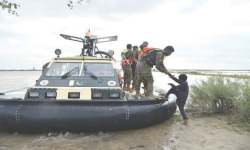
Pakistan Navy has promptly deployed hovercrafts in the flood affected districts of Kashmore, Ghotki, Sukkur and Shikarpur in Sindh, to evacuate affected people. These hovercrafts are capable of operating across land, water and swampy areas. In these districts of Sindh, 4,335 people and over 125 livestock have been successfully evacuated.

Pakistan Navy’s ERTs carried out rescue operation in multiple regions of Pakistan, including Ali Wahan, Alif Kacha, Bachal Shah Miani, village Haji Ghulam Mustafa Jatoi and Soomro Goth in Sukkur, Jam Ali Chachar and KK Bundh in Kashmore, Soomro Panvari in Pano Aqil, Ghumro Goth in Shikarpur and Shank Bund in Ghotki. In addition, Pakistan Navy’s relief and rescue operations are also ongoing in Kasur, Rajanpur, Dera Ismail Khan, Mirpur Khas, Sanghar ,Sujawal، Buner,Shangla and Mingora.

Stranded individuals were transported to safe locations with the assistance of Pakistan Navy hovercraft and boats. Alongside evacuating residents, the teams ensured safe transfer of household belongings and fertilizer stocks. Pakistan Navy’s relief teams are also providing food supplies, healthcare services and vital medicines to flood affected communities. These operations are conducted in close coordination with local civil administration to ensure smooth execution of rescue and relief activities.

The timely and swift rescue missions are a reaffirmation of Pakistan Navy’s resolve to stand firm with the nation, remaining committed to relentless relief efforts until the safety of every affected citizen is ensured.
 
PN has no destroyer plans
Hello sir,

I dont think going for destroyers is going to change much. Having 64 VLS Heavy frigates or light destroyers in range of 4500 to 5000 ton is better.
 
PN has no destroyer plans
There was a brief debate I had with a former head of PN programs, whose exact title escapes me, but he also served as Ambassador to a close neighboring country.

The core of the discussion was about the role of surface vessels versus submarines, combined with missile boats and A2/AD (Anti-Access/Area Denial) strategies.

The key point is that PN’s primary focus for surface ships lies in peacetime roles such as projection of power, diplomacy, force involvement, and anti-submarine warfare (ASW).

Surface combatants serve dual functions in conflict scenarios. They can act as "bait" to provoke enemy engagement while simultaneously serving as vital sensors to provide targeting information for other assets in the system.

During peacetime and low-intensity operations, surface combatants have a near-dominant role in presence missions and operational responsibilities.

However, in wartime or high-intensity environments, in a broader integrated system, surface combatants are deliberately employed as less valuable and more dispersed units.

This dispersion minimizes risk to key assets while complementing a potent submarine fleet and missile boats, creating layered defenses and offensive kill zones.

The combined effect is to snare the Indian Navy (IN) into pre-planned kill zones, leveraging submarines' stealth and missile boats' striking power supported by surface ships acting as sensors and engagement triggers.

Given Pakistan’s limited defense budget, challenging geography, critical sea lines of communication (SLOCs), and the relative size and capability of the Indian Navy, this integrated approach is highly effective when executed properly.

Pakistan’s constrained resources make it impractical to match India ship-for-ship or technology-for-technology in conventional surface combatants. Instead, focusing on a combined system of dispersed surface combatants, missile boats, and a strong submarine fleet maximizes cost-effectiveness and leverage.

The geography such as narrow littoral waters, chokepoints, and proximity to key SLOCs amplifies the advantage of stealthy, agile, and surprise attack-capable platforms like submarines and missile boats.

By using surface vessels primarily for peacetime presence, diplomatic signaling, and ASW, Pakistan preserves its limited naval assets and maintains an economy of force.

In wartime, these surface vessels act as sensors and engagement bait to channel the Indian Navy into carefully prepared kill zones dominated by submarines and missile boats. This creates a layered A2/AD bubble that threatens India’s SLOCs and limits their freedom of maneuver.

This approach’s success depends heavily on strong coordination between all branches of the Pakistani military, including the Air Force and Army, as well as overarching strategic alignment in wartime.

C4ISR (command, control, communications, intelligence, surveillance, and reconnaissance) integration, effective logistics, and rapid response capabilities are critical to turning this multi pronged system into a credible deterrent and wartime force multiplier.

Now, no plan survives contact with the enemy - so it’s just a case of execution in ensuring that PNs plan takes less hits versus INs
 
By using surface vessels primarily for peacetime presence, diplomatic signaling, and ASW, Pakistan preserves its limited naval assets and maintains an economy of force.

In wartime, these surface vessels act as sensors and engagement bait to channel the Indian Navy into carefully prepared kill zones dominated by submarines and missile boats. This creates a layered A2/AD bubble that threatens India’s SLOCs and limits their freedom of maneuver.
The destroyers not only provide long range radars and sensors, they have longer range AshMs and can provide effective air cover to remaining surface vessels and sea ports.
 
The destroyers not only provide long range radars and sensors, they have longer range AshMs and can provide effective air cover to remaining surface vessels and sea ports.
They also cost a lot more and need more numbers to be truly assets to protect.
Unless you get them in numbers - and then associate frigates to protect them. They are like Vikrant - a juicy white elephant target.
 
The destroyers not only provide long range radars and sensors, they have longer range AshMs and can provide effective air cover to remaining surface vessels and sea ports.
They are also big juicy targets themselves and since we can't hope to field more destroyers than India, we will always lose a shooting match given equal losses.
 
There was a brief debate I had with a former head of PN programs, whose exact title escapes me, but he also served as Ambassador to a close neighboring country.

The core of the discussion was about the role of surface vessels versus submarines, combined with missile boats and A2/AD (Anti-Access/Area Denial) strategies.

The key point is that PN’s primary focus for surface ships lies in peacetime roles such as projection of power, diplomacy, force involvement, and anti-submarine warfare (ASW).

Surface combatants serve dual functions in conflict scenarios. They can act as "bait" to provoke enemy engagement while simultaneously serving as vital sensors to provide targeting information for other assets in the system.

During peacetime and low-intensity operations, surface combatants have a near-dominant role in presence missions and operational responsibilities.

However, in wartime or high-intensity environments, in a broader integrated system, surface combatants are deliberately employed as less valuable and more dispersed units.

This dispersion minimizes risk to key assets while complementing a potent submarine fleet and missile boats, creating layered defenses and offensive kill zones.

The combined effect is to snare the Indian Navy (IN) into pre-planned kill zones, leveraging submarines' stealth and missile boats' striking power supported by surface ships acting as sensors and engagement triggers.

Given Pakistan’s limited defense budget, challenging geography, critical sea lines of communication (SLOCs), and the relative size and capability of the Indian Navy, this integrated approach is highly effective when executed properly.

Pakistan’s constrained resources make it impractical to match India ship-for-ship or technology-for-technology in conventional surface combatants. Instead, focusing on a combined system of dispersed surface combatants, missile boats, and a strong submarine fleet maximizes cost-effectiveness and leverage.

The geography such as narrow littoral waters, chokepoints, and proximity to key SLOCs amplifies the advantage of stealthy, agile, and surprise attack-capable platforms like submarines and missile boats.

By using surface vessels primarily for peacetime presence, diplomatic signaling, and ASW, Pakistan preserves its limited naval assets and maintains an economy of force.

In wartime, these surface vessels act as sensors and engagement bait to channel the Indian Navy into carefully prepared kill zones dominated by submarines and missile boats. This creates a layered A2/AD bubble that threatens India’s SLOCs and limits their freedom of maneuver.

This approach’s success depends heavily on strong coordination between all branches of the Pakistani military, including the Air Force and Army, as well as overarching strategic alignment in wartime.

C4ISR (command, control, communications, intelligence, surveillance, and reconnaissance) integration, effective logistics, and rapid response capabilities are critical to turning this multi pronged system into a credible deterrent and wartime force multiplier.

Now, no plan survives contact with the enemy - so it’s just a case of execution in ensuring that PNs plan takes less hits versus INs
It's also worth noting that the sensors and munitions themselves have gotten relatively more efficient and smaller. So, if designed well, a 3000-4000-ton design could in theory carry LR-SAMs, but without the added operating costs (due to size) of a larger DDG.

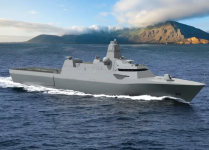
IMO, the PN will shift to procuring new surface combatants at a piecemeal pace, e.g., iterating on JCF by adopting the larger AS3600 platform for later tranches. In fact, I think them switching JCF from CODAD to CODAG is a neat sign of them focusing on efficiency, speed, and tight integrated packages as opposed to pursuing big numbers, be it in fleet size or tonnage.

I wish we hadn't amassed so many surface assets off the tab (e.g., T-Class, B-Class, Y-Class) and, instead, took a step back and designed one core scalable platform via which we rebuild our fleet from scratch.

Basically, think 1 core platform split into 2 families, i.e., an OPV built to commercial standards and an FFG built to proprietary standards, but both around 3,500~4,000 tons. They can use a common module interface, thereby sharing the same sensor, munition, and mission systems, and interchange between them as needed.

We'd also 'decouple' the shipbuilding from the subsystems and weapons, with the latter two integrated into the mission module solution. The typical blue water navy wouldn't even look at this approach, but we're neither blue navy nor typical.

It'd look something like the Damen Crossover series, in some ways:

https://www.damen.com/vessels/defence-and-security/crossovers

1757711575400.png
 
Last edited:
It's also worth noting that the sensors and munitions themselves have gotten relatively more efficient and smaller. So, if designed well, a 3000-4000-ton design could in theory carry LR-SAMs, but without the added operating costs (due to size) of a larger DDG.

IMO, the PN will shift to procuring new surface combatants at a piecemeal pace, e.g., iterating on JCF by adopting the larger AS3600 platform for later tranches. In fact, I think them switching JCF from CODAD to CODAG is a neat sign of them focusing on efficiency, speed, and tight integrated packages as opposed to pursuing big numbers, be it in fleet size or tonnage.

I wish we hadn't amassed so many surface assets off the tab (e.g., T-Class, B-Class, Y-Class) and, instead, took a step back and designed one core scalable platform via which we rebuild our fleet from scratch.

Basically, think 1 core platform split into 2 families, i.e., an OPV built to commercial standards and an FFG built to proprietary standards, but both around 3,500~4,000 tons. They can use a common module interface, thereby sharing the same sensor, munition, and mission systems, and interchange between them as needed.

We'd also 'decouple' the shipbuilding from the subsystems and weapons, with the latter two integrated into the mission module solution. The typical blue water navy wouldn't even look at this approach, but we're neither blue navy nor typical.

It'd look something like the Damen Crossover series, in some ways:

https://www.damen.com/vessels/defence-and-security/crossovers

View attachment 146486
There are other advantages to smaller more dispersed assets operating with a well layered A2/AD net.

If you can network them effectively then you have an adaptive sensor net that can handle losses and protect its key nodes better.

One thing is clear from the recent engagements that Pakistani current ADGE net is not capable of fully fusing everything yet and not all systems talk at the same level of interoperability.

Also the reason Pakistan wants European platforms because they are more open to different integration “api” so to speak compared to Chinese ones which seem to warrant a Chinese infrastructure to be most effective.
 
They also cost a lot more and need more numbers to be truly assets to protect.
Unless you get them in numbers - and then associate frigates to protect them. They are like Vikrant - a juicy white elephant target.
They are also big juicy targets themselves and since we can't hope to field more destroyers than India, we will always lose a shooting match given equal losses.


They are more expensive but more heavily defended too. Their deployment duration is also higher because of more endurance. That means more operational time.

Larger hull means more space for more number of missiles. Capable to engage enemy missiles at longer ranges and basically has more layers of defense.

Arleigh burke has vast number of SM-2/3s, then at close range they have RIM missiles. Because of their size they can incorporate bigger & powerful radars that can track skies at much longer distances. Simiarly these can host powerful EW systems. Its true for European & chinese destroyers.

Actually I used to think just like you guys. But when I see all the destroyer programs across the world and the possibilities of weapons onboard then my views were changed. I also used to think that more dispersed fleet is good. But how good are two light ships which cannot defend themselves properly versus a single heavier ship that has all tools & gadgets to defend itself with compete layered defense and ample number of missiles available to it. Secondly, PN is not even considering dispersal at even bases level. They just have 2 major naval bases. (3 if include Gwadar) . I'd agree to more smaller warships doctrine if Navy would have built tactics around it and there should have been 5,6 bases hosting smaller warships and create a dispersed / networked deployment. It's isn't like that. They use concentrated force.

Larger ships have one most important feature that is more room for future upgrades. You get several choices on VLS / type of missiles / number of missiles / size of missilles when you have ample room. Room for future upgrades enables these to serve for longer in service. Secondly, future weapon systems both the electronic Warfare ones and the laser based weapons are power hungry weapons. Large powerful warships will have significant advantage in future. Even today large powerful flat paneled radars with larger coverage are only possible in larger size warships.

I remember one interview of pn ex-rear admiral who said pn has aspirations for destroyers for future. See below interview from 21:55 for some hints. So, Navy would really love to get hands on destroyers if they ever get the fiscal capacity. In the end, its all related with finances.

To view this content we will need your consent to set third party cookies.
For more detailed information, see our cookies page.


I agree PN do not have an active destroyer aquisition program at the moment. But that does not mean PN don't want it or that destroyers are a juicy target. Destroyers just don't fit with the finances as of now that's the main issue.
 

Users who are viewing this thread

Country Watch Latest

Back
Top