No you are not. Neither is the proverbial blip on the ops screen somehow “live” emulating one sensor nor is the blip on the screen going to be some tea leaves
@side-winder needs to read.
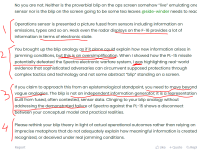
Operations sensor is presented a picture fuzed from sensors including information on emissions, types and so on. Heck even the radar displays on the F-16 provides a lot of information in terms of electronic state.
You brought up the blip analogy as if it alone could explain how new information arises in jamming conditions, but this is an oversimplification. When I showed how the PL-15 missile potentially defeated the Spectra electronic warfare system, I was highlighting real-world evidence that sophisticated adversaries can circumvent supposed protections through complex tactics and technology and not some abstract “blip” standing on a screen.
If you claim to approach this from an epistemological standpoint, you need to move beyond vague analogies. The blip is not an independent information generator; it is a representation built from fused, often contested, sensor data. Clinging to your blip analogy without addressing the demonstrated failure of Spectra against the PL-15 shows a disconnect between your conceptual model and practical realities.
Please rethink your blip theory in light of actual operational outcomes rather than relying on imprecise metaphors that do not adequately explain how meaningful information is created, recognized, or deceived under real jamming conditions.
so until now, you have written at least 6 paras for my at least 6 lines!
I have highlighted few biases (could be survival, sampling and confirmation bias)
that's not productive or output driven or shall I say, trait of someone who precisely and surgically knows what he is talking about!
Point proven?!!!! sure, list 10 more functionalities and look smart and bash some one who is not educated on these matters!
I may lack deep expertise, and my explanations relied on metaphors and analogies, while you appear highly knowledgeable (im not an engineer!). Please read the following carefully:
How was blip speed determined in a specific jamming environment? Which came first: the characterization of the jamming-speed output, or the generation of the blip?
Your writing sometimes reads like the work of someone who has skimmed scientific journals but hasn’t fully engaged with the phenomenon. You give the impression of not being willing to explain the blip in alternative terms. Different interpretations change how concepts are applied; using technical terms without rephrasing them limits practical understanding. A short list of names and specifications does not substitute for a full understanding of system behavior.
Additionally, you seem to assume that a blip’s characteristics are identical across different jamming environments. That assumption requires justification.
I am not claiming Spectra failure. Rather, I am highlighting a piece of information that was previously unrecognized. Yet you keep asserting that “the spectra has not failed” and keep labeling my analogies as vague (I could do the same, line by line for each of yours argument!).
I feel dismissed (and ridiculed). I don’t think a productive conversation is possible under these conditions with you ever because the way you write!
you know a lot probably, I cannot doubt it, you may!
but it does'nt look like that, the way you have written biases in paras!
thats borderline fan boy stuff and not scientific approach!
sorry!
Next time (which wont be any!), try to develop arguments (there are'nt any as shown by highlighting biases!) beyond my analogies. It’s your understanding — so why belittle mine when I’m not even an engineer?
That’s ridiculous and boyish!