Pakistan-Saudi Arabia mutual defense pact: News & Discussion

I said a few days back when this deal was announced, a lot would depend if we took Iran into confidence. I think we may well of done. This is another diplomatic victory for Pakistan and Saudi.. If Iran is saying they welcome this deal, it is basically saying Saudi/Pak have nothing to worry about. Many so called "analysts" in the West and India were predicting a harsh Iranian reaction (or wishing for one). Now basically it is obvious, it is only Israel and India that need worry....

Iran welcomes Pak-Saudi defence deal as start of ‘comprehensive regional security system’

Dawn.com | Reuters Published September 25, 2025 Updated 18 minutes ago

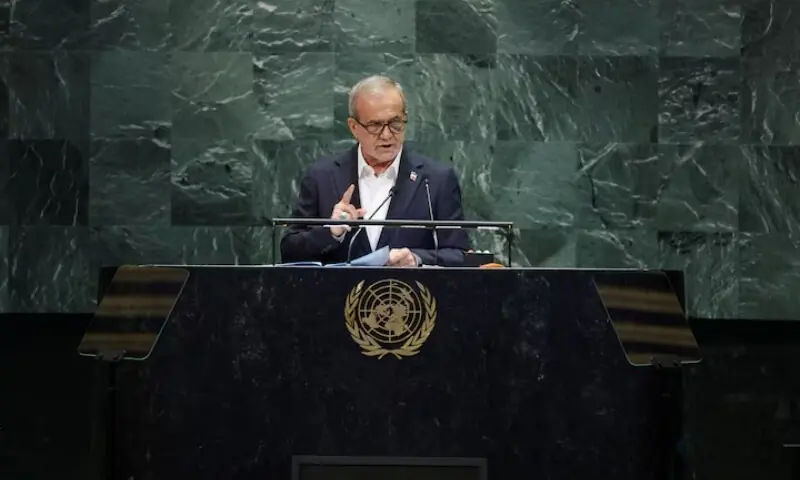
Iran’s President Masoud Pezeshkian addresses the 80th United Nations General Assembly at the UN headquarters in New York, US, Sept 24. — Reuters
Listen to article1x1.2x1.5x
Join our Whatsapp channel
Iranian President Masoud Pezeshkian on Wednesday welcomed the landmark mutual defence deal struck between Pakistan and Saudi Arabia as the beginning of a “comprehensive regional security system”.

ADVERTISEMENT


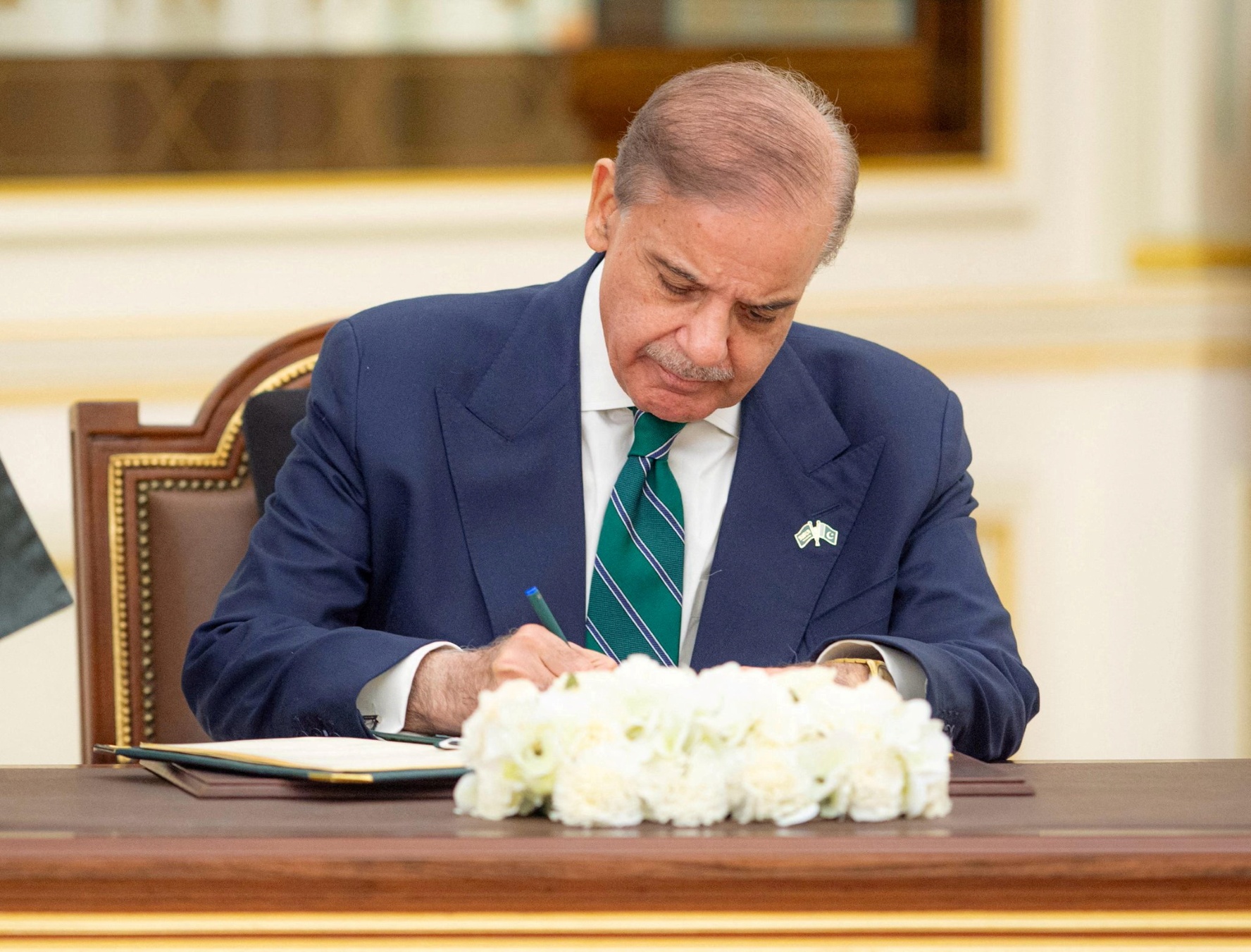
Pakistan and Saudi Arabia entered into a landmark mutual defence agreement, under which any aggression against one state will be considered an attack on both. The pact was signed by Prime Minister Shehbaz Sharif and Saudi Crown Prince Mohammad Bin Salman at the Al-Yamamah Palace in Riyadh last week.

The agreement came amid diplomatic upheaval in the Middle East and just months after a deadly India-Pakistan conflict in May, as well as the 12-day war between Iran and Israel in June.

The Iranian president praised the defence deal while addressing the General Debate of the 80th Session of the United Nations General Assembly (UNGA) today.


“Iran welcomes the defensive pact between the two brotherly Muslim countries, the Kingdom of Saudi Arabia and the Islamic Republic of Pakistan, as a beginning for a comprehensive regional security system with the cooperation of the Muslim states of West Asia in the political security and defence domains,” he said.


Deputy Prime Minister and Foreign Minister Ishaq Dar had hinted on Friday that some countries were showing interest in building strategic defence agreements with Pakistan following the deal.

“It’s premature to say anything, but some other countries want to enter into an agreement of this nature,” FM Dar had told reporters in London, replying to a question about whether other states will join the pact or ink similar deals.

Iran and Saudi Arabia have often been on opposing sides of regional conflicts, including in Syria and Yemen. The two regional heavyweights broke off diplomatic relations in 2016 before re-establishing them in 2023 under a rapprochement deal brokered by China.


The two Muslim countries have since been witnessing warming relations with high-level meetings of their leaders.

Saudi Arabia had condemned the Israeli strikes on Iran in May, calling them “aggressions” and a “clear violation of international laws”. Riyadh had also expressed its “great concern” following the US strikes on Iranian nuclear facilities.

President Pezeshkian also said Iran has no intention to build nuclear weapons, just days before international sanctions could be reimposed on his country over Tehran’s nuclear ambitions.

“I hereby declare once more before this assembly that Iran has never sought and will never seek to build a nuclear bomb. We do not seek nuclear weapons,” Pezeshkian said.

On August 28, Britain, France and Germany launched a 30-day process to reimpose UN sanctions that ends on September 27, accusing Tehran of failing to abide by a 2015 deal with world powers aimed at preventing it from developing a nuclear weapon.

The European powers have offered to delay reinstating sanctions for up to six months to allow space for talks on a long-term deal if Iran restores access for UN nuclear inspectors, addresses concerns about its stock of enriched uranium, and engages in talks with the US

Pezeshkian criticised the move by European powers as “illegal”, saying it was made at “the behest of the United States of America”.

The US, its European allies and Israel accuse Tehran of using its nuclear programme as a veil for efforts to try to develop the capability to produce weapons. Iran says its nuclear programme is for peaceful purposes only.

“In doing so, they (the E3) set aside good faith. They circumvented legal obligations. They sought to portray Iran’s lawful remedial measures … as a gross violation,” Pezeshkian said.

But amid the looming threat of sanctions and last-ditch talks on the sidelines of the UNGA, gaps remain between Tehran and European powers over a deal to avert the snapback of sanctions.

Still, both sides have left the door open to further negotiations. While the E3 says Iran’s clerical rulers have so far failed to meet the conditions it set, Tehran says it will not offer concessions.


Iran’s Supreme Leader Ayatollah Ali Khamenei, who has the last say on key state matters such as foreign policy and Iran’s nuclear programme, has ruled out negotiations with the US under threat.

If Tehran and the E3 fail to reach a deal on an extension by the end of September 27, then all UN sanctions will be reimposed on Iran, where the economy already struggles with crippling sanctions reimposed since 2018 after President Donald Trump ditched the pact during his first term.

The so-called “snapback” process would reimpose an arms embargo, a ban on uranium enrichment and reprocessing, a ban on activities with ballistic missiles capable of delivering nuclear weapons, a global asset freeze and travel bans on Iranian individuals and entities.

Soon after the US and Israeli attacks on Iranian nuclear sites in June, Iran’s parliament passed a law suspending cooperation with the International Atomic Energy Agency (IAEA).

However, the IAEA and Tehran reached a deal on September 9 to resume inspections at nuclear sites and UN nuclear watchdog chief Rafael Grossi said on Tuesday a team of inspectors was on its way to Iran should Tehran and the E3 strike a deal this week to avert revival of sanctions.


Pakistan has been speaking up for Iran

To view this content we will need your consent to set third party cookies.
For more detailed information, see our cookies page.


To view this content we will need your consent to set third party cookies.
For more detailed information, see our cookies page.


On a seperate note, I very much like the Pakistan un ambassador
 
Pakistan has been speaking up for Iran

To view this content we will need your consent to set third party cookies.
For more detailed information, see our cookies page.


To view this content we will need your consent to set third party cookies.
For more detailed information, see our cookies page.


On a seperate note, I very much like the Pakistan un ambassador


Yes, guy is very articulate, calm and to the point.
 
There are no US military/foreign military bases in KSA nor US soldiers other than a few advisors or when there are joint military exercises.

In the region they are based in Israel/Zionist entity, Turkey (NATO), Kuwait, Bahrain, UAE and Qatar on top of my head.

And the US presence in those smaller GCC states, aside from the GCC being one of the most strategic areas (geopolitically and geographically) on earth and richest places on earth, so the US has actively sought a presence in the region, is also, as discussed earlier in this thread, a kind of "security police" of those regimes in regards to KSA who they secretely fear will annex them again as those small nations on their own are not able to survive on their own without outside support and would naturally merge with KSA/the dominant entity in Arabia as has been the case for millennia whether it was ancient civilizations, empires, caliphates, kingdoms, sultanates, emirates, imamates, sheikdoms etc.

For instance I do personally not trust the current UAE (Abu Dhabi) regime and would prefer that they would not join this pact. They are too close to India/Israel, Indians far outnumber locals many times over (another joke and another reason why KSA NEEDS to annex those smaller GCC states eventually) not to mention that UAE is now infested with Zionists and all kinds of hostile elements by design.

If MbS was clever, without committing the faults of Saddam, he should make a deal with world powers, and annex Bahrain (already de facto a part of KSA in many ways) as a start. Then Kuwait and eventually Qatar, UAE and Oman. Afterwards South and East Yemen and eventually unify Arabia fully into one truly powerful entity. Either that or someone else (local) needs to do it in the future for the sake of everyone of us and our children and grandchildren.

In fact a deal with Pakistan in this regard should be made in return for Pakistani military bases in Oman (in order to gain strategic leverage against India and for a greater direct Pakistani role in the Middle East) and other incentatives. Enough of fragmentation in the region that outsiders (West in particular) are taking advantage of.

The humiliating attack on Qatar (for the Al-Thanis) by the Zionists (while hosting the by far largest US base in the region - Al-Udeid) is a confirmation of why the current status quo must change and cannot be taken seriously looking at the bigger picture and the future.

KSA is 10-20 years away from indirectly annexing the GCC fully or forcing other leaderships under its umbrella completely.

If somehow the Houthis/future Yemeni leadership/one untied Yemen and KSA can reach an understanding about the future of Arabia, due to sheer population, size, economics and power, we could jointly shape the region in our own way for the benefit of all. Due to population alone, Kuwait, Bahrain, UAE, Qatar and Oman (less than 10 million locals/citizens overall) cannot survive on their own long-term, no matter the current economic size/sovereign wealth funds and what not. But the world powers, in particular the US and the Zionists (as well as regional Muslim nations, maybe outside of Pakistan), would hate to see that happening. So messed up is our Muslim world of today and leaderships.
This is a very fascinating insight, and a very tricky quagmire given outside influence and rival Arab monarchies


UAE is the middle East outpost for high finance capital, it's fate is linked to the current dollar system in my opinion.
 
Good take by Brookings Institute (Very close to US establishment) and echoes what some of us have been saying on here and highlights parts we have not talked about


The signal and substance of the new Saudi-Pakistan defense pact​


Even those accustomed to dramatic developments in the Middle East and South Asia were caught off guard by the announcement last week by Saudi Arabia and Pakistan of a new “Strategic Mutual Defense Agreement.” The pact, formalized with considerable pageantry in Riyadh on September 17 during Prime Minister Shehbaz Sharif’s visit, went far beyond the platitudes that typically characterize cooperative security announcements. It included a sweeping commitment to mutual defense, and although the text was not released, some officials on both sides—including Pakistan’s own minister of defense—intimated that the deal involved the provision of extended nuclear deterrence.

The pact clearly formalizes and deepens decades of Saudi-Pakistani security and defense cooperation, building on a landmark 1982 protocol agreement. Pakistan, home to one of the world’s largest standing armies, has deployed sizable military forces to the kingdom since the 1970s—at times exceeding 10,000 troops. Pakistani forces helped to defend Saudi territory and holy sites during the 1990-91 Gulf War, and Pakistan has reportedly provided an ongoing rotation of forces in training and advisory roles, estimated today at over 1,500 personnel. Riyadh has reciprocated by periodically extending financial lifelines to Islamabad, including oil and loans during periods of economic stress.

The new agreement’s implications are consequential, given each of the two parties’ own sets of allies and long-standing adversaries. Even at this early stage, the key questions are clear: Where did this deal arise from, and why now? What might it mean for Saudi-Pakistani cooperation in the conventional realm—and how, if at all, will it intersect with persistent debates about nuclear assurances? And what should we watch for over the horizon as the accord is translated into practice?

A timely diversification​

It is tempting to read this new agreement as a direct response to very recent events, particularly the Israeli strike on the Hamas leadership in Qatar. This attack further stoked fears in Riyadh about Israel’s assertive use of force and the United States’ apparent unwillingness to restrain Israel, even when it acts against a key U.S. regional security partner and a “major non-NATO ally.” However, while the strike in Qatar may have been a catalyst for finalizing the deal, the Saudi-Pakistan agreement appears to have been years in the making, and is better understood as an effort by both countries to diversify their defense partnerships and hedge against the evolving risks that they face in the region.

For Saudi Arabia, the impulse for this deal was grounded both in its growing concerns about Israel and its long-standing rivalry with Iran. Tehran’s regional influence has undoubtedly waned over the last year as a result of sustained Israeli and U.S. military pressure, and the dramatic collapse of Bashar al-Assad’s regime in Syria. But Riyadh likely worries that the Trump administration seems to have abruptly lost interest in the Houthi threat, seems to lack a plan following this summer’s 12-day war for dealing with Iran’s nuclear ambitions, and may not be overly invested in countering other vectors of Iranian support in the region.

More broadly, the Saudis are acutely aware of the increasingly capricious nature of U.S. policymaking toward the Middle East; if they have thus far escaped the kind of coercion that President Donald Trump has eagerly directed at other close U.S. security and economic partners, it is only because they have more economic largesse to offer. But as Japan has recently learned, this also makes them a target for heavy-handed dealmaking by Washington.

For Pakistan, the logic is quite different but equally compelling. Ever since the Taliban captured Kabul in the summer of 2021, the Pakistani military leadership has been anxious—for good reason—about the prospect of becoming overly reliant on a single patron: China. The United States’ suspension of military sales and reduction of economic assistance to Pakistan, combined with India’s successful efforts over the last decade to cultivate deeper economic ties with the Gulf Cooperation Council (GCC) countries, left Islamabad isolated. The Pakistani military probably has reason to believe that this pact might institutionalize more sustained and diversified financial support from Saudi Arabia; dampen Riyadh’s engagement with New Delhi on defense, technology, and infrastructure investment; create new opportunities for leverage over India in a bilateral crisis; and demonstrate to its own people and to other countries in the region that it has built a resilient set of partners and is not unduly reliant on China for economic and security assistance.

But what does it mean?​

The announcement raised but did not answer an important question: beyond the signaling and diplomatic maneuvering, what does this deal actually mean for Saudi-Pakistan security cooperation, and how will it be operationalized?

The reality is that we do not yet know. But part of the significance of a pact of this kind is that it creates a structure and an intelligible public logic that can be expanded and systematized by both parties over time. The presence of a mutual defense commitment also creates incentives for both countries to invest in more robust information-sharing, secure communications, and analytic exchanges. In that sense, the structure could prove to be consequential even if there is not yet any “fine print” specifying new cooperative activities.

There is, first of all, considerable scope for cooperation in the conventional defense domain. Pakistan has a highly capable military; as the dominant institution in the country, and one that controls its own budget, it is inclined to generate overcapacity in personnel and capabilities. It thus benefits politically and financially from stationing forces in Saudi Arabia and from advising the Saudi military. These cooperative arrangements might well expand over time through more frequent combined exercises, access arrangements, and embedded advisory roles, especially as Riyadh is in the midst of a long-term effort to build human capital in the defense domain and move away from its reputation as merely a buyer of exquisitely expensive foreign defense materiel.

There may also be a profitable defense industrial angle, though this would likely develop gradually. Saudi Arabia has stated ambitions to localize a greater share of its defense procurement under Vision 2030, which requires partners willing to share technology. Pakistan has coproduced defense systems with China and, as we observed in the India-Pakistan crisis in May 2025, can serve as an operational testbed for sophisticated Chinese equipment.

It is not clear that Riyadh is currently interested in reviving its earlier efforts to procure Chinese arms, particularly in light of its ongoing and protracted negotiations with Washington over a mutual defense agreement. It might, however, look to invest as a financier or a buyer in jointly produced Pakistan-China platforms, or engage directly with the Pakistani industrial base that is developing niche capabilities in several advanced technology areas. To be sure, adding Chinese or Pakistani equipment could complicate Saudi Arabia’s efforts to build the kind of integrated, networked architecture that future warfare demands, but deeper diversification may be judged a tolerable cost if it mitigates the risk of over-reliance on the United States, or if U.S.-Saudi negotiations on a defense agreement stall.


This agreement might also pave the way for Pakistani forces’ more direct involvement in Saudi regional campaigns. A brief history here is instructive: in 2015, when Riyadh sought Pakistani troops for operations in Yemen, Pakistani leaders demurred and engineered a parliamentary resolution to remain neutral. A demurral of that kind would be harder to defend in the wake of a mutual defense pact. Indeed, Pakistan’s military leaders might worry that they would put at risk other dimensions of the bilateral security relationship—or possible Saudi support in an India-Pakistan crisis—if they told their counterparts in Riyadh that a regional conflict such as the one in Yemen unfortunately did not meet the threshold for “mutual defense” assistance.

The nuclear question​

The nuclear implications of this deal are, unsurprisingly, much murkier. Pakistan’s defense minister (who has, unfortunately, proven to be an unreliable narrator of his own government’s intentions) and other unnamed officials in both countries asserted that the mutual defense commitment extends to Pakistan’s strategic assets. But that characterization was quickly walked back by Pakistani commentators, who cast the pact principally as a “show of solidarity” and framed the nuclear dimension as, at most, an exercise in signaling.

We should indeed be careful not to extrapolate operational nuclear cooperation from political statements, particularly as rumors of a secret Saudi-Pakistani nuclear deal have been persistent but unconfirmed for decades. Nevertheless, as Bruce Riedel has eloquently argued, there is in fact a coherent strategic logic to the idea that Pakistan would offer an extended nuclear deterrent to Saudi Arabia, even if the arrangement is contingent. Riyadh has long sought extended deterrence guarantees from Washington, and until and unless such an agreement is consummated, it has good reason to look to Pakistan for some form of nuclear assurance, especially as a hedge against a nuclear Iran. At the same time, Saudi Arabia is pursuing civil nuclear capabilities and will not want to raise non-proliferation concerns that could jeopardize a possible agreement with the United States.

Regardless of what bilateral nuclear understanding is or is not in place, the recent bilateral pact could have strategic implications in two ways. First, ambiguity about the security arrangement’s nuclear dimension generates its own kind of deterrence that could be modestly useful for both parties as they eye current and future adversaries. Second, the agreement could help to foster the kind of institutionalized military and intelligence-sharing structures that make nuclear cooperation more likely over the long run, even if that cooperation remains deliberately opaque.

These nuclear implications are significant, though even an overt nuclear umbrella would alter but not transform the region’s conflict dynamics. Pakistan and Saudi Arabia undoubtedly recognize what recent history underscores: nuclear weapons only deter certain kinds of aggression in certain circumstances. The record of India-Pakistan crises across the sub-conventional and conventional spectrum suggests that nuclear weapons would not deter many of the acute security risks that likely preoccupy Saudi military planners.

Risks and regional ripple effects​

This new deal is valuable for both Saudi Arabia and Pakistan, but it is not without risk.

Another India-Pakistan crisis, especially of the kind that has arisen with troubling regularity over the last two decades, would quickly test the pact’s political elasticity. Riyadh’s instinct would be to stay passive, preserving hard-won trade equities with India while honoring its security obligations to Pakistan. That balance will now be harder to sustain, though Saudi Arabia may take some comfort from the fact that Pakistan has not publicly demanded support from its other principal ally, China, in recent Indo-Pakistani crises. And although an Abraham Accords-style rapprochement with Israel now feels distant, Saudi leaders might find over a longer horizon that deepened defense and possibly nuclear links with Pakistan could complicate their room for maneuver for a future normalization.

For Pakistan, the most immediate operational risk is entanglement. Intensified Houthi activity in the Red Sea and beyond could generate renewed Saudi requests for air defense, maritime security, and defense of critical infrastructure on Saudi soil. Islamabad’s appetite for those missions will be limited by domestic politics, force readiness, and the need to keep capabilities focused on India. Pakistani leaders also need to manage expectations about Saudi largesse; Chinese investment under the China-Pakistan Economic Corridor has noticeably slowed, but Pakistan’s partners in the Gulf, including in Saudi Arabia, have been cautious about financing even the high-profile minerals sector in Pakistan, due in part to economic fundamentals and in part to local security concerns. Moreover, even the perception of a Saudi financial backstop could dampen Pakistan’s incentives to engage in long-overdue structural economic reforms.

Other countries in the region will no doubt be watching carefully to see what kind of practical cooperation emerges from the Saudi-Pakistan accord. India has perhaps the most to lose, as the agreement complicates New Delhi’s notably successful efforts over the last decade to cultivate deeper energy, trade, and diaspora links with Gulf states, while at the same time forging a robust technology and defense industrial partnership with Israel. A visible Saudi tilt toward Pakistan, even if mostly symbolic, sharpens contradictions in India’s “have it all” approach to the region. Furthermore, such a tilt might complicate the U.S.-supported India-Middle East-Europe Economic Corridor (IMEC), which is designed to connect India and Israel via Saudi Arabia and other Gulf partners. India would grow particularly anxious if the Saudi-Pakistan defense agreement were expanded over time to include other Gulf states, though such an arrangement would probably dilute the agreement’s value and exclude even the intimation of extended deterrence.

Ultimately, this deal is important not only for what it portends for the Saudi-Pakistan security relationship but also for what it says about the changing mood in the region. Beyond the predictable and long-standing anxieties that leaders in the Middle East and South Asia hold about U.S. regional policy, there is a sense they are discomfited by deeper trends—the questionable reliability of U.S. security commitments, the return of a more volatile global trading order, and the confusing signals from Washington about whether it will sustain or abandon its competitive approach to China. In this light, countries across the region may rightly view the Saudi-Pakistan pact as a hedge against over-dependence on great powers, and they may well seek out their own strategies to do the same.

 
Fully agreed. This is the way forward.
This is why economic integration/interdependence is a necessary prerequisite; similar to joining the EU. If we can depend on you with our cash, maybe we can depend on you with our lives.

Just look at what Europe achieved this week:
To view this content we will need your consent to set third party cookies.
For more detailed information, see our cookies page.

To view this content we will need your consent to set third party cookies.
For more detailed information, see our cookies page.
 
I think he thought this was a documentary

To view this content we will need your consent to set third party cookies.
For more detailed information, see our cookies page.


America removed pakistans nukes within 3 minutes. You can see how easy it was.....all they needed was around 12 soldiers half of them women.


Still the best one:
To view this content we will need your consent to set third party cookies.
For more detailed information, see our cookies page.
 
To view this content we will need your consent to set third party cookies.
For more detailed information, see our cookies page.
 
India making demands of Saudi....make exception for India


Last comment - no way India will allow Pakistan to get upper hand in middle East

To view this content we will need your consent to set third party cookies.
For more detailed information, see our cookies page.

Could someone please count how many times the word 'PAKISTAN' was mentioned in this conversation..
 
Modi is like .... Kia howa tera wahda 😥
This is a very positive statement from Iran considering how the west presented Iran as a threat to the Arab world to fool them in to buing billions of dollars of useless military equipment from the uS an dothe rwestern countries for the last seven or more decades. Imagine all that wealth spent on the economic development of the arab/muslim world and forming some sort of military alliance.
 
I said a few days back when this deal was announced, a lot would depend if we took Iran into confidence. I think we may well of done. This is another diplomatic victory for Pakistan and Saudi.. If Iran is saying they welcome this deal, it is basically saying Saudi/Pak have nothing to worry about. Many so called "analysts" in the West and India were predicting a harsh Iranian reaction (or wishing for one). Now basically it is obvious, it is only Israel and India that need worry....

Iran welcomes Pak-Saudi defence deal as start of ‘comprehensive regional security system’

Dawn.com | Reuters Published September 25, 2025 Updated 18 minutes ago

Iran’s President Masoud Pezeshkian addresses the 80th United Nations General Assembly at the UN headquarters in New York, US, Sept 24. — Reuters
Listen to article1x1.2x1.5x
Join our Whatsapp channel
Iranian President Masoud Pezeshkian on Wednesday welcomed the landmark mutual defence deal struck between Pakistan and Saudi Arabia as the beginning of a “comprehensive regional security system”.

ADVERTISEMENT


Pakistan and Saudi Arabia entered into a landmark mutual defence agreement, under which any aggression against one state will be considered an attack on both. The pact was signed by Prime Minister Shehbaz Sharif and Saudi Crown Prince Mohammad Bin Salman at the Al-Yamamah Palace in Riyadh last week.

The agreement came amid diplomatic upheaval in the Middle East and just months after a deadly India-Pakistan conflict in May, as well as the 12-day war between Iran and Israel in June.

The Iranian president praised the defence deal while addressing the General Debate of the 80th Session of the United Nations General Assembly (UNGA) today.


“Iran welcomes the defensive pact between the two brotherly Muslim countries, the Kingdom of Saudi Arabia and the Islamic Republic of Pakistan, as a beginning for a comprehensive regional security system with the cooperation of the Muslim states of West Asia in the political security and defence domains,” he said.


Deputy Prime Minister and Foreign Minister Ishaq Dar had hinted on Friday that some countries were showing interest in building strategic defence agreements with Pakistan following the deal.

“It’s premature to say anything, but some other countries want to enter into an agreement of this nature,” FM Dar had told reporters in London, replying to a question about whether other states will join the pact or ink similar deals.

Iran and Saudi Arabia have often been on opposing sides of regional conflicts, including in Syria and Yemen. The two regional heavyweights broke off diplomatic relations in 2016 before re-establishing them in 2023 under a rapprochement deal brokered by China.


The two Muslim countries have since been witnessing warming relations with high-level meetings of their leaders.

Saudi Arabia had condemned the Israeli strikes on Iran in May, calling them “aggressions” and a “clear violation of international laws”. Riyadh had also expressed its “great concern” following the US strikes on Iranian nuclear facilities.

President Pezeshkian also said Iran has no intention to build nuclear weapons, just days before international sanctions could be reimposed on his country over Tehran’s nuclear ambitions.

“I hereby declare once more before this assembly that Iran has never sought and will never seek to build a nuclear bomb. We do not seek nuclear weapons,” Pezeshkian said.

On August 28, Britain, France and Germany launched a 30-day process to reimpose UN sanctions that ends on September 27, accusing Tehran of failing to abide by a 2015 deal with world powers aimed at preventing it from developing a nuclear weapon.

The European powers have offered to delay reinstating sanctions for up to six months to allow space for talks on a long-term deal if Iran restores access for UN nuclear inspectors, addresses concerns about its stock of enriched uranium, and engages in talks with the US

Pezeshkian criticised the move by European powers as “illegal”, saying it was made at “the behest of the United States of America”.

The US, its European allies and Israel accuse Tehran of using its nuclear programme as a veil for efforts to try to develop the capability to produce weapons. Iran says its nuclear programme is for peaceful purposes only.

“In doing so, they (the E3) set aside good faith. They circumvented legal obligations. They sought to portray Iran’s lawful remedial measures … as a gross violation,” Pezeshkian said.

But amid the looming threat of sanctions and last-ditch talks on the sidelines of the UNGA, gaps remain between Tehran and European powers over a deal to avert the snapback of sanctions.

Still, both sides have left the door open to further negotiations. While the E3 says Iran’s clerical rulers have so far failed to meet the conditions it set, Tehran says it will not offer concessions.


Iran’s Supreme Leader Ayatollah Ali Khamenei, who has the last say on key state matters such as foreign policy and Iran’s nuclear programme, has ruled out negotiations with the US under threat.

If Tehran and the E3 fail to reach a deal on an extension by the end of September 27, then all UN sanctions will be reimposed on Iran, where the economy already struggles with crippling sanctions reimposed since 2018 after President Donald Trump ditched the pact during his first term.

The so-called “snapback” process would reimpose an arms embargo, a ban on uranium enrichment and reprocessing, a ban on activities with ballistic missiles capable of delivering nuclear weapons, a global asset freeze and travel bans on Iranian individuals and entities.

Soon after the US and Israeli attacks on Iranian nuclear sites in June, Iran’s parliament passed a law suspending cooperation with the International Atomic Energy Agency (IAEA).

However, the IAEA and Tehran reached a deal on September 9 to resume inspections at nuclear sites and UN nuclear watchdog chief Rafael Grossi said on Tuesday a team of inspectors was on its way to Iran should Tehran and the E3 strike a deal this week to avert revival of sanctions.


The main reason for them to welcome the agreement is because tety have first hand experienced the naked aggression of illegitimate entity and open support by the western world. I hope Turkey, Iran and Egypt also join the alliance and they agree on a framework.
 
So the India attack on Pakistan will be considered attack on Saudi Arabia ?


No Saudi are knee deep in new GCC pack for repatriation of Palestinian in Gaza and rebuilding. Saudi knows what is coming and this time they use Pakistan as there shield . Soon will hear Asim Munir will take charge of Islamic forces in 2027 after retirement of Raheel Sharif. Pak army will may deployed along Turkish army in Gaza.
 
Last edited:
So the India attack on Pakistan will be considered attack on Saudi Arabia ?


No Saudi are knee deep in new GCC pack for repatriation of Palestinian in Gaza and rebuilding. Saudi knows what is coming and this time they use Pakistan as there shield . Soon will hear Asim Munir will take charge of Islamic forces in 2027 after retirement of Raheel Sharif. Pak army will may deployed along Turkish army in Gaza.

Pakistani troops in Gaza? That would be like some prophecy being fulfilled.

Several years ago a prominent person from Pakistan told this story. He went for Umrah to Mecca and met some Palestinians. They asked him when is Pakistan coming to help them. He asked them what they meant. They said that according to their prophecies Pakistan will come to help them and they’re waiting.

It’s uncertain if the Israelis will let the Pakistan army into Palestine because once they get in they’re never leaving. Israelis won’t be able to bomb them and get away with it.
 
  • Like
Reactions: TAC

Users who are viewing this thread

Back
Top