Pakistan-Saudi Arabia mutual defense pact: News & Discussion

What if it is found that the Saudis turned a blind eye to the Israeli air strike in Yemen, while the latter utilized its airspace? What will it mean to the defence pact with Pakistan?

Unlikely to have any impact.

Yemen and Palestine are both with tacit approval of many neighbouring nations. They look the other way or participate indirectly by not acting even when they can.

This behaviour isn’t unique either. Nations forge relationships for their own good and many issues are shoved under the carpet for reaching those pacts.
 
US's estimated financial sector is worth $ 150 trillion and US household net worth is estimated around $ 170 trillion dollars +. So total size is estimated to be over $ 320 trillion dollars. That's a massive size with just $ 38 trillion debt I think? While the Chinese total financial system is around $ 69 trillion dollars. So China has decades to catch up to this. They will however win in economic growth. US economy's size is $ 30 trillion, Chinese at near $ 18 trillion. So in about 20-25 years, China will start to match the US economic size. Then for next 10 years, they will play see-saw, one up and the other one up the next year. Then eventually the Chinese will win and the US will become the second largest economy. US's population and 50 state's combined resources are unmatched by the world and China is a near peer competition only. So net net, after about 40 years, China will permanently take the 1st spot. This analysis includes no world war or large devastations damaging the world order like WWII did.

Where the US in my opinion is already on a loosing streak is their Geo Political strength. That's where China is winning with both hands and even the Europeans are distancing themselves with some US policies specifically the policies towards Israel.
It needs to be backed by wealth - both physical and intellectual. No wonder President Trump has gone "mad" to diversify both. Support to Pakistan has got something to do with it too....
 
The Saudi-Pakistan Deal Upends India's Strategic Thought

Author : Kabir Taneja
Originally Published The Hindu Published on Sep 26, 2025

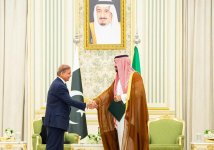
The Riyadh-Islamabad agreement is being downplayed but is one that has wider geopolitical reverberations

1758882868_img-soudi-pakistan.jpg

The announcement by Pakistan and Saudi Arabia of the conclusion of a Strategic Mutual Defence Agreement has, expectedly, rankled nerves in New Delhi. In the statement’s text, the part which says “any aggression against either country shall be considered an aggression against both” has raised concerns and questions alike, specifically over the trajectory of the India-Saudi dynamic.

India has mobilised a global diplomatic effort to isolate Pakistan following the April 2025 terror attack in Pahalgam, Jammu and Kashmir, which led to the largest military exchange between the two countries since 1971. However, an aim to internationally quarantine Pakistan has fallen short. The Saudi-Pakistan deal is another feather in Islamabad’s cap since then.

In May, as Operation Sindoor was launched to militarily target terrorist camps inside Pakistan, diplomats from Saudi Arabia and Iran were in New Delhi as missiles began to fly across the border. Prime Minister Narendra Modi was in Riyadh on an official visit during this period and had rushed back to India due to the terror strike. Saudi Minister of State for Foreign Affairs, Adel al-Jubeir arrived soon after to meet External Affairs Minister S. Jaishankar. But Mr. Adel al-Jubeir’s meeting at the Prime Minister’s Office turned heads, and while both sides remained tight-lipped, Riyadh, in all likelihood, tried to diffuse an escalating situation.

Linked to geopolitical changes​

Beyond South Asia, the events above are also a window into the geopolitical fracas unravelling on multiple fronts in West Asia ever since the terror attack by Hamas against Israel, in October 2023, which has pushed a reorienting of strategic calculation across the wider region. Fast forward to September, and the Riyadh-Islamabad agreement is being downplayed but has wider geopolitical reverberations.

Indian interests are peripheral for Riyadh, but for Pakistan, this deal kill two birds with one stone. It rekindles lost sheen with the Kingdom and challenges New Delhi’s security concerns simultaneously.

The pact is also a return to normal for what was a strained time between the Kingdom and Pakistan, the Islamic world’s only nuclear weapons power. In 2015, the then Nawaz Sharif government had refused to send troops to join Saudi’s campaign against the Iran-backed Houthi militia in Yemen. For decades, the Saudis have seen the Pakistani military, with its extensive real-world experience in warfare — most of which has come against India — as the best force to strengthen its own domestic and regional security. Moreover, with the United States increasingly being viewed as an unreliable military partner in West Asia, Riyadh is back shopping in its traditional stomping grounds. For Islamabad, the nuclear file is once again delivering dividends, albeit more as a matter of chance than design. Nonetheless, its effectiveness has been on display from Washington to Riyadh.

Reports in the western press have suggested that this deal had been in the making for around three years. In a statement, India’s Ministry of External Affairs said that it had been aware that such an agreement was under consideration between the two countries. For long, Pakistan, the only Islamic country in the world with nuclear weapons, has been touted as a supermarket for Riyadh’s potential nuclear requirements. The “12-day war” between Israel and Iran, and both taking turns to launch weapons at Qatar, has further raised the stakes.

The fundamentals are solid​

Beyond the surface, however, the Saudi-Pakistan pact is representative of multiple changes taking place in the international order. First and foremost, there is a false understanding of India’s bulging outreach to West Asia that an institutional wedge can be installed between Islamabad and the Arab states. These bilaterals are based on Islam, ideology, and theological principles. In Saudi and Pakistan’s case, it is a further strengthening around Sunnism. The fundamentals of this relationship are unbreakable. Second, Riyadh is now chasing strategic autonomy, multipolarity, and multialignment, all stated foreign policy aims and theories India wishes to implement as its core tenets to become a major power. This blueprint is aspirational to many others, and often, will put major partner states on the opposite end of Indian strategic interests.

The message for India​

The challenge raised by the Saudi-Pakistan formalisation for the centrality of the ‘Islamic bomb’, a term coined by the Pakistani press in the early 1980s, may not be immense, but is a trailer of how the geopolitical chessboard is being stacked. It also represents a core challenge for India, that its culturally risk-averse strategic thought and the slow pace at which this is changing, are increasingly detached from prevailing realities. The Indian leadership needs to onboard risks that come with both the embrace and mobilisation of power. Else, India risks losing traction if fence-sitting remains the chosen path and there is an adoption of an idealistic view of playing the role of ‘chief pacifist’ chokeholds strategic choices.

The world is being re-shaped and will not wait for what India believes is going to be “its time”. The Saudi-Pakistan pact is Islamabad — and more specifically the Pakistan Army — using disruptions and crevasses in the global and Western order, to its merit. Another opportunity to reshape how the world functions may not return this century. It is now when Indian calculations need to be right and it needs to act with resolve.

 
F-35 or F-22- don't think too much.
It doesn't mean anything for Pakistan.

I had a collection of such pins for my suits - as do most of the PAF folks - looks cool in official gatherings - but don't care much now.
Are you a retired Paf GDP pilot? Or in general associated with PAF ?
 
Two things are the utmost importance for Pakistan and Saudia to build a true future force:

1) 5th gen stealth platform that's their own. Developed between Pakistan and KSA with full TOT. An engine is a part of the deal, not separate.

2) Second strike capability in the shape of a couple of nuclear attack subs. These will be 1000% operated by Pakistan. But will play a huge role in maintaining a sea based offensive capability as a deterrence.
 
If Pakistan and Saudi Arabia are to have a credible deterrence against our enemies then we need a nuclear submarine force. This can happen through Saudi funding and Chinese technical assistance. Pakistan also needs to build H-bombs, thermonuclear weapons and more advanced longer range missiles.

Nuke cruise missiles on regular subs are fine.

We do not need to go all out and have SSNs with ICBMs on board.

Say two Hangors permanantly on patrol with some nuke armed Baburs are enough.
 
Perhaps more relevant to this thread: There was a NY Times article some months ago which said the Trump admin wants to 'carve up' the world into 'spheres of influence' in the old fashioned ways of imperial powers. I called it America's 'Economic Monroe Doctrine'. If that were to materialize then Pakistan benefits greatly while India would be relegated to a middling military power with a big market to exploit.
Is it possible for you to share the link or title of the article?
 
Not known, Saudi support would not really help that much milkitarily, even their Erieyes may not be equipped with Link 17

What matters is diplomatically and Economically we have strgethened Saudi backing
In a war..if Pakistan had the backing of Saudi money coupled with Chinese level of mass production for supplies...
...it would be a Ukraine/Russia type of situation on steroids(in conventional warfare). Russia was much stronger against Ukraine...as compared to India against Pakistan...
...this is all not counting on the threat of nukes ...which serve as an additional deterrent.
 
Source: The Washington Post
https://search.app/8rM4o

Has Pakistan extended its nuclear umbrella. No one will say?
perhaps still being worked on? But surely a detailed comprehensive assessment should be made before anything finalized.

Pakistan must tread carefully. I am fully against any of our nukes leaving our own soil......we must keep them on our own territory
 
If Pakistan and Saudi Arabia are to have a credible deterrence against our enemies then we need a nuclear submarine force. This can happen through Saudi funding and Chinese technical assistance. Pakistan also needs to build H-bombs, thermonuclear weapons and more advanced longer range missiles.
Go smell the coffee ☕
 

Users who are viewing this thread

Back
Top