Chinese 6th Generation Aircraft News & Discussions

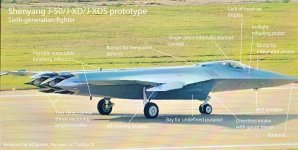
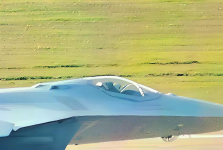
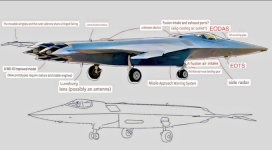
Interesting feature behind the canopy, look like a couple of sensors, but for what? MAWS? DAS? I find the intake design really interesting, not so much of a 'hump' for a DSI solution. And I'm already confused and overwhelmed by how many different sixth gen prototypes are now flying, is it 3? 4?

Noticed that too, it does look like some form of sensor setup. It is interesting(to me at least) that China has adopted a 2 piece canopy layout for this and not a single piece.
 
Last edited:
Noticed that too, it does look like some form of sensor setup. It is interesting(to me at least) that China has adopted a 2 piece canopy layout for this and not a single piece.

Is the J-50 China's first 2D - TVC aircraft for operational use? Dont think anything else has TVC.
The moving wingtip control surface is another unique feature not seen on anything before. There's also evidence that China has developed a seamless stealth coating, especially on the J36, which is flexible and stretches likes rubber, and covers joints and panel gaps. Although I find this at odds with the wingtip controls on the J50, as these would compromise stealth to a degree when moving.
 
The moving wingtip control surface is another unique feature not seen on anything before. There's also evidence that China has developed a seamless stealth coating, especially on the J36, which is flexible and stretches likes rubber, and covers joints and panel gaps. Although I find this at odds with the wingtip controls on the J50, as these would compromise stealth to a degree when moving.

The surface area of the wingtip controls looks small, almost the same size as the typhoon canards. I wonder if these are required/used at high speed, it maybe a solution for low speed handling where ideally you wont be as concerned as stealth?
 
Looks like a J35 without a tail ?
Same company, so it makes sense. (Shenyang)

Even the J-50 seems to be borrowing from the J-20, because again, same company. (Chengdu)
 
To view this content we will need your consent to set third party cookies.
For more detailed information, see our cookies page.

G1uW_HubkAAf15F.jpg
 
It continued with the testing.

To view this content we will need your consent to set third party cookies.
For more detailed information, see our cookies page.
 
It continued with the testing.

To view this content we will need your consent to set third party cookies.
For more detailed information, see our cookies page.

China is in a rush of stealth jet proliferation. Maybe within a single generation, air combat would go back to dogfight with guns.
 
Interesting feature behind the canopy, look like a couple of sensors, but for what? MAWS? DAS? I find the intake design really interesting, not so much of a 'hump' for a DSI solution. And I'm already confused and overwhelmed by how many different sixth gen prototypes are now flying, is it 3? 4?
IMO my bet (purely especulative) It is part of EOTS (360 degree IRST). In that position, the pilot would see any heat emitter from the back and Up from miles away.
 
China is in a rush of stealth jet proliferation. Maybe within a single generation, air combat would go back to dogfight with guns.
Gun era is almost over for any major airforce of the world and within visual range air to air missiles are also for last resort, we are living in era of BVR fights not a gun fight

And did you see a gun on J20?

And there's lots of way to detect stealth jets at long range and your military is already working on these solutions
 
Gun era is almost over for any major airforce of the world and within visual range air to air missiles are also for last resort, we are living in era of BVR fights not a gun fight

And did you see a gun on J20?

And there's lots of way to detect stealth jets at long range and your military is already working on these solutions
If the stealth-ness is good enough, no missile could lock on it. If getting a lock-on requires being very close, you might as well just use guns. :)
 
If the stealth-ness is good enough, no missile could lock on it. If getting a lock-on requires being very close, you might as well just use guns. :)
You have wrong concept of STEALTH, STEALTH DOESN'T MEAN TOTAL 100% INVISIBILITY TO ENEMY RADARS AND SENSORS BUT LO DESIGN IS THE RIGHT TERM (LOW OBSERVABLE) YOU CAN'T HIDE ANYTHING FROM SKY NO MATTER HOW STEALTH DESIGN IS AND HOW ADVANCED YOU DEVELOP RAM (RADAR ABSORBING MATERIALS) STEALTH JETS CAN BE DETECTED AT LONG RANGES USING RIGHT TECHNIQUE AND PROCEDURES
 
Same company, so it makes sense. (Shenyang)
Even the J-50 seems to be borrowing from the J-20, because again, same company. (Chengdu)
This analytical theory may be applicable in the West, but not in China.

Chengdu Aircraft Design and Research Institute.
Codename: Institute 611. Overall design organization for the JF-17/J-10/J-20/J-36.​
Chengdu Aircraft Company Limited.
Codename: Factory 132. Manufacturing plant.​
Shenyang Aircraft Design and Research Institute.
Codename: Institute 601. Overall design organization for the Chinese Flanker series/J-35/J-50.​
Shenyang Aircraft Corporation.
Codename: Factory 112. Manufacturing plant.​
These four institutions collaborate with each other and are independent and equal. They are all first-level subsidiaries of AVIC. In general, we usually think of 611 and 132 as CAC, and 601 and 112 as SAC. But in fact, they are independent and equal institutions, not subordinate to each other.

For general projects, each institution completes them independently.
For key national projects, AVIC headquarters coordinates, with one aircraft design institute taking primary responsibility, and other design institutes providing support. When necessary, research institutes under related group companies, such as AECC and CETC, are invited to join the project team.

In actual production, each factory also collaborates on a division of labor. Certain components of the J-35 fighter jet series are also shipped to SAC after being produced at CAC.

In China, there's no "technological gap" between all relevant companies. If SAC needs it, with approval from AVIC headquarters, they can easily obtain all the J-20 blueprints from CAC. Conversely, CAC can also obtain all the J-35 blueprints. Of course, some degree of competition generally exists between them, but this competition is at the operational level, not at the core technology level.

This is also the fundamental reason for the existence of the AVIC headquarters. It can control the competition and cooperation among China's major aircraft design, research and manufacturing groups at an ideal level. This avoids duplicate development and waste of resources.
 

Users who are viewing this thread

Pakistan Defence Latest

Country Watch Latest

Back
Top