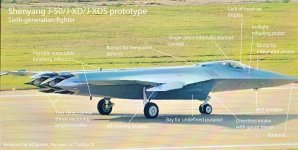
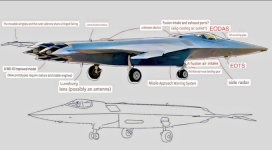
Same company, so it makes sense. (Shenyang)
Even the J-50 seems to be borrowing from the J-20, because again, same company. (Chengdu)
This analytical theory may be applicable in the West, but not in China.
Chengdu Aircraft Design and Research Institute.
Codename: Institute 611. Overall design organization for the JF-17/J-10/J-20/J-36.
Chengdu Aircraft Company Limited.
Codename: Factory 132. Manufacturing plant.
Shenyang Aircraft Design and Research Institute.
Codename: Institute 601. Overall design organization for the Chinese Flanker series/J-35/J-50.
Shenyang Aircraft Corporation.
Codename: Factory 112. Manufacturing plant.
These four institutions collaborate with each other and are independent and equal. They are all first-level subsidiaries of AVIC. In general, we usually think of 611 and 132 as CAC, and 601 and 112 as SAC. But in fact, they are independent and equal institutions, not subordinate to each other.
For general projects, each institution completes them independently.
For key national projects, AVIC headquarters coordinates, with one aircraft design institute taking primary responsibility, and other design institutes providing support. When necessary, research institutes under related group companies, such as AECC and CETC, are invited to join the project team.
In actual production, each factory also collaborates on a division of labor. Certain components of the J-35 fighter jet series are also shipped to SAC after being produced at CAC.
In China, there's no "technological gap" between all relevant companies. If SAC needs it, with approval from AVIC headquarters, they can easily obtain all the J-20 blueprints from CAC. Conversely, CAC can also obtain all the J-35 blueprints. Of course, some degree of competition generally exists between them, but this competition is at the operational level, not at the core technology level.
This is also the fundamental reason for the existence of the AVIC headquarters. It can control the competition and cooperation among China's major aircraft design, research and manufacturing groups at an ideal level. This avoids duplicate development and waste of resources.