Again, how exactly and specifically does attacking Afghanistan hurt India very badly ? Were RAW agents targetted in the attack ?
India would love nothing more than open war between Pakistan and Afghanistan and fighting Pakistan to the last Afghan in exchange for a few hundred million dollars of funding.
Okay lets look at some ground realities that people are ignoring here:
Since mid-2024–2025 Afghanistan remains a major source of illicit opiates and other contraband; trans-border smuggling routes through Pakistan (Khyber, Balochistan/Makran, and Sindh coast) continue to be exploited by criminal networks and sometimes taxed/leveraged by local armed actors.
[Source:
https://www.unodc.org/documents/data-and-analysis/WDR_2025/WDR25_B1_Key_findings.pdf?]
Cross-border militant violence has increased in 2025 with high-profile ambushes and clashes in frontier areas, highlighting an upsurge in capability and activity by groups such as TTP and other insurgents operating along/from Afghan border areas. Islamabad has publicly blamed sanctuaries across the border; Kabul faces international pressure to act.
[Source:
https://www.reuters.com/world/asia-...ved-attack-that-killed-11-soldiers-2025-10-10]
The drug economy remains a major enabler — rising opium/heroin prices and high profits create powerful incentives for smuggling and corruption that indirectly sustain militant logistics. UNODC and other agencies note sharply elevated prices and continued flows.
[Source:
https://www.unodc.org/documents/crop-monitoring/Afghanistan/Afghanistan_Drug_Insights_V4.pdf]
Current Picture - factual anchors:
Recent violence: Pakistani forces reported operations after an ambush that killed soldiers in early October 2025; security operations and cross-border rhetoric have intensified. [Source:
https://www.reuters.com/world/asia-...ed-attack-that-killed-11-soldiers-2025-10-10/]
Narcotics context: UNODC’s 2025 reporting documents continued dominance of Afghan opiates in regional trafficking, with higher prices increasing smuggling incentives; Pakistan remains a major transit route. [Source:
https://www.unodc.org/documents/data-and-analysis/WDR_2025/WDR25_B1_Key_findings.pdf]
Insurgent landscape: TTP has re-emerged as a major national security threat inside Pakistan, while ISIS-K and various local networks remain active in the border region—multiplicity of actors complicates attribution of attacks and links to smuggling networks. [Source:
https://acleddata.com/report/battle-borderlands-tehreek-i-taliban-pakistan-challenges-states-control]
Key drivers:
Economic incentives from illicit economies — record/high opium and heroin prices create financial rewards for smugglers and intermediaries; proceeds can be taxed/used by armed groups. [Source:
https://unis.unvienna.org/unis/pressrels/2025/unisnar1495.htm]
Security vacuums and sanctuary dynamics — porous border areas, uneven control, and local alliances enable militant groups to regroup and operate across the frontier. Recent spikes in attacks indicate these sanctuaries are being exploited.[Source:
https://www.reuters.com/world/asia-...ved-attack-that-killed-11-soldiers-2025-10-10]
Organizational overlap — criminal smuggling networks, patronage networks, and some militant groups have transactional relationships (safe passage, finance, logistics). This blurs lines between pure “criminal” and “terrorist” flows. [Source:
https://www.state.gov/wp-content/up...otics-Control-Strategy-Volume-1-Accessible.pd]
Regional geopolitics — shifting diplomatic relations (e.g., greater external engagement with Kabul) and interstate tensions affect cooperation on border control and counterterrorism.[Source:
https://apnews.com/article/india-afghanistan-taliban-muttaqi-899bac27dee2422e88a54372bdd9efaa]
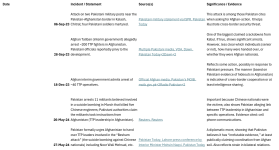
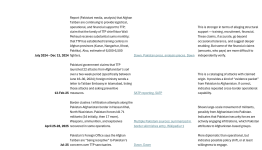
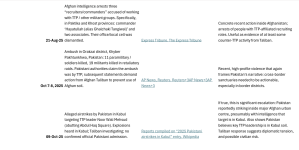
Timeline and Evidence:
Heat Mapping:
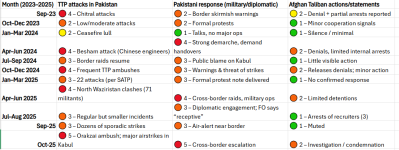 Historic Trend analysis:
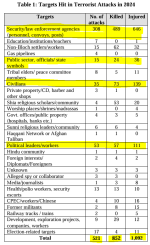 Analysis:
Although terrorist attacks were recorded in all four provinces and the federal capital
in 2024, over
95% of them were concentrated in Khyber Pakhtunkhwa and
Balochistan.
Khyber Pakhtunkhwa recorded the highest number of terrorist incidents in the country in 2024, with 295 attacks that also included five sectarian-related attacks. These attacks claimed 509 lives and left 517 others injured.
Compared to the previous year, the number of terrorist incidents in the province increased by 69%, while fatalities rose by 21%. This indicates that militants not only escalated the frequency of their attacks but also carried out more intense and high-impact attacks during the year under review.
Most of the terrorist activity in Khyber Pakhtunkhwa was concentrated in six southern
districts—
North and South Waziristan,
Bannu,
Tank,
Lakki Marwat, and
Dera Ismail
Khan—which collectively accounted for 171 attacks, or
58% of the total incidents in
the province.
Other significant hotspots included Bajaur, with 34 attacks largely attributed to the Islamic State Khorasan Province (IS-K), and the provincial capital, along with the neighbouring Khyber district, which together witnessed 36 attacks.
Overall, terrorist activity was reported in 22 districts across Khyber Pakhtunkhwa in
2024.
Security and law enforcement personnel, particularly from the army and police,
were the primary targets, accounting for over 68% of the total reported attacks in the
province.
Cross referencing the above attacks with most likely smuggling routes based on data provided by UNODC:
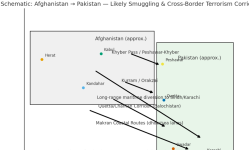
The above schematic is very important to provide a quick snapshot of the main transit and interdictions routes from cross-border smuggling routes - it is also the main route for movement of terrorists into Pakistan.
Borders are managed by "two nations" - Afghanistan as a state has the responsibility to manage her side of the border, a task her "government" has failed at multiple times as the officials inside Kabul do not recognise the Durand line nor the Pakistan/Afghanistan border.
Based on demands by Islamabad they are two main models to be examined here in examining any conflict between Pakistan and Afghanistan:
- Scenario A: Strong Afghan action against TTP
- Scenario B: Afghanistan maintains the status quo
What would Scenario A look like: Afghan authorities move from public denials/limited measures to sustained, visible counter-TTP operations — arrests of senior TTP figures, disruption of logistics and training grounds, plus joint security steps or intelligence-sharing with Pakistan.
Likelihood based on Analysis from Brookings:
Low-Moderate (Source:
https://www.brookings.edu/articles/the-talibans-three-years-in-power-and-what-lies-ahead)
What would Scenario B look like: continued Afghan denials, limited or symbolic actions, constrained enforcement in border areas, and TTP continues to operate with some sanctuary/access to Afghan territory.
Likelihood based on historic monitoring and reporting:
Moderate-High - Reasoning: current reporting and repeated cycles of accusation/limited cooperation point to this being the baseline trajectory. (Source Cited:
https://www.aljazeera.com/news/2024...ns-ties-with-the-afghan-taliban-turned-frigid)
Second-order effects & risks:
Escalation: Pakistan may increase unilateral military actions (air or cross-border strikes), raising the risk of a sustained cross-border confrontation. (Source:
https://warontherocks.com/2025/03/decoding-pakistans-2024-airstrikes-in-afghanistan)
Regional consequences: Increased instability may draw in China (protecting projects/ nationals), or see international pressure on Afghanistan; refugee flows or cross-border displacement could rise. (Source:
https://www.congress.gov/crs-product/R45122)
TTP consolidation: Continued safe haven enables TTP to recruit, plan larger attacks, and potentially coordinate with other militant groups, raising the long-term threat level. (Source:
https://acleddata.com/report/battle-borderlands-tehreek-i-taliban-pakistan-challenges-states-control)
Escalation Trigger timeline:
0–3 months: Status quo continues; occasional big attacks in Pakistan draw loud diplomatic protests. Islamabad signals readiness for action; Kabul issues denials. (
Baseline seen repeatedly through 2024–2025 reporting).
3–9 months: If external pressure + incentives rise (or a political decision in Kabul), limited cooperation or targeted Afghan actions may appear (Scenario A partial realization). Otherwise, continued tit-for-tat (Scenario B).
9–18 months: Path diverges: successful Afghan sustained action could reduce attacks and open security channels;
failure or persistence of status quo increases risk of sustained Pakistani unilateral measures and regional friction.
^ We are here!
Key triggers for widening escalation:
1. A major inside-Pakistan attack with high civilian or foreign national casualties — raises pressure for drastic action.
2. A sudden policy pivot within the Taliban leadership
^ We are here!
TLDR: The status quo within Afghanistan is unsustainable for Pakistan from a security perspective. 


