Chinese PLAAF News

After seeing the new Chinese weapon, Trump fires Pentagon innovation chief
To view this content we will need your consent to set third party cookies.
For more detailed information, see our cookies page.


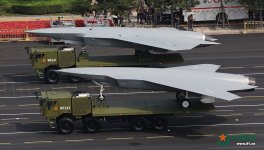
After getting intelligence assessment of China's new weapon lineup for the 3 Sep 80th Anniversary of WW2 Victory Parade - Trump fired the Pentagon Innovation Chief for lack of innovation!During rehearsals for its September 3, 2025, 80th-anniversary parade, China has displayed several new and highly advanced military weapons.

These systems are aimed at showcasing the country's military modernization and serve as a strategic message to potential rivals, particularly the United States.New Weapon Systems DisplayedBased on reports and leaked images from rehearsals, the new and upgraded weapon systems include: * Hypersonic Missiles: This is the most significant category of new weapons. Several new missiles from the YJ series were spotted, including the YJ-17, YJ-19, and YJ-20.

These missiles are believed to be hypersonic, with one reportedly having a hypersonic glide vehicle similar to the existing DF-17. Their ability to fly at more than five times the speed of sound and maneuver in flight makes them extremely difficult to intercept by current missile defense systems. * New Ballistic Missiles: An armored vehicle carrying a massive missile canister was seen, which analysts believe could be a new road-mobile intercontinental ballistic missile (ICBM) system. The design suggests either a new system or a major upgrade to an existing one, indicating an expansion of China's strategic deterrence capabilities. *

Unmanned Systems: China is putting a strong emphasis on unmanned warfare. The parade rehearsals have included: * Extra-Large Unmanned Underwater Vehicles (UUVs): These torpedo-shaped drones are significantly larger than existing models, posing a new threat for naval operations. * Unmanned Tanks: A new tank with a 105mm main gun and an unmanned turret has been seen. The crews were reportedly wearing augmented reality helmets, signaling the integration of human-machine combat systems. *

Drones and Counter-Drone Systems: The parade will feature a range of new drones and ground-based vehicles equipped with laser weapons and other systems designed to take out enemy drones.Implications for the United StatesThe display of these new weapons has significant implications for U.S. military strategy and the balance of power, particularly in the Indo-Pacific region. * Countering U.S. Naval Power: The new hypersonic and anti-ship missiles (YJ series) are a direct threat to U.S. naval assets, especially aircraft carriers, which are the cornerstone of American power projection.

These weapons are a key component of China's anti-access and area denial (A2/AD) strategy, which aims to prevent U.S. forces from operating effectively in a potential conflict over Taiwan or in the South China Sea. * Strategic Deterrence: The potential new ICBM system, along with the rapid expansion of China's nuclear arsenal, is a clear signal that Beijing is moving toward a more robust and survivable nuclear deterrent. This could degrade the credibility of the U.S.'s "extended deterrence" commitments to its allies in the region, such as Japan and South Korea, by raising the risk of nuclear escalation in a conflict. * Shifting Warfare Dynamics: The focus on unmanned systems, from sea drones to autonomous tanks, indicates that China is preparing for a new era of warfare that leverages AI, robotics, and integrated combat networks. This poses a challenge to the U.S. military, which must now contend with adversaries capable of overwhelming traditional defenses with large numbers of sophisticated, low-cost autonomous weapons. * Psychological and Deterrent Effect: Beyond their technical capabilities, the public display of these weapons is intended to be a psychological tool. China's message is one of transparency aimed at intimidation. The goal is to project an image of overwhelming strength to deter potential adversaries and weaken their resolve to intervene in a conflict, thereby "winning without fighting."Anyone wants to apply for the job of Pentagon Innovation Chief? Please write directly to [email protected] directly with your CV


First of all, America or any nation can't do anything about the Chinese dynamic industrial base. In current times, computerized automated manufacturing has become a standard in China and mass production is the word. So firing Pentagon's innovation chief is not the core issue. The fact is, Chinese manufacturing competes with the entire world. Second aspect is R&D, China now spends the most after the US for R&D. This is the second fact one can't deny.

Third fact is, China's rise militarily has been since the 2000's. Post 2000, the world saw advancement in tech, essentially tech built on new designs and computing power much faster than humans ever produced before, using Rare Earth Mineral.

So fast forward to today, China's almost entire defense industry is built on the current modern hi-tech standards, while, the US and others have their established militaries running for the past 80 years. And there is a lot of old-tech weapon's baggage for those years that can't just be retired. They are doing upgrades, but you can't beat a nation with the largest manufacturing base building everything on today's tech standards. That's near impossible.

Now to grow American Robotic warfare capabilities, I see Elon Musk jumping in and his SpaceX and a few others becoming prime contractors for future warfare tech. Musk already called Pentagon's generals stupid for building more F-35's because in his opinion, for the cost of 1 F-35, you could build over two dozen stealth fighter drones. But Trump didn't listen to him. Now these voices will be heard, funding will be allocated quickly and a massive transformation will start
 
First of all, America or any nation can't do anything about the Chinese dynamic industrial base. In current times, computerized automated manufacturing has become a standard in China and mass production is the word. So firing Pentagon's innovation chief is not the core issue. The fact is, Chinese manufacturing competes with the entire world. Second aspect is R&D, China now spends the most after the US for R&D. This is the second fact one can't deny.

Third fact is, China's rise militarily has been since the 2000's. Post 2000, the world saw advancement in tech, essentially tech built on new designs and computing power much faster than humans ever produced before, using Rare Earth Mineral.

So fast forward to today, China's almost entire defense industry is built on the current modern hi-tech standards, while, the US and others have their established militaries running for the past 80 years. And there is a lot of old-tech weapon's baggage for those years that can't just be retired. They are doing upgrades, but you can't beat a nation with the largest manufacturing base building everything on today's tech standards. That's near impossible.

Now to grow American Robotic warfare capabilities, I see Elon Musk jumping in and his SpaceX and a few others becoming prime contractors for future warfare tech. Musk already called Pentagon's generals stupid for building more F-35's because in his opinion, for the cost of 1 F-35, you could build over two dozen stealth fighter drones. But Trump didn't listen to him. Now these voices will be heard, funding will be allocated quickly and a massive transformation will start
Good point, people need to realise alot of US Navy and air force jets are using 1980s and 1990s stuff, yes advanced up until the 2010s, but now with advances in AI and GAN, the US has outdated avionics and radar. Heck, even the ships are like 40 years old rust buckets. China paints our ships with a new nano anti rust layer, US is still using paint standards from the 80s.. FFS, minuteman is controlled using a 1980s computer.
 
China now stands at the forefront of aerospace development with multiple gee-whiz prototypes like this one successfully tested.


China unveils VTOL drone that looks like UFO ‘Gimbal’ spotted by US Navy pilots​

Chinese scientists successfully test drone which resembles a flying spindle and represents a radical change in aerodynamic design​

Stephen Chenin Beijing

Published: 2:21pm, 29 Aug 2025|Updated: 3:00pm, 29 Aug 2025

In 2015, a US Navy F/A-18 pilot flying off the East Coast with the aircraft carrier USS Theodore Roosevelt encountered something inexplicable: an unidentified flying object shaped like a spindle, hovering above the clouds with no visible means of propulsion.

Encoded as “Gimbal”, the footage – officially declassified in 2021 – ignited global speculation about unidentified aerial phenomena and prompted serious questions about advanced aerospace technology beyond known military capabilities.

Now, nearly a decade later, scientists in China have unveiled and successfully tested a vertical take-off and landing (VTOL) drone whose form bears a striking resemblance to that enigmatic object. While still at an experimental stage, this new aircraft represents a radical change in aerodynamic design that could improve endurance, stability and multi-mission versatility in uncrewed flight.

Unlike most drones, this new vehicle’s airframe is centred around an elliptical, ringlike wing that integrates a straight central wing section, forming a closed-loop structure.

Four rotors are mounted at junctions between the elliptical wings and vertical stabilisers – serving both as lift generators and structural reinforcements.

At a distant glance, it resembles a flying spindle rather than a conventional fixed-wing or quadcopter drone.

The seemingly fantastical form is carefully calculated, according to the project team led by Professor Liu Zhanhe with the Zhengzhou University of Aeronautics.

The spindle-shaped UFO “Gimbal” spotted by US Air Force pilots. Photo: Handout

The spindle-shaped UFO “Gimbal” spotted by US Air Force pilots. Photo: Handout

The vertical fin extends above and below, anchored into the ring wing and blending into the fuselage. This not only houses avionics and payloads but also helps in lateral stability during hover.

Beneath the smooth outer shell, an engineered flow field is at work. High-pressure zones under the lower forewing are channelled ahead of the horizontal tail, creating a stable airflow that boosts control authority even at high angles of attack.

Meanwhile, the horizontal stabiliser, mounted at the wingtips rather than the fuselage, avoids turbulent inner-wing wake, improving lift and control efficiency. The entire structure – blended, continuous and load-sharing – maximises structural integrity while minimising parasitic weight.

“It has the best of both worlds from multi-rotor and fixed-wing aircraft,” wrote Liu and his colleagues in a peer-reviewed paper published in the Chinese-language journal Experimental Technology and Management in June.

For decades, aircraft designers have faced a fundamental trade-off: vertical take-off and landing capabilities offer unmatched operational flexibility, but fixed-wing flight delivers the range and efficiency drones need for meaningful missions. Most VTOL drones sacrifice one for the other.

This new design appears to bridge the gap. During take-off and landing, all four rotors provide stable, precise hover – ideal for operations from ships, uneven terrain or even water surfaces.

Once airborne, the vehicle transitions smoothly into forward flight. The elliptical hybrid wing generates substantial lift through a combination of circulation control and enhanced pressure differential.

A close-up look at the Chinese VTOL drone. Photo: Zhengzhou University of Aeronautics

A close-up look at the Chinese VTOL drone. Photo: Zhengzhou University of Aeronautics

Computer modelling suggests extraordinary flight performance: the lift curve slope of the elliptical wing is over twice as high as that of a conventional straight wing. This means it produces lift more efficiently across a broader range of angles, delaying stall and enabling stable flight at low speeds and high attack angles – critical for some military applications.

More than just an aerodynamic curiosity, this drone is built to perform, according to the project team.

Its robust structure allows it to carry a range of modular payloads such as high-resolution sensors, thermal imagers, life-saving equipment, emergency supply pods and atmospheric samplers.

It can launch from a mountain ridge, fly long distances on a single charge, sample water quality during an environmental crisis and return, operating reliably in complex terrain, coastal zones and maritime environments where traditional drones falter.

In addition to military use such as battlefield surveillance, the drone “holds significant potential for other applications, such as continuous multipoint water quality sampling over water surfaces, rapid material delivery on water and emergency water rescue operations”, they added.

Some similar designs have been proposed in the past, but most of them remained on paper. Some critics argued that the spindle-like shape would generate excessive drag and instability.

Flying taxis, airships and drones: the rise of China's low-altitude economy

Flying taxis, airships and drones: the rise of China's low-altitude economy

Liu’s team conducted multiple test flights in various locations. After a smooth, controlled vertical ascent, the drone transitioned into forward flight – accelerating with surprising force, wings generating considerable lift.

Post-flight analysis confirmed the lift coefficient exceeded that of conventional wings. The 116.19 per cent gain in lift curve slope was validated in real-world conditions. Even at high angles of attack, airflow remained attached, thanks to the ring wing’s ability to manage vortices and delay separation.

But the drone does have limitations, mainly aerodynamic drag.

The researchers said they were looking to refine the airframe’s streamlined profile – smoothing sharp edges and corners to reduce pressure drag, and fine-tuning the elliptical wing’s curvature and aspect ratio to maximise the lift-to-drag ratio.

Flight control algorithms would also need to be optimised to minimise unnecessary attitude adjustments that generate induced drag.

Chinese scientists have proposed other radical designs for VTOL drones, including a more streamlined version that can be launched from almost any warship.


How China plans to lead the fighter jet race​

To view this content we will need your consent to set third party cookies.
For more detailed information, see our cookies page.
 
While it's true that China has taken over the world in aircraft design and manufacturing (and manufacturing in general), there are other issues that still impact it's superiority.

1) The US is building F-35's in thousands. China has to catch up with the US to create parity.

2) There are nearly 5000 combat jets the US military has. All 4+ generation. With some upgrades, they will possess the latest radars and long range missiles that are currently designed for 5th gen jets.

China needs nearly 4000 fighter jets before it can have parity.

3) US is working on next generation of Satellite and Space warfare. If you noticed, they've not bought any E-7's and still using 40 year old E-3 AWACS systems, although upgraded. We know today, half the war is based on electronic warfare capability. So what does this mean? It means the US is putting all it's electronic warfare components in space so the data and capability is readily available across the world in any conflict zone real time. China is still behind here also.

4) US has a network of allies, China is a standalone nation. If China doesn't want to build allies for wars, that's fine. But it must build an eco-system of foreign military sales to generate additional revenue and fund modern technology. China has the money to do it alone, but what she really needs are partner nations like Pakistan, in its influence. Strategic value of this goes far beyond. This is soft power.

So yes, it looks like China is making a lot of advancement. It's ahead of the rest of the world, even Europeans. But lacks far behind the American military and its soft power.
5) China still lags behind the west in engine manufacturing. Hst it has made great improvements in the reliability of it's engines.
 
2025/10/02: A PLAAF 4th Gen J-16 intercepted and drove off two 5th USAF Gen F-22s near China coast.

Except for its ASEA radar, the F-22 is a 4th Gen fighter, less advanced than the J-16.

The J-16 locked onto the F-22s within 10 sec. Unable to break radar lock, the F-22s fled.

Additional details of the humiliating interception of two USAF F-22s by a single PLAAF J-16 that the US Department of War has understandably refused to make public.
To view this content we will need your consent to set third party cookies.
For more detailed information, see our cookies page.
 

Just 90 Miles From India’s Sikkim, China Deploys J-20’s Stealth Buddy, GJ-11 Sharp Sword Drone At Shigatse​

By Sumit Ahlawat
-October 14, 2025

In a new headache for India, China has boosted its air power near the contested Line of Actual Control (LAC). Following the deployment of fifth-generation J-20 fighter jets, Beijing has now reportedly deployed its stealthy flying-wing uncrewed combat air vehicles (UCAV), the GJ-11 Sharp Sword, near the border with India’s Sikkim.

Worryingly, the stealthy GJ-11 Sharp Sword could partner the J-20 in a Manned-Unmanned Teaming (MUMT) format.

Furthermore, the stealthy drone could penetrate contested airspace and perform a variety of missions, including Intelligence, Surveillance, and Reconnaissance (ISR), Electronic Warfare (EW), jamming enemy air command and control centres, and air-to-surface and air-to-air strikes.

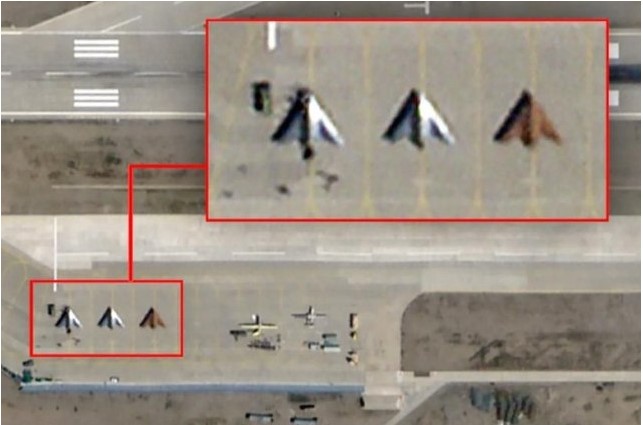
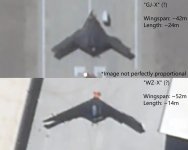
According to satellite imagery from the open-source intelligence platform Planet Labs, three GJ-11 Sharp Sword flying-wing UCAVs were deployed at the Shigatse Air Base in China’s Tibet Autonomous Region between August 6 and September 5.

Notably, the Shigatse Air Base in Tibet is situated just around 90 miles northeast of the boundary with India’s Sikkim state.

The sensitive area has seen multiple armed clashes over the years.

Screenshot-2025-10-13-164753.jpg


Satellite imagery showing the GJ-11 Sharp Sword at the Shigatse Air Base. Credits Planet Labs.

In September 1967, India and China fought one of their bloodiest armed confrontation at Nathu La pass in Sikkim, in which 65 Indian soldiers were killed. On the Chinese side, 300 to 400 soldiers were killed, according to Indian sources; however, independent sources placed the figure of PLA soldiers killed at around 200 to 300.

Just one month later, in October 1967, clashes erupted again at the nearby Cho La Pass, in which nearly 40 Chinese soldiers were killed. India prevailed in both these confrontations, boosting the morale of the Indian military following the setback in the 1962 Sino-India war.

A tenuous peace prevailed for nearly four decades before tensions erupted again in 2017. A two-month-long military standoff followed in the Dokhlam plateau, near the tri-junction area where the borders of India, China, and Bhutan converge.

Again, minor clashes in the Sikkim sector were reported following the Galwan clash in June 2020.

For India, the area is crucial, as it overlooks the strategic ‘Silliguri Corridor,’ also known as the Chicken’s Neck, a narrow strip of land connecting mainland India with its Northeastern states.

The deployment of China’s most advanced stealth fighter jets and drones near the Sikkim border is a worrisome signal for India, suggesting that, despite the recent thaw in India-China relations, New Delhi cannot let its guard down on the nearly 3,488-km-long LAC.


The GJ-11 Sharp Sword UCAV

The GJ-11 Sharp Sword UCAV has been in development for over a decade. A substantially non-stealthy version of the drone flew in 2013.

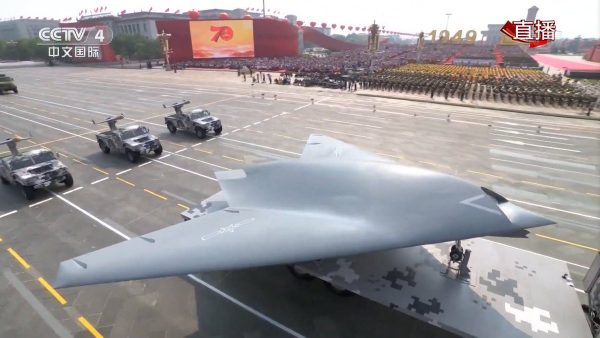
The stealthy version of the GJ-11 was first officially revealed in an October 2019 military parade marking the 70th anniversary of the People’s Republic of China (PRC) (or the National Day) and has been widely believed to rival the US stealth RQ-170 Sentinel drone.

Developed and manufactured by AVIC, the first photos were only top and side views of the drone, which was mounted on a truck during the parade.


GJ-11
via X
Subsequent photos of a scale model in September 2021, taken during an air show in China, revealed its two internal belly weapons bays open between the side landing gears.

“Each bay has four ammunition, which look like guided precision air-to-ground glide bombs. Experts said that the drone would likely carry multiple types of precision ammunition, including larger ones that were not displayed at the air show,” a Global Times report had then pointed out.

It further quoted military aviation expert Zhang Xuefeng, who said the flying-wing-shaped drone had high stealth and subsonic cruise capability, coupled with extended range. Narrators on CCTV during the parade said that the GJ-11’s primary mission would be to conduct deep-penetrating strikes against critical targets.

The “GJ” in the designation, which also means ‘gonji’ (Chinese for ‘attack’), is another indication that the UCAV’s primary role is strike-oriented.

The stealthy UCAV was also displayed during the September 3 military parade in Beijing this year.

Notably, the GJ-11 UCAV is also optimized for carrier-capable operations.

Chinese military aviation expert Andreas Rupprecht posted a picture in December 2023 that showed a land-based mock aircraft carrier facility in Wuhan. That facility had dummies of the J-15, J-35/J-31/FC-31 Gyrfalcon, KJ-600, and a GJ-11 on the flight deck.

To view this content we will need your consent to set third party cookies.
For more detailed information, see our cookies page.


Another People’s Liberation Army (PLA) expert, Rick Joe, called it a “near confirmation” that a “flying wing UAV/UCAV is intended for carrier aviation.”

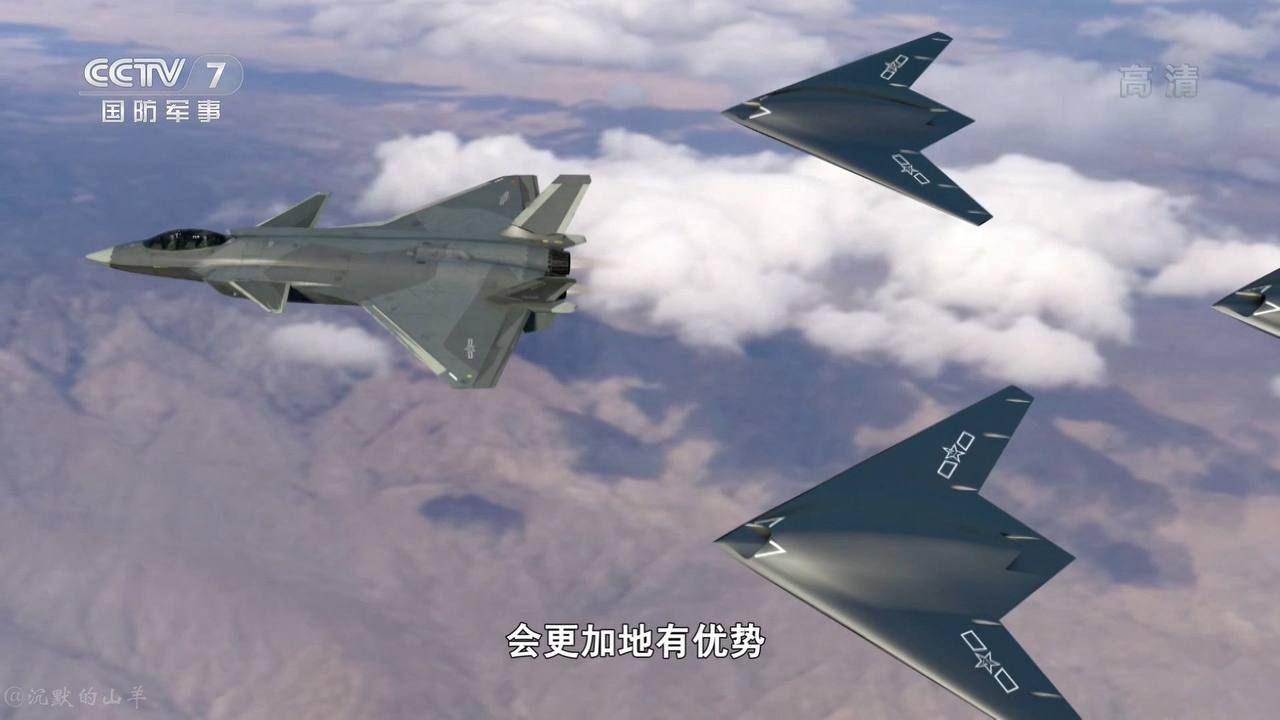
Another possible role would be flying alongside the J-20 stealth fighter as a part of a manned-unmanned team. Screen grabs from an October 2022 digital representation on China Central Television (CCTV) showed J-20s and H-6K strategic bombers controlling wingman drones, and the drones in the video were GJ-11s.

J-20 GJ-11 Manned Unmanned Teaming wingman concept
J-20 GJ-11 Manned Unmanned Teaming wingman concept.
The deployment of these drones at the Shigatse Air Base in Tibet suggests that the stealthy UCAV is nearing operationalization.

The GJ-11’s Stealthy Features

The GJ-11 UCAV has a flying-wing design optimized for stealth.

A flying-wing UAV (Unmanned Aerial Vehicle) is a type of drone with a tailless, fixed-wing configuration, where the aircraft’s body generates lift, resembling a single large wing without a distinct fuselage or traditional tail section.

This concept draws on aerodynamic principles pioneered in manned aircraft, such as the Northrop B-2 Spirit bomber, and adapts them for unmanned systems.

Furthermore, the UCAV features an internal weapons bay. The lack of a tail, protruding parts, and smooth contours ensures a low Radar Cross-Section (RCS).

Additionally, the UCAV features a flat exhaust nozzle, which is typically used to reduce its infrared signature.

According to reports, the UCAV has an RCS of less than 0.05 square meters.

China’s Rising Air Power At The Shigatse Air Base

The Shigatse Air Base in Tibet is situated just around 90 miles from India’s Sikkim.

The air base features one of the world’s longest airstrips, stretching approximately 16,404 feet (5,000 meters).

In 2017, as India and China clashed on the nearby Doklam plateau, China constructed an additional 9,840-foot (3,000-meter) auxiliary runway with seven large aircraft parking spots.

China has also deployed its stealth J-20 fighter jets on the airbase. In a satellite image from May last year, six J-20 fighter jets were spotted on the Shigatse Air Base.

To view this content we will need your consent to set third party cookies.
For more detailed information, see our cookies page.


According to media reports, China is also constructing an expanded apron and at least five hangars at the air base.

Apart from the fifth-generation J-20, satellite imagery from the air base has also confirmed the presence of J-10Cs, airborne early warning and control aircraft, helicopters, and stealthy drones.

Shigatse was also reportedly the first air base to operate the high-flying WZ-7 Soaring Dragon reconnaissance drone.

China’s infrastructure and air power buildup at the Shigatse air base is a clear warning signal for India, given the history of violent clashes between the two countries in the Sikkim sector.

However, India is not sitting idle either. The Indian Air Force’s base in Hasimara, West Bengal, hosts the IAF’s second squadron of 16 Rafale fighter aircraft. These Rafales are tasked with defending the Himalayan frontier over Eastern India.

Besides, India has also deployed the Su-30 MKI near the LAC.

According to reports earlier this year, India has also deployed one squadron of the S-400 air defense system near the LAC in the Sikkim sector.

China’s deployment of advanced stealth drones at the Shigatse air base could be a response to India’s deployment of S-400 near the border.
 
However, India is not sitting idle either. The Indian Air Force’s base in Hasimara, West Bengal, hosts the IAF’s second squadron of 16 Rafale fighter aircraft. These Rafales are tasked with defending the Himalayan frontier over Eastern India.

Besides, India has also deployed the Su-30 MKI near the LAC.

According to reports earlier this year, India has also deployed one squadron of the S-400 air defense system near the LAC in the Sikkim sector.

China’s deployment of advanced stealth drones at the Shigatse air base could be a response to India’s deployment of S-400 near the border.
Counter deployment by both sides. Likely in response to the S400 deployment.
 
Last edited:

Just 90 Miles From India’s Sikkim, China Deploys J-20’s Stealth Buddy, GJ-11 Sharp Sword Drone At Shigatse​

By Sumit Ahlawat
-October 14, 2025

In a new headache for India, China has boosted its air power near the contested Line of Actual Control (LAC). Following the deployment of fifth-generation J-20 fighter jets, Beijing has now reportedly deployed its stealthy flying-wing uncrewed combat air vehicles (UCAV), the GJ-11 Sharp Sword, near the border with India’s Sikkim.

Worryingly, the stealthy GJ-11 Sharp Sword could partner the J-20 in a Manned-Unmanned Teaming (MUMT) format.

Furthermore, the stealthy drone could penetrate contested airspace and perform a variety of missions, including Intelligence, Surveillance, and Reconnaissance (ISR), Electronic Warfare (EW), jamming enemy air command and control centres, and air-to-surface and air-to-air strikes.

According to satellite imagery from the open-source intelligence platform Planet Labs, three GJ-11 Sharp Sword flying-wing UCAVs were deployed at the Shigatse Air Base in China’s Tibet Autonomous Region between August 6 and September 5.

Notably, the Shigatse Air Base in Tibet is situated just around 90 miles northeast of the boundary with India’s Sikkim state.

The sensitive area has seen multiple armed clashes over the years.

Screenshot-2025-10-13-164753.jpg


Satellite imagery showing the GJ-11 Sharp Sword at the Shigatse Air Base. Credits Planet Labs.

In September 1967, India and China fought one of their bloodiest armed confrontation at Nathu La pass in Sikkim, in which 65 Indian soldiers were killed. On the Chinese side, 300 to 400 soldiers were killed, according to Indian sources; however, independent sources placed the figure of PLA soldiers killed at around 200 to 300.

Just one month later, in October 1967, clashes erupted again at the nearby Cho La Pass, in which nearly 40 Chinese soldiers were killed. India prevailed in both these confrontations, boosting the morale of the Indian military following the setback in the 1962 Sino-India war.

A tenuous peace prevailed for nearly four decades before tensions erupted again in 2017. A two-month-long military standoff followed in the Dokhlam plateau, near the tri-junction area where the borders of India, China, and Bhutan converge.

Again, minor clashes in the Sikkim sector were reported following the Galwan clash in June 2020.

For India, the area is crucial, as it overlooks the strategic ‘Silliguri Corridor,’ also known as the Chicken’s Neck, a narrow strip of land connecting mainland India with its Northeastern states.

The deployment of China’s most advanced stealth fighter jets and drones near the Sikkim border is a worrisome signal for India, suggesting that, despite the recent thaw in India-China relations, New Delhi cannot let its guard down on the nearly 3,488-km-long LAC.


The GJ-11 Sharp Sword UCAV

The GJ-11 Sharp Sword UCAV has been in development for over a decade. A substantially non-stealthy version of the drone flew in 2013.

The stealthy version of the GJ-11 was first officially revealed in an October 2019 military parade marking the 70th anniversary of the People’s Republic of China (PRC) (or the National Day) and has been widely believed to rival the US stealth RQ-170 Sentinel drone.

Developed and manufactured by AVIC, the first photos were only top and side views of the drone, which was mounted on a truck during the parade.


GJ-11
via X
Subsequent photos of a scale model in September 2021, taken during an air show in China, revealed its two internal belly weapons bays open between the side landing gears.

“Each bay has four ammunition, which look like guided precision air-to-ground glide bombs. Experts said that the drone would likely carry multiple types of precision ammunition, including larger ones that were not displayed at the air show,” a Global Times report had then pointed out.

It further quoted military aviation expert Zhang Xuefeng, who said the flying-wing-shaped drone had high stealth and subsonic cruise capability, coupled with extended range. Narrators on CCTV during the parade said that the GJ-11’s primary mission would be to conduct deep-penetrating strikes against critical targets.

The “GJ” in the designation, which also means ‘gonji’ (Chinese for ‘attack’), is another indication that the UCAV’s primary role is strike-oriented.

The stealthy UCAV was also displayed during the September 3 military parade in Beijing this year.

Notably, the GJ-11 UCAV is also optimized for carrier-capable operations.

Chinese military aviation expert Andreas Rupprecht posted a picture in December 2023 that showed a land-based mock aircraft carrier facility in Wuhan. That facility had dummies of the J-15, J-35/J-31/FC-31 Gyrfalcon, KJ-600, and a GJ-11 on the flight deck.

To view this content we will need your consent to set third party cookies.
For more detailed information, see our cookies page.


Another People’s Liberation Army (PLA) expert, Rick Joe, called it a “near confirmation” that a “flying wing UAV/UCAV is intended for carrier aviation.”

Another possible role would be flying alongside the J-20 stealth fighter as a part of a manned-unmanned team. Screen grabs from an October 2022 digital representation on China Central Television (CCTV) showed J-20s and H-6K strategic bombers controlling wingman drones, and the drones in the video were GJ-11s.

J-20 GJ-11 Manned Unmanned Teaming wingman concept
J-20 GJ-11 Manned Unmanned Teaming wingman concept.
The deployment of these drones at the Shigatse Air Base in Tibet suggests that the stealthy UCAV is nearing operationalization.

The GJ-11’s Stealthy Features

The GJ-11 UCAV has a flying-wing design optimized for stealth.

A flying-wing UAV (Unmanned Aerial Vehicle) is a type of drone with a tailless, fixed-wing configuration, where the aircraft’s body generates lift, resembling a single large wing without a distinct fuselage or traditional tail section.

This concept draws on aerodynamic principles pioneered in manned aircraft, such as the Northrop B-2 Spirit bomber, and adapts them for unmanned systems.

Furthermore, the UCAV features an internal weapons bay. The lack of a tail, protruding parts, and smooth contours ensures a low Radar Cross-Section (RCS).

Additionally, the UCAV features a flat exhaust nozzle, which is typically used to reduce its infrared signature.

According to reports, the UCAV has an RCS of less than 0.05 square meters.

China’s Rising Air Power At The Shigatse Air Base

The Shigatse Air Base in Tibet is situated just around 90 miles from India’s Sikkim.

The air base features one of the world’s longest airstrips, stretching approximately 16,404 feet (5,000 meters).

In 2017, as India and China clashed on the nearby Doklam plateau, China constructed an additional 9,840-foot (3,000-meter) auxiliary runway with seven large aircraft parking spots.

China has also deployed its stealth J-20 fighter jets on the airbase. In a satellite image from May last year, six J-20 fighter jets were spotted on the Shigatse Air Base.

To view this content we will need your consent to set third party cookies.
For more detailed information, see our cookies page.


According to media reports, China is also constructing an expanded apron and at least five hangars at the air base.

Apart from the fifth-generation J-20, satellite imagery from the air base has also confirmed the presence of J-10Cs, airborne early warning and control aircraft, helicopters, and stealthy drones.

Shigatse was also reportedly the first air base to operate the high-flying WZ-7 Soaring Dragon reconnaissance drone.

China’s infrastructure and air power buildup at the Shigatse air base is a clear warning signal for India, given the history of violent clashes between the two countries in the Sikkim sector.

However, India is not sitting idle either. The Indian Air Force’s base in Hasimara, West Bengal, hosts the IAF’s second squadron of 16 Rafale fighter aircraft. These Rafales are tasked with defending the Himalayan frontier over Eastern India.

Besides, India has also deployed the Su-30 MKI near the LAC.

According to reports earlier this year, India has also deployed one squadron of the S-400 air defense system near the LAC in the Sikkim sector.

China’s deployment of advanced stealth drones at the Shigatse air base could be a response to India’s deployment of S-400 near the border.


China needs to keep a close eye on these vege burgers.
 

Users who are viewing this thread

Latest Posts

Back
Top