Navigation
Install the app
How to install the app on iOS
Follow along with the video below to see how to install our site as a web app on your home screen.
Note: This feature may not be available in some browsers.
More options
Style variation
You are using an out of date browser. It may not display this or other websites correctly.
You should upgrade or use an alternative browser.
You should upgrade or use an alternative browser.
2025 China Victory Day Parade
- Thread starter Michael
- Start date
More options
Who Replied?


Beijingwalker
VIP Member
HQ-29: China’s New “Satellite-Killer” Missiles Threaten To End U.S. Space Dominance, Cripple American Military
By Sumit Ahlawat-September 4, 2025
China showcased a series of offensive weapons systems during the Victory Day military parade in Beijing on September 3 to mark the 80th anniversary of the victory over Japan in the Second World War.
China’s hypersonic weapons, anti-ship ballistic missiles, submarine-launched missiles, nuclear-tipped torpedoes, and laser weapon systems all gathered worldwide attention.
During the parade, China also demonstrated its layered state-of-the-art air defense and antiballistic missile systems.
To demonstrate its multi-stage, multi-layer air and missile defense network, the People’s Liberation Army Air Force (PLAAF) brought six types of advanced AD systems to the parade.
The HQ-11, HQ-20, HQ-22A, HQ-9C, HQ-19, and HQ-29 – Six types of air defense systems were showcased during the parade.
Among them, the event marked the public debut of the HQ-20 and HQ-22A anti-aircraft missile systems. China also unveiled its long-speculated HQ-29 air and missile defense system for the first time.
The other three AD systems — HQ-11, HQ-9C, and HQ-19 — have been part of Chinese defense shows in recent years. The HQ-11 and HQ-19 were showcased at the 15th Airshow in Zhuhai, China, in November 2024.
Chinese AD Systems
Together, the six Chinese AD systems can carry out long-range, medium-range, and short-range air defense missions and multiple-course, multi-layer antiballistic missile interception, building a solid barrier for air and aerospace defense.The HQ-11 has been described as a terminal defense weapon, mainly used to intercept air-to-surface missiles, guided bombs, cruise missiles, as well as fixed-wing combat aircraft, helicopters, and other air strike weapons, providing mid to low-altitude and short-range terminal defense for high-value targets.
The HQ-22 is mainly responsible for mid to high altitude and medium-range air defense missions. It can intercept aerodynamic targets such as combat aircraft, attack helicopters, and mid to high-altitude drones.
The HQ-19 was first unveiled at the 2024 Airshow China. This type of antiballistic missile system is mainly used for regional interception of ballistic missile targets in the terminal stage at high altitudes, with the interception altitude and range greatly expanded. It has the characteristics of a large coverage of combat protection areas and a strong ability to penetrate defenses.
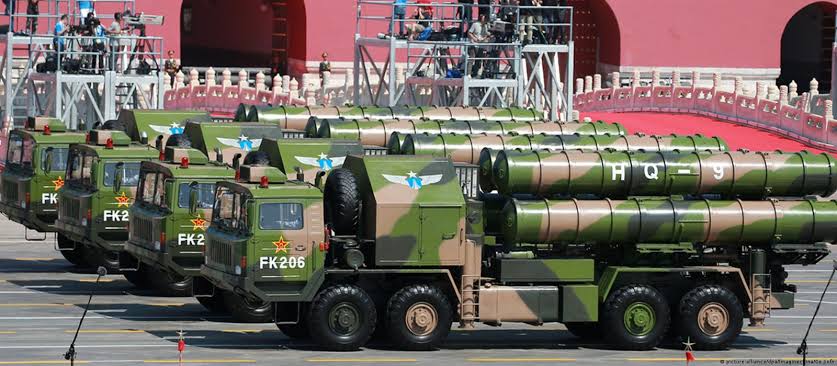
Wang Yanan, chief editor of Aerospace Knowledge magazine, told China Daily that in addition to conventional ballistic missiles, the HQ-19 can also defend against hypersonic glide vehicle weapons that boast extremely fast speeds and supreme agility. As a cutting-edge strike hardware, the hypersonic glide vehicle weapon is virtually impossible to intercept by previous air-defense missiles and poses a significant threat to high-value assets.
In the Ukraine war, Russia has used hypersonic glide vehicles to great effect, and even Western air defense systems have struggled against these threats.
The HQ-9C is used primarily for air defense operations within the atmosphere, but can also perform terminal low altitude antiballistic missile missions, and it can intercept some medium and short-range ballistic missiles.
“The combination of the HQ-9 series and the HQ-19 will form a powerful, multi-layer network to keep our important assets safe from threats from air and exo-atmosphere,” Zhang Xuefeng, a military hardware observer and retired PLA officer, told China Daily.
The combined multi-layered capabilities of these AD systems mean that China has become one of the few countries in the world with a complete antiballistic missile system, which has significant strategic significance.
However, perhaps the most significant AD system showcased at the parade is the HQ-29.
HQ-29: China’s Exoatmospheric Missile Interception System
During the parade, China finally unveiled its long-speculated HQ-29 exoatmospheric missile interception system.Previously, the Chinese defense ministry has announced multiple times that China had conducted technical tests for land-based mid-course antiballistic missile interception, achieving expected goals.
However, this was the first time that the AD system was publicly unveiled.
While the HQ-29 can also intercept hostile missiles outside the atmosphere, unlike conducting regional interception in the upper terminal phase like the HQ-19, the HQ-29 can intercept ballistic missiles in the mid-course phase, mainly targeting high-value ballistic missiles with longer ranges.
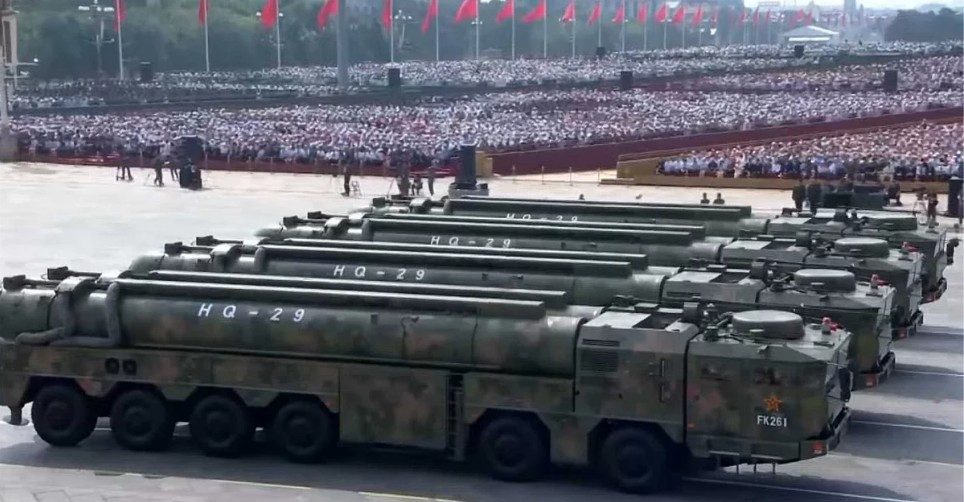
The HQ-29 is also China’s largest surface-to-air missile system ever shown. Compared to the HQ-19, the HQ-29’s missile has a significantly larger and longer body. Only two missiles are transported by a launcher vehicle with six sets of wheels. In comparison, each launcher vehicle of HQ-19 carries six canister missiles.
Each HQ-29 missile interceptor measures approximately 7.5 meters in length and 1.5 meters in diameter.
“With a larger missile body, HQ-29 can further expand the scope of China’s antiballistic missile operations,” military affairs expert Zhang Xuefeng told the Global Times.
The solid-fueled, high-velocity HQ-29 missile interceptors can perform a dual role, intercepting ballistic missiles in their midcourse phase and space-based threats in low Earth orbit. According to experts, the HQ-29 can also engage hostile satellites in low Earth orbit.
The HQ-29 fills a crucial gap between the HQ-19 (high-altitude interceptor) and the HQ-9 series (terminal defense) and is comparable to the American SM-3 and Russian S-500 systems. Its range is expected to exceed 500 km, marking a major strategic advance in Chinese air defense capabilities.
The integration of HQ-9 and HQ-19 with HQ-29 will provide China with a complete, multi-layered anti-ballistic missile defense capability –
The HQ-9: Designed for low-altitude terminal defense.
The HQ-19: A high-altitude interceptor, which is comparable to the US THAAD system.
The HQ-29: It fills the gap between the two as an intermediate or exo-atmospheric interceptor.
Internationally, the system is comparable to the US SM-3, a US Navy-operated missile interceptor capable of engaging ballistic missiles mid-flight. Similarly, the system is considered equivalent to the Russian S-500, which is designed for exo-atmospheric engagement.
The HQ-29 system can also be compared to the Russian PL-19 Nudol, an anti-satellite interceptor also capable of exo-atmospheric engagement.
Given the HQ-29’s exo-atmospheric engagement capabilities that allow it to eliminate even hostile satellites in low-Earth orbit, the AD system has also been called “satellite hunter system”.
Thus, the operationalization of the HQ-29 into China’s AD doctrine will further blur the lines between traditional missile defense systems and space defense and will raise concerns about the militarization of space. Consequently, the AD system has the potential to alter the power balance in space.
The operationalization of the multi-course and multi-layer antiballistic missile interception system means that China has become one of the few countries in the world with a complete antiballistic missile system.
“Their appearance is not only a concentrated display of China’s strategic defense capabilities, but also a display of strategic deterrence. With complete antiballistic missile capability, China can significantly contain the enemy’s strategic strike capabilities, which is of great significance,” Zhang added.
The HQ-29’s anti-satellite (ASAT) capabilities could really endanger U.S. space assets. It employs kinetic kill vehicles equipped with multiple solid-state pulse thrusters for precise mid-course maneuvers, allowing it to destroy satellites during their orbital coasting phase.
This dual ABM-ASAT functionality positions it as a versatile tool for space denial, potentially targeting U.S. reconnaissance, communication, and GPS satellites in LEO—critical for military operations worldwide.
Analysts note that China’s counterspace program, including the HQ-29, poses a “credible threat” to U.S. space-based architecture, as highlighted in U.S. Space Force intelligence reports. It could disrupt systems like Starlink or military SATCOM, which rely on LEO constellations.
In a potential clash in the South China Sea, the HQ-29 can blind U.S. forces by destroying surveillance and degrading command-and-control networks.
HQ-29: China’s New "Satellite-Killer" Missiles Threaten To End U.S. Space Dominance, Cripple American Military
China showcased a series of offensive weapons systems during the Victory Day military parade in Beijing on September 3 to mark the 80th anniversary of the victory over Japan in the Second World War. China’s hypersonic weapons, anti-ship ballistic missiles, submarine-launched missiles...
 www.eurasiantimes.com


Guys, let's keep it simple: Stop with all this political comments, coping on the one side and complaining about cope from the other, insults & provocations and even more that stupid China vs India penis-contest!
A lot of posts were deleted! and anyone who cannot stick to this will get a vacation from this thread!
And even more, please leave out that orange man in Washington.
A lot of posts were deleted! and anyone who cannot stick to this will get a vacation from this thread!
And even more, please leave out that orange man in Washington.


Beijingwalker
VIP Member
China's new weapons of war
Hi-tech and spectacular Beijing parade was a 'direct message to us all'
The new weaponry was deliberately exposed to the world as an open message that China's restoration as a superpower is almost complete
(Image credit: Illustration by Stephen Kelly / Getty Images / AP)
BY CHAS NEWKEY-BURDEN, THE WEEK UK
PUBLISHED Sept. 4 2025
Nuclear missiles, underwater vehicles and robot dogs were the stars of a parade in Beijing this week as China's military might was on display for all to see.
The new weaponry was "deliberately exposed to the world" as "an open message" that China's restoration as a superpower is "almost complete", said The Times.
What was the parade about?
Held to mark the 80th anniversary of the end of the Second World War, the parade saw tens of thousands of service personnel march "in lines so straight they could almost have been animated", said Sky News, with "every flex of the foot, every turn of the head, every cry of allegiance exactly in sync".It also offered a "rare look" at China’s new armoury, said The New York Times as jets "screamed across the sky" and a cavalcade of missiles and armoured vehicles "rolled past Tiananmen Square".
What are these latest weapons?
China showed off its liquid-fuelled intercontinental strategic nuclear missiles that have the "entire world under its strike range", according to state media. Beijing also revealed its first air-launched nuclear missile, the JL-1, which was displayed on a military truck.According to experts, China's new hypersonic missiles are the "finest set in the world", said The Times. They have a range of 746 miles, a Mach 8 speed and are designed to take out ships at sea. The military's new tanks are a lighter, more agile replacement for the standard PLA Type 99A, prompted by Russia’s experience in the Ukraine war, when its tanks were destroyed by Ukrainian artillery and drones.
Beijing also paraded two types of extra-large uncrewed underwater vehicles (XLUUVs), plus a sea drone "built to be stealthy", said The Independent. Plus, laser weapons, constructed as a defence against drone attacks and other "low-end threats".
Finally, robot dogs, which will be deployed in what Beijing calls "intelligentised warfare" sat atop armoured vehicles. The "unsettling wolves" that "stole the show" have "enhanced combat features, including mounted cameras for real-time reconnaissance" and "precision strike capability", said Indian news site Mathrubhumi.
What does this mean for the world?
If much of the "post-parade attention" is focused on new long-range nuclear-armed weapons, the new mobile truck-and ship-mounted laser air defence weapons could be "more important in the long run", said CNN. They could be a real barrier for any enemy’s "ability to blunt Chinese military movements around the region".The new armoured ground vehicles showed in particular that Beijing is investing in "possible rapid deployment" to Taiwan, said The New York Times, but the "show of military strength and diplomatic pulling power" was a "direct message to us all" and should "worry us all", said Sky News,

China's new weapons of war
Hi-tech and spectacular Beijing parade was a 'direct message to us all'
 theweek.com
Beijingwalker
VIP Member
China Flaunts New Hypersonic Missile for Critical Strikes
Today at nullChina has unveiled a new hypersonic cruise missile, claiming the superfast weapon offers "powerful penetration" strike capabilities.
The Chinese Foreign Ministry did not immediately respond to a request for comment.
Why It Matters
The newest Chinese hypersonic missile debuted during Wednesday's military parade in Beijing, which showcased a number of new advanced weapons, including anti-ballistic missile defense systems and nuclear missiles capable of reaching targets worldwide.Major military powers—including China, the United States and Russia—are racing to develop and deploy hypersonic weapons, which are capable of flying at over five times the speed of sound and maneuvering during flight, making them difficult to intercept.
China's latest military development follows the inaugural deployment of the U.S.' Long-Range Hypersonic Weapon (LRHW) in the Western Pacific during a July war game. The LRHW is scheduled to field its first operational unit by the end of this month.
What To Know
A formation of three types of cruise missiles was paraded through Tiananmen Square in Beijing on Wednesday, featuring the CJ-20A, the YJ-18C and the CJ-1000, which are operated respectively by the air force, the navy and the rocket force—the branch responsible for land-based missiles.According to the state-run Xinhua News Agency, the CJ-1000 hypersonic cruise missile is capable of conducting long-range precision strikes. China Central Television reported that the new missile features "powerful penetration" and "instant-launch" capabilities.
Chinese military expert Shao Yongling told the Global Times that the CJ-1000 is an upgraded version of the CJ-100, which was unveiled in 2019.
Given its high-speed and maneuverability, the CJ-1000 could be deployed to strike heavily defended and time-sensitive high-value targets, according to the expert.
Time-sensitive targets are defined as fleeting targets requiring an immediate response, such as mobile command and control vehicles or mobile rocket launchers.
The CJ-100 flies slightly slower than the CJ-1000, reaching up to four times the speed of sound, according to information disclosed at a Chinese airshow last year.
The CJ-100 is reported to have a range of 1,864 to 2,485 miles, allowing it to strike Guam—America's westernmost territory and a military hub—from mainland China. It is unknown if the CJ-1000 has a longer range.
For comparison, the U.S. Tomahawk cruise missile has a range of 1,000 miles and can be launched from ships, submarines and the Typhon land-based system. The combat-tested missile, however, flies at subsonic speeds.
What People Are Saying
Chinese military expert Shao Yongling told the Global Times on Wednesday: "Due to its faster flight speed and better maneuverability, the CJ-1000 can effectively reduce the success rate of interception by existing missile defense systems."The Pentagon's Chinese military power report commented: "The [People's Liberation Army Rocket Force] is critical to the [People's Republic of China]'s nuclear deterrence strategy and its strategy to deter and counter third-party intervention in regional conflicts."
What Happens Next
It remains to be seen whether China will test-launch the CJ-1000 in the near future to demonstrate its deterrence against U.S. forces operating in the Western Pacific.
China flaunts new hypersonic missile for critical strikes
A Chinese military expert said the CJ-1000 missile could be deployed to strike heavily defended and time-sensitive high-value targets.
 www.newsweek.com
Beijingwalker
VIP Member
China’s JL-1 Air Launched Ballistic Missile’s Official Debut Is A Big Deal
Beyond the unveiling of the JL-1 itself, the huge parade in Beijing was the first real showcase of the air leg of China's new nuclear triad.JOSEPH TREVITHICK
PUBLISHED SEP 4, 2025 7:47 PM EDT
https://www.twz.com/air/chinas-jl-1...issiles-official-debut-is-a-big-deal#comments
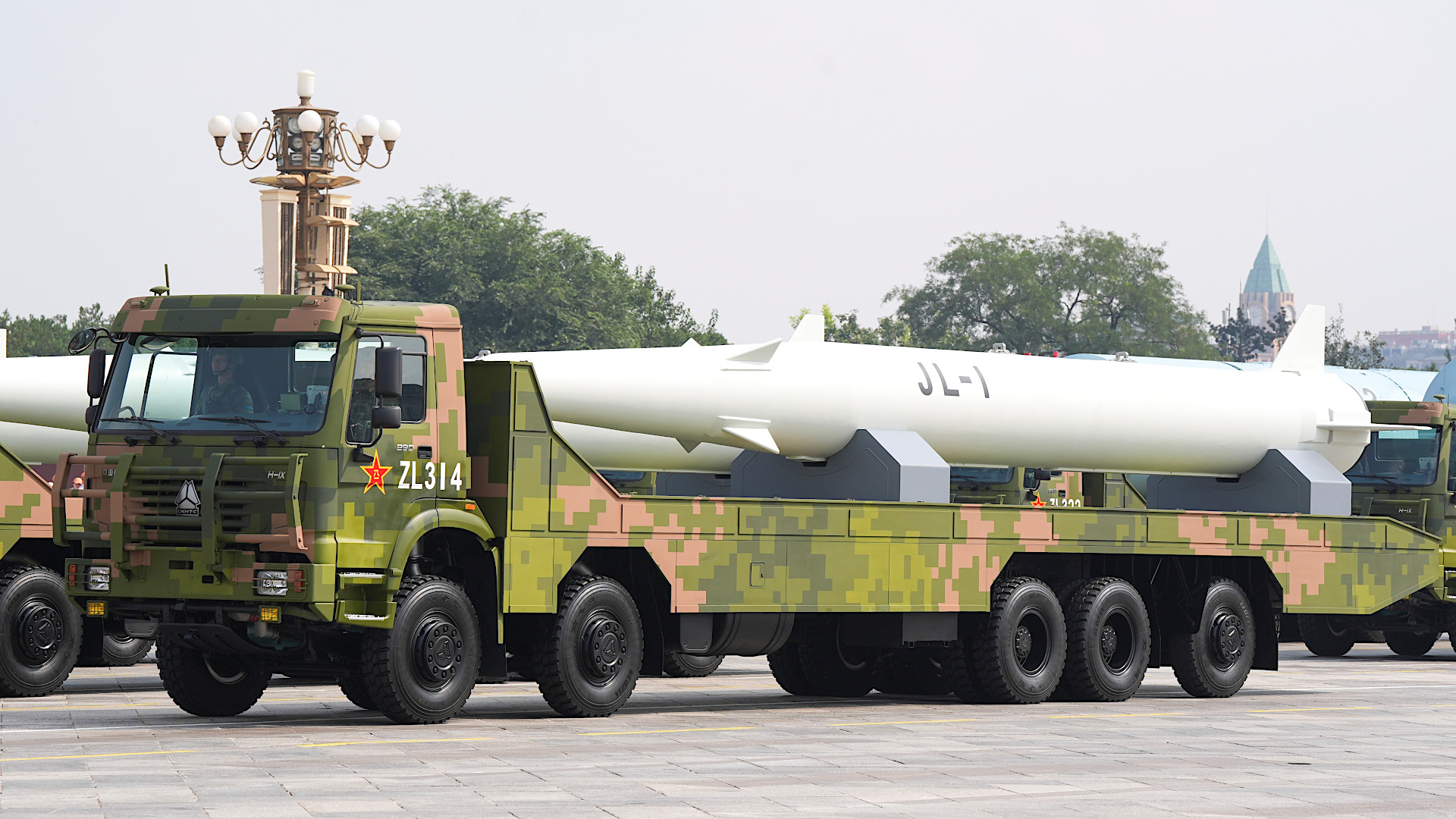
China officially unveiled a nuclear-capable air-launched ballistic missile (ALBM) called the JL-1 at its sprawling military parade in Beijing yesterday. With the JL-1 displayed alongside submarine-launched and intercontinental ballistic missiles (SLBM/ICBM), the event also marked the first time that elements of all three legs of the current Chinese strategic nuclear triad had been shown together publicly.
The JL-1 was one of many notable reveals at yesterday’s parade, as TWZ had already been reporting on as preparations had gotten underway earlier in the summer. It is important to note up front that the JL-1 (Jinglei-1) ALBM should not be confused in any way with the now-retired JL-1 (Julang-1) SLBM. Jinglei translates into English variously as sudden thunder, thunderbolt, or thunderclap, while Julang is typically translated as huge wave.
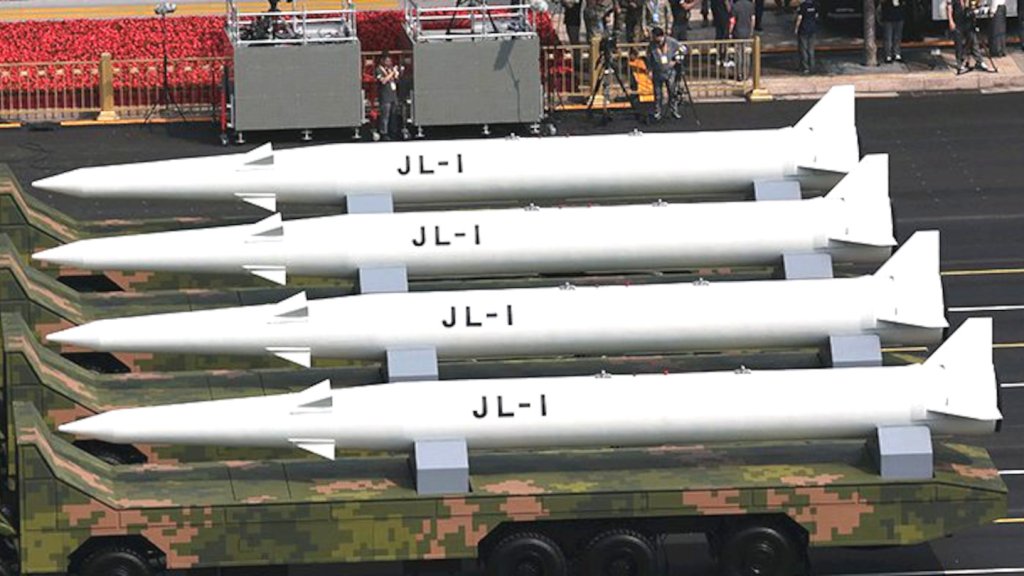
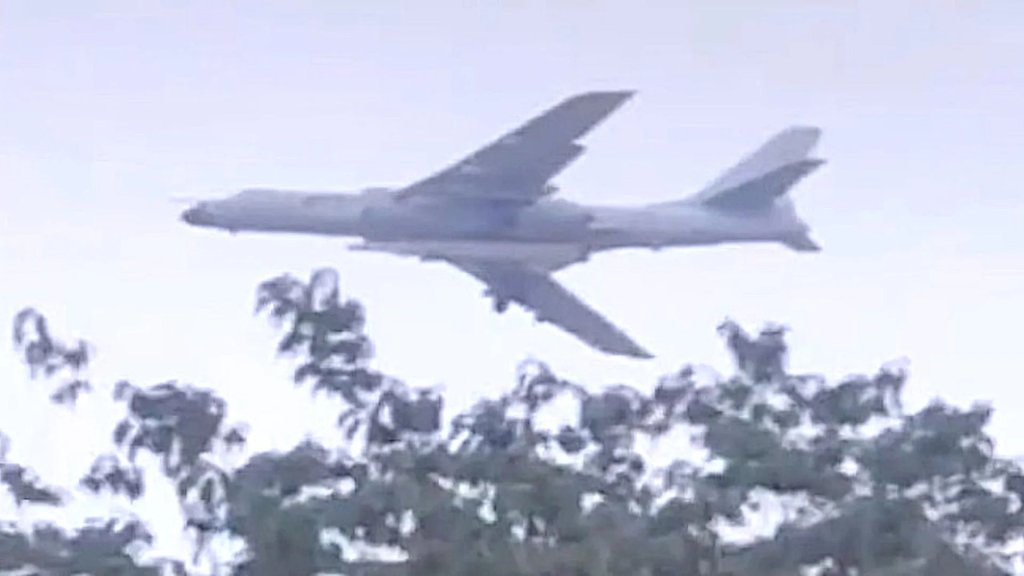
The JL-1 ALBM is very likely to be the same missile that has been referred to in the past in the West as the CH-AS-X-13, and which is understood to have been in development since at least the mid-2010s. Grainy images of an extremely similar, if not identical missile have been seen loaded underneath the fuselages of specialized H-6N missile carrier aircraft on several occasions in the past, but Chinese authorities have not previously acknowledged its existence. The H-6N, which is also capable of being refueled in flight to extend its range, was officially shown to the public for the first time at another major parade in Beijing back in 2019.

The CH-AS-X-13 has also been referred to as the KF-21 in the past, based on past reports that it is derived, at least in part, from the DF-21 series of two-stage ground-launched ballistic missiles. Though this connection has yet to be officially confirmed, the JL-1s, or mockups thereof, shown at the parade yesterday are broadly in line with the design of the DF-21D, which consists of a main stage and a maneuverable re-entry vehicle (MARV) on top that detaches in the latter stage of flight. The JL-1 also has a three-fin tail configuration indicative of an air-launched missile. The DF-21D is conventionally armed and optimized for anti-ship strikes. China’s longer-range DF-26 also has a two-stage configuration with a MARV, but is notably larger than the DF-21. Depending on their exact design, MARVs can allow for additional terminal phase course corrections for improved accuracy, as well as maneuvering to make any attempt at an intercept more difficult.
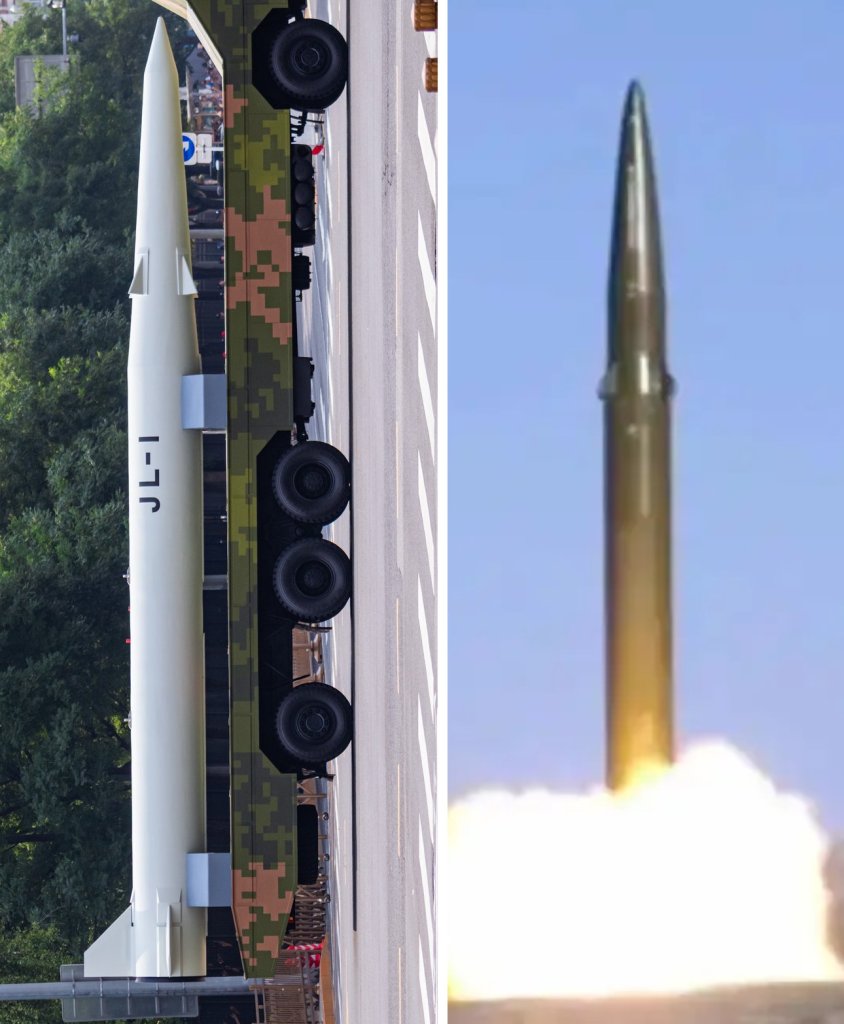
Imagery had also emerged in the past, as seen below, which has contributed to discussions about the possibility of a second variation on the CH-AS-X-13, or another different missile for the H-6N, with what may be a wedge-shaped unpowered hypersonic boost-glide vehicle (HBGV) on top. Conical HBGV designs that can look similar externally to a MARV also exist.
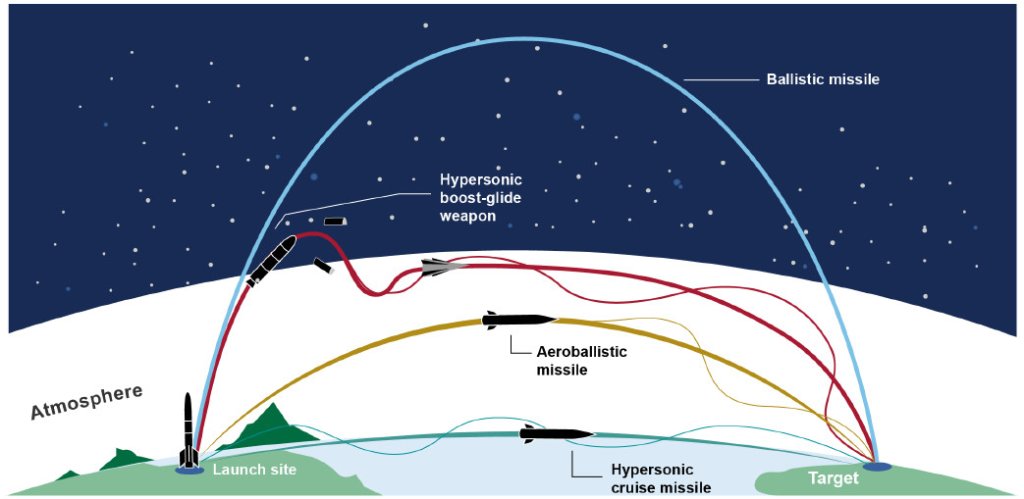
However they are designed, HBGVs are fundamentally different from MARVs, the latter of which still follow a roughly ballistic path to their impact point. In contrast, after release, HBGVs are designed to proceed along relatively shallow, atmospheric flight paths to their targets while also being able to maneuver erratically along the way. Coupled with hypersonic speed, defined as anything about Mach 5, presents additional challenges for defenders. It is worth noting here that larger ballistic missiles also reach hypersonic speeds in the terminal phase of flight.
Beijingwalker
VIP Member
The Pentagon has also posited in the past that the CH-AS-X-13 may be capable of carrying conventional or nuclear warheads, as is the case with the DF-21 series and the DF-26. The connection to the DF-21, and the DF-21D most specifically, has also prompted previous discussions about the H-6N having an anti-ship role, particularly against U.S. carrier strike groups. Few hard details were offered during the parade about the JL-1, but it was explicitly described as a nuclear weapon, though this would not preclude the existence of a conventionally-armed version for use against targets at sea or on land.
During the event, state media narrators also reportedly said the JL-1 has a range of approximately 4,970 miles (8,000 kilometers). If true, this is substantially longer than the assessed maximum range of current-generation DF-21 variants, as well as the DF-26. The Pentagon’s most recent unclassified annual report to Congress on Chinese military developments, released in 2024, said the DF-21D “has a range exceeding 1,500 km [932 miles].” That same report pegged the DF-26’s range at approximately 2,485 miles (4,000 kilometers).
As a general rule, missiles fired from aircraft benefit from the speed and altitude of the launch platform, particularly when it comes to range. As such, an air-launched ballistic missile can reasonably be expected to have greater reach than a comparable design launched from the ground or a vessel at sea. As an example, Russia’s air-launched Kinzhal is understood to have an appreciably longer range than the ground-launched Iskander-M short-range ballistic missile it is based on.
Whatever its exact capabilities might be, the JL-1’s appearance at the parade yesterday had the additional and perhaps greater significance of being the first official display of the aerial component of China’s present nuclear triad to the public. Of the currently accepted nine nuclear powers globally (which includes Israel and its unacknowledged stockpile), only the United States, Russia, China, and India field triads in any form. The core arguments for having a nuclear triad are the operational flexibility it offers, as well as its resilience to attack. Even if one or two legs were to be neutralized, capacity would remain to launch retaliatory strikes.
The Pentagon had publicly assessed back in 2019 that the People’s Liberation Army Air Force (PLAAF) was moving to resume a strategic nuclear deterrence role with the appearance of the H-6N. Before then, the exact status of China’s stockpile of air-dropped nuclear bombs had become unclear. With the operational fielding of the H-6N in 2020, the Pentagon further assessed that the PLA had established a “nascent nuclear triad.”
“The PLAAF has operationally fielded the H-6N bomber, providing a platform for the air component of the PRC’s [People’s Republic of China] nuclear triad. The H-6N, compared to other H-6 bombers, adds an air-to-air refueling probe as well as its recessed fuselage modifications that enable external carriage of a nuclear-capable ALBM,” the Pentagon wrote in its unclassified 2024 report to Congress on Chinese military developments. “The ALBM carried by the H-6N appears to be armed with a maneuvering reentry vehicle, indicating the ALBM – along with the DF-26 IRBM [intermediate-range ballistic missile] – likely can conduct nuclear precision strikes against targets in the Indo-Pacific theater.”
China’s triad, which we now know officially includes the JL-1, is part of a larger nuclear build-up underway in the country that also includes expanding the land and sea-based legs. The construction of vast new fields of silos for ICBMs in recent years has been a particularly visible component of this broader effort. Those silos may not all be intended to hold missiles as part of a ‘shell game’ to create targeting complications for opponents.
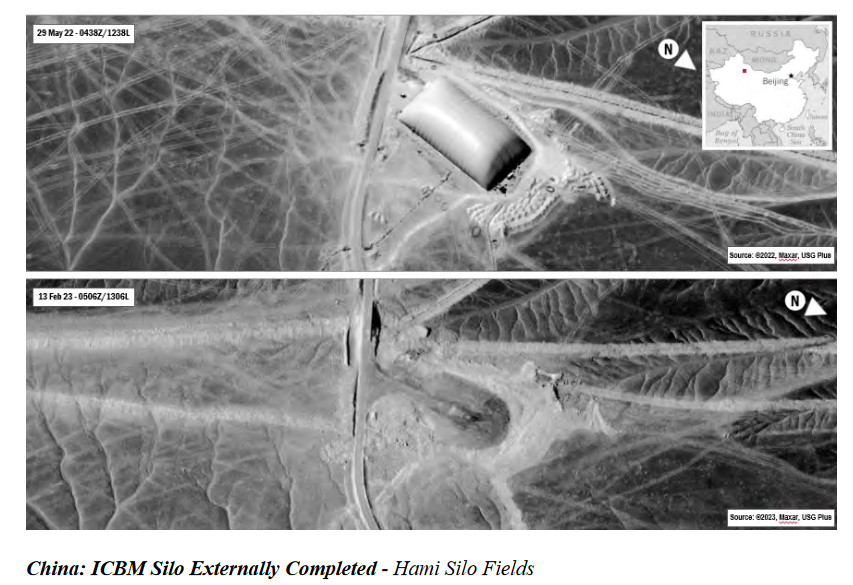
“Over the next decade, the PRC [People’s Republic of China] probably will continue to modernize, diversify, and expand its nuclear forces rapidly. The PLA seeks a larger and more diverse nuclear force, comprised of systems ranging from low-yield precision strike missiles to ICBMs with multi-megaton yields to provide it multiple options on the escalation ladder,” according to the Pentagon’s 2024 report on China to Congress. “In 2023, Beijing continued its rapid nuclear expansion. DoD estimates the PRC has surpassed 600 operational nuclear warheads in its stockpile as of mid-2024 and will have over 1,000 operational nuclear warheads by 2030, much of which will be deployed at higher readiness levels. The PRC will continue growing its force through at least 2035.”
“The PRC has not publicly or formally acknowledged or explained its nuclear expansion and modernization. The buildup almost certainly is due to the PRC’s broader and longer-term perceptions of progressively increased U.S.-PRC strategic competition. The PLA’s nuclear expansion and modernization very likely are tied to its overall military strategy – seeking to close capability gaps and become a competitive global power,” the report added. “As a result, the PRC probably perceives that a stronger nuclear force is needed to deter U.S. intervention, check potential nuclear escalation or first strike, and will allow for increased control of the scope and scale of escalation during a conflict in a way its previously smaller and less diverse nuclear force could not.”
All of this is in line with the establishment of a nuclear triad, as well as the Pentagon’s past assessment that China has been moving to adopt a launch-on-warning (LOW) deterrent posture. LOW entails a plan to execute a massive counterstrike upon detecting incoming nuclear threats, primarily to help ensure a retaliatory strike can be successfully initiated before the hostile weapons reach their targets.
There have also been separate discussions about how the growing size of China’s nuclear stockpile points to plans for so-called countervalue targeting, in which weapons would also be aimed at an enemy’s population centers. Strikes directed at military targets are referred to as counterforce.
Altogether, the public debut of China’s JL-1 ALBM is a very important development with ramifications well beyond the missile itself.
China's JL-1 Air Launched Ballistic Missile's Official Debut Is A Big Deal
Beyond the unveiling of the JL-1 itself, the huge parade in Beijing was the first real showcase of the air leg of China's new nuclear triad.
 www.twz.com
Beijingwalker
VIP Member
China's New Sword: The ultimate hypersonic and nuclear deterrent
China14:09, 05-Sep-2025Gong Zhe
CGTN
China's V-Day parade on September 3 came as a shock to many die-hard military fans, as a streak of new, sci-fi-looking weapons were on display with almost no details provided. CGTN's "China's New Sword" is a series of reports that explain these weapons using publicly available information that has not yet been thoroughly introduced to the English-language internet.
While the world's attention has often been on China's naval growth and air force upgrades, this parade revealed something much more significant: a new generation of strategic weapons built for maximum deterrence. Many of the systems shown were making their public debut.
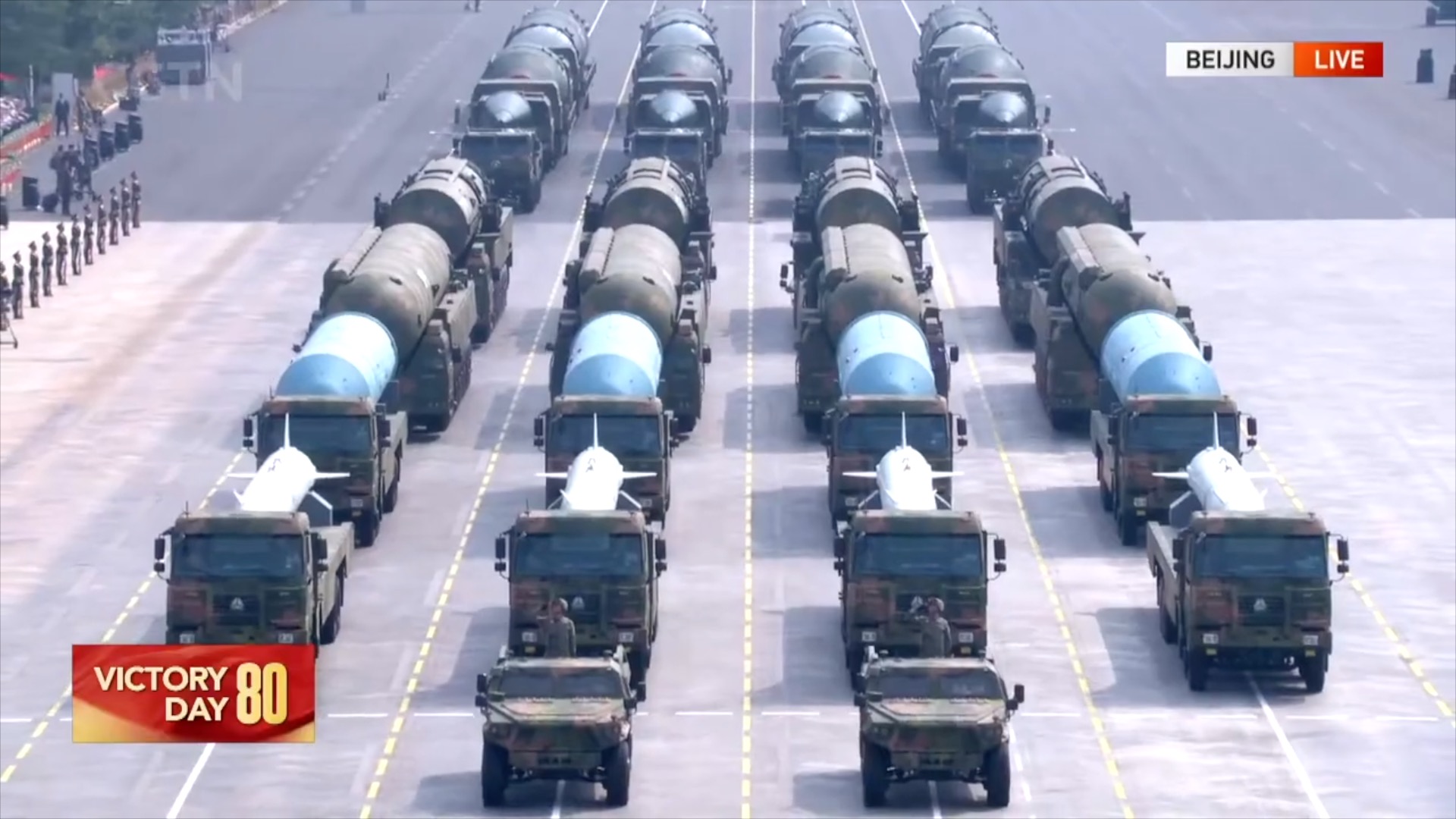
Dawn of hypersonic age
Leading the charge were China's hypersonic missiles, capable of traveling at least five times the speed of sound. These are not just faster missiles; they signify a fundamental shift in how missiles can bypass existing defense systems.
The DF-17 missile is easily recognizable by its distinctive, flattened cone-shaped warhead, a design that greatly improves its maneuverability and ability to breach missile defenses.
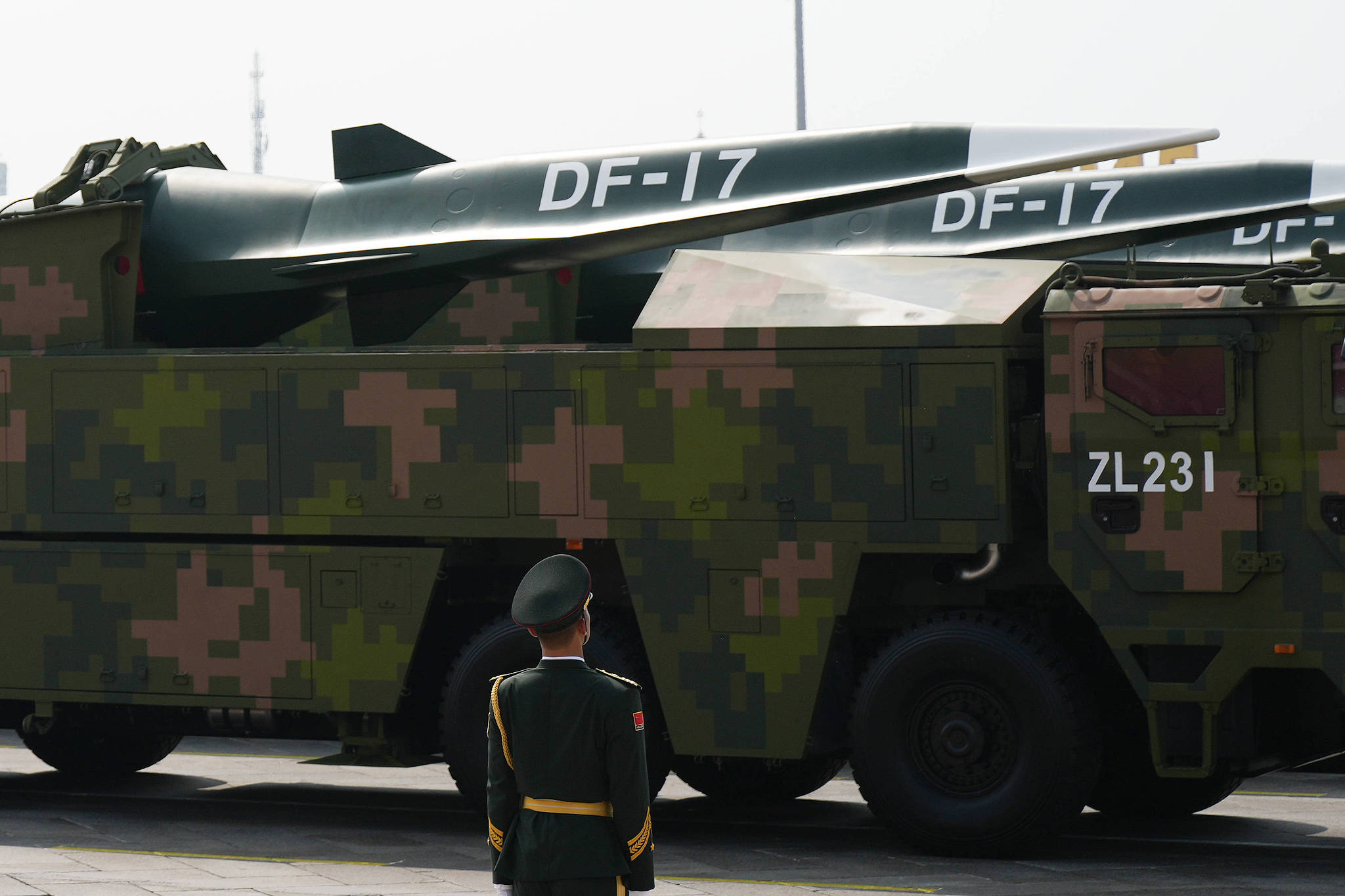
The DF-61 hypersonic missiles are showcased during the V-Day military parade in Beijing, China, September 3, 2025. /VCG
An upgraded version of the DF-26, the DF-26D features an integrated launch vehicle and canister launch technology, making it more adaptable to complex battlefield environments. It is a key part of China's "killer weapon" arsenal.
The YJ-17, YJ-19, YJ-20, and YJ-21, displayed both in joint formations and as part of an anti-ship missile system, highlight China's focus on building a multi-layered hypersonic capability that can be launched from land, sea, and air.
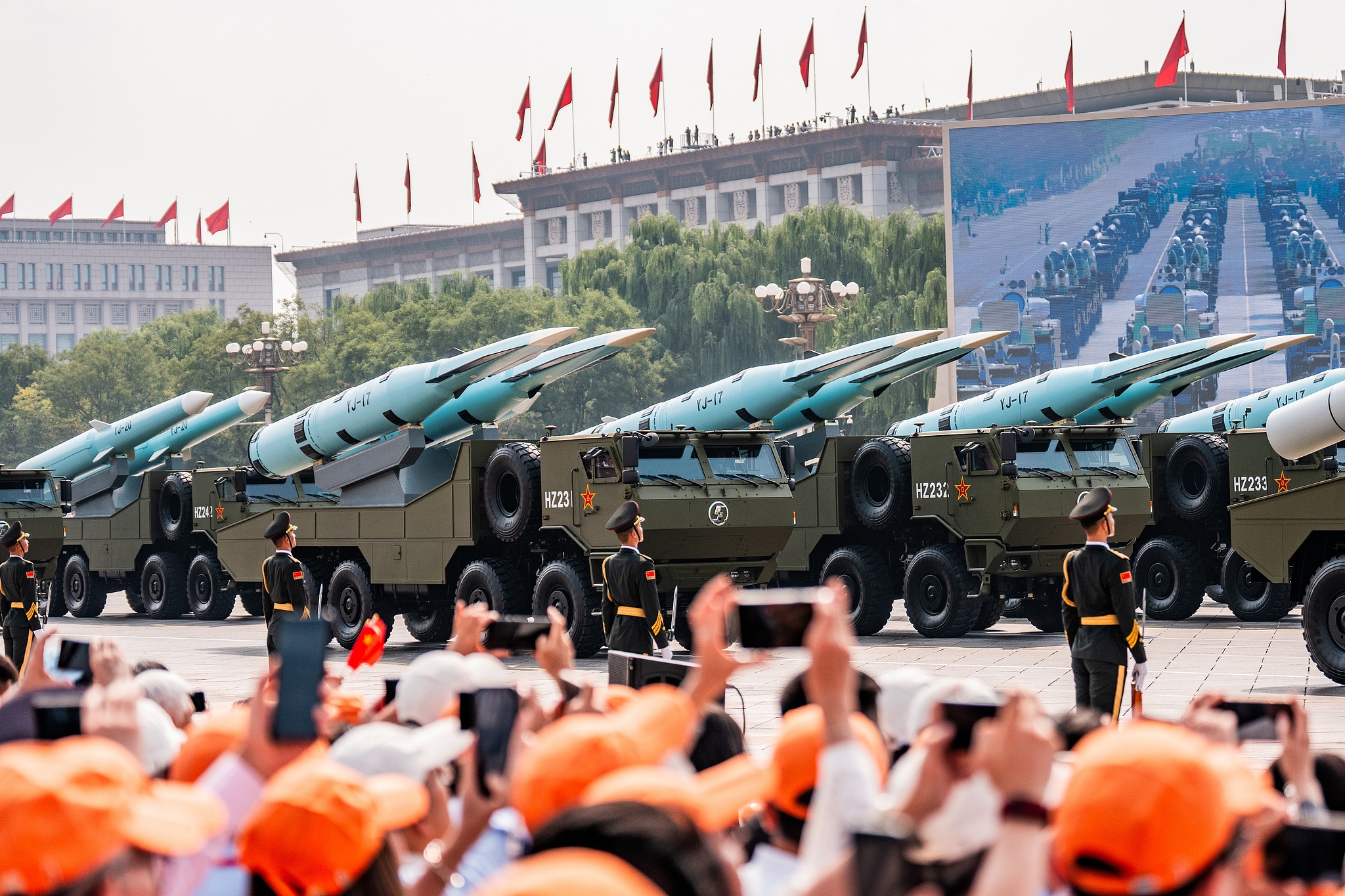
The YJ-21 hypersonic missiles are showcased during the V-Day military parade in Beijing, China, September 3, 2025. /VCG
The Changjian-1000 was also introduced as China's first hypersonic cruise missile. With its high maneuverability and instant launch ability, it is built for precision strikes, also known as surgical strikes.
Beijingwalker
VIP Member
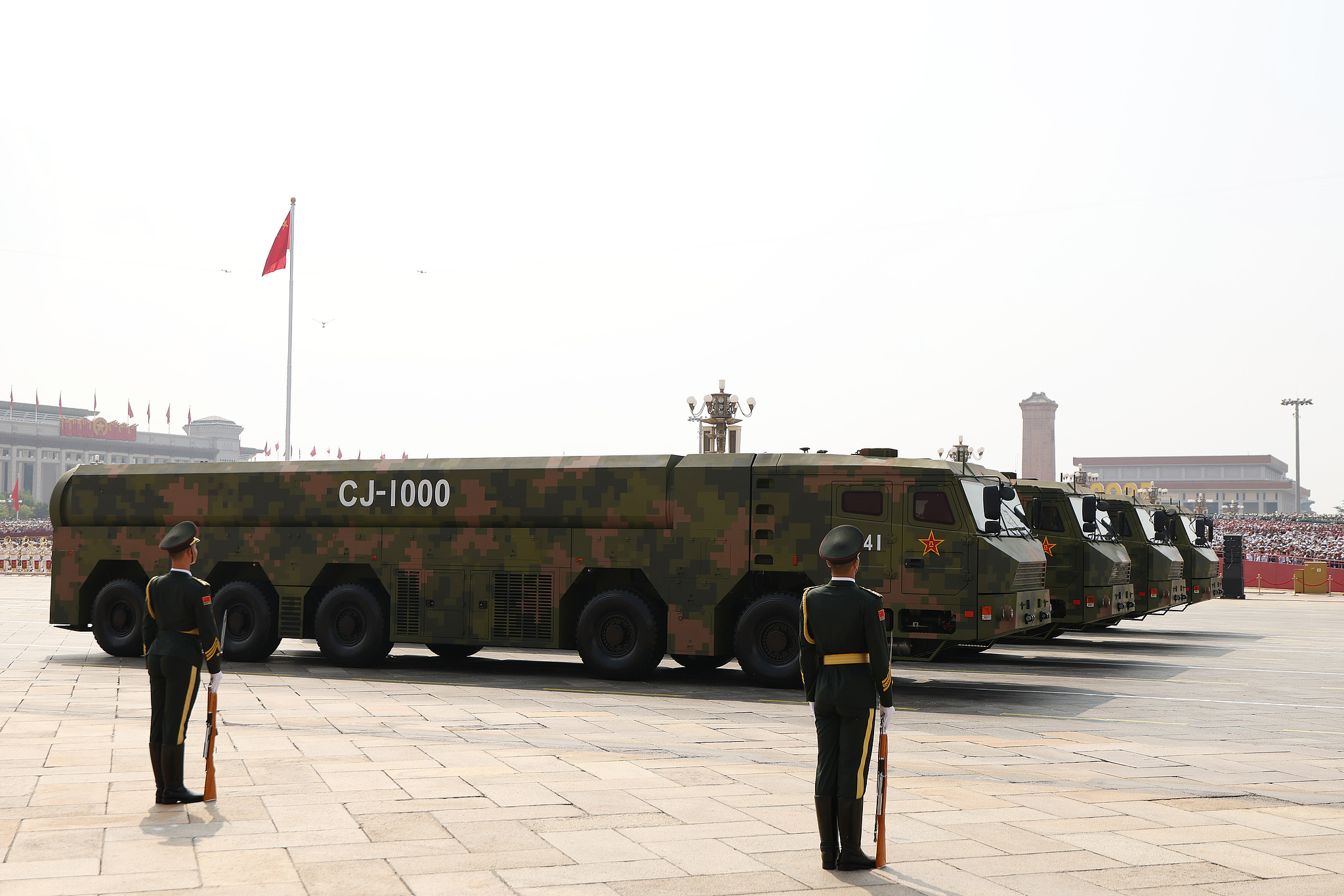
The CJ-1000 hypersonic missiles are showcased during the V-Day military parade in Beijing, China, September 3, 2025. /VCG
Triad of nuclear power
While hypersonic technology is seen as the future, the parade also highlighted the lasting strength of China's nuclear arsenal. For the first time, a complete nuclear triad – land, sea, and air-based – was showcased publicly.
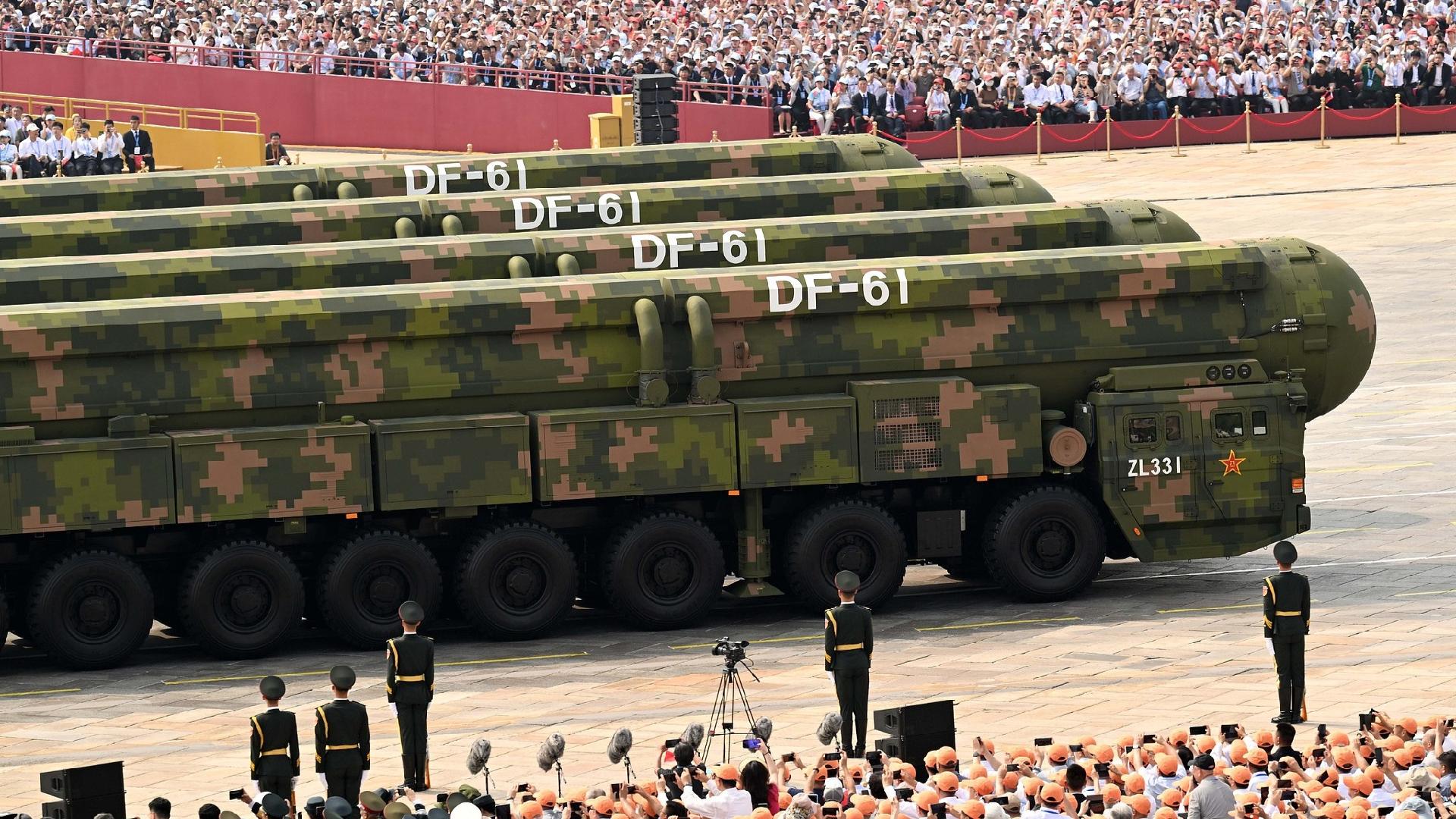
Land-based: The DF-5C liquid-fueled intercontinental ballistic missile (ICBM) was the centerpiece. Its large frame was carried in three different sections, with its conical warhead clearly visible. It stands as a key part of China's deterrence strategy due to its global strike capability. The parade also showcased the new DF-61 and DF-31BJ land-based ICBMs.
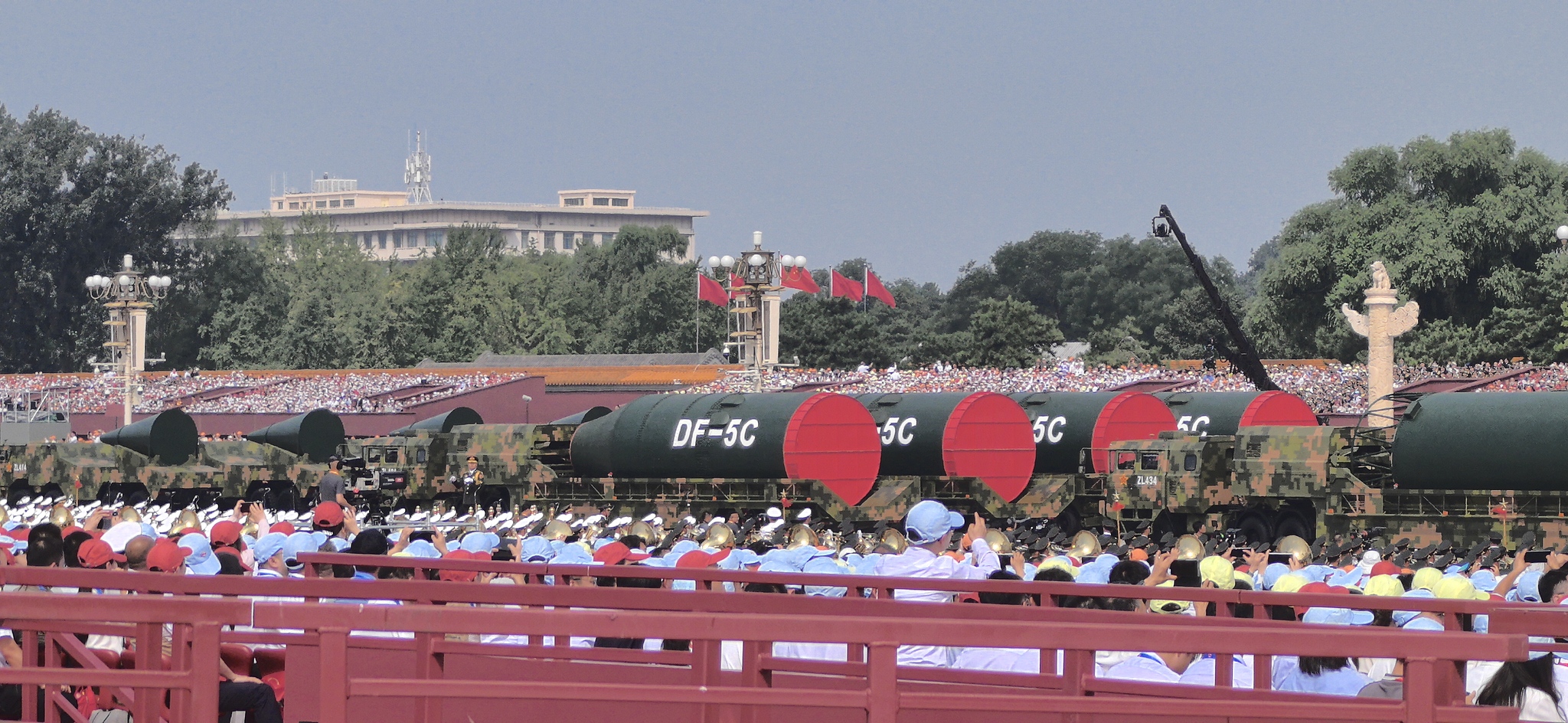
The DF-5C ICBMs are showcased during the V-Day military parade in Beijing, China, September 3, 2025. /VCG
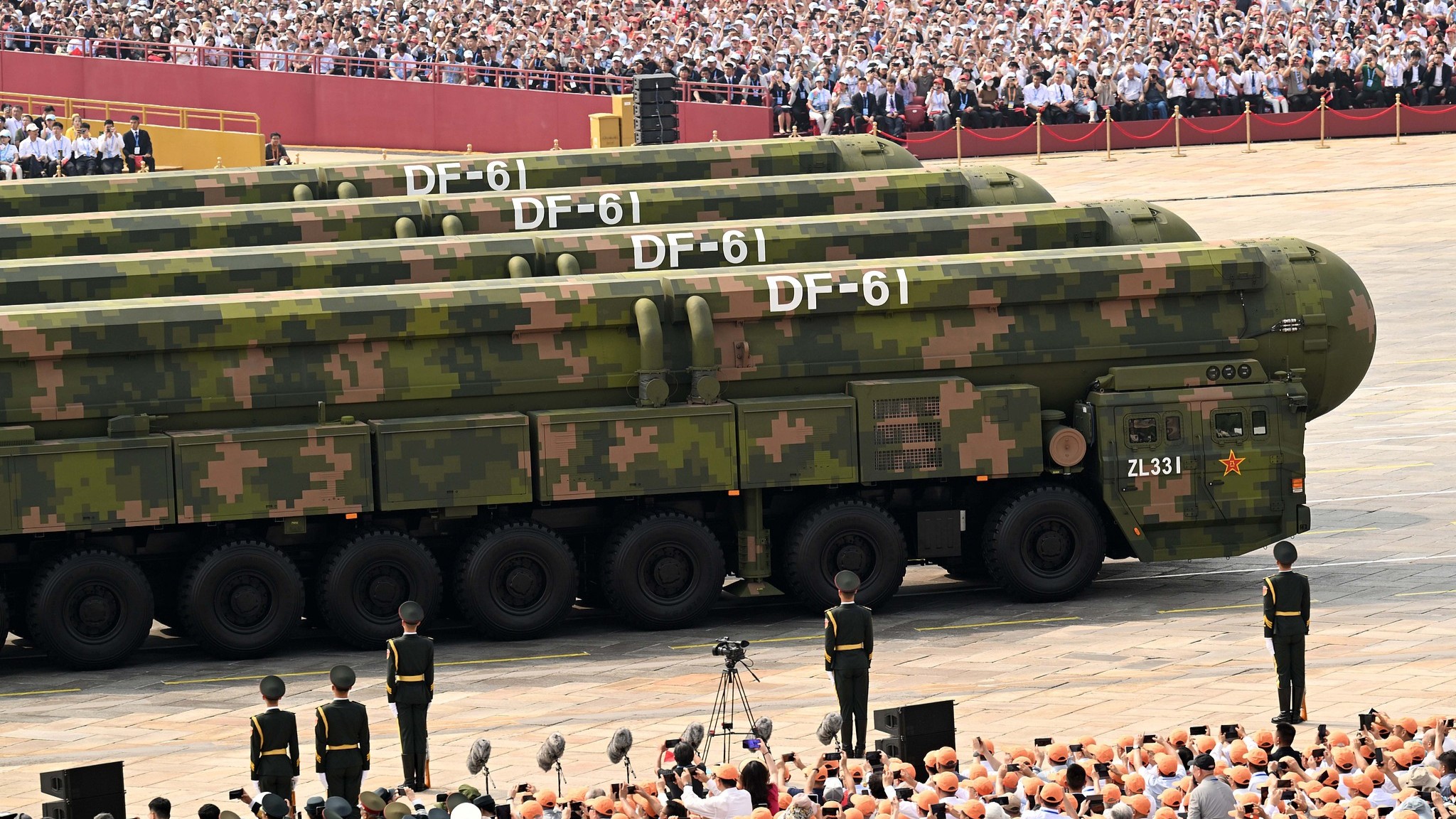
The DF-61 ICBMs are showcased during the V-Day military parade in Beijing, China, September 3, 2025. /VCG
Sea-based: The JL-3 (Julang or "Tidal Wave") submarine-launched ICBM is presented as the upgraded naval component. This missile gives China the capability to launch a second-strike from a hidden location.
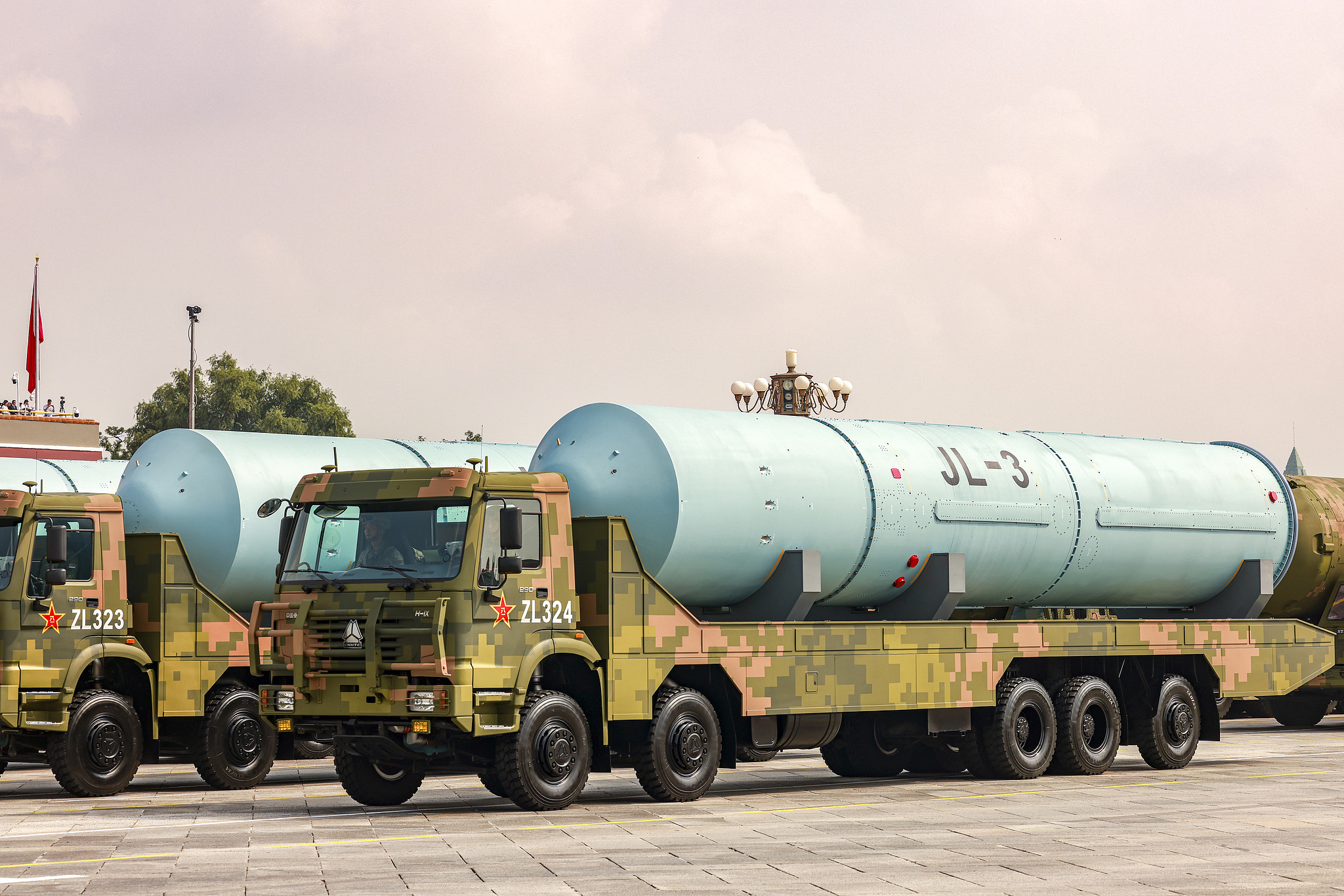
The JL-3 ICBMs are showcased during the V-Day military parade in Beijing, China, September 3, 2025. /VCG
Air-based: The JL-1 (Jinglei or "Thunderclap") air-launched long-range missile completed the triad, demonstrating China's ability to deliver a nuclear payload from the air.
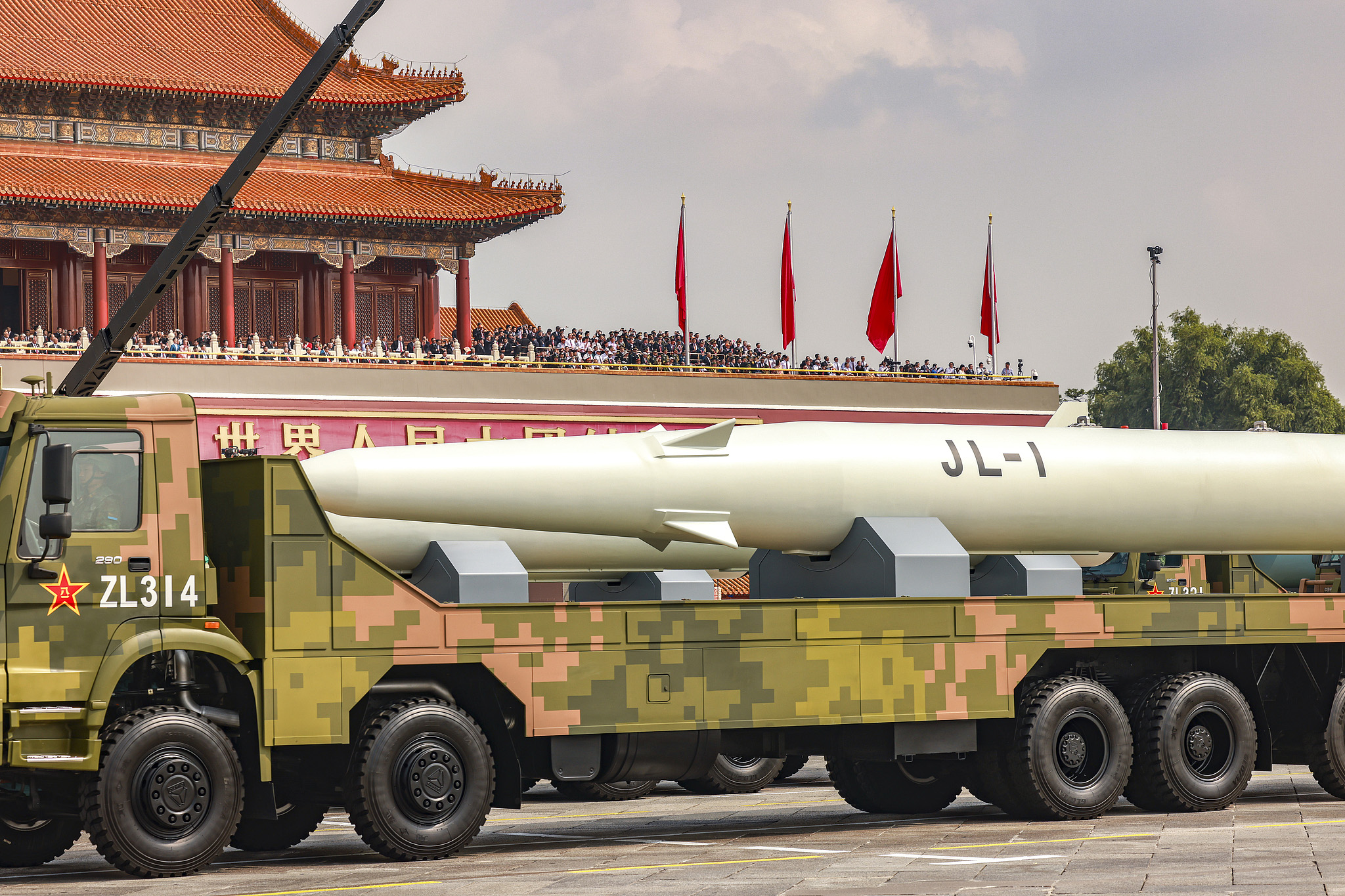
The JL-1 missiles are showcased during the V-Day military parade in Beijing, China, September 3, 2025. /VCG
The single-sided cockpit design of the missile transporters also emphasized a new design philosophy centered on integration and intelligence.
This display of nuclear capabilities was presented not as a threat, but as a "strategic trump card" to protect national sovereignty and keep the peace.
China's New Sword: The ultimate hypersonic and nuclear deterrent
China's V-Day parade on September 3 came as a shock to many die-hard military fans, as a streak of new, sci-fi-looking weapons were on display with almost no details provided. CGTN's "China's New Sword" is a series of reports that explain these weapons
Beijingwalker
VIP Member
Nan Yang
Registered Member

LOL. China was in the middle of a civil war and war against warlords when Japan launch a full scale invasion China in 1937.You bet! That's right.
Just like China today when they sell stuff to both sides in wars because they "take no sides"
So I have no problem at all with the US helping the Japanese War machine... I hope we made good profits too.
Ever hear of the Flying Tigers...your ignorance of Chinese History is showing.
View attachment 144600
View attachment 144601
View attachment 144613
Stalemated? Tell that to all the other countries in SouthEast Asia that were fighting for their survival...which BTW you weren't helping at all..no matter what stupid "stalemated" excuse you try and pull.
View attachment 144604
I don't remember China stalemating anything.
You were a bunch of losers now trying to claim some big achievement.
That American flag in the top right is at Midway Island where we sank 4 Japanese aircraft carriers 6 months after Pearl Harbor to cover our Western flank so we could concentrate better on fighting Germany.
The Imperial Japan Navy was the third largest navy in the world by 1920, behind the Royal Navy and the United States Navy (USN) and was arguably the most powerful navy in the world.
Japan was just looting a burning house.
But China have huge strategic depth and KMT just kept withdrawing to the mountain fortress of ChongQing to keep fighting the Japanese and never even think of surrendering.
Even Chinese people in Malaysia form the MPAJA and fought the Japanese after the British Empire surrender. Malaysian lorry drivers also volunteer to supply ChongQing via the Burma road.
Constructed between 1937 and 1938, the Burma Road involved the collaborative efforts of Chinese laborers, British, and American engineers. More than 200,000 Chinese laborers embarked on a seemingly impossible task: to cut a 700-mile overland route -- the Burma Road -- from the southwest Chinese city of Kunming to Lashio
https://www.dangerousroads.org/asia/china/321-burma-road-china.html
Do not underestimate Chinese resolve.
Remember, after Japan bomb Pearl Harbor, one of the first thing in President Roosevelt mind was CHINA.

Hamartia Antidote
Elite Member

Stay on topic people....
I see you think those reasons give China some kind of elevated legitimacy to say they beat Imperial Japan versus what the people of Korea, Philippines, Malaysia, Singapore, Burma, Vietnam, Cambodia, Laos, and numerous islands did...because apparently those countries didn't have any worthy hardships/problems to use as an asterisk.

If not...what point are you trying to make then in your post that is on-topic?
okay if you think this is somehow on topic.LOL. China was in the middle of a civil war and war against warlords when Japan launch a full scale invasion China in 1937.
The Imperial Japan Navy was the third largest navy in the world by 1920, behind the Royal Navy and the United States Navy (USN) and was arguably the most powerful navy in the world.
Japan was just looting a burning house.
But China have huge strategic depth and KMT just kept withdrawing to the mountain fortress of ChongQing to keep fighting the Japanese and never even think of surrendering.
Even Chinese people in Malaysia form the MPAJA and fought the Japanese after the British Empire surrender. Malaysian lorry drivers also volunteer to supply ChongQing via the Burma road.
Constructed between 1937 and 1938, the Burma Road involved the collaborative efforts of Chinese laborers, British, and American engineers. More than 200,000 Chinese laborers embarked on a seemingly impossible task: to cut a 700-mile overland route -- the Burma Road -- from the southwest Chinese city of Kunming to Lashio
https://www.dangerousroads.org/asia/china/321-burma-road-china.html
Do not underestimate Chinese resolve.
Remember, after Japan bomb Pearl Harbor, one of the first thing in President Roosevelt mind was CHINA.
I see you think those reasons give China some kind of elevated legitimacy to say they beat Imperial Japan versus what the people of Korea, Philippines, Malaysia, Singapore, Burma, Vietnam, Cambodia, Laos, and numerous islands did...because apparently those countries didn't have any worthy hardships/problems to use as an asterisk.
If not...what point are you trying to make then in your post that is on-topic?
Last edited:
Beijingwalker
VIP Member
Does China celebrating victory day mean denying all other countries contribution? what's wrong with your mind? or you just like to troll as you always do.Ah I see you think those reasons give China some kind of elevated legitimacy to say they beat Imperial Japan versus what the people of Korea, Philippines, Malaysia, Singapore, Burma, Thailand, Vietnam, Cambodia, Laos, and numerous islands did...because apparently those countries didn't have any hardships/problems.
Users who are viewing this thread
Total: 1 (members: 0, guests: 1)
Pakistan Defence Latest


Country Watch Latest
-
-
 US Navy unveils new long range air-air missile in testing the AIM-424 Malice (7 Viewers)
- Latest: SolarWarden
-
 Bangladesh Keen To Join Saudi-Pak-Turkey Defence Alliance, Says PM's Top Aide (12 Viewers)
- Latest: Arthur
-
If given a choice, IAF would happily Walk Away from Tejas - Angad Singh - Defence Writer (7 Viewers)
- Latest: Faani83
-
Latest Posts
-
China, Pakistan oppose India’s bid for permanent seat at UNSC; supports ‘special case’ of Africa (32 Viewers)
- Latest: retaxis
-
-
-
-
US Navy unveils new long range air-air missile in testing the AIM-424 Malice (7 Viewers)
- Latest: SolarWarden