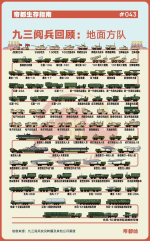
A common saying in military enthusiast circles is: “No matter how powerful a single weapon is, it can only win a; only integrated operations can win a war.” So, let’s dive into how the 93rd military parade showcased “systemization.”
Systemization refers to integrating the combat capabilities of individual branches or platforms into an interconnected, mutually supportive whole.
From a vertical perspective, it links tactical, operational, and strategic levels; horizontally, it enables joint operations across land, sea, air, space, electronic, and cyber domains; in the temporal dimension, it covers pre-war early warning, mid-war strikes, and post-war assessments.
In other words, systemized warfare is not about head-to-head clashes at a single point but about “comprehensive encirclement and hunting.”
The 93rd military parade was a concentrated display of this approach.
In modern warfare, the land combat system remains a core pillar but is no longer a solitary steel torrent. The combination of the Type 99B main battle tank, the PHL-191 long-range rocket artillery, and the new generation of army unmanned platforms forms a comprehensive land warfare framework of “deep strikes + rapid assaults + sustained suppression.” It’s not just about capturing territory but about dismantling the enemy’s defenses step by step through a systemized firepower chain.
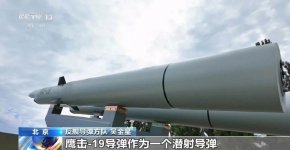
The naval combat system emphasizes deterrence and anti-access/area denial. The Type 052D/055 destroyers’ long-range air defense and anti-ship capabilities, paired with the YJ-21 hypersonic anti-ship missile and the underwater deterrence of the Type 094 nuclear submarine, create a multi-layered maritime kill network. Even if a carrier battle group enters the Western Pacific, this system can achieve “distributed hunting” across different range layers. The navy no longer operates in isolation but is interconnected with the air force, rocket force, and electromagnetic forces, truly transforming sea control into “regional denial.”
The air combat system’s focus has shifted from individual aircraft performance to comprehensive domain control. The J-20, as the “spearhead” of the system, handles intelligence gathering and penetration suppression tasks; the J-35 stealth carrier-based fighter, paired with the Type 055, extends the radius of far-sea operations; early warning aircraft like the KJ-600 serve as command nodes; and drone swarms provide low-cost saturation attacks. The key here isn’t who is stronger but who can maintain air dominance across the entire electromagnetic spectrum.
The space-based system is the neural network of the entire combat system. Beidou navigation, remote sensing satellites, electronic reconnaissance satellites, and early warning satellites ensure a closed-loop chain from intelligence gathering and precision guidance to target designation. Without a space-based system, long-range strikes are like “a blind man throwing stones”; with it, “second-level detection and minute-level strikes” become possible.
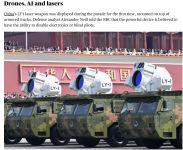
The electromagnetic and cyber systems are the invisible blades of systemized warfare. Electronic warfare aircraft, high-power microwave weapons, directed-energy weapons, and cyber warfare units can disrupt an enemy’s radar, command links, and even financial systems before the battle begins. These capabilities are typically not showcased prominently in parades, but their deterrent effect is no less than that of any superweapon.
Finally, the nuclear and strategic strike system includes the JL-1, Dongfeng-5C, Dongfeng-61, and Julang-3 strategic nuclear forces, combined with the hypersonic and medium-to-long-range precision strike capabilities of the Dongfeng-17 and Dongfeng-26, forming a “nuclear-conventional dual-purpose” deterrence system. It ensures that in conventional conflicts, China has sufficient confidence to maintain strategic composure, while in extreme scenarios, it can impose unacceptable costs on adversaries.
In summary, systemization is not about “single-point breakthroughs” or flashy displays but about weaving land, sea, air, space, electronic, and nuclear domains into a comprehensive combat network. The enemy doesn’t face a single weapon but a dynamically operating, continuously suppressing war operating system. Its deterrence lies in leaving the adversary with no entry point to exploit.
Thus, the true highlight of the 93rd military parade is not a single star piece of equipment but the “war operating system” revealed by the collective display of all formations. When you see this system in action, you’ll understand why some call it a “horror movie.” This isn’t just a display of military might but a declaration to the world: any provocateur will become the protagonist in this horror movie, with no survivors