A Paradigm Shift in Grand Strategy—Moving Beyond Deter War toward Proactive Treaty Enforcement

SilentWatch

Registered Member
Joined
May 31, 2025
Messages
116
Reaction score
231
Reputation
686.4
Country of Origin
Country of Residence

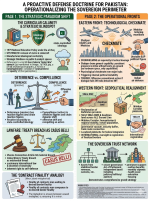
The Curricular Calamity and Our Strategic Blindspot

Let’s be completely honest with ourselves: like many of you, I was largely unaware of the precise, literal operational mandate handed to our military until this viral clip from the 2026 Shangri-La Dialogue began making the rounds on our feeds. That lack of awareness wasn't born out of personal ignorance or apathy. It is the direct consequence of a murky civic transparency landscape and a decades-long educational blackout that has systematically hollowed out our national consciousness.

When the 1979 National Education Policy under General Zia-ul-Haq systematically restructured our curriculum—explicitly mandating that all content be reorganized to give education an ideological orientation—it inflicted a quiet calamity upon our nation. By wiping out objective civics, critical statecraft, and chronological historiography, and replacing them with a highly curated, state-approved framework, the state induced a collective strategic blindness. Generations of Pakistanis have been raised without the analytical tools required to evaluate complex bilateral treaties, international law, or grand strategy. Instead, we have been conditioned to view national security through a purely reactive, passive defense lens.

This strategic blindspot is brought into sharp relief by the post captured in https://x.com/clashreport/status/2061361976735920445 . In the image, Pakistan's Rocket Force Commander, Lt Gen Nauman Zakaria, explicitly states:

"I'll share the first two words of the mission given to my army by the government of Pakistan: 'Deter war.' The primary mission of the Pakistan military is to deter war."

While the General's broader address rightly notes that compressed decision-making timelines leave no room for diplomatic hesitation, we as analysts must ask a deeper question: Has a purely passive deterrence strategy locked Pakistan into an expensive, endless holding pattern that drains our resources without ever delivering an end-state?

The Ideological Twin Paradox and the Metaphor of Finality

To chart a more effective path forward, we should look at a fascinating, if highly sensitive, structural parallel. From a geopolitical standpoint, Pakistan and Israel exist as modern history’s unique "political Gemini twins"—the only two nation-states explicitly founded upon an intersection of distinct religious identity and political ideology, both facing what look like forever wars.

Yet, their execution of national defense diverges sharply. While the state in the Levant aggressively dictates its security architecture through offensive posture, Pakistan possesses an even cleaner, more legitimate existential mandate: the absolute stabilization of its recognized International Borders (IB). We harbor zero expansionist ambitions; our overriding strategic priority is not the acquisition of more land, but the permanent, undisputed termination of border volatility.

We can find a lighthearted, tongue-in-cheek blueprint for this level of finality right inside our own borders. Consider our collective national obsession with the Defence Housing Authority (DHA) real estate framework. Why is a DHA file, plot, or house—especially in a complex, unpredictable urban landscape like Karachi—universally treated as the safest asset a person can own? It comes down to an institutional obsession with ironclad paperwork, absolute clarity of legal titles, and unshakeable contract enforcement.

If our strategic institutions can deliver that level of flawless finality and transactional security for a plot file, why shouldn't we apply that exact same administrative logic to our macro-geopolitical borders? The ultimate mission of the Pakistan Armed Forces should be to act as the supreme guarantor of external "political-military" contracts. Under the explicit direction of our civil-political leadership, the military’s role should pivot toward using calibrated force to compel our adversaries to sign ironclad, permanent boundary treaties—effectively locking our frontiers into indisputable legal realities.

Realigning the Mission Mandate: A Conventional First-Use Policy

Passive deterrence is a luxury of states that enjoy status-quo stability. For Pakistan, maintaining a purely defensive posture while political dialogue is non-existent drains our economic vitality without ever forcing a conclusion.

The most logical option to break this cycle is to structurally align our conventional warfighting posture with our established nuclear doctrine. Pakistan maintains a credible, defensive nuclear first-use option to deter existential annihilation. To complement this, the state should consider adopting a First-Use Conventional War Policy whenever political diplomacy completely breaks down.

Instead of treating the military as a passive shield to "deter war," the armed forces' mandate could pivot toward making war as a deliberate political-military mechanism. If an adversary refuses to talk, we apply a calculated mix of overt and covert force to make them submit to a binding treaty of stable borders. To absorb, sustain, and project this active strategy, our continued growth and modernization multipliers must remain steady across all personnel size and high-tech capacities within our Army, Navy, Air Force, and Cyber commands.

This active treaty-enforcement doctrine would fundamentally redefine our primary theaters:

1. The Eastern Front (India)

Forcing strategic finality with India does not require launching high-casualty, boots-on-the-ground territorial invasions deep into their mainland. Instead, the optimum route is achieving overwhelming, localized Air Superiority.

By maintaining a persistent, unblinking fleet of naked-eye visual Shahpar UCAVs and modular loitering munitions directly over the skies of Delhi and Mumbai, we establish a permanent, figurative cocked gun to the forehead of the enemy. This psychological checkmate is uniquely capable of triggering internal political destabilization within a hostile regime.

Since the Modi government took power, bilateral dialogue has been a dead letter. Under our current passive mission objective, Pakistan simply waits around in a frozen state. Under this proactive model, a total absence of dialogue serves as the immediate trigger for offensive conventional action. Furthermore, India’s unilateral manipulation and ongoing abeyance of the Indus Waters Treaty (IWT) provides Pakistan with a globally recognized, legally ironclad casus belliunder customary international law—giving us the perfect legal justification to shift from passive defense to active treaty enforcement over Indian-occupied Kashmir and Sir Creek.

2. The Western Front (Afghanistan & The Durand Line)

  • Territorial Security Zones: The mandate should prioritize the conventional reclamation of Kafiristan province, paired with the immediate enforcement of a strict 50km Demilitarized Zone (DMZ) and a continuous "deadman's land" across the entire length of the Durand Line to permanently sever cross-border asymmetric networks.

  • The Wakhan Corridor Buffer: As a matter of long-term humanitarian and regional stability, executing a targeted conventional operation to occupy the Wakhan Corridor would secure a vital geopolitical buffer between Central Asia and CPEC. This would allow Pakistan to hold a localized, democratic plebiscite for the region to formally integrate into the state as federal territory, rescuing a vulnerable Wakhi Ismaili population from the administrative vacuum of Taliban rule.

  • Sovereign Trust Networks: To ensure these security maneuvers directly benefit our society, federal lands or economic assets secured during these border stabilizations could be funneled into a dedicated, state-administered Sovereign Trust Network. This trust would be legally shielded and designed to permanently fund and care for the families of Pakistan’s terrorism victims.

Strategic Stress-Testing: Questions for the Think-Tanks

If we are to present this paradigm shift to the halls of power in Rawalpindi and Islamabad, we must move past emotional rhetoric and stress-test this as a cold, calculating doctrine. I open the floor to my fellow analysts and patriots to comment on these specific lines of thinking:

  • The Dialogue-Trigger Matrix: How should GHQ define the exact operational metric for a "failure of political dialogue"? If an adversary state officially refuses bilateral talks for a consecutive 24-month window, should that automatically trigger a pre-planned, localized conventional offensive to enforce treaty conditions, thereby removing political hesitation from the PM House?

  • Air Superiority vs. Symmetric Attrition: Given our resource constraints, can a doctrine reliant on persistent, unblinking aerial dominance over enemy capitals via advanced drone swarms and cyber-disruption genuinely substitute for traditional, high-attrition ground maneuvers to force a treaty signing?

  • The Lawfare Strategy: How can Pakistan's foreign office best prime the international community to accept unilateral violations of the Indus Waters Treaty (IWT) as a legitimate, legal casus belli for conventional first-use action, ensuring we maintain the diplomatic high ground?

  • Managing the Escalation Ladder: If Pakistan transitions from a passive "deter war" posture to an active "make war to enforce treaties" model, how do we structurally prevent a conventional first-use operation from prematurely tripping the nuclear threshold on either side?
 
We can easily double or triple our territory by making an EU like economic Union with Turkey, Afghanistan and Iran and then add other Central Asian States. After that, we can impose Indus Water Treaty with force.
 

The Curricular Calamity and Our Strategic Blindspot

Let’s be completely honest with ourselves: like many of you, I was largely unaware of the precise, literal operational mandate handed to our military until this viral clip from the 2026 Shangri-La Dialogue began making the rounds on our feeds. That lack of awareness wasn't born out of personal ignorance or apathy. It is the direct consequence of a murky civic transparency landscape and a decades-long educational blackout that has systematically hollowed out our national consciousness.

When the 1979 National Education Policy under General Zia-ul-Haq systematically restructured our curriculum—explicitly mandating that all content be reorganized to give education an ideological orientation—it inflicted a quiet calamity upon our nation. By wiping out objective civics, critical statecraft, and chronological historiography, and replacing them with a highly curated, state-approved framework, the state induced a collective strategic blindness. Generations of Pakistanis have been raised without the analytical tools required to evaluate complex bilateral treaties, international law, or grand strategy. Instead, we have been conditioned to view national security through a purely reactive, passive defense lens.

This strategic blindspot is brought into sharp relief by the post captured in https://x.com/clashreport/status/2061361976735920445 . In the image, Pakistan's Rocket Force Commander, Lt Gen Nauman Zakaria, explicitly states:


While the General's broader address rightly notes that compressed decision-making timelines leave no room for diplomatic hesitation, we as analysts must ask a deeper question: Has a purely passive deterrence strategy locked Pakistan into an expensive, endless holding pattern that drains our resources without ever delivering an end-state?

The Ideological Twin Paradox and the Metaphor of Finality

To chart a more effective path forward, we should look at a fascinating, if highly sensitive, structural parallel. From a geopolitical standpoint, Pakistan and Israel exist as modern history’s unique "political Gemini twins"—the only two nation-states explicitly founded upon an intersection of distinct religious identity and political ideology, both facing what look like forever wars.

Yet, their execution of national defense diverges sharply. While the state in the Levant aggressively dictates its security architecture through offensive posture, Pakistan possesses an even cleaner, more legitimate existential mandate: the absolute stabilization of its recognized International Borders (IB). We harbor zero expansionist ambitions; our overriding strategic priority is not the acquisition of more land, but the permanent, undisputed termination of border volatility.

We can find a lighthearted, tongue-in-cheek blueprint for this level of finality right inside our own borders. Consider our collective national obsession with the Defence Housing Authority (DHA) real estate framework. Why is a DHA file, plot, or house—especially in a complex, unpredictable urban landscape like Karachi—universally treated as the safest asset a person can own? It comes down to an institutional obsession with ironclad paperwork, absolute clarity of legal titles, and unshakeable contract enforcement.

If our strategic institutions can deliver that level of flawless finality and transactional security for a plot file, why shouldn't we apply that exact same administrative logic to our macro-geopolitical borders? The ultimate mission of the Pakistan Armed Forces should be to act as the supreme guarantor of external "political-military" contracts. Under the explicit direction of our civil-political leadership, the military’s role should pivot toward using calibrated force to compel our adversaries to sign ironclad, permanent boundary treaties—effectively locking our frontiers into indisputable legal realities.

Realigning the Mission Mandate: A Conventional First-Use Policy

Passive deterrence is a luxury of states that enjoy status-quo stability. For Pakistan, maintaining a purely defensive posture while political dialogue is non-existent drains our economic vitality without ever forcing a conclusion.

The most logical option to break this cycle is to structurally align our conventional warfighting posture with our established nuclear doctrine. Pakistan maintains a credible, defensive nuclear first-use option to deter existential annihilation. To complement this, the state should consider adopting a First-Use Conventional War Policy whenever political diplomacy completely breaks down.

Instead of treating the military as a passive shield to "deter war," the armed forces' mandate could pivot toward making war as a deliberate political-military mechanism. If an adversary refuses to talk, we apply a calculated mix of overt and covert force to make them submit to a binding treaty of stable borders. To absorb, sustain, and project this active strategy, our continued growth and modernization multipliers must remain steady across all personnel size and high-tech capacities within our Army, Navy, Air Force, and Cyber commands.

This active treaty-enforcement doctrine would fundamentally redefine our primary theaters:

1. The Eastern Front (India)

Forcing strategic finality with India does not require launching high-casualty, boots-on-the-ground territorial invasions deep into their mainland. Instead, the optimum route is achieving overwhelming, localized Air Superiority.

By maintaining a persistent, unblinking fleet of naked-eye visual Shahpar UCAVs and modular loitering munitions directly over the skies of Delhi and Mumbai, we establish a permanent, figurative cocked gun to the forehead of the enemy. This psychological checkmate is uniquely capable of triggering internal political destabilization within a hostile regime.

Since the Modi government took power, bilateral dialogue has been a dead letter. Under our current passive mission objective, Pakistan simply waits around in a frozen state. Under this proactive model, a total absence of dialogue serves as the immediate trigger for offensive conventional action. Furthermore, India’s unilateral manipulation and ongoing abeyance of the Indus Waters Treaty (IWT) provides Pakistan with a globally recognized, legally ironclad casus belliunder customary international law—giving us the perfect legal justification to shift from passive defense to active treaty enforcement over Indian-occupied Kashmir and Sir Creek.

2. The Western Front (Afghanistan & The Durand Line)

  • Territorial Security Zones: The mandate should prioritize the conventional reclamation of Kafiristan province, paired with the immediate enforcement of a strict 50km Demilitarized Zone (DMZ) and a continuous "deadman's land" across the entire length of the Durand Line to permanently sever cross-border asymmetric networks.

  • The Wakhan Corridor Buffer: As a matter of long-term humanitarian and regional stability, executing a targeted conventional operation to occupy the Wakhan Corridor would secure a vital geopolitical buffer between Central Asia and CPEC. This would allow Pakistan to hold a localized, democratic plebiscite for the region to formally integrate into the state as federal territory, rescuing a vulnerable Wakhi Ismaili population from the administrative vacuum of Taliban rule.

  • Sovereign Trust Networks: To ensure these security maneuvers directly benefit our society, federal lands or economic assets secured during these border stabilizations could be funneled into a dedicated, state-administered Sovereign Trust Network. This trust would be legally shielded and designed to permanently fund and care for the families of Pakistan’s terrorism victims.

Strategic Stress-Testing: Questions for the Think-Tanks

If we are to present this paradigm shift to the halls of power in Rawalpindi and Islamabad, we must move past emotional rhetoric and stress-test this as a cold, calculating doctrine. I open the floor to my fellow analysts and patriots to comment on these specific lines of thinking:

  • The Dialogue-Trigger Matrix: How should GHQ define the exact operational metric for a "failure of political dialogue"? If an adversary state officially refuses bilateral talks for a consecutive 24-month window, should that automatically trigger a pre-planned, localized conventional offensive to enforce treaty conditions, thereby removing political hesitation from the PM House?

  • Air Superiority vs. Symmetric Attrition: Given our resource constraints, can a doctrine reliant on persistent, unblinking aerial dominance over enemy capitals via advanced drone swarms and cyber-disruption genuinely substitute for traditional, high-attrition ground maneuvers to force a treaty signing?

  • The Lawfare Strategy: How can Pakistan's foreign office best prime the international community to accept unilateral violations of the Indus Waters Treaty (IWT) as a legitimate, legal casus belli for conventional first-use action, ensuring we maintain the diplomatic high ground?

  • Managing the Escalation Ladder: If Pakistan transitions from a passive "deter war" posture to an active "make war to enforce treaties" model, how do we structurally prevent a conventional first-use operation from prematurely tripping the nuclear threshold on either side?
Your source is?
 

Users who are viewing this thread

Back
Top