Navigation
Install the app
How to install the app on iOS
Follow along with the video below to see how to install our site as a web app on your home screen.
Note: This feature may not be available in some browsers.
More options
Style variation
You are using an out of date browser. It may not display this or other websites correctly.
You should upgrade or use an alternative browser.
You should upgrade or use an alternative browser.
Abdul Sattar Edhi : Renowned philanthropist and chairman of Edhi Foundation
- Thread starter ghazi52
- Start date
More options
Who Replied?


ghazi52
THINK TANK: CONSULTANT
- Thread starter
- #34
Edhi: A life less ordinary
Edhi sahib was always restless, as if he were about to go someplace. He didn’t like the idea of sitting and chatting.Hasan Zaidi
This article was originally published on July 8, 2016.
Abdul Sattar Edhi collects donations at a roadside in Peshawar. — AP Photo
Here is a tribute one always expected to write. Dreaded, but expected. Because one knew nobody, not even Edhi sahib, the one true permanent fixture of life in Karachi, can live forever. And yet, where does one begin?
How does one write about true greatness? When it seems everyone already has remarkable stories to share about Abdul Sattar Edhi. In my lifetime, I have not come across anyone who touched so many lives in so many different ways. What can then one say that does not sound trite and predictable?
In the face of a persona that is as much of a Colossus — straddling ethnic, class and religious divides — one is forced to fall back on personal recollections of a personality that was the opposite: humble, supremely matter-of-fact, ordinary, very, very human.
I became aware of the man at quite a young age. My mother first interviewed Edhi sahib and his steadfast partner Bilquis Edhi for a magazine she was bringing out in the early 1980s.
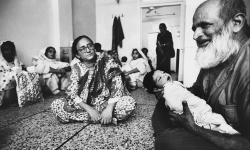
Abdul Sattar Edhi holds infants at Edhi Childcare Center in Karachi. —AP Photo
She still recalls his childlike enthusiasm when he found out my mother was interested in palmistry. She wanted to see what kind of lines someone like him, who’d devoted his entire life to caring for others, had. I remember her bringing home his hand-prints, made with the ink of ordinary office stamp pads. She still has them somewhere.
The next time I heard about them (because Bilquis was inseparable from Abdus Sattar) was when my mother went to them to facilitate an adoption for close friends.
My mother told me about two Edhi drivers who had been fired by Edhi sahib in front of her that day, for eating with the poor they were delivering food to in a settlement.
In my mind at the time, they were other-worldly. How could someone be as invested in the happiness and well-being of people they barely knew?“You are paid a salary,” he had told them, “you should eat from that money, this food is not meant for you.”
Karachi's real source
When I entered the field of journalism, Edhi was the go-to source for information about any disaster. Karachi was in turmoil, an army operation was on, people were dying left and right. Sometimes a building had collapsed.It was the easiest thing in the world to contact the Edhi Centre because they were always accessible, always willing to corroborate or correct official figures.
Most journalists had the Edhi Centre on speed-dial. Everyone trusted Edhi’s figures because it was Edhi and his workers who were removing the debris, Edhi ambulances that were ferrying the injured or picking up the dead, and often burying them.
My first substantive interaction with Edhi sahib was over three days in 1997 when I convinced him to allow me to shoot sequences of him for a video I was working on. He was initially reluctant – and most certainly nothing like the photo-hounds that some engaged in social work are.
I wanted to film him, he wanted me to film his workers and his centres. Eventually we reached a compromise, I’d shoot both.
It was a hectic shoot because Edhi had no interest in adhering to our schedules. He’d go about his daily routine and if we wanted we could tag along. The maximum allowance I had was to capture him on a walkabout through the streets of Meethadar where his office was located.
On the streets here, people spontaneously raised their hands to their foreheads to say salaam to him or came to hug him. It barely registered for him.
In between our shooting, during down-times while the filming crew recuperated or had lunch, I’d sit and talk to him. What I discovered during those frank and very candid discussions was a completely matter-of-fact man.
He had seen so much misery, so much ugliness and so much apathy in his work and around him that nothing fazed him.
Not for him the romanticisation of poverty of Mother Teresa, not for him the resignation of the religiously minded, of trusting things to God’s will. He had practical answers for everything and he was very clear in his thoughts — a clarity born out of decades of working with the most disenfranchised, the most neglected in society.
In fact, if anything made him bitter it was how some mullahs had perverted the spirit of religion with literal interpretations. He would rail many times about how the clergy only created problems for other people, never helped those in need. Sometimes, he’d suddenly remember how his statements could affect his work and drop his voice to tell me not to repeat what he’d said publicly. For the most part, I haven’t ever.
I found it ironic that for someone commonly referred to as a ‘maulana’ (religious scholar), he had no time for the rituals of religion. At times he was an agnostic, at times a fiery socialist, and yet, he embodied in himself all the best parts of his Muslim faith as well.
Bilquis Edhi — A bond of devotion
Through Bilquis I learned a different side of him. For her he was the obstinate, sometimes uncaring husband who was more obsessed with his office than home.She was interested in watching films but he never went with her. She could be bitter too, recalling once how when their own grandson had tragically died in a fire accident, he’d left to go pick up bodies from somewhere else.
Abdul Sattar Edhi speaks with his wife Bilquis Edhi in his office in Karachi. —AFP
And yet, she’d never once wavered from the work they had undertaken together, or from her loyalty to him. Together they presented as human a couple as you could imagine to find.
Over the years, I had plenty of other occasions to see both Edhi sahib and Bilquis Edhi, some for reasons that shall remain unrecounted here; each time it was like visiting grandparents.
Edhi
There was always something more important to do. Understandable, given the huge empire of services he’d constructed.
And yet, a story my brother told me encapsulated perfectly why people universally loved and trusted him.
While covering an earthquake in Balochistan for the BBC, my brother came across Edhi sahib who was providing tents and health services to the displaced people there, fundraising and arranging logistics for ambulances and other supplies.
“When I was leaving, I gave him whatever money I had on me, around 2000 rupees, and told him I’d seen sports stores in the area, and inquired if he could buy footballs for the displaced children in the camps to play with.”
Many weeks later, my brother ran into Edhi sahib again, this time covering a conference in Islamabad. Not only did Edhi remember him, he called out to him by name.
“Oye Ali, idhar aao!” he yelled.
“When I went over to him,” recalls my brother, “he said to me ‘I mentioned to Bilquis about the money you gave me and she said the stuff would be cheaper in Karachi and that we should buy it from there and send it back here, and that’s what we did. Just thought you should know.’”
This was a man handling millions in donations and interacting with thousands of people on a daily basis, it is no wonder then that he has left us all gobsmacked. That’s what true greatness can do.
May he rest in peace, may his amazing work continue through the institutions he built, and may we come to a point where the Pakistani state does not require more Edhis to do the work for it.
ghazi52
THINK TANK: CONSULTANT
- Thread starter
- #36
KARACHI: He created a charitable empire out of nothing, masterminding Pakistan’s largest welfare organisation. Today Abdul Sattar Edhi is revered by many as a national hero.
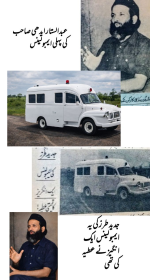
Content with just two sets of clothes, he sleeps in a windowless room of white tiles adjoining the office of his charitable foundation. Sparsely equipped, it has just one bed, a sink and a hotplate.
“He never established a home for his own children,” says his wife Bilquis, who manages the foundation’s homes for women and children.
What he has established is something of a safety net for the poor and destitute, mobilising the nation to donate and help take action -- filling a gap left by a lack of welfare state.
“Mr Edhi sits here, waiting for your donations,” sputters the speaker of an Edhi ambulance parked in an affluent neighbourhood of Karachi.
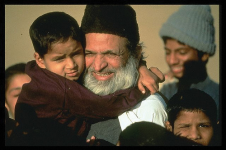
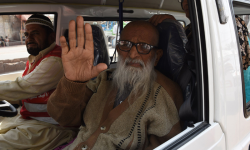
Passers-by deposit alms or pay their respects to the frail old man, whose white beard and worn triangular cap karakul are known throughout the country and beyond.
Mr Edhi has been nominated several times for the Nobel Peace Prize, and appears on the list again this year -- put there by Malala Yousafzai, Pakistan’s teenage Nobel laureate.
Born to a family of traders in Gujarat, he arrived in Pakistan in 1947.
“He thought that this new Muslim nation would be a social welfare state,” says his son Faisal.
But, when they got to Pakistan, he found “it was the exact opposite”.
The state’s failure to help his struggling family care for his mother -- paralysed and suffering from mental health issues -- was his painful and decisive turning point towards philanthropy.
In the sticky streets in the heart of Karachi, Mr Edhi, full of idealism and hope, opened his first clinic in 1951.
“Social welfare was my vocation, I had to free it,” he says in his autobiography, ‘A Mirror To The Blind’.
Motivated by a spiritual quest for justice, over the years Mr Edhi and his team have created maternity wards, morgues, orphanages, shelters and homes for the elderly -- all aimed at helping those who cannot help themselves.
ghazi52
THINK TANK: CONSULTANT
- Thread starter
- #37
Mother Bilquis
Abandoned children and the elderly, battered women, the disabled, drug addicts; Mr Edhi’s foundation now houses some 5,700 people in 17 shelters across the country.
It employs around 3,000 people, many of whom were former residents.
The project Bilquis Edhi is most proud of is the baby cradles adoption service.
In the early days of his work, as Mr Edhi cruised the streets in his ambulance, he was made desperate by the number of infant corpses he came across, many believed abandoned.
Now the foundation has before each centre a large cradle bearing the inscription: “Do not kill innocent babies, leave them in our cradle”.
The initiative has earned Mr Edhi further attacks by extremists who accuse him of promoting extra-marital sex.
But Bilquis proudly displays photos of now-grown women who are graduates of prestigious universities.
Several thousand children -- the vast majority of them girls -- left in the cradles over the past four decades have been housed by Edhi centres and adopted, she says.
Without Mr Edhi, “I would have had no life,” says Seher, 16, who grew up in the foundation’s decrepit headquarters.
“Bilquis and Mr Edhi are there for us round the clock,” smiles the girl.
She cares for younger children -- including the small daughter of a thief jailed for the burglary of the foundation in 2014, a crime which caused uproar in the country.
Now frail and weak, Mr Edhi says he is unable to manage his kingdom. He appointed his son Faisal as managing trustee early this year.
“I have done a lot of work. I am satisfied with my life,” the patriarch sighs.
“He is my hero,” says Faisal, adding that stepping into his father’s humble but mighty shoes is a “great responsibility”. “We still have so much to do.”
Abandoned children and the elderly, battered women, the disabled, drug addicts; Mr Edhi’s foundation now houses some 5,700 people in 17 shelters across the country.
It employs around 3,000 people, many of whom were former residents.
The project Bilquis Edhi is most proud of is the baby cradles adoption service.
In the early days of his work, as Mr Edhi cruised the streets in his ambulance, he was made desperate by the number of infant corpses he came across, many believed abandoned.
Now the foundation has before each centre a large cradle bearing the inscription: “Do not kill innocent babies, leave them in our cradle”.
The initiative has earned Mr Edhi further attacks by extremists who accuse him of promoting extra-marital sex.
But Bilquis proudly displays photos of now-grown women who are graduates of prestigious universities.
Several thousand children -- the vast majority of them girls -- left in the cradles over the past four decades have been housed by Edhi centres and adopted, she says.
Without Mr Edhi, “I would have had no life,” says Seher, 16, who grew up in the foundation’s decrepit headquarters.
“Bilquis and Mr Edhi are there for us round the clock,” smiles the girl.
She cares for younger children -- including the small daughter of a thief jailed for the burglary of the foundation in 2014, a crime which caused uproar in the country.
Now frail and weak, Mr Edhi says he is unable to manage his kingdom. He appointed his son Faisal as managing trustee early this year.
“I have done a lot of work. I am satisfied with my life,” the patriarch sighs.
“He is my hero,” says Faisal, adding that stepping into his father’s humble but mighty shoes is a “great responsibility”. “We still have so much to do.”


AZADPAKISTAN2009
Elite Member


A human , we all remember for his compassion and fear of Allah.
Done great amount of positive things in life
Never chased a Nobel peace award, only Dua (prayers from poor)
Similar to Imran Khan (as he focused on health care, poor class), Edhi focused on people , always on people (Social services)
Edhi's is one of shinning examples of our civilian Excellence
Done great amount of positive things in life
Never chased a Nobel peace award, only Dua (prayers from poor)
Similar to Imran Khan (as he focused on health care, poor class), Edhi focused on people , always on people (Social services)
Edhi's is one of shinning examples of our civilian Excellence
Last edited:

ghazi52
THINK TANK: CONSULTANT
- Thread starter
- #42
Edhi:
A life less ordinary
Edhi sahib was always restless, as if he were about to go someplace. He didn’t like the idea of sitting and chatting.Hasan Zaidi
July 8, 2020
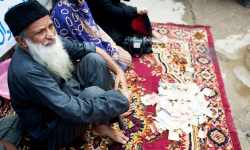
Abdul Sattar Edhi collects donations at a roadside in Peshawar. — AP Photo
Here is a tribute one always expected to write. Dreaded, but expected. Because one knew nobody, not even Edhi sahib, the one true permanent fixture of life in Karachi, can live forever. And yet, where does one begin?
How does one write about true greatness? When it seems everyone already has remarkable stories to share about Abdul Sattar Edhi. In my lifetime, I have not come across anyone who touched so many lives in so many different ways. What can then one say that does not sound trite and predictable?
In the face of a persona that is as much of a Colossus — straddling ethnic, class and religious divides — one is forced to fall back on personal recollections of a personality that was the opposite: humble, supremely matter-of-fact, ordinary, very, very human.
I became aware of the man at quite a young age. My mother first interviewed Edhi sahib and his steadfast partner Bilquis Edhi for a magazine she was bringing out in the early 1980s.
Abdul Sattar Edhi holds infants at Edhi Childcare Center in Karachi. —AP Photo
She still recalls his childlike enthusiasm when he found out my mother was interested in palmistry. She wanted to see what kind of lines someone like him, who’d devoted his entire life to caring for others, had. I remember her bringing home his hand-prints, made with the ink of ordinary office stamp pads. She still has them somewhere.
The next time I heard about them (because Bilquis was inseparable from Abdus Sattar) was when my mother went to them to facilitate an adoption for close friends.
My mother told me about two Edhi drivers who had been fired by Edhi sahib in front of her that day, for eating with the poor they were delivering food to in a settlement.
“You are paid a salary,” he had told them, “you should eat from that money, this food is not meant for you.”
In my mind at the time, they were other-worldly. How could someone be as invested in the happiness and well-being of people they barely knew?
ghazi52
THINK TANK: CONSULTANT
- Thread starter
- #43
Karachi's real source
When I entered the field of journalism, Edhi was the go-to source for information about any disaster. Karachi was in turmoil, an army operation was on, people were dying left and right. Sometimes a building had collapsed.It was the easiest thing in the world to contact the Edhi Centre because they were always accessible, always willing to corroborate or correct official figures.
Most journalists had the Edhi Centre on speed-dial. Everyone trusted Edhi’s figures because it was Edhi and his workers who were removing the debris, Edhi ambulances that were ferrying the injured or picking up the dead, and often burying them.
My first substantive interaction with Edhi sahib was over three days in 1997 when I convinced him to allow me to shoot sequences of him for a video I was working on. He was initially reluctant – and most certainly nothing like the photo-hounds that some engaged in social work are.
I wanted to film him, he wanted me to film his workers and his centres. Eventually we reached a compromise, I’d shoot both.
It was a hectic shoot because Edhi had no interest in adhering to our schedules. He’d go about his daily routine and if we wanted we could tag along. The maximum allowance I had was to capture him on a walkabout through the streets of Meethadar where his office was located.
On the streets here, people spontaneously raised their hands to their foreheads to say salaam to him or came to hug him. It barely registered for him.
In between our shooting, during down-times while the filming crew recuperated or had lunch, I’d sit and talk to him. What I discovered during those frank and very candid discussions was a completely matter-of-fact man.
ghazi52
THINK TANK: CONSULTANT
- Thread starter
- #44
Bilquis Edhi — A bond of devotion
Through Bilquis I learned a different side of him. For her he was the obstinate, sometimes uncaring husband who was more obsessed with his office than home.She was interested in watching films but he never went with her. She could be bitter too, recalling once how when their own grandson had tragically died in a fire accident, he’d left to go pick up bodies from somewhere else.
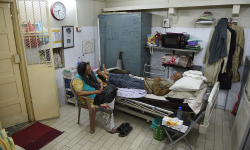
Abdul Sattar Edhi speaks with his wife Bilquis Edhi in his office in Karachi. —AFP
And yet, she’d never once wavered from the work they had undertaken together, or from her loyalty to him. Together they presented as human a couple as you could imagine to find.
Over the years, I had plenty of other occasions to see both Edhi sahib and Bilquis Edhi, some for reasons that shall remain unrecounted here; each time it was like visiting grandparents.
Edhi
There was always something more important to do. Understandable, given the huge empire of services he’d constructed.
And yet, a story my brother told me encapsulated perfectly why people universally loved and trusted him.
While covering an earthquake in Balochistan for the BBC, my brother came across Edhi sahib who was providing tents and health services to the displaced people there, fundraising and arranging logistics for ambulances and other supplies.
“When I was leaving, I gave him whatever money I had on me, around 2000 rupees, and told him I’d seen sports stores in the area, and inquired if he could buy footballs for the displaced children in the camps to play with.”
ghazi52
THINK TANK: CONSULTANT
- Thread starter
- #45
May he rest in peace, may his amazing work continue through the institutions he built, and may we come to a point where the Pakistani state does not require more Edhis to do the work for it.
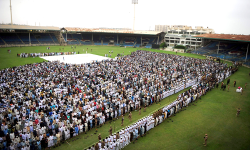
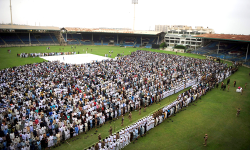
Abdul Sattar Edhi's namaz-e-janaza was attended by thousands of mourners. —AFP
Abdul Sattar Edhi's namaz-e-janaza was attended by thousands of mourners. —AFP
Users who are viewing this thread
Total: 1 (members: 0, guests: 1)
Pakistan Defence Latest
-
Punjab faces greater threat from other provinces than 'neighbouring countries': CM Maryam (20 Viewers)
- Latest: RealNapster
-

-

-

-
Country Watch Latest
-
 Pantsir, Kusha, IACCS: How India could strengthen and protect its S-400 squadrons (9 Viewers)
- Latest: Yasser76
-
 Bangladesh Keen To Join Saudi-Pak-Turkey Defence Alliance, Says PM's Top Aide (11 Viewers)
- Latest: LeonBlack08
-
-

-
Latest Posts
-
Punjab faces greater threat from other provinces than 'neighbouring countries': CM Maryam (20 Viewers)
- Latest: RealNapster
-
-
-
Pantsir, Kusha, IACCS: How India could strengthen and protect its S-400 squadrons (9 Viewers)
- Latest: Yasser76
-
 USS Lincoln ‘Hit’ By Iran’s ‘Rustsheed’ Missile? Rusty Warship Fuels A Chilling New Claim (17 Viewers)
- Latest: Starlord