Navigation
Install the app
How to install the app on iOS
Follow along with the video below to see how to install our site as a web app on your home screen.
Note: This feature may not be available in some browsers.
More options
Style variation
You are using an out of date browser. It may not display this or other websites correctly.
You should upgrade or use an alternative browser.
You should upgrade or use an alternative browser.
AI, Software, Coding, Internet Security Thread
- Thread starter Indos
- Start date
More options
Who Replied?

Indos
INT'L MOD
- Thread starter
- #513
The end of ‘easy’ IT jobs? India’s tech workforce faces AI challenges

Employees discuss a character from the AI-generated series Mahabharata, seen on a laptop screen at Galleri5, the tech studio arm of Collective Artists Network, in Bengaluru.
PHOTO: REUTERS
Published Apr 17, 2026, 05:00 AM
NEW DELHI – Many Indian workers form the backbone of information technology firms worldwide. Ms Tanya Gupta (not her real name) has been one of them, handholding new customers for an American financial software firm in Dublin, Ireland, for nearly five years.
The going was good but her annual contract was not renewed in 2026 – part of a wider move by the company to invest more in artificial intelligence, something that promises to make its output not just more efficient but also cheaper in the long run.
“A lot of the repetitive work is being automated, allowing employees to focus more on higher-value, strategic and creative work,” she said.
“If an engineer took two days to finish a task, the same thing can now be achieved by AI in less than 30 minutes. So, logically, the company felt it does not need the same workforce size as before.”
The 39-year-old declined to use her real name because she does not want her being laid off to affect future employment prospects.
She is among many Indian IT workers who have lost their jobs in the past year amid the industry’s growing reliance on AI as well as moves to cut employees and make operations more cost-efficient.
India, where its iconic computer and information services sector is a major employer, has been no exception to this trend.
The sector accounted for around 7.2 million jobs in 2024, but as AI continues to make inroads into the country’s economy, it has led to tens of thousands of job losses and raised critical questions about how India prepares itself for the transition by adequately skilling its workforce for emerging new tech opportunities.
Earlier in April, news emerged that Oracle was laying off an estimated 10,000 employees in the country, part of a wider international workforce reduction that has been attributed to the firm’s desire to cut costs and increase spending on data centre infrastructure to handle AI workloads.
This is not the only such prominent downsizing in India. Tata Consultancy Services (TCS), the country’s largest IT services exporter, also shed more than 23,400 jobs, with its employee headcount falling to 584,519 in the financial year ending in March 2026 from 607,979 in financial year 2025.
Firms such as TCS and Infosys have long powered middle-class aspirations in India through stable, well-paying jobs, but that pathway has become increasingly uncertain as hiring slows and skill requirements shift in the age of AI.
According to data from TeamLease Digital, a talent solutions firm that caters to the IT industry, India’s tech ecosystem has seen close to 40,000 layoffs in the past year or so, including many mid-level managerial roles.
“Unlike previous cycles, this is a structural – not cyclical – correction driven by AI-led productivity compression, slower global discretionary tech spending, and a pivot away from legacy services,” said Ms Neeti Sharma, chief executive of TeamLease Digital.
Post-Covid-19 boom gone bust
As the pandemic ebbed, many Indian IT services firms had looked to rebound to their conventional work model that relied on a large workforce, enabling them to bid for and take on a large number of contracts from clients.“They went on a hiring spree, wanting to get back on track revenue-wise, manpower-wise,” said Mr Ashish Singh, founder of HireMaven, a firm that specialises in recruitment for the IT sector.
Salaries were doubled or tripled as firms retained talent and hired new ones. Reality, however, hit hard soon as projects did not materialise in the anticipated large numbers amid global economic uncertainty, making large staff “bench strengths” a liability for employers.
AI, too, began to make its impact felt more and more around the same time. A lot of the basic coding work was outsourced to AI repositories with autonomous or semi-autonomous tools that can assist directly with software engineering tasks on the basis of mere prompts.
“If a firm had 10 employees engaged in coding and development, they today need just one person with the knowledge of AI to handle all that work,” said Mr Singh.
This made many junior employees engaged in basic coding tasks as well as their mid-level team managers redundant, and it prompted employers to reduce headcounts while they invest in AI tools.
As investments into AI begin to yield further results and companies put in more money to expand profitable AI-driven operations, experts fear India’s IT sector will reel from more “workforce rationalisation” in the coming months.
“A lot of employees who are unable to upskill and align themselves to the future needs of an organisation will get impacted in the next 12 to 18 months,” said Ms Sharma.
A threat but also an opportunity
Mr Kashyap Kompella, founder of RPA2AI Research, an analysis and advisory firm focused on AI governance and policy, said AI will not eliminate the need for developers.“Their value will shift from code creation to validation, testing, integration, security and production reliability. These are areas where human judgment, context and accountability remain critical,” he said. “So the technology sector is not eliminating human roles, but we will see a different mix of roles and skills.”
Beyond the short-term retrenchment phase also lies the promise of new jobs as employment patterns shift in the continuously evolving technology sector. The emergence of new technologies is creating roles for professionals in AI, data, cybersecurity and cloud computing, demand for which continues to outpace supply.
Moreover, skilled engineers who understand specific industries such as finance, healthcare, manufacturing or telecommunications and can apply AI within those contexts will be in higher demand, added Mr Kompella.
Employment opportunities are expanding beyond traditional IT services too. This includes roles in the booming data centre ecosystem that requires not just technicians and cybersecurity professionals but also civil engineers to help set up these centres and energy experts to keep them running efficiently.
While an October 2025 report from NITI Aayog, an Indian government think-tank, warned that AI-driven automation could displace up to two million jobs in India’s tech services sector by 2031, it also added that if the country were to skill people strategically, the number of jobs in the sector could swell by around four million in the next five years.
The Ministry of Electronics and Information Technology has undertaken several measures to skill the country’s workforce in new and emerging sectors. An estimated 168,000 individuals have been trained in various AI-related courses and the ministry is setting up labs in Tier 2 and 3 cities across the country to offer foundational-level courses in AI and data-related fields.
India already accounts for around 16 per cent of the global AI talent pool, but lack of adequate talent remains a concern.
According to a report from Deloitte, Indian AI talent demand is projected to grow from around 600,000 to more than 1.25 million by 2027. However, the AI market is expected to grow at 25 per cent to 35 per cent, potentially signalling a demand-supply gap in the talent pool and a need for upskilling existing talent.
Ms Gupta, whose job contract ends in April 2026, invested in a 12-week online AI-skilling course from MIT Professional Education that cost her around 200,000 rupees (S$2,700). “You have to keep yourself upskilled to be relevant in the employment market,” she said.
But there is a wider message in all this AI-driven churn for Indian youth waiting to enter the workforce and their parents. The conventional strategy of studying computer science in college to become a software developer is no longer sustainable as entry-level coding jobs shrink.
Many became software programmers with the hope of being deployed overseas to work for their employer’s clients, particularly in the US, and earning much higher salaries in US dollars – a dream that, too, has petered out with increased restriction on the employment of overseas workers in America.
“All this is a reality check for Indian families,” said Ms Sharma from TeamLease Digital.
“We need parents and their children to understand the shift in skills and domains that is happening right now in India and pivot into streams other than computer science so that each one stands a better chance at securing employment.”

India's IT workforce faces AI challenges
Explore how AI is transforming India's tech workforce, leading to job shifts and the urgent need for new skills. Read more at straitstimes.com. Read more at straitstimes.com.

Hamartia Antidote
Elite Member

Michael Truell: Building Cursor at 23, Taking on GitHub Copilot, and Advice to Engineering Students

Cursor's 25-year-old CEO is a former Google intern who just inked a $60 billion deal with SpaceX | Fortune
From Google intern at 18 to a billionaire at 25, Cursor CEO Michael Truell's rise is one of Silicon Valley's fastest.
Cursor’s 25-year-old CEO is a former Google intern who just inked a $60 billion deal with SpaceX
Indos
INT'L MOD
- Thread starter
- #515
"Software Fundamentals Matter More Than Ever" — Matt Pocock
AI coding tools are overhyped and powerful at the same time. Used well, they're extraordinary. Used badly, they'll bury you in spaghetti code faster than any human team could.
The difference isn't the tool. It's the process. After 18 months of teaching developers to build with AI agents, Matt Pocock has watched the same patterns emerge: the devs who succeed aren't the ones who delegate everything or nothing. They're the ones who fall back on engineering fundamentals.
In this talk, he shares the iterative process his students use to ship high-quality applications with AI agent swarms, and why the principles that make it work (ubiquitous language, vertical slices, TDD, deep modules) are decades-old ideas that didn't break. They got more important.
Indos
INT'L MOD
- Thread starter
- #517
Three skills that matter when AI handles the coding
Opinion
May 7, 2026
As AI takes on the heavy lifting, developers must master the ability to prompt models, evaluate model output, and above all, retain their coding skills.

Writing code has always been the most time- and resource-intensive task in software development. AI is changing that, and faster than most engineering organizations are prepared for. Tools like Claude Code and Cursor are already handling significant parts of code construction, freeing developers to spend more time on requirements, architecture, and design.
But that shift creates a new challenge nobody is talking about enough. As AI takes on the heavy lifting, the skills that matter most are moving upstream: how to provide the right context for a prompt, how to evaluate what the model produces, and how to understand a problem deeply enough that you can’t be fooled by a confident but wrong answer.
This piece explores those three skills and why developers who master them will have a significant edge over those who don’t.
Beyond coding: Mastering the art of the prompt
Software translation tools such as compilers and assemblers map a high-level description of code to a lower-level representation suitable for execution. Layering such tools led to the first dramatic improvements in coding productivity. AI prompt engineering represents the next generation of layered translation software that sits above the compiler and assembler. With AI code generation, the focus will move from writing good code to writing good prompts.What constitutes a good prompt? The answer is good context. But what provides the best context? Most importantly, the developer must have a good understanding of the task the software must perform. Consider what’s required to write a typical software module that is part of a larger system. The prompt should cover:
- Expected inputs and outputs, like the software’s core functionality
- Errors and exception conditions and how they should be handled
- Performance expectations
- Existing frameworks the software is surrounded by and the programming language used
- Interface expected by the user
- Required storage, compute, and network resources.
How system design informs context
For new initiatives, the context for this module should be taken from a detailed system design. The system design is essentially the blueprint for the software, created by breaking down the overall design into smaller, separate parts called modules. Each of the modules is responsible for performing a specific function that the software needs to deliver. In microservice implementations, domain-driven design breaks the business requirements into distinct subdomains that can be mapped to microservices.Good system designs have a coherent architecture that provides a concept of operation like how the modules work together to meet the functional requirements. The best system designs result when well-understood requirements are combined with the right architecture.
By working backwards and building the context into a prompt we discovered the most important phases in the development life cycle including requirements analysis (what the software has to do), and architecture and system design (how it does it).

An example of a linear software life cycle.
Confluent
Although one design pass might work, often developers will need to iterate on their design to get the best outcome. This has been emphasized by many software experts over the years, but perhaps best put by the famous computer scientist Fred Brooks: “Plan to throw one away, you will anyway.”

An example of an iterative software life cycle.
Confluent
Iterative life cycles like spiral and evolutionary prototyping build the “throw one away” part into the process. Throwing something away sounds wasteful, but each iteration builds a deeper understanding of the problem: user requirements, architecture limitations, risks, and opportunities. Learning from each iteration greatly reduces the cost and complexity of the final product.
InfoWorld Smart Answers
Explore related questions
- How can I ensure my AI-generated code is production-ready?
- Why do AI code generation models still require human debugging?
- How do Agile practices mitigate risks in AI-assisted software development?
- Are prompt engineering certifications actually valuable for your tech career?
- How does the Vibe Coding workflow fit into traditional development?
How AI tools can impact developer productivity
AI translation tools have the potential to make us more productive, but also introduce the risk that we will become lazy and dependent on them. A recent study found that LLM-assisted essay writing reduced user’s cognitive energy associated with their work relative to those who wrote essays unassisted by LLMs. This effect was termed “cognitive debt.”I work with a strength trainer because modern life is too easy. It doesn’t require heavy lifting or strenuous activity. So we have to simulate it to improve both our strength and health. AI coding tools are like robots that do the heavy lifting of code generation for us. Without different challenges for us to overcome, we’ll get weaker.
Modern coding and AI tools
We need to find ways to keep our brains working hard while using AI tools, so that we have the capacity to think through the hard problems in our software design and its development work.Writing optimized assembly code is no longer considered a good use of anyone’s time because compilers are so good at it. But until recently, writing good code for a compiler or run-time engine in Java, Go, or Python has been an important skill. In fact, these skills will remain important even as LLMs support code generation because developers will still need to review the generated code and verify that the LLM output meets certain standards. Experienced developers who have been writing code for years already have these skills. Both new and existing developers will be able to learn and expand their knowledge via interaction with LLM tools that expose them to new techniques and ideas.
We need to find the equivalent of strength training for coding that replaces some coding directly but retains understanding and judgement for the code the LLM produces. Where can we put our brains to work to avoid cognitive debt?
Avoiding the cognitive debt danger
First, study and understand the code generated from your prompt. Then re-write your prompt to improve the generated code, or rewrite the generated code if it’s close enough to what you need. LLMs behave statistically, so the generated code might not meet design goals. LLM gaslighting is real: quite often what it generates won’t run or isn’t correct, but the LLM will insist confidently that all is well. Don’t trust. Always verify.LLMs can generate alternative designs from the same or slightly different prompt. Many developers are already leveraging this capability to explore the design space. Make sure you put the effort into understanding and modifying the code generated, and you’ll retain your coding skills.
Second, the focus of prompt engineering is to provide context to an LLM. So the key becomes creating that context, and understanding and judging the code that is generated. In addition to retaining their existing language and coding skills, software professionals should focus on other life-cycle elements, especially requirements, architecture, and design, so they have high-quality context for prompts.
Third, learn new languages and data models, and understand where each one fits best.
Fourth, build an understanding of best practices in code construction and design, independent of languages, so you can judge generated code using best practices that work across many different languages.
To stay competitive, you should understand that the bar will be rising. Historically, research has shown that the most productive individual developers are already about 10 times more effective than the least productive ones, and the best teams are about five times better than the weakest teams. AI tools could increase these differences by two or three times more, further widening the productivity gap. Many of these highly productive teams will work for your competitors.
AI will allow developers and teams that can crystallize requirements, architecture, and design to rapidly apply and evaluate different languages and data models to their project. AI will make iterative life cycles like spiral and evolutionary prototyping even more effective by allowing parallel development paths during each iteration. The key to success is leveraging AI in a way that allows you to focus on higher-level design issues while not losing control over code complexity. If you don’t learn these higher-level skills, developers and teams that do will be far more productive than you are.
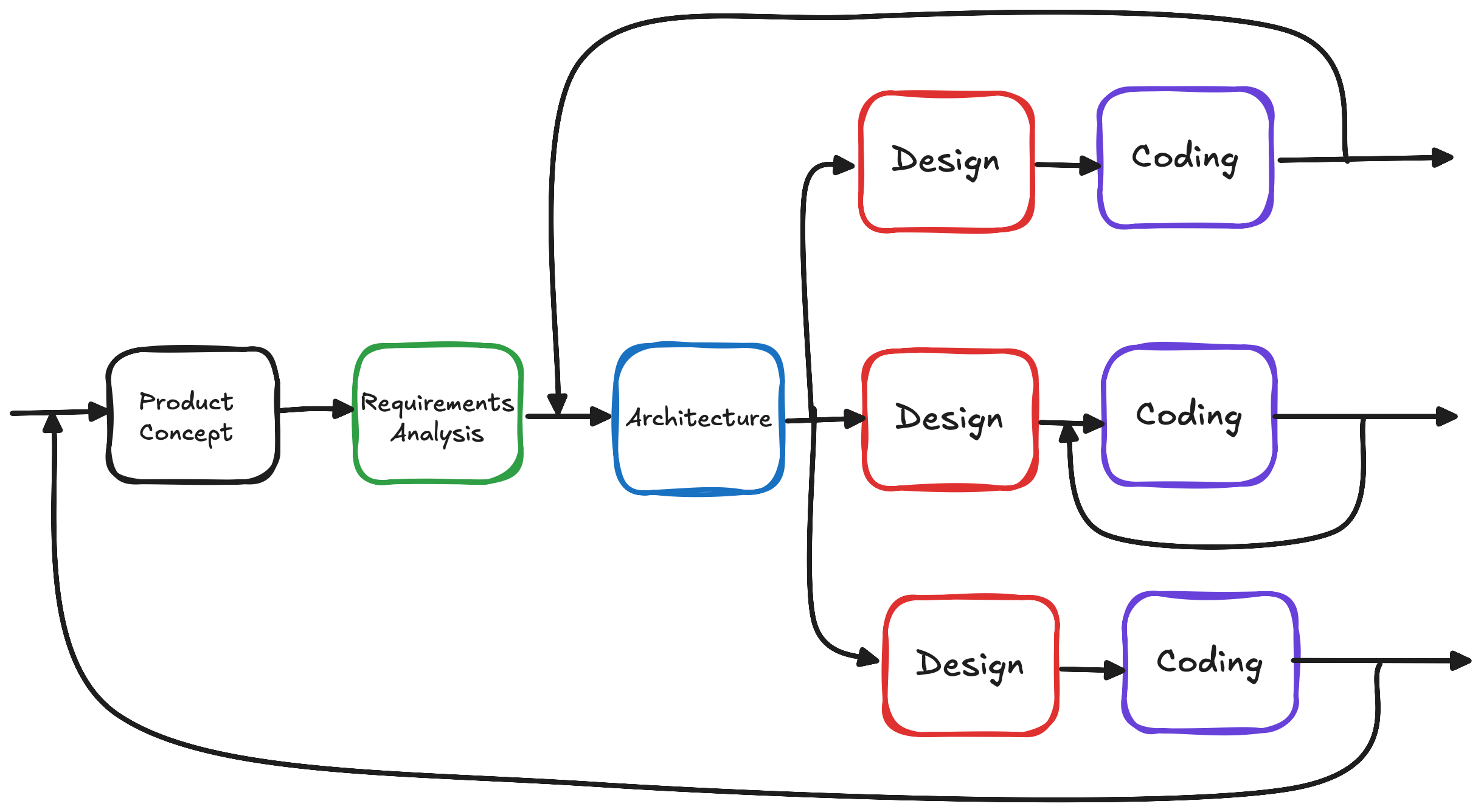
Iterative life cycle with parallel paths and feedback loops.
Confluent
Accidental vs. essential complexity – why AI cannot be a silver bullet
Some have argued that AI will significantly improve software productivity. They envision a future in which software developers need only write a few prompts and an LLM will produce software that can replace existing SaaS products. But as Fred Brooks argued in a famous 1986 paper, “No Silver Bullet,” this is still impossible because of the two types of complexity that remain—accidental complexity and essential complexity.Accidental complexity (or ‘accidents’)
Accidents are not inherent to the problem itself, but to the production process including the tools, languages, hardware limits, and implementation details we use to build the software. Historically, most productivity gains come from reducing accidental complexity. AI productivity can reduce accidental complexity, but developers must deal with its own challenges including hallucinations and poor-quality generated code that must be detected.Essential complexity (or ‘essence’)
Essence refers to the inherent, unavoidable complexity of the problem itself. It is the challenge of “fashioning the complex conceptual construct” such as the abstract, interlocking ideas, data relationships, algorithms, and behaviors that accurately model the real-world problem the software must solve.AI cannot be a silver bullet because of software’s inherent complexity. Even if you could reduce the time for all the accidental tasks to zero, the essential tasks still will be your biggest challenge and take up most of your efforts. Nevertheless, AI is a powerful tool. When used properly to manage complexity and explore the design space, it can significantly increase the productivity of teams and the quality of the software developed.
—
New Tech Forum provides a venue for technology leaders—including vendors and other outside contributors—to explore and discuss emerging enterprise technology in unprecedented depth and breadth. The selection is subjective, based on our pick of the technologies we believe to be important and of greatest interest to InfoWorld readers. InfoWorld does not accept marketing collateral for publication and reserves the right to edit all contributed content. Send all inquiries to [email protected].
by Matthew OKeefe, Contributor
Matthew O’Keefe is a Principal Technologist in the Technology Strategy Group at Confluent, working on data modeling, schema discovery and management, and Kafka integrations with relational databases. Prior to Confluent, he was on the database engineering team at Oracle, working on product marketing, outbound product management, and field sales engineering. He has founded two software companies, one of which was acquired by Red Hat. He has a PhD from Purdue University in parallel processing.
He was also a professor at the University of Minnesota, helping PhD and MS students learn and advance computer science and application development. Outside of work, Matthew likes sailing and boating around Lake Superior and Apostle Islands National Park with his family, friends, and dogs.
Three skills that matter when AI handles the coding
As AI takes on the heavy lifting, developers must master the ability to prompt models, evaluate model output, and above all, retain their coding skills.
 www.infoworld.com
Indos
INT'L MOD
- Thread starter
- #518
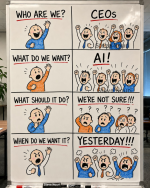
Everyone wants AI now.
And it is costing them millions.
But, What breaks if you kill the pilot?
For many companies, the answer is: not much.
That is not just my opinion. The data is starting to say the same thing.
RAND found that more than 80% of AI projects fail, roughly twice the failure rate of non-AI IT projects.
MIT NANDA found that despite $30–40B in enterprise GenAI investment, only 5% of integrated AI pilots are extracting major value, while most show no measurable P&L impact.
S&P Global found that the share of companies abandoning most AI initiatives rose from 17% to 42%, with the average organization scrapping 46% of AI proof-of-concepts before production.
BCG found that only 5% of companies are achieving AI value at scale, while 60% are seeing minimal revenue or cost gains despite serious investment.
Different reports.
Same underlying truth.
AI does not magically fix how a business actually works.
If anything, it exposes the cracks:
↳ Data lives in twelve places.
↳ Metrics mean one thing in finance and another in sales.
↳ Ownership is passed around like a ping-pong ball.
↳ Governance shows up after the demo, not before it.
↳ Responsible AI is treated like a slide, not an operating system.
Still, many companies keep launching pilots and hoping AI will smooth over the mess.
But tools do not create transformation.
Operating models do.
The teams actually getting value do three things differently:
1. They use AI to expose the broken parts of the business.
Not before transformation.
Through transformation.
The failed prompts, messy handoffs, bad data, duplicate processes, and unclear approvals are not distractions. They are the map.
2. They kill pilots early.
If a pilot cannot connect to revenue, cost, risk, speed, customer experience, or decision quality, it should not survive just because it sounds innovative.
Fail fast is not failure.
Keeping a useless pilot alive is.
3. They use AI for the right job.
If the goal is simple automation, there are often cheaper and easier ways to do it.
AI is powerful when the work requires language, reasoning, context, decision support, creativity, or judgment at scale.
Not every workflow needs an agent.
Not every problem needs a model.
The test is simple:
Turn it off.
If no one notices, it was never transformation.
It was theatre.

Everyone wants AI now. And it is costing them millions. But, What breaks if you kill the pilot? For many companies, the answer is: not much. That is not just my opinion. The data is starting to say… | Steve Nouri | 136 comments
Everyone wants AI now. And it is costing them millions. But, What breaks if you kill the pilot? For many companies, the answer is: not much. That is not just my opinion. The data is starting to say the same thing. RAND found that more than 80% of AI projects fail, roughly twice the failure...
 www.linkedin.com
Indos
INT'L MOD
- Thread starter
- #519
Exclusive: Microsoft eyeing startup deals for life after OpenAI
By Deepa Seetharaman, Milana Vinn and Kenrick CaiMay 14, 2026
Updated May 14, 2026
- Microsoft explores AI startup acquisitions to diversify beyond OpenAI partnership, sources say
- Competition for AI talent intensifies as SpaceX and others pursue similar deals
- Microsoft considered acquiring Cursor but dropped talks over regulatory concerns, sources say
- Microsoft has spent over $100 billion on OpenAI, executive says
SAN FRANCISCO / NEW YORK, May 13 (Reuters) - Microsoft (MSFT.O), opens new tab is shopping for artificial-intelligence startups as the software company prepares for a future independent of its once-vital partner OpenAI, five people familiar with the matter said.
The potential acquisitions could help the company stock up on AI talent and deliver on its stated goal of building a cutting-edge AI model by next year, three of the people said.
This spring, Microsoft weighed acquiring code-generation startup Cursor, four people said. But Microsoft backed away due to internal concerns that such a deal would not pass regulatory scrutiny, given Microsoft's ownership of GitHub Copilot, three of the people said.
Microsoft is in discussions with Inception, a small startup built by a Stanford University team focused on a different method of developing large language models, three people familiar with the matter said. Inception was founded in mid-2024. Microsoft's venture fund M12 invested in Inception’s $50 million seed round in late 2025.
The discussions are ongoing and may not result in a deal, these sources said.
Inception declined to comment.
HEATED MARKET
Microsoft is eyeing deals in an increasingly heated market. AI researchers can easily command tens of millions of dollars or more in compensation. Startup valuations are soaring as investors scramble for positions in promising AI technology.Microsoft is also facing significant competition for deals from other tech giants, notably Elon Musk's SpaceX, two people familiar with the matter said. SpaceX, which bought Musk's AI research startup xAI in February, announced a deal with Cursor shortly after Microsoft walked away.
Cursor declined to comment.
SpaceX also courted Inception, three people said. Inception recently hired a bank to help negotiate a deal, a person familiar with the startup said, adding that Inception is looking for a price of over $1 billion.
SpaceX did not immediately respond to a request for comment.
10 TRILLION PARAMETERS
Catching up to OpenAI and other labs at the frontier is a tall order. Some of the most advanced AI labs are building models of around 10 trillion parameters, a measurement of their sophistication, researchers say. That is up from about 1 trillion parameters three years ago.Inception's models produce text using a technique called diffusion, more commonly used to generate AI images and videos. While standard models generate one token at a time, diffusion generates and refines multiple tokens simultaneously. This method can significantly boost the model's speed.
But diffusion can be unpredictable and it is unclear if it can be used to produce mammoth-sized models, AI researchers say.
Any deals would add to the work under way at Microsoft, including teams led by DeepMind co-founder Mustafa Suleyman, a person familiar with the strategy said.
Microsoft and OpenAI have been partners since 2019, when Microsoft invested $1 billion into the then-unknown research lab. OpenAI's release of ChatGPT in late 2022 anointed Microsoft as an AI pioneer while also powering growth for Microsoft’s Azure cloud-computing business. Microsoft has given $11.8 billion of its promised $13 billion to OpenAI, Microsoft said in an April 29 securities filing, opens new tab.
Microsoft has spent more than $100 billion on its OpenAI investments and its costs of building infrastructure and hosting, Michael Wetter, who runs the company's corporate development, testified in court on Wednesday.
The initial deal gave Microsoft exclusive access to OpenAI’s technology and gave OpenAI a guaranteed source of computing resources to pursue research. But tensions flared between OpenAI and Microsoft over the years as both sides chafed over the contract's restrictions.
OpenAI found that its needs outstripped what Microsoft could supply. Microsoft was also contractually barred from building a foundation model that could compete with OpenAI's offerings, two of the people said. The two companies have loosened their contract several times over the years.
An amended deal in late 2025 allowed Microsoft to build artificial general intelligence, a still-theoretical advanced form of AI that can do complex tasks better than a human. In late April, OpenAI and Microsoft struck a deal that gives OpenAI the freedom to build some products with Microsoft's rivals, such as Amazon.
Reporting by Deepa Seetharaman in San Francisco and Milana Vinn in New York; editing by Kenneth Li and Rod Nickel
Indos
INT'L MOD
- Thread starter
- #520
Twin Brothers Deleted Government Databases Minutes After Being Fired
Intan Rakhmayanti
18 May 2026 10:15

JAKARTA — Two twin brothers in the United States deleted 96 government databases just minutes after being fired from the technology company where they worked.
The brothers, Muneeb Akhter and Sohaib Akhter, both 34 years old, reportedly had prior cybercrime convictions dating back to 2015. At that time, Muneeb was sentenced to three years in prison, while Sohaib received a two-year sentence.
After their release, both returned to the technology sector. In 2023, Muneeb joined a Washington DC-based company that provided software and services to 45 US federal government clients. A year later, Sohaib also joined the same company.
However, according to US authorities, the two brothers later became involved in illegal activities again.
Government documents stated that on February 18, 2025, both men were called into a Microsoft Teams meeting and immediately terminated from the company.
The meeting ended at 4:50 PM local time. Five minutes later, Sohaib attempted to log back into the company network, but his VPN and Windows accounts had already been disabled.
Muneeb’s account, however, had not yet been deactivated. Authorities said he quickly exploited the oversight to carry out what prosecutors described as a digital revenge attack.
At 4:56 PM, Muneeb began accessing US government databases managed by the company. He reportedly executed commands to block other users before deleting databases one by one.
Two minutes later, a database belonging to the US Department of Homeland Security was deleted using the command:
Authorities also said Muneeb later used an AI tool in an attempt to learn how to erase digital traces of the attack.“DROP DATABASE dhsproddb.”
Within roughly one hour, a total of 96 US government databases had reportedly been deleted.“How to delete system logs from SQL server after dropping a database?” he reportedly asked the AI tool at 4:59 PM, according to Ars Technica.
Authorities also accused him of downloading 1,805 files belonging to the Equal Employment Opportunity Commission (EEOC) and stealing federal tax data belonging to at least 450 individuals.
During the incident, the brothers allegedly discussed the possibility of extorting the company.
However, Muneeb rejected the idea.“You should have had a kill script. Extorting them for money maybe could—” Sohaib reportedly said.
Three weeks later, federal agents raided their home in Virginia. Authorities said they found various technology devices, seven firearms, and hundreds of rounds of ammunition at Sohaib’s residence.“Don’t do that. That’s clear evidence we’re guilty,” he replied.
Both brothers were eventually arrested in December 2025.
Muneeb pleaded guilty in April 2026, while Sohaib chose to take his case to trial.
On May 7, 2026, a jury found Sohaib guilty of conspiracy to commit computer fraud, illegal password trafficking, and illegal possession of firearms.

Baru Dipecat 6 Menit, Dua Bersaudara Hapus Data Negara
Dua saudara kembar di AS, Muneeb dan Sohaib Akhter, menghapus 96 database pemerintah setelah dipecat.
 www.cnbcindonesia.com
Indos
INT'L MOD
- Thread starter
- #521
OpenAI gives European companies access to its latest models to bolster resilience
By Paul Sandle
May 12, 2026
6:01 PM GMT+7
Updated May 12, 2026
LONDON, May 12 (Reuters) - U.S. artificial intelligence giant OpenAI said it was granting access to its latest models including GPT-5.5-Cyber to Deutsche Telekom, BBVA and dozens more European companies to help bolster their resilience to vulnerabilities in their systems.
Other companies added to the scheme included Spain's Telefonica, Britain's Sophos and German financial services firm Scalable Capital, Open AI said.
OpenAI's "Trusted Access for Cyber" programme gives verified companies in vital sectors such as financial services, telecoms, energy and public services access to its models, including precise safeguards for defensive work.
OpenAI's MD for EMEA, Emmanuel Marill, said there was an important balance to be struck between access, usefulness and safety as AI became more capable.
"We need to block dangerous activity, while making sure trusted defenders have tools that are genuinely useful in protecting systems, finding vulnerabilities and responding to threats quickly," he said on Tuesday.
The release of Mythos by OpenAI's rival Anthropic last month significantly upped the risks posed to banks and other companies from new frontier AI models.
Their capabilities to code at a high level have given them an unprecedented ability to identify cybersecurity risks and devise ways to exploit them, raising fears they could be used to destabilise banks and other companies.
OpenAI has offered the European Commission open access to cybersecurity features, Brussels said on Monday, but a Commission spokesperson added that Anthropic had not been as forthcoming.
Former British finance minister George Osborne, who heads the company's "OpenAI for Countries" initiative, on Monday sent an explanatory letter to the Commission, saying that democratizing access to defensive tools could strengthen shared security, support public safety and reflect European priorities.
OpenAI also said on Monday it was setting up a new company with more than $4 billion in initial investment to help organisations build and deploy AI systems, and would acquire AI consulting firm Tomoro to quickly scale up the unit.
Indos
INT'L MOD
- Thread starter
- #523
Anthropic’s Code with Claude showed off coding’s future—whether you like it or not
As tools like Claude Code get better, more and more developers are happy to hand off coding tasks to them. The way software gets built has changed for good.
By Will Douglas Heavenarchive page
May 21, 2026

The vibes were strong at Code with Claude, Anthropic’s two-day event for software developers in London that kicked off on May 19, the same day as Google’s I/O in Palo Alto. (A coincidence, not a flex, Anthropic staffers assured me.)
“Who here has shipped a pull request in the last week that was completely written by Claude?” Jeremy Hadfield, an engineer at Anthropic, asked from the main stage. Almost half the people in the packed room—many sitting with laptops on their knees, coding or prompting as they watched the talks—raised their hands.
Pull requests are fixes or updates to existing software that are submitted for review before they go live. They are the bread and butter of software development, the chunks of code that most professional developers spend their lives writing—or did until now.
“Who here has shipped a pull request that was completely written by Claude where they did not read the code at all?” Hadfield asked next. Nervous laughter. Most of the hands stayed up.
It’s not news that LLM-powered tools like Anthropic’s Claude Code and OpenAI’s Codex have upended the way software gets made. Top tech companies now like to boast of how little code their developers write by hand. (“Most software at Anthropic is now written by Claude,” Hadfield said. “Claude has written most of the code in Claude Code.”) OpenAI, Google, and Microsoft make similar claims. Many others wish they could.
Even so, it is striking how normal this new paradigm already seems, and how fast it has set in. This was the second year that Anthropic has put on developer events, which also run in San Francisco and Tokyo. This time last year, the company had just released Claude 4. It could code, kind of. But with Anthropic’s latest string of updates—especially Claude 4.6 and then 4.7, released in February and April—Claude Code is a tool that more and more developers seem happy to hand their work off to.

ANTHROPIC (GRAPHIC) / WILL DOUGLAS HEAVEN (PHOTO)
Anthropic says its goal is to push automation as far as it will go. Instead of using AI to generate code and then having humans clean it up and fix the mistakes, it wants Claude to check and correct its own work. “The default isn’t ‘I’m going to prompt Claude’—the default is now ‘I’m going to have Claude prompt itself,’” Boris Cherny, who heads Claude Code, said in the opening keynote.
If all goes well, human developers shouldn’t even see the error messages when something doesn’t work. That will all be handled by Claude, which will test and tweak, test and tweak, until everything runs as it should. As Ravi Trivedi, an engineer at Anthropic, put it in another talk: “The key principle is getting out of Claude’s way. We like to say: ‘Let it cook.’”
Trivedi presented a new feature in Claude Code, announced two weeks ago, which Anthropic calls dreaming. Claude Code agents write notes to themselves, recording and saving useful information about specific tasks. When another coding agent later starts to work on the same code, it can use the notes to get up to speed faster and learn from any errors that previous agents may have made.
Dreaming is a system that Claude Code uses to read through all these notes and consolidate the information they contain, spotting patterns and common issues across different tasks. In theory, dreaming should help Claude Code learn about a particular code base and get better and better at working on it.
Success stories
Code with Claude is an event aimed at developers. As well as product showcases and hands-on workshops from Anthropic, there were how-tos from a range of companies that have reshaped their software development teams around Claude Code, including Spotify and Delivery Hero as well as Lovable, Base44, and Monday.com—three startups vibe-coding apps that help people vibe-code apps.
There were no signs of unease at Code with Claude. Everybody I met wanted in.
And yet outside the conference there have been a number of reports that many coders are starting to question this bright new future. Some gripe in online forums like Reddit and Hacker News that AI coding tools are being pushed by managers chasing productivity gains, when in practice the technology makes software development harder because of all the extra code developers now have to review. “The only people I've heard saying that generated code is fine are those who don’t read it,” a user called pron posted on Hacker News last week.
Others claim that their coding abilities have fallen off as they hand more tasks to AI. And researchers have warned that AI tools can produce unsafe code that will make software more vulnerable to attacks.
I sat down with Claude engineering lead Katelyn Lesse and Claude product lead Angela Jiang and asked them what they made of the concerns that a sudden flood of code generated (and shipped) without proper human oversight was kicking serious security and maintenance problems down the road.
“All of the old software development best practices still apply. They’ve applied this entire time,” said Lesse. “I think there are a lot of people and teams that may have lost sight of them in this moment.”
And yet as Anthropic and others push for greater automation and tools like Claude Code improve, the temptation increases to offload more and more tasks, including oversight. Lesse told me that some of the technical managers at Anthropic are exhausted by keeping up with all the code their teams now produce. “Part of things happening so much more quickly is just managing your time,” she said.
“I think that right now Claude is probably as good as a midlevel engineer at writing code,” she added. You still need expert engineers to design a system and troubleshoot harder problems, she said. “But over time we want Claude to get better and better at all different types of engineering.”
Jiang agreed: “I think the absolute end state we’re trying to get to is Claude basically being able to build itself.”

Anthropic’s Code with Claude showed off coding’s future—whether you like it or not
As tools like Claude Code get better, more and more developers are happy to hand off coding tasks to them. The way software gets built has changed for good.
 www.technologyreview.com
Users who are viewing this thread
Total: 1 (members: 0, guests: 1)
Pakistan Defence Latest
-
 Federal cabinet gives nod to imposition of emergency in KP; summary sent to president (20 Viewers)
- Latest: flyingorca
-

-
-

Country Watch Latest


Latest Posts
-
-
Federal cabinet gives nod to imposition of emergency in KP; summary sent to president (20 Viewers)
- Latest: flyingorca
-
-

-
