Navigation
Install the app
How to install the app on iOS
Follow along with the video below to see how to install our site as a web app on your home screen.
Note: This feature may not be available in some browsers.
More options
Style variation
You are using an out of date browser. It may not display this or other websites correctly.
You should upgrade or use an alternative browser.
You should upgrade or use an alternative browser.
AI, Software, Coding, Internet Security Thread
- Thread starter Indos
- Start date
More options
Who Replied?

Indos
INT'L MOD
- Thread starter
- #167
Will chatbots eat India’s IT industry?
TCS, Infosys and others try to harness the technology first

Photograph: Rebecca Conway/The New York Times/Redux/Eyevine
May 9th 2024|Bangalore
WHAT IS THE ideal job to outsource to artificial intelligence? Today’s AIs, in particular the ChatGPT-like generative sort, have a leaky memory, cannot handle physical objects and are worse than humans at interacting with humans. Where they excel is in manipulating numbers and symbols, especially within well-defined tasks such as writing bits of computer code. This happens to be the forte of giant existing outsourcing businesses—India’s information-technology (IT) companies. Seven of them, including the two biggest, Tata Consultancy Services (TCS) and Infosys, collectively laid off 75,000 employees last year. The firms say this reduction, equivalent to about 4% of their combined workforce, has nothing to do with AI and reflects the broader slowdown in the tech sector. In reality, they say, AI is an opportunity, not a threat.
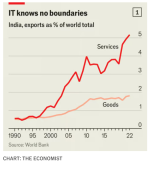
Business services are critical to India’s economy. The sector employs 5m people, or less than 1% of Indian workers, but contributes 7% of GDP and nearly a quarter of total exports. Simple services such as call centres account for a fifth of those foreign revenues. Three-fifths are generated by IT services such as moving data to the computing cloud. The rest comes from sophisticated processes tailored for individual clients. Capital Economics, a research firm, calculates that an extreme case, in which AI wiped out the industry entirely and the resources were not reallocated, would knock nearly one percentage point off annual GDP growth over the next decade in India. In a likelier scenario of “a slow demise”, the country would grow 0.3-0.4 percentage points less fast.
The simplest jobs are the most vulnerable. Data from Upwork, a freelancing platform, shows that earnings for uncomplicated writing tasks like copy-editing fell by 5% between ChatGPT’s launch in November 2022 and April 2023, relative to roles less affected by AI. In the year after Dall-E 2, an image-creation model, was launched in April 2022, wages for jobs like graphic design fell by 7-14%. Some companies are using AI to deal with simple customer-service requests and repetitive data-processing tasks. In April K. Krithivasan, chief executive of TCS, predicted that “maybe a year or so down the line” chatbots could do much of the work of a call-centre employee. In time, he mused, AI could foretell gripes and alleviate them before a customer ever picks up the phone.
But Mr Krithivasan and fellow Indian IT bosses believe that in the age of AI the world is going to need more tech workers, not fewer—and a lot of them will come from India. They are thinking how to turn the AI revolution to their firms’ advantage.
One way is to use AI to boost the firms’ productivity. Infosys has rolled out AI helpers to all 330,000 of its employees. It says this has already led to a 10-30% reduction in the time needed to build some new applications. Sales assistants who previously waited hours or days to get input from colleagues in order to answer clients’ questions can now respond in 30 minutes.

The hope is that added efficiency will greatly boost demand for such services. Another source of fresh demand—and the IT companies’ second big opportunity—is for all-new tasks tied to clients’ deployment of AI in their organisations. The IT firms have been preparing for this. A paper last year by Alexander Copestake of the IMF and colleagues identified “near-exponential growth” in demand for AI-related skills in India’s service sector since 2016. Two in five Indian AI job postings in the 2010s were in Bangalore, which is home to Infosys and where TCS has a large campus.
These recruits have been busy. Infosys has already built AI tools, such as chatbots that answer queries based on internal company data, for 50 clients. An executive at TCS says his teams have been developing voice assistants for customers since before anyone heard of ChatGPT. Some liken the current AI moment to the lead-up to the year 2000, when Western businesses raced to prevent their computer systems from being fatally flummoxed by the zeroes marking the new millennium. Fear of the “Y2K bug” enriched the Indian IT firms. A series of mini-Y2Ks, as clients rush to stay ahead of the fast-changing technology, may create another bonanza.
The outsourcing giants hope that AI will also help them win back some business they have been losing to their multinational clients’ own Indian IT operations. In-house “global capability centres” have been mushrooming in India in recent years. They make it easier for companies to safeguard sensitive data and intellectual property. But if AI tools become an off-the-shelf commodity like cloud storage, then economies of scale could give the IT-services specialists an edge. Last June Infosys acquired the IT centre in India belonging to Danske Bank, a Danish lender.
Nandan Nilekani, chairman and co-founder of Infosys, argues that his company and its Indian IT rivals will benefit from what he calls “velocity of experience”. Already, he observes, one client wants a coding “copilot”; another wants better customer support; a third wants to predict how a wildfire might affect an energy utility. Solving these diverse problems makes firms like Infosys well-suited to tackle new scenarios, he explains. In time, it may help them avoid a cliff-edge. ■
To stay on top of the biggest stories in business and technology, sign up to the Bottom Line, our weekly subscriber-only newsletter

Will chatbots eat India’s IT industry?
TCS, Infosys and others try to harness the technology first
Indos
INT'L MOD
- Thread starter
- #168
AI tool service by other companies using their own model that I believe will use open source ones basically will compete directly with companies using Chat GPT as their AI model using Chat GPT API
IT companies offering AI tool will also compete with Chat GPT that offer AI integration with companies internal data and Apps through API.
Using Chat GPT AI model to process data inside the companies is also not really expensive, it is in my opinion the most efficient way when it comes to implementing AI in our company whether for the consumption of the internal workers or selling other Apps by using Chat GPT AI modeI for the AI engine.
I would say Chat GPT is likely emerging as another Google for AI industry as like Google current domination in the search engine business. Chat GPT is also now entering search engine business as well.
When the data is very sensitive, companies should make its own IT department that uses open source AI engine and have its own servers.
Actually what is actually sensitive data ? Most companies already use Cloud Computing already to store data, running applications etc where the Cloud itself is managed by other companies like AWS, Google, Microsoft, etc. Banking system is also already leaving internal servers and uses Cloud Computing managed by other companies. Inside Cloud Computing, any company also can use AI model that is stored and run in the Cloud
IT companies offering AI tool will also compete with Chat GPT that offer AI integration with companies internal data and Apps through API.
Using Chat GPT AI model to process data inside the companies is also not really expensive, it is in my opinion the most efficient way when it comes to implementing AI in our company whether for the consumption of the internal workers or selling other Apps by using Chat GPT AI modeI for the AI engine.
I would say Chat GPT is likely emerging as another Google for AI industry as like Google current domination in the search engine business. Chat GPT is also now entering search engine business as well.
When the data is very sensitive, companies should make its own IT department that uses open source AI engine and have its own servers.
Actually what is actually sensitive data ? Most companies already use Cloud Computing already to store data, running applications etc where the Cloud itself is managed by other companies like AWS, Google, Microsoft, etc. Banking system is also already leaving internal servers and uses Cloud Computing managed by other companies. Inside Cloud Computing, any company also can use AI model that is stored and run in the Cloud
Last edited:
Proud Thamizhan
Registered Member


don't mix up Chatgpt and AIThat should give an indication of where AI is most useful, not for any innovation, but for where it is the least regulated and used for low end uses
Indos
INT'L MOD
- Thread starter
- #175
Microsoft expects to spend $80 billion on AI-enabled data centers in fiscal 2025
Published Fri, Jan 3 2025 2:08 PM ESTUpdated 5 Hours Ago
Jordan Novet@jordannovet
KEY POINTS
- Microsoft expects to spend $80 billion in fiscal 2025 on the construction of data centers that can handle artificial intelligence workloads, the company said in a Friday blog post.
- Over half of Microsoft's $80 billion in spending will take place in the U.S., Microsoft Vice Chair and President Brad Smith wrote.

Vice Chair and President at Microsoft, Brad Smith, participates in the first day of Web Summit in Lisbon, Portugal, on November 12, 2024. The largest technology conference in the world this year has 71,528 attendees from 153 countries and 3,050 companies, with AI emerging as the most represented industry. (Photo by Rita Franca/NurPhoto via Getty Images)
Nurphoto | Nurphoto | Getty Images
Microsoft plans to spend $80 billion in fiscal 2025 on the construction of data centers that can handle artificial intelligence workloads, the company said in a Friday blog post.
Over half of the expected AI infrastructure spending will take place in the U.S., Microsoft Vice Chair and President Brad Smith wrote. Microsoft's 2025 fiscal year ends in June.
"Today, the United States leads the global AI race thanks to the investment of private capital and innovations by American companies of all sizes, from dynamic start-ups to well-established enterprises," Smith said. "At Microsoft, we've seen this firsthand through our partnership with OpenAI, from rising firms such as Anthropic and xAI, and our own AI-enabled software platforms and applications."
Several top-tier technology companies are rushing to spend billions on Nvidia graphics processing units for training and running AI models. The fast spread of OpenAI's ChatGPT assistant, which launched in late 2022, kicked off the AI race for companies to deliver their own generative AI capabilities. Having invested more than $13 billion in OpenAI, Microsoft provides cloud infrastructure to the startup and has incorporated its models into Windows, Teams and other products.
Microsoft reported $20 billion in capital expenditures and assets acquired under finance leases worldwide, with $14.9 billion spent on property and equipment, in the first quarter of fiscal 2025. Capital expenditures will increase sequentially in the fiscal second quarter, Microsoft Chief Financial Officer Amy Hood said in October.
Analysts surveyed by Visible Alpha were looking for $63.2 billion in additions to property and equipment in fiscal 2025, implying 42% year-over-year growth.
Microsoft's revenue from Azure and other cloud services increased 33% in the fiscal first quarter, with 12 percentage points stemming from AI services.
Smith called on President-elect Donald Trump's incoming administration to protect the country's leadership in AI through education and the promotion of U.S. AI technologies abroad.
"China is starting to offer developing countries subsidized access to scarce chips, and it's promising to build local AI data centers," Smith wrote. "The Chinese wisely recognize that if a country standardizes on China's AI platform, it likely will continue to rely on that platform in the future."
He added, "The best response for the United States is not to complain about the competition but to ensure we win the race ahead. This will require that we move quickly and effectively to promote American AI as a superior alternative."

Microsoft expects to spend $80 billion on AI-enabled data centers in fiscal 2025
Over half of Microsoft's $80 billion in spending will take place in the U.S., Microsoft Vice Chair and President Brad Smith wrote in a Friday blog post.
 www.cnbc.com
Indos
INT'L MOD
- Thread starter
- #179
OpenAI's Latest AI Can Cost More Than $1,000 Per Query
Brainpower, at an extreme premium.
12.30.24, 4:47 PM EST
by Frank Landymore
Money to Burn
OpenAI's recently unveiled o3 model is purportedly its most powerful AI yet, but with one big drawback: it costs ungodly sums of money to run, TechCrunch reports.Announced just over a week ago, o3 "reasons" through problems using a technique known as test-time compute — as in, it takes more time to "think" and explore multiple possibilities before spitting out an answer. As such, OpenAI engineers hope that the AI model will produce better responses to complex prompts instead of jumping to a faulty conclusion.
It appears to have worked, at least to some degree. In its most powerful "high-compute mode," o3 scored 87.5 percent on the ARC-AGI benchmark designed to test language models, according to the test's creator François Chollet. That's nearly three times as high as the previous o1 model's best score, at just 32 percent.
All that fastidious thinking, however, comes with exorbitant expenses. To achieve that high-water mark, o3 used well over $1,000 of computing power per task — over 170 times more compute than a low-power version of o3, and leagues beyond its predecessor, which cost less than $4 per task.
Wall to Wall
These costs complicate the industry's claims that o3's performance soundly debunks fears that improving AI models through "scaling," or by furnishing them with more processing power and training data, has hit a wall.On the one hand, that o3 scored nearly three times higher than o1, which was released just three months ago, seems ample evidence that AI gains aren't slowing down.
But the criticism with scaling is that it yields diminishing returns. While the gains here were in large part achieved through changing how the AI model "reasons" instead of scaling alone, the added costs are difficult to ignore.
Even the low-compute version of o3, which scored a still breakthrough-worthy 76 percent on the benchmark, cost around $20 per task. That's a relative bargain, but still many times more expensive than its predecessors — and with ChatGPT Plus costing just $25 per month, it's not clear how much smarter that user-facing product will be able to get without putting OpenAI deeply in the red.
High Salary
In a blog post explaining the benchmark results, Chollet asserts that though o3 is approaching human levels of performance, it "comes at a steep cost, and wouldn't quite be economical yet.""You could pay a human to solve ARC-AGI tasks for roughly $5 per task (we know, we did that)," he wrote, "while consuming mere cents in energy."
He is adamant, however, that "cost-performance will likely improve quite dramatically over the next few months and years."
And to that, we'll just have to wait and see. Right now, o3 isn't available to public yet, with a "mini" version of it slated to launch in January.

OpenAI's Latest AI Can Cost More Than $1,000 Per Query
OpenAI's recently unveiled o3 AI model can cost well over $1,000 per task when used in its most powerful mode.
 futurism.com
Indos
INT'L MOD
- Thread starter
- #180
How AI-assisted coding will change software engineering: hard truths
A field guide that also covers why we need to rethink our expectations, and what software engineering really is. A guest post by software engineer and engineering leader Addy Osmani
Hi, this is Gergely with a bonus issue of the Pragmatic Engineer Newsletter. In every issue, we cover topics related to Big Tech and startups through the lens of software engineers and engineering leaders. To get articles like this in your inbox, every week, subscribe:
Happy New Year! As we look toward the innovations that 2025 might bring, it is a sure bet that GenAI will continue to change how we do software engineering.
It’s hard to believe that just over two years ago in November of 2022 was ChatGPT’s first release. This was the point when large language models (LLMs) started to get widespread adoption. Even though LLMs are built in a surprisingly simple way, they produce impressive results in a variety of areas. Writing code turns out to be perhaps one of their strongest points. This is not all that surprising, given how:
- Programming involves far simpler grammar than any human language
- There is a massive amount of high-quality training data for these LLMs to use, in the form of working source code, thanks to open source software and crawling GitHub and other free-to-access code repositories (this kind of crawling and training is happening, regardless of whether it is ethical or not)
Mainstream media has been painting an increasingly dramatic picture of the software engineering industry. In March, Business Insider wrote about how “Software engineers are getting closer to finding out if AI really can make them jobless”, and in September, Forbes asked: “Are software engineers becoming obsolete?” While such articles get wide reach, they are coming from people who are not software engineers themselves, don’t use these AI tools, and are unaware of the efficiency (and limitations!) of these new GenAI coding tools.
But what can we realistically expect from GenAI tools for shaping software engineering? GenAI will change parts of software engineering, but it is unlikely to do so in the dramatic way that some previous headlines suggest. And with two years of using these tools, and with most engineering teams using them for 12 months or more, we can shape a better opinion of them.
Addy Osmani is a software engineer and engineering leader, in a good position to observe how GenAI tools are really shaping software engineering. He’s been working at Google for 12 years and is currently the Head of Chrome Developer Experience. Google is a company at the forefront of GenAI innovation. The company authored the research paper on the Transformers architecture in 2017 that serves as the foundation for LLMs. Today, Google has built one of the most advanced foundational models with Gemini 2.0 and is one of the biggest OpenAI competitors.
Addy summarized his observations and predictions in the article The 70% problem: Hard truths about AI-assisted coding. It’s a grounded take on the strengths and weaknesses of AI tooling, one that highlights fundamental limitations of these tools, as well as the positives that are too good to not adopt as an engineer. It also offers practical advice for software engineers from junior to senior on how to make the most out of these tools. With Addy’s permission, this is an edited version of his article, re-published, with more of my thoughts added at the end. This issue covers:
- How developers are actually using AI. Very different usages for “bootstrappers” versus “iterators.” Perhaps a reason why one tool is unlikely to work equally well for both groups?
- The 70% problem: AI's learning curve paradox. Lesser-talked-about challenges with AI: the “two steps back paradox,” the hidden cost of “AI speed,” and the “knowledge paradox.”
- What actually works: practical patterns. AI-first draft, constant conversation, and “trust but verify” patterns.
- What does this mean for developers? Start small, stay modular, and trust your experience.
- The rise of agentic software engineering. A shift to collaborating with AI, multi-modal capabilities, autonomous but guided approaches, and an “English-first” development environment.
- The return of software as a craft? The lost art of polish to return, and the renaissance of personal software.
- Additional thoughts. A good time to refresh what software engineering really is and how it has been the dream of needing no developers since the 1960s. And still, demand for experienced engineers could well increase in the future, rather than decrease.
Elevate
to get Addy’s posts in your inbox.
With this, it’s over to Addy:
After spending the last few years embedded in AI-assisted development, I've noticed a fascinating pattern. While engineers report being dramatically more productive with AI, the actual software we use daily doesn’t seem like it’s getting noticeably better. What's going on here?
I think I know why, and the answer reveals some fundamental truths about software development that we need to reckon with. Let me share what I've learned.
How AI-assisted coding will change software engineering: hard truths
A field guide that also covers why we need to rethink our expectations, and what software engineering really is. A guest post by software engineer and engineering leader Addy Osmani
 newsletter.pragmaticengineer.com
Users who are viewing this thread
Total: 1 (members: 0, guests: 1)
Pakistan Defence Latest
-

-

-
 Federal cabinet gives nod to imposition of emergency in KP; summary sent to president (6 Viewers)
- Latest: Cipher212
-
 PTI Murad Saeed in Afghanistan, was 'controlling KP govt' from there: Rana Sanaullah (1 Viewer)
- Latest: Meengla
-


