F-22Raptor
Elite Member

An AI-generated solution of the 167-year-old problem, long considered far out of reach to human mathematicians, would cap off the technology’s year-long conquest of math in spectacular fashion
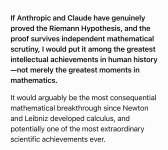
Levent Alpöge, a mathematician and employee at artificial intelligence company Anthropic, claimed on Friday to have proven the most famous problem in all of mathematics using an LLM.
“I believe I have, working with Claude, discovered a proof of the Riemann Hypothesis,” Alpöge wrote in a statementposted on his website.
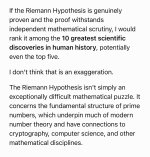
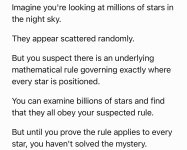
The Riemann hypothesis was first proposed in 1859 by the mathematician Bernhard Riemann. It claims that the locations of the prime numbers along the number line, which appear random at first blush, are actually determined by an intricate, meaningful order.
The conjecture has since become the North Star for the entire field of number theory, and is the most famous open problem in math. It’s one of the few open problems on which the Clay Mathematics Institute has placed a million-dollar bounty. Progress toward solving the Riemann hypothesis was so rare that most top experts spent little of their time actually working on it, because there was no obvious path to proving Riemann’s guess. The first chink in the problem’s armor appeared in October, when one of the proofs in OpenAI’s massive dump of math results made significant progress on making sense of the primes.
Now the long struggle appears over. Alpöge posted his Claude proof coded in the programming language Lean, which verifies the mathematical correctness of each argument. Issues can arise in Lean, but it shouldn’t take long for experts to verify whether the hypothesis is properly coded, and if the proof is correct.
If that happens, it will cap off a year in which AI’s mathematical capabilities ascended from unreliable college student to a superhuman force, leaving no part of the discipline undisrupted. The announcement comes just a day after Anthropic's record-breaking debut on the stock market.
Alpöge says his proof confirms the “Generalized Riemann Hypothesis,” a gargantuan expansion on Riemann’s initial guess that undergirds the entire mathematical universe with untold hidden structure. There is no superlative strong enough for how this would transform mathematics, instantly unlocking a deluge of truths contingent upon the ambitious conjecture.
“If the proof is correct and understood, this completes a dictionary between different branches of math where the connections were only partial,” says Hector Pasten, a mathematician at the Pontifical Catholic University of Chile. “Something like a Rosetta Stone.”
The work could open whole new areas of research. "If true, even from a first high level scan of the summary of the proposed argument, it is very plausible to me that the new ideas in the proof will open up brand new avenues of thinking in number theory and have an immense impact beside the obviously extremely influential result in itself," says mathematician Carlo Pagano, a professor at Concordia University and a visiting researcher at Google DeepMind.
Alpöge’s statement is elegiac—recognizing the sense of grief many mathematicians are feeling—but also optimistic. “It is natural to feel that this is an end, in my case a loss of a principal guiding light,” he wrote, “but what I saw during the course of progress so amazed me that I believe it is one dawn across science of something far greater.”
The Anthropic mathematician has been the subject of headlines since he tweeted a Claude-generated solution to the famous Jacobian conjecture in July, kicking off math’s unprecedented summer. He was central to September’s Navier-Stokes controversy involving OpenAI, when NYU mathematician Tristan Buckmaster implied that the company had stolen his and Alpöge’s work.
The Riemann result, if correct, will echo far beyond mathematics. It doesn’t have any immediate real-world applications—it won’t upend global banking or make the internet run faster. But after a year of watching LLMs surpass one math benchmark after another, there is no more staggering achievement it could possibly reach. A machine may have just solved a problem that the smartest people on the planet all agreed they were nowhere close to figuring out. As MIT mathematician Andrew Sutherland once put it to me: “An AI that can prove the Riemann hypothesis is not one I’d want to meet. If that happens, mathematicians having jobs will be the least of our problems.”
“This is indeed an historic moment,” Sutherland told me today after he had independently compiled Alpöge’s result in Lean. “The world has changed… I know there will be a wide range of reactions in our community, but to me this is a human triumph, and a day for celebration.”
It’s worth celebrating, Sutherland says, the human work behind the development of Lean and LLMs—and, for that matter, the millennia of mathematical achievements upon which today’s advance rests. But processing the earthshaking reality of what has occurred “is going to take some time.”
“There is much work to be done to understand the mathematical details of the proof,” he says. “And I can’t wait to dig into them. But perhaps the single most important step in the proof was building a machine that can think.”