Any attempt to divert Pakistan’s water to be treated as act of war, India ‘must make no mistake about it’: PM at UNGA

Feroze

Trusted Member
Joined
Apr 18, 2023
Messages
7,258
Reaction score
5,807
Reputation
2,114.5
Country of Origin
Country of Residence

Any attempt to divert Pakistan’s water to be treated as act of war, India ‘must make no mistake about it’: PM at UNGA​


1790363001735.png

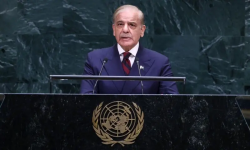
Prime Minister Shehbaz Sharif speaks during the 81st United Nations General Assembly at UN headquarters in New York on September 25, 2026. — AFP
comments
Join our Whatsapp Channel
Add Dawn as a trusted source

Google Preferred Source

Prime Minister Shehbaz Sharif reiterated before the United Nation’s General Assembly on Friday that any attempt by India to divert Pakistan’s share of water would be treated as an “act of war”.

“Water must never be weaponised. Rivers should nourish nations, not divide them. Therefore, any attempt to stop, impede or divert Pakistan’s share of the waters will be treated as an act of war. India must make no mistake about it,” he said.

The premier was addressing the 81st session of the United Nations General Assembly (UNGA) in New York.

“The pursuit of peace is among the noblest of human endeavours,” the premier began his speech by saying, adding that Quaid-i-Azam Muhammad Ali Jinnah’s declaration of support for the UN Charter had shaped Pakistan’s national ethos and “guided our conduct at home and abroad”.


He addressed the conflict in the Gulf region and wider Middle East, highlighting the loss of lives, economic suffering and pressure faced by critical maritime routes, particularly the Strait of Hormuz.

“At this critical moment, Pakistan chose to act swiftly. Through concerted efforts, Pakistan brought Washington and Tehran under one roof in Islamabad,” PM Shehbaz said, referring to the Islamabad Talks that resulted in the signing of the Islamabad Memorandum of Understanding by the United States and Iran in June.

In this regard, he appreciated Chief of Defence Forces and Chief of the Army Staff Field Marshal Asim Munir, whose “relentless efforts helped create space for diplomacy under exceptionally difficult and challenging circumstances”. He also extended his appreciation to Deputy Prime Minister and Foreign Minister Ishaq Dar for his role in the process.

“Amid the roar of missiles, drones and guns, the voice for diplomacy must echo even louder and stronger,” the premier stated.

“The Strait of Hormuz and Bab al-Mandab are arteries of the global economy. They must remain open, connecting nations, not becoming choke points of confrontation.”


He also condemned, “in the strongest possible terms”, the recent attacks by the Houthis against the Kingdom of Saudi Arabia, calling them “deplorable”. He expressed Pakistan’s complete solidarity with Saudi Arabia.

He also highlighted the Makkah Joint Defence Agreement signed by Pakistan, Turkiye and Saudi Arabia as a reflection of Pakistan’s commitment to peace.

“This alliance is not directed against any country; it is a collective commitment for defence, stability and peace in the region, and nothing more,” he stressed.

PM Shehbaz also addressed last year’s conflict with India, which was driven by a terror attack in Pahalgam that New Delhi blamed on Islamabad, which denied the allegations.

“Our brave and valiant armed forces, under the courageous leadership of Field Marshal Asim Munir, responded with precision and professionalism,” he said.

He once again praised US President Donald Trump’s “resolute and visionary leadership” in brokering a ceasefire between the two countries in May 2025, stressing that it saved “hundreds of millions of lives”.

“Who knows the extent of devastation that could have taken place had President Trump not stepped in at this critical moment with clarity of thought and action?” he said.

“We must therefore ensure that South Asia never reaches this precipice ever again.”

This, however, the premier added, required a fair resolution of the Kashmir dispute.

“For eight decades, the Kashmiri people have waited for the United Nations to fulfill its solemn commitment of a free and impartial plebiscite,” he pointed out, adding that they had endured “illegal occupation, arbitrary detention, extrajudicial killings, enforced disappearances, sexual violence and collective punishment” for generations.

He declared that Pakistan would continue to extend its full diplomatic, political and moral support to Kashmiris until they were granted their right to self-determination, terming Kashmir “Pakistan’s jugular vein”.

The prime minister also called attention to India’s unilateral decision to hold the Indus Water Treaty (IWT) in abeyance since last year’s conflict, stressing that it had no legal basis.

He highlighted that the country’s claims and actions regarding the treaty had been rejected by UN experts as well as by the Permanent Court of Arbitration, leaving Pakistan “vindicated beyond any ray of doubt” in its position.

“Water must never be weaponised. Rivers should nourish nations, not divide them,” he stressed, calling the Indus river system the “lifeblood” of the entire region.

He added that any attempt to stop, impede or divert Pakistan’s share of the waters would be regarded as an act of war by India.

During his address, PM Shehbaz also restated Pakistan’s support for Palestine, expressing his concern for ongoing Israeli violence in Gaza and the West Bank as well as its continued aggression against Lebanon and Syria. In particular, he noted that the forcible eviction of Palestinians in the West Bank “clearly reflects Israel’s genocidal agenda”.

“Pakistan believes that the only just and lasting solution is the creation of an independent, sovereign, viable and contiguous State of Palestine, based on pre-1967 borders, with Al-Quds Al-Sharif as its capital,” he reaffirmed.

The premier also termed terrorism a grave threat to international peace and security, emphasising that Pakistan had sacrificed “almost 100,000 precious lives” and suffered economic losses of over $150 billion in combating terrorism.

He added that Afghan territory continued to be exploited by the TTP and the BLA. These foreign-funded groups operated from sanctuaries in Afghanistan intending to destabilise Pakistan, he said.

He called on Afghan authorities to halt all such attacks, fulfill their international commitments and take “verifiable, decisive action to ensure that Afghan soil is never again used against Pakistan or any other country”.


 

Any attempt to divert Pakistan’s water to be treated as act of war, India ‘must make no mistake about it’: PM at UNGA​


View attachment 216853

Prime Minister Shehbaz Sharif speaks during the 81st United Nations General Assembly at UN headquarters in New York on September 25, 2026. — AFP
comments
Join our Whatsapp Channel
Add Dawn as a trusted source
Google Preferred Source
Prime Minister Shehbaz Sharif reiterated before the United Nation’s General Assembly on Friday that any attempt by India to divert Pakistan’s share of water would be treated as an “act of war”.

“Water must never be weaponised. Rivers should nourish nations, not divide them. Therefore, any attempt to stop, impede or divert Pakistan’s share of the waters will be treated as an act of war. India must make no mistake about it,” he said.

The premier was addressing the 81st session of the United Nations General Assembly (UNGA) in New York.

“The pursuit of peace is among the noblest of human endeavours,” the premier began his speech by saying, adding that Quaid-i-Azam Muhammad Ali Jinnah’s declaration of support for the UN Charter had shaped Pakistan’s national ethos and “guided our conduct at home and abroad”.


He addressed the conflict in the Gulf region and wider Middle East, highlighting the loss of lives, economic suffering and pressure faced by critical maritime routes, particularly the Strait of Hormuz.

“At this critical moment, Pakistan chose to act swiftly. Through concerted efforts, Pakistan brought Washington and Tehran under one roof in Islamabad,” PM Shehbaz said, referring to the Islamabad Talks that resulted in the signing of the Islamabad Memorandum of Understanding by the United States and Iran in June.

In this regard, he appreciated Chief of Defence Forces and Chief of the Army Staff Field Marshal Asim Munir, whose “relentless efforts helped create space for diplomacy under exceptionally difficult and challenging circumstances”. He also extended his appreciation to Deputy Prime Minister and Foreign Minister Ishaq Dar for his role in the process.

“Amid the roar of missiles, drones and guns, the voice for diplomacy must echo even louder and stronger,” the premier stated.

“The Strait of Hormuz and Bab al-Mandab are arteries of the global economy. They must remain open, connecting nations, not becoming choke points of confrontation.”


He also condemned, “in the strongest possible terms”, the recent attacks by the Houthis against the Kingdom of Saudi Arabia, calling them “deplorable”. He expressed Pakistan’s complete solidarity with Saudi Arabia.

He also highlighted the Makkah Joint Defence Agreement signed by Pakistan, Turkiye and Saudi Arabia as a reflection of Pakistan’s commitment to peace.

“This alliance is not directed against any country; it is a collective commitment for defence, stability and peace in the region, and nothing more,” he stressed.

PM Shehbaz also addressed last year’s conflict with India, which was driven by a terror attack in Pahalgam that New Delhi blamed on Islamabad, which denied the allegations.

“Our brave and valiant armed forces, under the courageous leadership of Field Marshal Asim Munir, responded with precision and professionalism,” he said.

He once again praised US President Donald Trump’s “resolute and visionary leadership” in brokering a ceasefire between the two countries in May 2025, stressing that it saved “hundreds of millions of lives”.

“Who knows the extent of devastation that could have taken place had President Trump not stepped in at this critical moment with clarity of thought and action?” he said.

“We must therefore ensure that South Asia never reaches this precipice ever again.”

This, however, the premier added, required a fair resolution of the Kashmir dispute.

“For eight decades, the Kashmiri people have waited for the United Nations to fulfill its solemn commitment of a free and impartial plebiscite,” he pointed out, adding that they had endured “illegal occupation, arbitrary detention, extrajudicial killings, enforced disappearances, sexual violence and collective punishment” for generations.

He declared that Pakistan would continue to extend its full diplomatic, political and moral support to Kashmiris until they were granted their right to self-determination, terming Kashmir “Pakistan’s jugular vein”.

The prime minister also called attention to India’s unilateral decision to hold the Indus Water Treaty (IWT) in abeyance since last year’s conflict, stressing that it had no legal basis.

He highlighted that the country’s claims and actions regarding the treaty had been rejected by UN experts as well as by the Permanent Court of Arbitration, leaving Pakistan “vindicated beyond any ray of doubt” in its position.

“Water must never be weaponised. Rivers should nourish nations, not divide them,” he stressed, calling the Indus river system the “lifeblood” of the entire region.

He added that any attempt to stop, impede or divert Pakistan’s share of the waters would be regarded as an act of war by India.

During his address, PM Shehbaz also restated Pakistan’s support for Palestine, expressing his concern for ongoing Israeli violence in Gaza and the West Bank as well as its continued aggression against Lebanon and Syria. In particular, he noted that the forcible eviction of Palestinians in the West Bank “clearly reflects Israel’s genocidal agenda”.

“Pakistan believes that the only just and lasting solution is the creation of an independent, sovereign, viable and contiguous State of Palestine, based on pre-1967 borders, with Al-Quds Al-Sharif as its capital,” he reaffirmed.

The premier also termed terrorism a grave threat to international peace and security, emphasising that Pakistan had sacrificed “almost 100,000 precious lives” and suffered economic losses of over $150 billion in combating terrorism.

He added that Afghan territory continued to be exploited by the TTP and the BLA. These foreign-funded groups operated from sanctuaries in Afghanistan intending to destabilise Pakistan, he said.

He called on Afghan authorities to halt all such attacks, fulfill their international commitments and take “verifiable, decisive action to ensure that Afghan soil is never again used against Pakistan or any other country”.


1790370424250.png
 
Yeah, I'm sure the Indian's will drop their dry doti's and come begging for mercy; looking at that face.
We will see what happens.

India may be the world's most populated nation with an economy larger than Japan's, but still...India is not a very powerful nation.

India is still slumdog shit nation.

Ever seen Slumdog millionaire movie? lol.
 
We will see what happens.

India may be the world's most populated nation with an economy larger than Japan's, but still...India is not a very powerful nation.

India is still slumdog shit nation.

Ever seen Slumdog millionaire movie? lol.

Yes, I've seen the film, and I've visited Pakistan on many occasions, and I've seen similar conditions; to me, neither is any different; both have slums if you look in the right place.

In totality, India still has many advantages that Pakistan wishes it had.

As for movie comparison:

The Comparison

FilmGlobal Box Office RevenueYear
Slumdog Millionaire$378.4 million2008
The Legend of Maula Jatt (Highest-grossing Pakistani film)$13.9 million
2022
 
Pakistan's due diligence in averting a global catastrophe is a pure human endeavour of an extremely mature and restrained nation facing the threat of climate change and water terrorism.

Good things do not last long, with a very young population weened on state propaganda and disillusioned by globalised misery, the joyride is about to end abruptly.
 
Not sure why everyones mocking him for showing a spine. Hate him or love him his statement is 100 percent how it should be. It's better to go out fighting than a guaranteed slow death.
 
Yes, I've seen the film, and I've visited Pakistan on many occasions, and I've seen similar conditions; to me, neither is any different; both have slums if you look in the right place.

In totality, India still has many advantages that Pakistan wishes it had.

As for movie comparison:

The Comparison

FilmGlobal Box Office RevenueYear
Slumdog Millionaire$378.4 million2008
The Legend of Maula Jatt (Highest-grossing Pakistani film)$13.9 million2022
Yeah, but India has more poverty and poverty percentage than Pakistan has.
 

Users who are viewing this thread

Pakistan Defence Latest

Back
Top