Armament of the Russian Army

To view this content we will need your consent to set third party cookies.
For more detailed information, see our cookies page.
 
To view this content we will need your consent to set third party cookies.
For more detailed information, see our cookies page.
 
To view this content we will need your consent to set third party cookies.
For more detailed information, see our cookies page.
 
To view this content we will need your consent to set third party cookies.
For more detailed information, see our cookies page.
 
Signalers of the Russian 35th Combined Arms Army, Forces Group "East," have begun using SNARK-120R satellite communications stations. The SNARK-120R satellite stations are designed for the rapid establishment of broadband satellite communications in the field. The SNARK mobile communications systems are a completely Russian development. SNARK stations are manufactured by the Race Group of Companies in the Moscow Region.
The SNARK-120R portable satellite communications systems can be set up in 10 minutes and are also used in civilian applications.

To view this content we will need your consent to set third party cookies.
For more detailed information, see our cookies page.
 
1761549286503.jpeg

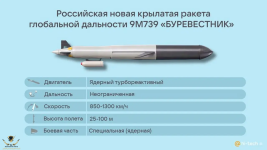
Russian Army: Successful testing of the world's first nuclear-powered missile

Russian Chief of the General Staff Valery Gerasimov briefed President Vladimir Putin on the successful testing of the world's first nuclear-powered missile that traveled a distance of 14,000 kilometers and flew horizontally and vertically for 15 hours.

Gerasimov added that the flight lasted 15 hours and that the missile was able to pass all radar systems during its flight with different vertical and horizontal paths, before reaching its supposed target accurately.

1761549524032.png
 
Episodes from past exercises of Russia's strategic nuclear forces. The video shows high-quality footage of the launch of a Russian R-29RMU2 Sineva nuclear intercontinental ballistic missile from the K-117 Bryansk nuclear-powered submarine in the Barents Sea. The K-117 Bryansk nuclear-powered ballistic missile submarine, the fifth ship of Project 667BDRM Delfin, was launched in 1988. The Bryansk submarine can dive to depths of 650 meters, at speeds up to 24 knots, and has an endurance of up to 90 days. The K-117 Bryansk submarine carries 16 R-29RMU2 Sineva missiles. The R-29RMU2 Sineva missiles have a range of 11,547 km and carry up to ten independently targetable warheads with a yield of 100 kt each.

To view this content we will need your consent to set third party cookies.
For more detailed information, see our cookies page.
 
To view this content we will need your consent to set third party cookies.
For more detailed information, see our cookies page.
 
turtle tank

To view this content we will need your consent to set third party cookies.
For more detailed information, see our cookies page.
 
fiber optic drone

To view this content we will need your consent to set third party cookies.
For more detailed information, see our cookies page.
 
Russia demonstrated tests of an air defense system designed to combat FPV drones; the system's name has not been disclosed. The video shows tests of a new turret armed with a PKT machine gun, and judging by the video, the tests are quite successful. The targeting system is unclear; presumably, it is optical; the video does not show a radar. Technical details are not yet available. The turret operates automatically and engages drones at a range of up to 800 meters.

To view this content we will need your consent to set third party cookies.
For more detailed information, see our cookies page.
 
To view this content we will need your consent to set third party cookies.
For more detailed information, see our cookies page.
 

Some shotguns used by Russian units for drone defense.​


To view this content we will need your consent to set third party cookies.
For more detailed information, see our cookies page.
 
A Russian repair battalion from the 20th Army is working on an active tank defense system against FPV drones. This homemade tank defense system is based on the 81mm launchers of the 902 "Tucha" anti-tank system, which we previously demonstrated on T-90 tanks. The soldiers removed the smoke mixture from the 81mm 3D17 ammunition and replaced it with buckshot charges. Development of the system has only just begun and is not yet funded. Currently, it offers only limited protection for the tank. Currently, the system cannot detect drones and can only be activated manually.

To view this content we will need your consent to set third party cookies.
For more detailed information, see our cookies page.
 
To view this content we will need your consent to set third party cookies.
For more detailed information, see our cookies page.
 

Users who are viewing this thread

Pakistan Defence Latest

Country Watch Latest

Latest Posts

Back
Top