The Russian Burevestnik unmanned aerial vehicle regiment unveiled a prototype of a homemade system for countering fiber-optic-controlled FPV drones. These FPV drones are known to fly along designated corridors, making them convenient and safe to operate. Barbed wire is strung across the drones' path in fields, and a motor is mounted on the end of the installation to rotate the wire. As the drone flies past, its control cable descends to the ground and hits the wire. As the wire rotates, it entangles the drone's communication cable and sever it. The device is simple and quite effective, and it is already in use. However, it is not yet in mass production.
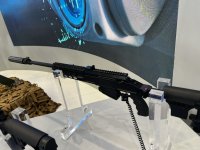
absolutely monster of a rifle - 7.62x54R suppressed with a bolt action.
First time seeing a bolt action from Klashnikov concern, I thought they only made their DMR/LSR in semi automatic
5.8KGS without the ammo and scope
The Russian Air Force has received a batch of second-stage fifth-generation Su-57 fighters, according to some media reports. The new Su-57s are capable of being equipped with the second-stage AL-51F1 "article 30" engine. The batch is reportedly large, but its size is unknown. The fighters feature new onboard systems with expanded functionality, intelligent support, and the ability to use a wider range of weapons. The aircraft have been accepted by technical staff and have undergone a full cycle of factory testing. Footage of the first flights of the Algerian Air Force Su-57E is also included at the end of the video; the aircraft is easily recognizable by its engine sound. Algeria has officially confirmed the purchase of the Su-57E from Russia, becoming the first export customer for these aircraft.
Russian mechanics demonstrated an unusual homemade anti-drone system and a "Mangal" for tracked drones. The "Mangal" is mounted on the Russian NRTK "Courier" robotic platform. It's worth noting that this type of protection for military vehicles was first proposed in Britain in 1941. This type of protection is still frequently offered online. The protection consists of propellers with cables mounted along the sides of the robot. The rotating cables are designed to shoot down incoming drones. It's unlikely that this anti-drone system will be developed further, but testing is planned.