Armament of the Russian Army

To view this content we will need your consent to set third party cookies.
For more detailed information, see our cookies page.
 
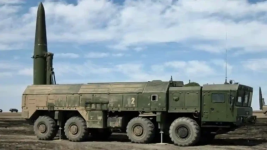
Russia moves from producing 36 missiles in one year to 50 Iskander-M missiles per month
1771110893156.png


A new assessment by the Center for Strategic and International Studies (CSIS) confirms that Russia is currently producing about 50 Iskander-M (9M723) ballistic missiles per month in 2025.
 
To view this content we will need your consent to set third party cookies.
For more detailed information, see our cookies page.
 
To view this content we will need your consent to set third party cookies.
For more detailed information, see our cookies page.
 
The Barrage-1 stratospheric broadband communications platform was launched in Russia for the first time. The platform is designed to relay 5G NTN communications and can be used in place of the Starlink satellite communications system. The Barrage-1 platform can also be used to provide communications for units, control drones, and transmit data. The Barrage-1 stratospheric platform is designed for extended stays in the stratosphere at an altitude of up to 20 km, from several days to several weeks, with a payload of up to 100 kg. The Barrage-1 platform can be used in areas where it is impractical to install communication towers. A pneumatic ballasting system allows the Barrage-1 to change its flight altitude and navigate in the desired direction using the wind, without the use of engines.

To view this content we will need your consent to set third party cookies.
For more detailed information, see our cookies page.
 
To view this content we will need your consent to set third party cookies.
For more detailed information, see our cookies page.
 

RU POV: Lancet destroyed Ukrainian M109 SPG near Pokrovskoe​


To view this content we will need your consent to set third party cookies.
For more detailed information, see our cookies page.


RU POV: Fiber-optic drone strikes on Ukrainian AMX-10RC near the village of Dobropillya in Donbass. Published on 16.02.2026​


To view this content we will need your consent to set third party cookies.
For more detailed information, see our cookies page.
 
To view this content we will need your consent to set third party cookies.
For more detailed information, see our cookies page.
 
The Russian company Aeroplatforms also launched a stratospheric balloon for broadband internet connectivity. Previously, the Russian broadband communications platform "Barrage-1" was demonstrated launching into the stratosphere. The project is being managed by JSC Aerodrommash.
Aeroplatforms' stratospheric balloon can ascend to an altitude of up to 24 kilometers. It's worth noting that air defense systems have difficulty intercepting targets at such altitudes, as the balloons have low radar and thermal signatures. The balloons will provide Russian troops with an additional channel for controlling drones at ranges over 100 kilometers, a function previously achieved through cellular communications. Ground troops will also be able to utilize alternative communication channels. Stratospheric internet connectivity projects are temporary solutions for providing connectivity to specific areas.

To view this content we will need your consent to set third party cookies.
For more detailed information, see our cookies page.
 

RU POV: Fiber-optic drone destroyed Ukrainian M109 SPG fully loaded with ammunition.​


To view this content we will need your consent to set third party cookies.
For more detailed information, see our cookies page.
 
To view this content we will need your consent to set third party cookies.
For more detailed information, see our cookies page.
 
To view this content we will need your consent to set third party cookies.
For more detailed information, see our cookies page.


To view this content we will need your consent to set third party cookies.
For more detailed information, see our cookies page.


To view this content we will need your consent to set third party cookies.
For more detailed information, see our cookies page.
 
Last edited:
To view this content we will need your consent to set third party cookies.
For more detailed information, see our cookies page.
 

RU POV: FPV drone strikes on Ukrainian Caesar SPG near the village of Shilovka in Donbass.​


To view this content we will need your consent to set third party cookies.
For more detailed information, see our cookies page.
 
Kazan Helicopters delivered four Mi-38PS helicopters to the Russian Ministry of Emergency Situations. The Mi-38PS search and rescue helicopter is designed for operations in the Arctic at temperatures down to -60°C. The Mi-38PS automatically checks all of its onboard systems, requiring the pilot to press only one button. The Mi-38PS significantly outperforms the Mi-8 in range, speed, and payload. With additional fuel tanks, it can fly up to 1,500 kilometers. The helicopter is equipped with a water discharge device and a suspended sprayer for extinguishing fires and eliminating oil spills. It also has a module with medical equipment and search and rescue equipment, including a radio beacon and a winch for evacuation. The Mi-38PS has a maximum takeoff weight of 16.5 tons and is capable of carrying up to 4.5 tons of cargo inside the cabin and 5 tons on an external sling, lifting up to 40 people, and reaching speeds of up to 300 kilometers per hour. The helicopter has a crew of two.

To view this content we will need your consent to set third party cookies.
For more detailed information, see our cookies page.
 

Users who are viewing this thread

Pakistan Defence Latest

Back
Top