AWACS

1751477319637.webp


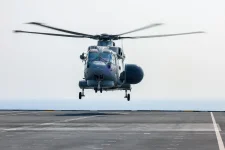
RN Merlin Mk2 Crowsnest Airborne Early Warning achieves OC

May 9, 2025

The Royal Navy Merlin Mk2 Crowsnest Airborne Early Warning Helicopters have received Full Operational Capability and will be the eyes and ears of the UK Carrier Strike Group on its deployment to the Indo-Pacific over the next eight months.

The Merlin helicopters from 820 Naval Air Squadron arrived on HMS Prince of Wales from their home at Royal Naval Air Station Culdrose to begin their involvement in the Carrier Strike Group 25 mission. The 200 men and women and their aircraft from the Merlin Helicopter Force will provide cutting edge anti-submarine warfare and airborne surveillance and control for the task group.

Wherever the CSG operates, the helicopters will hunt threats beneath the waves and scan the horizon for air and surface threats and can be used to coordinate defense and strike operations.

Among the nine helicopters are three designed for Airborne and Control (ASaC) which, delivered through the Crowsnest program, will fly more than a mile above the Carrier Strike Group using their radars, lowered underneath the fuselage in a domed bag, which earns them the nickname ‘Baggers’, to look ‘over the horizon’ up to 100 miles in any direction.

Captain Colin McGannity, Carrier Air Wing and Strike Warfare Commander said: “It’s an essential element of the Carrier Enabled Power Projection programme that, of course, we’re getting to the point of full operating capability for, with the Carrier Strike Group in the deployment coming up.

The principal reason for having the ASaC capability and the Crowsnest programme to do that is for protection of the strike group against air threats and, although it doesn’t fire anything to engage missiles, it’s there to provide early warning to ships and particularly for the targets that ships would struggle to see themselves. By getting a really capable radar up high and looking down, we’re taking advantage of all the lessons that we’ve learned in the past, particularly back in the Falklands War to make sure that we’ve got that capability to help protect the strike group.”

Crowsnest reached Full Operating Capability ahead of deploying with the Carrier Strike Group and is now fully developed to ensure full protection to the task force’s warships from threats such as hostile aircraft, ships or incoming drones or missiles, enabling essential command and control over an extended area.
 
I don't know which Mod moved this thread, but the point of this thread was not to post flashy pics, but an informative / database type of thread, to highlight its role as a force multiplier, as evidenced in the latest skirmish.

Thank You
 

Beijing ups AEW&C game with emergence of KJ-3000

By Greg Waldron
30 December 2024

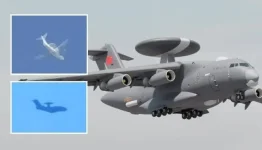
View attachment 97885
Artist's rendering of China's KJ-3000 AEW&C aircraft. Photo: 跨过海峡解放台湾/Weibo

View attachment 97886The KJ-3000 AEW&C aircraft during its recent flight.
Photo: Chinese social media


Beijing is taking steps to advance its airborne early warning and control (AEW&C) capabilities, with the emergence of the long-rumoured Xian KJ-3000.

Images have appeared on Chinese social media showing a large, four-engined AEW&C aircraft derived from China’s homegrown strategic transport, the Y-20.

The aircraft appears to be powered by four indigenous Shenyang WS-20 high-bypass turbofans. The new engine – which also powers new examples of the Y-20B transport – should be more efficient than the Y-20’s legacy powerplant, the Soloviev D-30KP-2.

The thick line across the underside of the aircraft’s overhead-mounted radome suggests that it contains two active electronically scanned array (AESA) radars, and likely needs to rotate to ensure full coverage.

There is speculation that the aircraft’s fuselage boasts side-mounted AESA radars. These are a feature of another advanced Chinese AEW&C aircraft, the KJ-700, a derivative of the Shaanxi Y-9 tactical transport that has entered People’s Liberation Army Air Force (PLAAF) service in small numbers.


When it enters service the KJ-3000 will become the PLAAF’s second jet-powered AEW&C aircraft after the KJ-2000, a derivative of the Ilyushin Il-76.

While the KJ-2000 is understood to be the PLAAF’s most capable AEW&C type, with a non-rotating, three-sided AESA array, there are only four operational examples.

Indeed, the KJ-3000 has long been seen as the eventual replacement for the PLAAF’s small KJ-2000 fleet.

With its efficient engines the KJ-3000 is likely to have a clear endurance advantage over the KJ-2000. Moreover, the limited available imagery makes it clear that the type has an air-to-air refuelling probe, something lacking in the KJ-2000.

It is also probable that the WS-20 engine has superior electrical generation capabilities compared with its Russian made predecessor. This is a key consideration given the power of the KJ-3000’s sensors and the high degree of energy-intensive computing required for an advanced AEW&C capability. In a conflict, the KJ-3000 will be called on detect difficult targets such as stealth aircraft and a dizzying array of unmanned systems and decoys, as it also directs a broad spectrum of joint Chinese capabilities.

While China’s KJ-200 and KJ-500 platforms are understood to be very capable, they are turboprops with limited operating ceilings. A large jet such as the KJ-3000 will be able to operate at greater altitudes, giving its radar arrays greater coverage, and allowing it to operate further away from adversary fighters.

The ability to operate further back could help counter advances in adversary air-to-air capabilities. The US Navy’s Raytheon AIM-174B air-to-air missile, a derivative of the ship-launched SM-6, has been deployed with the Boeing F/A-18E/F Super Hornet. Should a conflict occur, a clear target set for this weapon will be Chinese intelligence, surveillance and reconnaissance assets, including slow-moving AEW&C aircraft.

In its recent assessment of Chinese military power, the US Department of Defense did not mention the KJ-3000 or the KJ-700. It did state, however, that the KJ-500 continues to join the PLAAF.

“These aircraft amplify the PLAAF’s ability to detect, track, and target threats in varying conditions, in large volumes, and at greater distances,” says the report.

“It extends the range of the PLA’s [integrated air defence] network. Furthermore, [the People’s Republic of China] has produced at least one KJ-500 with an aerial refuelling probe, which will improve the aircraft’s ability to provide persistent AEW&C coverage.”

The air-to-air refuelling capability of the KJ-3000, which is likely to be far more capable AEW&C platform than the KJ-500, will certainly get the Pentagon’s attention.

The KJ-3000 builds on remarks made in July 2021 by Lu Jun, chief designer of the KJ-500. He envisaged an AEW&C network made up of traditional platforms and smaller aircraft, with the assets working together to build an “information network”.

In his view the smaller AEW&C aircraft are more capable of dealing with targets such as stealth aircraft and UAVs.

As with all Chinese defence programmes the development status of the KJ-3000 is not clear – apart from the fact that it is in flight testing. Given China’s rapid advances with the Y-20 platform and WS-20, not to mention its growing prowess with AESA radars, the KJ-3000’s arrival in PLAAF service can be expected within the coming years, with imagery on Chinese social media marking its progress.
1752352478375.webp
 

France announces intention to procure GlobalEye from Saab

18 June 2025

Saab and the French defence procurement agency, Direction générale de l'armement (DGA), have today signed a joint declaration of intent regarding the sale of Saab’s GlobalEye Early Warning and Control (AEW&C) aircraft to France, including ground equipment, training and support.

The joint declaration of intent, which was signed today at the Paris Air Show, includes DGA’s intention to procure two GlobalEye aircraft from Saab. The joint declaration of intent also includes an option for DGA to purchase two additional aircraft.

A final notification process to complete the procurement will now follow. The DGA has stated that a contract is expected to be finalised in the coming months. The parties have not yet entered into a contract and Saab has not yet received an order for GlobalEye from France.

"We welcome today’s announcement by France about the intention to procure GlobalEye, which will enhance the French Armed Forces’ situational awareness and threat detection across the air, land and sea domains. Our solution will enable France to maintain full sovereign control of its airborne early warning and control capability,” says Micael Johansson, President and CEO of Saab.

GlobalEye is an advanced multi-domain AEW&C solution with an array of active and passive sensors that provide long-range detection and identification of objects in the air, at sea and over land. By providing real-time information to air forces, armies and navies, GlobalEye enables enhanced situational awareness of the surrounding areas and early detection of threats.
 
There were plans for the PAF to acquire Hawkeyes in the early 2000s, along with the Block-52s, but clearly never materialised.
 
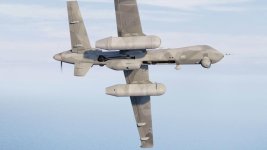
Saab and General Atomics are turning the MQ-9B into a UAEW (Uncrewed Airborne Early Warning) drone.

1753628395541.jpeg
 

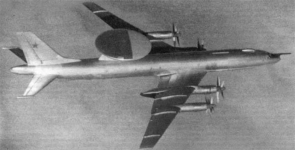
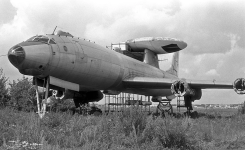
Tupolev Tu-126 Moss AWACS​

1778452198096.png

Tupolev Tu-126 Moss AWACS, was developed from the Tu-114 airliner which in turn was based on the Tu-95 Bear, only 9 were built, it's radar was considered inferior to western equivalents, it operated from 1965 to 1984 when they were replaced by the Beriev A-50 1778452223768.png

though the the radar provided 360-degree coverage it was limited to detecting high altitude targets and struggled to detect small, low-flying targets due to it's limited look-down capability, it was effective over water, it had poor thermal and sound insulation, the contra-rotating props compromised the performance of the radar and the vibrations caused discomfort to the crew, the radar equipment emitted a loud humming sound and sleeping in the rest compartment was impossible due to it being located behind the wing where all the noisy control valves for cabin pressurization was located, after extended missions, especially those missions that required mid-air refueling, the radar and electronics operators would leave the airplane looking almost "half dead”, poor metal plating of the aircraft's structure led to a gradual buildup of static electricity which after 3 hours of flight made some parts impossible to grasp and caused electric shocks, it lacked an APU which made life much more difficult on board, especially in the winter, due to poor shielding the radar antenna's strong radiation posed a health hazard to everyone on board, it was also planned to help guide Tu-128 interceptors to their targets but the system was not fully developed during it's service, despite it's problems it was accessed by western intelligence to have powerful jamming equipment, unlike the Tu-95 and Tu-142 it lacked any defensive armament though some aircraft were fitted with the SPS-100 Rezeda ECM system and automatic chaff ejectors in the rear, by 1984 the A-50 entered service and they were retired and placed in storage until 1990 where they were all scrapped except for the first one built which at the time was being used as a flying laboratory at taganrog, it was transferred there in 1977, it was used to test the A-50's shmel radar and later tested a mockup of the shmel-m radar for the A-50M, it was retired in 1990 and was last seen in an abandoned state at the Gromov Flight Research Institute's radio testing range at the Zhukovsky Airfield graveyard between 1992 to 1995 where it was later scrapped
 

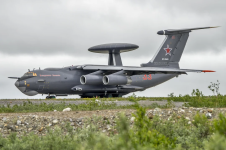
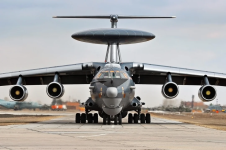
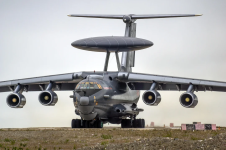
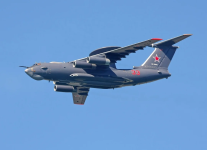
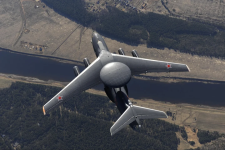
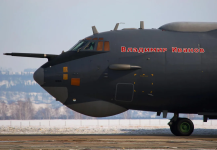
A-50U Mainstay AWACS "Vladimir Ivanov", known as the "Black Mushroom" due to it being the only A-50 to be painted in a dark grey paint scheme, and it's nickname the "mushroom" because of the distinctive shape of the rotodome.

It's the 2nd A-50 to be modernized to the U standard, besides mushroom it's also called the "flying saucer"

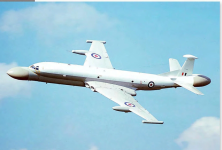
If the 33 was painted yellow it would have a similar paint scheme to the navy Il-38s


1779113050844.png
1779113081700.png
1779113105241.png
1779113126598.png
1779113198690.png
1779113238907.png
 

Users who are viewing this thread

Back
Top