By Dino Carrara
16th October 2026
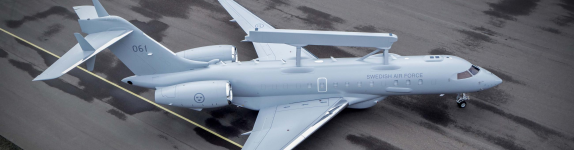
The first Saab GlobalEye for the Swedish Air Force was revealed on October 15, 2026.
The GlobalEye will be designated S 106 in the Swedish Air Force with the first example to be delivered in 2027. The aircraft carries the tail code ‘061’, which with the Swedish Air Force system of aircraft serials would make it 106061.
Micael Johansson, president and CEO of Saab commented: “The presentation of Sweden's first GlobalEye marks an important milestone for both Saab and the Swedish Armed Forces. As the programme progresses towards delivery, GlobalEye will provide Sweden with a powerful capability for airborne surveillance and situational awareness.”
The Saab press release stated: “The aircraft will now enter a phase of testing and verification ahead of its first flight and subsequent delivery to the customer.” It also said: “With GlobalEye, Sweden will gain a highly advanced airborne early warning and control capability, providing the information advantage needed to support timely decision-making and effective operations. The system delivers long-range surveillance and a comprehensive operational picture across the air, land and maritime domains, strengthening Sweden’s defence capability and enhancing national security.”
Sweden has ordered three GlobalEye aircraft from Saab. The first two aircraft were ordered by the Swedish Defence Materiel Administration (FMV) in 2022. An option for a third GlobalEye was exercised in 2024.
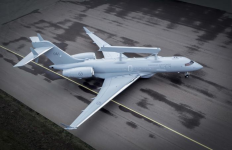 Saab has unveiled the first GlobalEye for the Swedish Air Force. Saab
This follows the recent announcement on September 10, 2026 that the Royal Netherlands Air and Space Force plans to purchase a single example of the GlobalEye. On that date, a letter of intent was signed between the Dutch Deputy Prime Minister and Minister of Defence, Dilan Yeşilgöz-Zegerius and the Swedish Defence Minister, Pål Jonson. According to Jonson: “The Netherlands is now acquiring its own airborne surveillance and command-and-control capability, closely integrated with Sweden and NATO”. The contents of the proposed agreement also include long term co-operation on airborne warning and control capabilities, with joint operation of the Dutch aircraft alongside the fleet of three due to be delivered to the Swedish Air Force.
Statements released by both sides confirmed that Dutch crews will have the opportunity to train on the Swedish platforms as early as 2028, about a year after the first is delivered to the latter country. The Netherlands will receive its own aircraft in 2031.
While the government level letter of intent includes plans to operate all four aircraft as a joint pool, allowing the fleet to benefit from common logistics and maintenance support, the Netherlands has yet to sign a formal contract for the procurement of its GlobalEye. This was confirmed by a statement released by Saab on September 10: “The parties have not yet entered into a contract and Saab has not yet received an order from the Netherlands.”
GlobalEyes replacing E-3s
Both the Netherlands and Sweden are also involved in the North Atlantic Treaty Organization (NATO) programme to replace its Boeing E-3A Sentry fleet, based at Geilenkirchen in Germany, with GlobalEyes.
NATO had originally intended to procure the Boeing E-7 Wedgetail as the future platform for its Airborne Early Warning and Control Force (NAEW&CF). However, the selection of the Swedish platform was announced on July 7, 2026, during the NATO Summit Defence Industry Forum in Ankara, Türkiye, with up to ten examples expected to be acquired. The E-3As are due to be retired in 2035. The Netherlands and Sweden are participating in the programme in conjunction with Belgium, Canada, Denmark, Germany, Latvia, Lithuania, Luxembourg, Norway and Romania.
NATO Secretary General Mark Rutte said: “Saab’s GlobalEye system takes airborne warning and control to a new level. For decades, NATO has relied on a fleet of E-3 Airborne Warning and Control Systems, that have been our ‘eyes in the skies’. They have been deployed from Northern Norway to Southern Turkey. They have served us well and continue to do so, but they are reaching the end of their lives.
“Today, several Allies are announcing the joint procurement of up to ten Saab GlobalEye aircraft to replace them. This will ensure we keep NATO’s owned and operated surveillance and early warning capability strong and credible for decades to come.”
A NATO press release stated: “The GlobalEye system will provide advanced, multi-domain surveillance across air, land and sea from a single platform. It will provide enhanced detection and tracking of complex threats, including drone swarms, ballistic missiles, and cruise missiles. The aircraft will strengthen NATO’s situational awareness and support operations.
“The project is an example of close transatlantic industrial cooperation, with European and Canadian industry in the lead and important contributions from US companies. In parallel, eight Allies also launched a new cooperative project to field airborne early warning capabilities to meet their national requirements.”
A Saab statement at the time said: “…Saab has not signed a contract or received an order related to the announcement.” Micael Johansson, president and CEO of Saab enthused: “We are honoured and proud to support NATO in its next-generation AEW&C capability. We are confident that GlobalEye is the right choice for the Alliance, delivering proven capability, adaptability and long-term operational advantage. Today’s announcement clearly positions GlobalEye as the world-leading solution for advanced airborne early warning and control. We look forward to the next steps in the negotiations.” The company added: “Saab will now proceed to formal negotiations with the NATO Support and Procurement Agency (NSPA) to secure a contract.”
In addition to the NATO alliance itself, the Netherlands is the fourth NATO country to select
GlobalEye, after Sweden, France and Canada.