Navigation
Install the app
How to install the app on iOS
Follow along with the video below to see how to install our site as a web app on your home screen.
Note: This feature may not be available in some browsers.
More options
Style variation
You are using an out of date browser. It may not display this or other websites correctly.
You should upgrade or use an alternative browser.
You should upgrade or use an alternative browser.
AWACS
- Thread starter Hussain
- Start date
More options
Who Replied?



Nuffle
Registered Member

An operational problem with this type of AWACS is the low speed of the aerostat, which does not allow it to scan a large area due to its slow performance.Although not an AWAC, but more of an airborne radar, which , fulfills the requirements of min. mid range i.e. 200Nm, low level / small rcs threats, such as drones and CM's, at a fraction of the cost of an aircraft borne radar, are the "Aerostat Radar Systems".
It's coverage is not limited to just low flying threats, but all flying threats, as well as ground / sea threats, plus communication relays, if configured to do so, as is the case with Atlas systems.
Usually filled with Helium, they have been known to be deployed up to 15,000ft.
They have been deployed at sea as well, but due to rapid weather changes have proved to be challenging.
With Drone tech evolving rapidly, this technology might become obsolete within a matter of years.
View attachment 87238
Basic Concept
View attachment 87242
Israeli Atlas Specs
View attachment 87245
View attachment 87246
ELTA ENA-2083 radar
View attachment 87243
A US Border Surveillance post
Although it covers a much smaller area than an AEW aircraft that can fly several kilometers high, it has the advantage of operating for weeks, uninterruptedly, at a minimum cost.
The aerostats should not replace AEW aircraft completely, but rather complement them in what they are worse at, that is, persistence.

Hussain
Trusted Member
- Thread starter
- #35
As of now, what I am seeing is border control, and air surveillance around sensitive installations.An operational problem with this type of AWACS is the low speed of the aerostat, which does not allow it to scan a large area due to its slow performance.
Although it covers a much smaller area than an AEW aircraft that can fly several kilometers high, it has the advantage of operating for weeks, uninterruptedly, at a minimum cost.
The aerostats should not replace AEW aircraft completely, but rather complement them in what they are worse at, that is, persistence.
Hussain
Trusted Member
- Thread starter
- #37
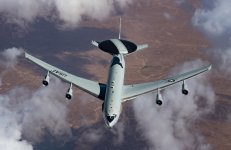
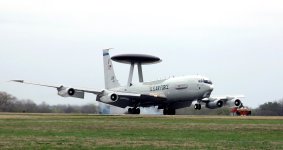
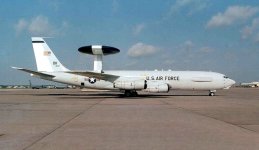
E-3 Sentry (AWACS)
General characteristics
Primary function: airborne battle management, command and control
Contractor: Boeing Aerospace Co.
Power plant: four Pratt and Whitney TF33-PW-100A turbofan engines
Thrust: 20,500 pounds each engine at sea level
Rotodome: 30 feet in diameter (9.1 meters), 6 feet thick (1.8 meters), mounted 11 feet (3.33 meters) above fuselage
Wingspan: 145 feet, 9 inches (44.4 meters)
Length: 152 feet, 11 inches (46.6 meters)
Height: 41 feet, 9 inches (13 meters)
Weight: 205,000 pounds (zero fuel) (92,986 kilograms) Maximum Takeoff Weight: 325,000 pounds (147,418 kilograms) Fuel Capacity: 21,000 gallons (79,494 liters)
Speed: optimum cruise 360 mph (Mach 0.48)
Range: more than 5,000 nautical miles (9,250 kilometers)
Ceiling: Above 29,000 feet (8,788 meters)
Crew: flight crew of four plus mission crew of 13-19 specialists (mission crew size varies according to mission) Unit Cost: $270 million (fiscal 98 constant dollars) Initial operating capability: April 1978
Inventory: active force, 32 (one test); Reserve, 0; Guard, 0
(Current as of September 2015)
Mission
The E-3 Sentry is an airborne warning and control system, or AWACS, aircraft with an integrated command and control battle management, or C2BM, surveillance, target detection, and tracking platform. The aircraft provides an accurate, real-time picture of the battlespace to the Joint Air Operations Center. AWACS provides situational awareness of friendly, neutral and hostile activity, command and control of an area of responsibility, battle management of theater forces, all-altitude and all-weather surveillance of the battle space, and early warning of enemy actions during joint, allied, and coalition operations.
Features
The E-3 Sentry is a modified Boeing 707/320 commercial airframe with a rotating radar dome. The dome is 30 feet (9.1 meters) in diameter, six feet (1.8 meters) thick, and is held 11 feet (3.33 meters) above the fuselage by two struts. It contains a radar subsystem that permits surveillance from the Earth's surface up into the stratosphere, over land or water. The radar has a range of more than 250 miles (375.5 kilometers). The radar combined with an identification friend or foe, or IFF, subsystem can look down to detect, identify and track enemy and friendly low-flying aircraft by eliminating ground clutter returns that confuse other radar systems.
Major subsystems in the E-3 are avionics, navigation, communications, sensors (radar and passive detection) and identification tools (IFF/SIF). The mission suite includes consoles that display computer-processed data in graphic and tabular format on video screens. Mission crew members perform surveillance, identification, weapons control, battle management and communications functions.
The radar and computer subsystems on the E-3 Sentry can gather and present broad and detailed battlefield information. This includes position and tracking information on enemy aircraft and ships, and location and status of friendly aircraft and naval vessels. The information can be sent to major command and control centers in rear areas or aboard ships. In time of crisis, this data can also be forwarded to the president and secretary of defense.
In support of air-to-ground operations, the Sentry can provide direct information needed for interdiction, reconnaissance, airlift and close-air support for friendly ground forces. It can also provide information for commanders of air operations to gain and maintain control of the air battle.
As an air defense system, E-3s can detect, identify and track airborne enemy forces far from the boundaries of the United States or NATO countries. It can direct fighter-interceptor aircraft to these enemy targets. Experience has proven that the E-3 Sentry can respond quickly and effectively to a crisis and support worldwide military deployment operations.
AWACS may be employed alone or horizontally integrated in combination with other C2BM and intelligence, surveillance, and reconnaissance elements of the Theater Air Control System. It supports decentralized execution of the air tasking order/air combat order. The system provides the ability to find, fix, track and target airborne or maritime threats and to detect, locate and ID emitters. It has the ability to detect threats and control assets below and beyond the coverage of ground-based command and control or C2, and can exchange data with other C2 systems and shooters via datalinks.
With its mobility as an airborne warning and control system, the Sentry has a greater chance of surviving in warfare than a fixed, ground-based radar system. Among other things, the Sentry's flight path can quickly be changed according to mission and survival requirements. The E-3 can fly a mission profile approximately 8 hours without refueling. Its range and on-station time can be increased through in-flight refueling and the use of an on-board crew rest area.
Background
Engineering, test and evaluation began on the first E-3 Sentry in October 1975. In March 1977 the 552nd Airborne Warning and Control Wing (now 552nd Air Control Wing, Tinker Air Force Base, Okla.), received the first E-3s.
There are 31 aircraft in the U.S. inventory. Air Combat Command has 27 E-3s at Tinker. Pacific Air Forces has four E-3 Sentries at Kadena AB, Japan and Elmendorf AFB, Alaska.
NATO has 17 E-3A's and support equipment. The first E-3 was delivered to NATO in January 1982. The United Kingdom has seven E-3s, France has four, and Saudi Arabia has five. Japan has four AWACS built on the Boeing 767 airframe.
As proven in operations Desert Storm, Allied Force, Enduring Freedom, Iraqi Freedom, and Odyssey Dawn/Unified Protector the E-3 Sentry is the world's premier C2BM aircraft. AWACS aircraft and crews were instrumental to the successful completion of operations Northern and Southern Watch, and are still engaged in operations Noble Eagle and Enduring Freedom. They provide radar surveillance and control in addition to providing senior leadership with time-critical information on the actions of enemy forces. The E-3 has also deployed to support humanitarian relief operations in the U.S. following Hurricanes Rita and Katrina, coordinating rescue efforts between military and civilian authorities.
The data collection capability of the E-3 radar and computer subsystems allowed an entire air war to be recorded for the first time in the history of aerial warfare.
In March 1996, the Air Force activated the 513th Air Control Group, an AWACS Reserve Associate Program unit which performs duties on active-duty aircraft.
During the spring of 1999, the first AWACS aircraft went through the Radar System Improvement Program. RSIP is a joint U.S./NATO development program that involved a major hardware and software intensive modification to the existing radar system. Installation of RSIP enhanced the operational capability of the E-3 radar electronic counter-measures and has improved the system's reliability, maintainability and availability.
The AWACS modernization program, Block 40/45, is currently underway. Bock 40/45 represents a revolutionary change for AWACS and worldwide Joint Command and Control, Battle Management, and Wide Area Surveillance. It is the most significant counter-air battle management improvement in Combat Air Forces tactical Command and Control history. The Block 40/45 Mission Computer and Display upgrade replaces current 1970 vintage mission computing and displays with a true open system and commercial off-the-shelf hardware and software, giving AWACS crews the modern computing tools needed to perform, and vastly improve mission capability. Estimated fleet upgrades completion in 2020.
Source: E3 - Sentry
Hussain
Trusted Member
- Thread starter
- #38
E-2 Hawkeye Airborne Command and Control Aircraft
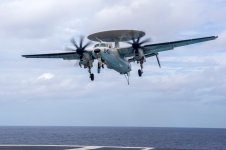
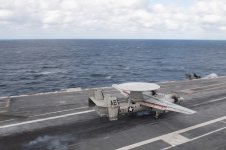
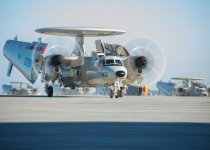
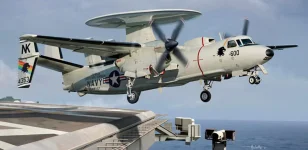
General Characteristics
Primary Function: Airborne Command and Control, Battle Space Management
Contractor:Northrop Grumman Aerospace Corp
Date Deployed: January 1964
Unit Cost: $80 million
Propulsion: Two Allison T-56-A427 turboprop engines; (5,100 shaft horsepower each)
Length: 57 feet 6 inches (17.5 meters)
Height: 18 feet 3 inches (5.6 meters)
Wingspan: 80 feet 7 inches (28 meters)
Weight: Max. gross, take-off: 53,000 lbs (23,850 kg) 40,200 lbs basic (18,090 kg)
Airspeed: 300+ knots (345 miles, 552 km. per hour)
Ceiling: 30,000 feet (9,100 meters)
Crew: Five
Last updated: 17 Sep 2021
Description
The E-2 Hawkeye is the Navy's all-weather, carrier-based tactical battle management airborne early warning, command and control aircraft. The E-2 is a twin engine, five crewmember, high-wing turboprop aircraft with a 24-foot diameter radar rotodome attached to the upper fuselage.
Features
The Hawkeye provides all-weather airborne early warning, airborne battle management and command and control functions for the Carrier Strike Group and Joint Force Commander. Additional missions include surface surveillance coordination, air interdiction, offensive and defensive counter air control, close air support coordination, time critical strike coordination, search and rescue airborne coordination and communications relay. An integral component of the Carrier Strike Group air wing, the E-2 uses computerized radar, Identification Friend or Foe and electronic surveillance sensors to provide early warning, threat analysis against potentially hostile air and surface targets.
Beyond the battle group, the Hawkeye's command and control capability makes it a multi-mission platform through its ability to coordinate concurrent missions that may arise during a single flight, to include: airborne strike, land force support, rescue operations, managing a reliable communications network between widely dispersed nodes and support for drug interdiction operations.
Background
The continuous improvements in early airborne radars by 1956 led to the concept of an airborne early warning and command and control aircraft. The first aircraft to perform this mission was the Grumman E-1 Tracer (a variant of the S-2 Tracker anti-submarine aircraft), which saw service from 1954 to 1964. The E-1's successor, the E-2 Hawkeye, was the first carrier-based aircraft designed from the outset for the all-weather airborne early warning and command and control mission. Since replacing the E-1 in 1964, the Hawkeye has been the "eyes of the fleet." Since its combat debut during the Vietnam conflict, the E-2 has served the Navy around the world.
Hawkeyes directed F-14 Tomcat fighters flying combat air patrol during the two-carrier battle group joint strike against terrorist-related Libyan targets in 1986. In the early 1990s, E-2s provided airborne command and control for successful Coalition Air Operations during the first Arabian Gulf War. Directing both land attack and combat air patrol missions over Iraq, the E-2 Hawkeye provided air control for the shoot-down of two Iraqi MIG-21 aircraft by carrier-based F/A-18s in the early days of the war. Later during the 1990s, E-2s supported Operations Northern and Southern Watch over Iraq. E-2s also supported NATO operations over the former Republic of Yugoslavia, including Operation Deny Flight. Recently in Operations Enduring Freedom and Iraqi Freedom, E-2 Hawkeyes provided critical Airborne Battle Management and Command and Control functions supporting numerous Close Air Support and Battlefield Interdiction missions. E-2s also have worked extremely effectively with U.S. law enforcement agencies in drug interdictions operating from bases both the United States and several foreign countries.
The E-2C became operational in 1973 and surpassed one million flight hours in August 2004. The aircraft has undergone several upgrades to its active and passive sensors, engines and propellers. The newest variant of the E-2C (Hawkeye 2000) with its new mission computer, improved radar displays and Cooperative Engagement Capability (CEC), combined with the shipboard Aegis weapon system, forms the cornerstone of sea based Theater Air Missile Defense (TAMD).
Variants of the E-2C Hawkeye are also flown by the Egyptian Air Force, Japanese Self Defense Air Force, Taiwan Air Force and the French Navy.
Advanced Hawkeye (AHE)
The E-2D Advanced Hawkeye (AHE) is the newest variant of the E-2 aircraft platform, replacing the E-2C Hawkeye.
It features a state-of-the-art radar with a two-generation leap in capability and upgraded aircraft systems that will improve supportability and increase readiness. Key E-2D objectives include improved battle space target detection and situational awareness, especially in the littorals; support of Theater Air Missile Defense (TAMD) operations; and improved operational availability.
The E-2D reached IOC in October 2014, and the Navy continues to invest in future capabilities to support command and control requirements for the strike group and the entire force.
Program Status
The first operational fleet squadron completed aerial refueling (AR) training in FY2020. Aerial refueling increases the range and persistence of the E-2D AHE. With AR capabilities, the E-2D can remain aloft and on station for an extended period of time, allowing for extended range from the carrier, dual E-2D coverage, increased persistence and operational flexibility. AR-equipped aircraft will also feature new high endurance seats, fuel system enhancements, and new exterior lighting.
Source: E-2 Hawkeye Airborne Command and Control Aircraft
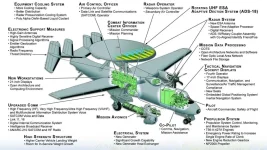
Once considered for replacement by the “Common Support Aircraft”, this concept was abandoned. The latest E-2 version is the E-2D Advanced Hawkeye, which features an entirely new avionics suite including the new AN/APY-9 radar, radio suite, mission computer, integrated satellite communications, flight management system, improved T56-A-427A engines, a glass cockpit and aerial refueling.
The APY-9 radar features an active electronically scanned array (AESA), which adds electronic scanning to the mechanical rotation of the radar in its radome. The E-2D includes provisions for the copilot to act as a “Tactical 4th Operator” (T4O), who can reconfigure his main cockpit display to show radar, IFF, Link 16 (JTIDS)/CEC and access all acquired data. The E-2D’s first flight occurred on 3 August 2007.
On 8 May 2009, an E-2D used its Cooperative Engagement Capability system to engage an overland cruise missile with a Standard Missile SM-6 fired from another platform in an integrated fire-control system test.
These two systems will form the basis of the Naval Integrated Fire Control – Counter Air (NIFC-CA) when fielded in 2015; the USN is investigating adding other systems to the NIFC-CA network in the future.
The APY-9 radar has been suspected of being capable of detecting fighter-sized stealth aircraft, which are typically optimized against high frequencies like Ka, Ku, X, C, and parts of the S-bands.
Small aircraft lack the size or weight allowances for all-spectrum low-observable features, leaving a vulnerability to detection by the UHF-band APY-9 radar, potentially detecting fifth-generation fighters like the Russian Sukhoi Su-57 and the Chinese Chengdu J-20 and Shenyang J-31.
Historically, UHF radars had resolution and detection issues that made them ineffective for accurate targeting and fire control; Northrop Grumman and Lockheed claim that the APY-9 has solved these shortcomings by using advanced electronic scanning and high digital computing power via space/time adaptive processing.
According to the Navy’s NIFC-CA concept, the E-2D could guide fleet weapons, such as AIM-120 AMRAAM and SM-6 missiles, onto targets beyond a launch platform’s detection range or capabilities.
Deliveries of initial production E-2Ds began in 2010. On 4 February 2010, Delta One conducted the first E-2D carrier landing aboard USS Harry S. Truman as a part of carrier suitability testing.
On 27 September 2011, an E-2D was successfully launched by the prototype Electromagnetic Aircraft Launch System (EMALS) at Naval Air Engineering Station Lakehurst. On 12 February 2013, the Office of the Secretary of Defense approved the E-2D to enter full-rate production.
The Navy plans for an initial operational capability by 2015. In June 2013, the 10th E-2D was delivered to the Navy, with an additional 10 aircraft in various stages of manufacturing and predelivery flight testing.
On 18 July 2013, Northrop Grumman was awarded a $113.7 million contract for five full-rate production Lot 2 E-2D Advanced Hawkeye aircraft.
On 13 August 2013, Northrop Grumman was awarded a $617 million contract for five E-2Ds until full-rate production Lot 1. On 30 June 2014, Northrop Grumman was awarded a $3.6 billion contract to supply 25 more E-2D, for a total contracted number of 50 aircraft; 13 E-2D models had been delivered by that time.
In December 2016, an E-2D flew for the first time fitted with an aerial refueling capability. This feature will allow the aircraft to double its time on station to five hours and increase total mission time from four to seven hours. The refueling modification will start being built into the 46th plane (out of 75 planned) for delivery in late 2020 costing an additional $2 million per aircraft and the Navy plans to retrofit the feature on all previous Hawkeyes for $6 million per plane.
Shephard Defence Insight notes that the AN/APY-9 UHF radar has a detection range of about 550km with continuous 360° coverage.
General Characteristics
Primary Function: Airborne Command and Control, Battle Space Management
Contractor:Northrop Grumman Aerospace Corp
Date Deployed: January 1964
Unit Cost: $80 million
Propulsion: Two Allison T-56-A427 turboprop engines; (5,100 shaft horsepower each)
Length: 57 feet 6 inches (17.5 meters)
Height: 18 feet 3 inches (5.6 meters)
Wingspan: 80 feet 7 inches (28 meters)
Weight: Max. gross, take-off: 53,000 lbs (23,850 kg) 40,200 lbs basic (18,090 kg)
Airspeed: 300+ knots (345 miles, 552 km. per hour)
Ceiling: 30,000 feet (9,100 meters)
Crew: Five
Last updated: 17 Sep 2021
Description
The E-2 Hawkeye is the Navy's all-weather, carrier-based tactical battle management airborne early warning, command and control aircraft. The E-2 is a twin engine, five crewmember, high-wing turboprop aircraft with a 24-foot diameter radar rotodome attached to the upper fuselage.
Features
The Hawkeye provides all-weather airborne early warning, airborne battle management and command and control functions for the Carrier Strike Group and Joint Force Commander. Additional missions include surface surveillance coordination, air interdiction, offensive and defensive counter air control, close air support coordination, time critical strike coordination, search and rescue airborne coordination and communications relay. An integral component of the Carrier Strike Group air wing, the E-2 uses computerized radar, Identification Friend or Foe and electronic surveillance sensors to provide early warning, threat analysis against potentially hostile air and surface targets.
Beyond the battle group, the Hawkeye's command and control capability makes it a multi-mission platform through its ability to coordinate concurrent missions that may arise during a single flight, to include: airborne strike, land force support, rescue operations, managing a reliable communications network between widely dispersed nodes and support for drug interdiction operations.
Background
The continuous improvements in early airborne radars by 1956 led to the concept of an airborne early warning and command and control aircraft. The first aircraft to perform this mission was the Grumman E-1 Tracer (a variant of the S-2 Tracker anti-submarine aircraft), which saw service from 1954 to 1964. The E-1's successor, the E-2 Hawkeye, was the first carrier-based aircraft designed from the outset for the all-weather airborne early warning and command and control mission. Since replacing the E-1 in 1964, the Hawkeye has been the "eyes of the fleet." Since its combat debut during the Vietnam conflict, the E-2 has served the Navy around the world.
Hawkeyes directed F-14 Tomcat fighters flying combat air patrol during the two-carrier battle group joint strike against terrorist-related Libyan targets in 1986. In the early 1990s, E-2s provided airborne command and control for successful Coalition Air Operations during the first Arabian Gulf War. Directing both land attack and combat air patrol missions over Iraq, the E-2 Hawkeye provided air control for the shoot-down of two Iraqi MIG-21 aircraft by carrier-based F/A-18s in the early days of the war. Later during the 1990s, E-2s supported Operations Northern and Southern Watch over Iraq. E-2s also supported NATO operations over the former Republic of Yugoslavia, including Operation Deny Flight. Recently in Operations Enduring Freedom and Iraqi Freedom, E-2 Hawkeyes provided critical Airborne Battle Management and Command and Control functions supporting numerous Close Air Support and Battlefield Interdiction missions. E-2s also have worked extremely effectively with U.S. law enforcement agencies in drug interdictions operating from bases both the United States and several foreign countries.
The E-2C became operational in 1973 and surpassed one million flight hours in August 2004. The aircraft has undergone several upgrades to its active and passive sensors, engines and propellers. The newest variant of the E-2C (Hawkeye 2000) with its new mission computer, improved radar displays and Cooperative Engagement Capability (CEC), combined with the shipboard Aegis weapon system, forms the cornerstone of sea based Theater Air Missile Defense (TAMD).
Variants of the E-2C Hawkeye are also flown by the Egyptian Air Force, Japanese Self Defense Air Force, Taiwan Air Force and the French Navy.
Advanced Hawkeye (AHE)
The E-2D Advanced Hawkeye (AHE) is the newest variant of the E-2 aircraft platform, replacing the E-2C Hawkeye.
It features a state-of-the-art radar with a two-generation leap in capability and upgraded aircraft systems that will improve supportability and increase readiness. Key E-2D objectives include improved battle space target detection and situational awareness, especially in the littorals; support of Theater Air Missile Defense (TAMD) operations; and improved operational availability.
The E-2D reached IOC in October 2014, and the Navy continues to invest in future capabilities to support command and control requirements for the strike group and the entire force.
Program Status
The first operational fleet squadron completed aerial refueling (AR) training in FY2020. Aerial refueling increases the range and persistence of the E-2D AHE. With AR capabilities, the E-2D can remain aloft and on station for an extended period of time, allowing for extended range from the carrier, dual E-2D coverage, increased persistence and operational flexibility. AR-equipped aircraft will also feature new high endurance seats, fuel system enhancements, and new exterior lighting.
Source: E-2 Hawkeye Airborne Command and Control Aircraft
Once considered for replacement by the “Common Support Aircraft”, this concept was abandoned. The latest E-2 version is the E-2D Advanced Hawkeye, which features an entirely new avionics suite including the new AN/APY-9 radar, radio suite, mission computer, integrated satellite communications, flight management system, improved T56-A-427A engines, a glass cockpit and aerial refueling.
The APY-9 radar features an active electronically scanned array (AESA), which adds electronic scanning to the mechanical rotation of the radar in its radome. The E-2D includes provisions for the copilot to act as a “Tactical 4th Operator” (T4O), who can reconfigure his main cockpit display to show radar, IFF, Link 16 (JTIDS)/CEC and access all acquired data. The E-2D’s first flight occurred on 3 August 2007.
On 8 May 2009, an E-2D used its Cooperative Engagement Capability system to engage an overland cruise missile with a Standard Missile SM-6 fired from another platform in an integrated fire-control system test.
These two systems will form the basis of the Naval Integrated Fire Control – Counter Air (NIFC-CA) when fielded in 2015; the USN is investigating adding other systems to the NIFC-CA network in the future.
The APY-9 radar has been suspected of being capable of detecting fighter-sized stealth aircraft, which are typically optimized against high frequencies like Ka, Ku, X, C, and parts of the S-bands.
Small aircraft lack the size or weight allowances for all-spectrum low-observable features, leaving a vulnerability to detection by the UHF-band APY-9 radar, potentially detecting fifth-generation fighters like the Russian Sukhoi Su-57 and the Chinese Chengdu J-20 and Shenyang J-31.
Historically, UHF radars had resolution and detection issues that made them ineffective for accurate targeting and fire control; Northrop Grumman and Lockheed claim that the APY-9 has solved these shortcomings by using advanced electronic scanning and high digital computing power via space/time adaptive processing.
According to the Navy’s NIFC-CA concept, the E-2D could guide fleet weapons, such as AIM-120 AMRAAM and SM-6 missiles, onto targets beyond a launch platform’s detection range or capabilities.
Deliveries of initial production E-2Ds began in 2010. On 4 February 2010, Delta One conducted the first E-2D carrier landing aboard USS Harry S. Truman as a part of carrier suitability testing.
On 27 September 2011, an E-2D was successfully launched by the prototype Electromagnetic Aircraft Launch System (EMALS) at Naval Air Engineering Station Lakehurst. On 12 February 2013, the Office of the Secretary of Defense approved the E-2D to enter full-rate production.
The Navy plans for an initial operational capability by 2015. In June 2013, the 10th E-2D was delivered to the Navy, with an additional 10 aircraft in various stages of manufacturing and predelivery flight testing.
On 18 July 2013, Northrop Grumman was awarded a $113.7 million contract for five full-rate production Lot 2 E-2D Advanced Hawkeye aircraft.
On 13 August 2013, Northrop Grumman was awarded a $617 million contract for five E-2Ds until full-rate production Lot 1. On 30 June 2014, Northrop Grumman was awarded a $3.6 billion contract to supply 25 more E-2D, for a total contracted number of 50 aircraft; 13 E-2D models had been delivered by that time.
In December 2016, an E-2D flew for the first time fitted with an aerial refueling capability. This feature will allow the aircraft to double its time on station to five hours and increase total mission time from four to seven hours. The refueling modification will start being built into the 46th plane (out of 75 planned) for delivery in late 2020 costing an additional $2 million per aircraft and the Navy plans to retrofit the feature on all previous Hawkeyes for $6 million per plane.
Shephard Defence Insight notes that the AN/APY-9 UHF radar has a detection range of about 550km with continuous 360° coverage.
Hussain
Trusted Member
- Thread starter
- #39
E2 Hawkeye - Foreign Operators
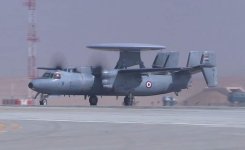
1) Egypt
Operated by: Egyptian Air Force
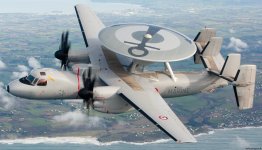
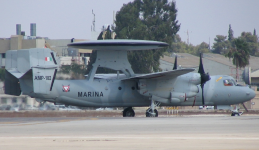
2) France
Operated by: French Navy
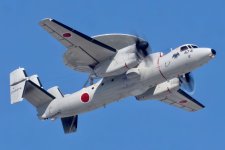
3) Japan
Operated by: Japan Air Self-Defense Force
4) Mexico
Operated by: Mexican Navy
5)Taiwan - Republic of China
Operated by: Republic of China Air Force
Former Operators:
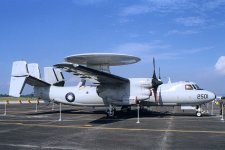
6) Singapore
Operated by: Republic of Singapore Air Force
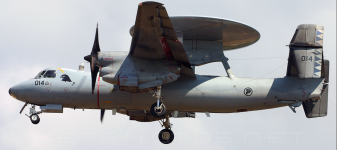
7) Israel
Operated by: Israeli Air Force
1) Egypt
Operated by: Egyptian Air Force
2) France
Operated by: French Navy
3) Japan
Operated by: Japan Air Self-Defense Force
4) Mexico
Operated by: Mexican Navy
5)Taiwan - Republic of China
Operated by: Republic of China Air Force
Former Operators:
6) Singapore
Operated by: Republic of Singapore Air Force
7) Israel
Operated by: Israeli Air Force
Hussain
Trusted Member
- Thread starter
- #40
In the 1960's the UK RN, contemplated the idea of a Hawker Siddley P.139b as a carrier based AEW aircraft, and another version for COD.
The AEW version would have radars place in the nose and the tail section, as seen in the last pic.
It did not go past the drawing board.
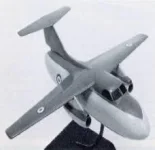
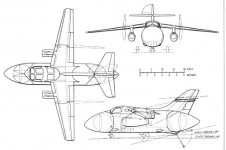
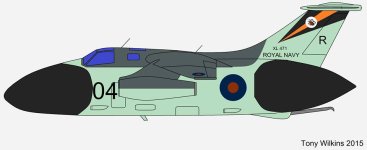
The AEW version would have radars place in the nose and the tail section, as seen in the last pic.
It did not go past the drawing board.
Hussain
Trusted Member
- Thread starter
- #41
Grumman E-1 Tracer
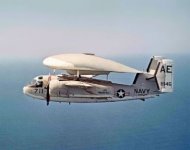
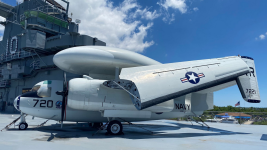
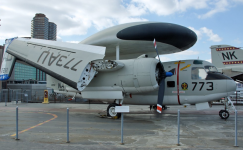
The Grumman E-1 Tracer, was the first purpose-built airborne early warning aircraft used by the United States Navy.
It was a derivative of the Grumman C-1 Trader, and served from 1960 to 1977.
It was replaced by the more modern Grumman E-2 Hawkeye by the mid-1960s-1970s.
The Tracer was fitted with the Hazeltine AN/APS-82, range of 250miles to 300miles
A airfoil-shaped dome protected the 17feet X 5 feet (5.2 m × 1.5 m) parabolic dish antennae, mounted above the fuselage
The Grumman E-1 Tracer, was the first purpose-built airborne early warning aircraft used by the United States Navy.
It was a derivative of the Grumman C-1 Trader, and served from 1960 to 1977.
It was replaced by the more modern Grumman E-2 Hawkeye by the mid-1960s-1970s.
The Tracer was fitted with the Hazeltine AN/APS-82, range of 250miles to 300miles
A airfoil-shaped dome protected the 17feet X 5 feet (5.2 m × 1.5 m) parabolic dish antennae, mounted above the fuselage
Last edited:
Hussain
Trusted Member
- Thread starter
- #43
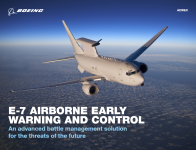
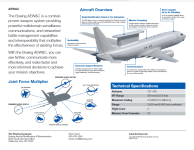
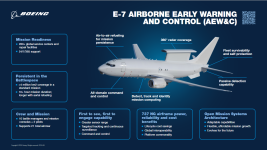
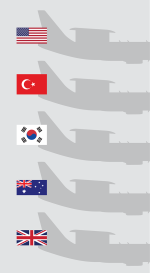
E-7 AEW&C Airborne Early Warning & Control Aircraft
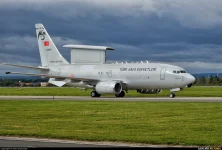
The Boeing E-7 Airborne Early Warning & Control (AEW&C) is a combat-proven force multiplier that provides unparalleled abilities to scan the skies, communicate with surface, ground and air assets and enable integration across the joint force.

Musings
Administrator
Done bro
Hussain
Trusted Member
- Thread starter
- #45
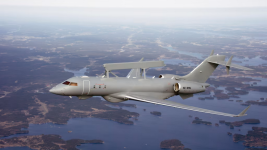
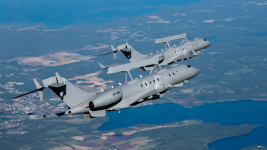
GlobalEye AEW&C
GlobalEye is a multi-domain Airborne Early Warning & Control (AEW&C) solution. With its mix of modern active and passive sensors, it provides long-range detection and identification of objects in air, at sea and over land.Key features
A multi-domain Command & Control (C2) system for real-time information.Newest, most advanced sensor suite for long-range air, sea and land surveillance.
A national asset providing security - in peace, crisis and war.
A national asset for safety and security
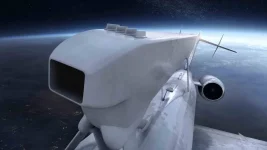
Ensuring national and international territorial integrity and security in today's complex and shifting threat environments has become more and more challenging. Based on the Global 6000/6500 aircraft family from Bombardier, GlobalEye combines Saab’s Erieye Extended Range radar with an advanced suit of sensors and a multi-domain Command and Control (C2) system.
Peace, crisis or war
Today and in the future, national and global security challenges requires timely and correct information to national authorities in order to maintain peace and stability. GlobalEye is the only AEW&C solution on the market that can provide long-range air-, sea- and land surveillance in real time, from a single platform. GlobalEye is an airborne solution that will support government- and military forces with real time-information. Whether in times of peace, crisis or war.
Multi-domain sensors and C2
GlobalEye combines our expertise in complex systems integration, radar, command, control and communication systems into one powerful solution, and it is an example of what can be achieved when world leading systems integration meets world-leading systems.
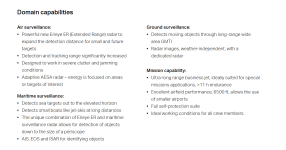
Air surveillance
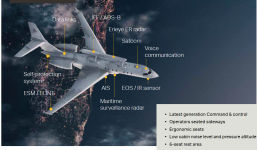
- Powerful new Erieye ER (Extended Range) radar to expand the detection distance for small and future targets
- Detection and tracking range significantly increased
- Designed to work in severe clutter and jamming conditions
- Adaptive Active Electronically Scanned Array (AESA) radar – energy is focused on areas or targets of interest
Maritime surveillance
- Detects sea targets out to the elevated horizon.
- Detects small boats like jet-skis at long distances.
- The unique combination of Erieye ER and maritime surveillance radar allows for detection of objects down to the size of a periscope.
- Automatic Identification System (AIS), Electro-Optical System (EOS) and (Inverse Synthetic Aperture Radar) ISAR for identifying objects.
Ground surveillance
- Detects moving objects through long-range wide area Ground Moving Target Indication (GMTI).
- Radar images, weather-independent, with a dedicated radar.
Mission capability
- Ultra-long range business jet, ideally suited for special missions applications, >11 h endurance
- GlobalEye’s instrumented range is well above 350NM (650 km)
- Excellent airfield performance, 6500 ft, allows the use of smaller airports
- Full self-protection suite
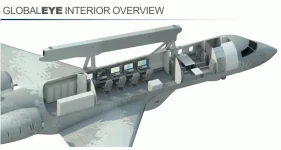
Operational endurance and crew comfort
The Global 6000/6500 aircraft from Bombardier adds over 11 hours of operational endurance, state-of-the-art avionics, and ideal working conditions for all crew members, making it perfectly suited for AEW&C missions.
Users who are viewing this thread
Total: 1 (members: 0, guests: 1)
Pakistan Defence Latest
-

-
 PTI Murad Saeed in Afghanistan, was 'controlling KP govt' from there: Rana Sanaullah (7 Viewers)
- Latest: Starlord
-
-

Country Watch Latest
-
 Iran - Israel/US War: Israel-US declare war on Iran, Iran responds (128 Viewers)
- Latest: Master Chief
-

-
Turkey, Pakistan, Qatar, and Indonesia forge ‘Badr’ Pact to Jointly Produce Weapons (24 Viewers)
- Latest: Batman
-
Which Turkish agency is responsible for securing Turkish diplomatic missions abroad? (10 Viewers)
- Latest: hyperman
-

Latest Posts
-
 France to receive just two Rafales in 2027 as air chief warns of fighter strain (4 Viewers)
- Latest: Ali_Baba
-

-
Iran - Israel/US War: Israel-US declare war on Iran, Iran responds (128 Viewers)
- Latest: Master Chief
-
