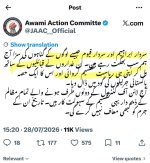
Kashmir was liberated whilst your army awaited orders. The mujahideen of Kashmir were betrayed by Musharraf which is why the Indian army is emboldened today. You guys read about Indians in your textbooks, we see them for who they really are. We can and will handle anything. It was Pakistan army that stopped Kashmiri marching towards loc after article 370.
The leaders of Iraq, Libya and Syria thought they were something special too.
who liberated? The army just left their uniform at home in 1948, read history of operation Gulmarg. Just because army went with civilian attire doesn't mean it didn't sacrifice to liberate AJK and hold it to this day. Obviously locals also wanted to join Pakistan, they were not brain dead like modern day JAAC/JKLF types, they had been under brutal rule of dogra regime for decades.
You cannot handle even AJK police dear forget about India.
For all those "we liberated AJK saar, army did nothing" types out there.
Following the partition of the subcontinent in August 1947, the newly independent dominions of India and Pakistan lacked native senior military leadership. As a result, the armies of both nations were still commanded by British officers transitioning the forces.
General Sir Douglas Gracey commanded the Pakistan Army, while General Rob Lockhart commanded the Indian Army. Above them both was Field Marshal Claude Auchinleck, the Supreme Commander overseeing the division of the military. Auchinleck had issued a strict "Stand-Down" order:
if a formal war broke out between India and Pakistan, all British officers in both armies would be immediately withdrawn.
Because neither nation's army could function effectively at the time without its senior British command structure, an official declaration of war was out of the question. When Indian forces airlifted into Srinagar in late October 1947, Pakistan's Governor-General Muhammad Ali Jinnah ordered General Gracey to send regular Pakistani troops into Kashmir. General Gracey bluntly refused to carry out the order without Auchinleck's approval, citing the stand-down directive.
To bypass this limitation and maintain "plausible deniability," Pakistan's military planners and political leaders orchestrated a covert proxy strategy known as
Operation Gulmarg.
- Civilian Attire: Pakistani army regulars, officially listed as being "on leave," crossed into Kashmir wearing civilian clothes or traditional tribal attire.
- "General Tariq": Senior Pakistani military officers assumed false identities to lead the campaign. Most notably, Brigadier (later Major General) Akbar Khan took command of the irregular forces under the pseudonym "General Tariq".
- Logistical Support: The regular military covertly provided weapons, ammunition, transport, and tactical leadership to the Pashtun tribesmen and the local rebels from Poonch, many of whom were WWII veterans of the British Indian Army.
The reliance on fighters in civilian clothes and tribal militias lasted for several months. However, as the Indian Army launched a spring offensive in 1948 that threatened to capture the entire region and push straight to the Pakistani border, the strategic calculus changed.
By May 1948, the pretense of "plausible deniability" was dropped. The Pakistan Army officially deployed regular, uniformed units into the conflict to establish defensive lines, marking the transition from a covert proxy conflict into a conventional interstate war.