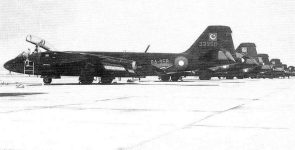
PAF B-57 Bombers - The Night Intruders
By
Sarmad Hassan Sharif
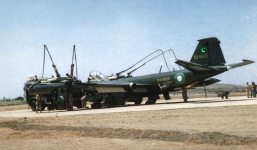
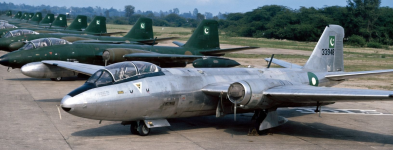
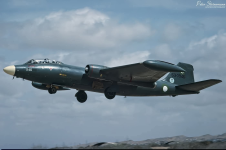
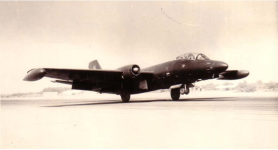
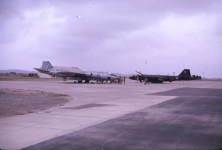
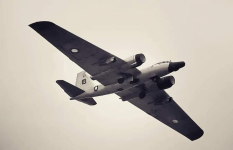
After 7th Septembers, while the Sabres and Starfighters were used sparingly as a conservation policy, there was no reprise to the crews of the B-57 bombers which remained committed to the night attack of Indian airfields as its principal task throughout the war.
The bombers had to operate non-stop throughout the night, disrupting the enemy’s war efforts. Its meager force of 22 aircraft undertook a total of 186 sorties delivering almost 1000 tons of bombs as compared to an estimated 92 night bombing sorties against PAF targets by more than 60 IAF Canberras.
They carried out counter air operations against enemy airfields at Jamnagar and Jodhpur in the South and Ambala, Adampur, Halwara, Srinagar and Pathankot in the north. Undefended by fighters, and beyond the range of own radar to receive any support, these night intruders made a lasting contribution to PAF's total war effort. After the first hectic night's operations, when the B-57 crews were extended to their limit by flying up to 3 sorties during the hours of darkness, no more than two missions per night were allowed.
This was a fairly frequent commitment, however, and the B-57 crew still had a very long tour of duty each day. For the first week of operations when most missions against the northern Indian airfields originated from Peshawar, the centralized spares and servicing organization for the B-57s at Mauripur necessitated the bomber crew returning to their Karachi base at the conclusion of each night's mission. The northern bases were also considered too vulnerable to IAF attacks during the day.
By arriving over their targets in a stream at intervals of about fifteen minutes, the B-57s certainly succeeded, disregarding even the actual damage they inflicted, in achieving a major disruption of the overall IAF effort, disabling their optimum attack capability the next morning.
The effect on the morale of the IAF personnel was devastating. The effect of fatigue caused to them was most pronounced on their air and ground crew while they were forced to keep shuttling in and out of air raid shelters and trenches. This made the task of PAF fighter pilots that much easier to fight them in the air the next morning.
However in 2005, the Authors of the India-Pakistan Air War made a startling revelation when they accepted the loss of a substantial IAF jets during B-57 raids which includes not less than 14 aircraft as destroyed and 9 aircraft damaged (however whether they were repaired and returned back to service during wartime is a big question mark). This by no means is a valuable contribution, owing to the fact that none of the bomber pilot had claimed any kill on the ground, nor PAF had actually counted these kills as there was no means to verify the damage done by its bombers.
IAF Canberras could not even destroy a light aircraft throughout this conflict and remained on the receiving end throughout the war, although they came real close in wiping out a significant portion of PAF in their raid against Peshawar. Mentioning PAF Bomber operations during 13-14 September in detail, P. V. S. Jagan Mohan and Samir Chopra states, “It was a very successful 30-hour period for the B-57s of the PAF. They had managed to destroy almost nine aircraft, with the loss of only one of their bombers.”
After 15th September, IAF decided to send its aircraft from its forward bases to its rear bases during the night, in order to stay safe from the relentless attacks by the PAF B-57s. PAF however got the information about this move. In addition to the usual strikes against Halwara and Adampur, the operational program for the night of 16th September included another attempt by a single B-57 to attack Ambala. Ambala was attempted twice before this mission by the B-57s but both times the mission got aborted and the pilots had to return home.
Explaining this mission, Fricker states, “This was a nature of a test exercise against this heavily defended rear IAF airfield, which was thought by the PAF to be used as a 'secure' overnight parking and dispersal areas for Indian Canberras and other operational aircraft. On this occasion, Ambala was found without undue difficulty and the airfield was skip bombed from very low altitude, according to schedule. It was not possible to observe the results of the strike but on the following day,
All India Radio claimed that the PAF has bombed a hospital on the outskirts of Ambala, causing a number of causalities.
18 September marked the renewal of the PAF offensive against Ambala, which this time was undertaken by two B-57s. These were flown by two of the PAF's most experienced bomber crews. First was Squadron Leader Najeeb A. Khan with Flight Lieutenant William B. Harney as his navigator, followed 20 minutes later by the second B-57. This was piloted by Wing Commander Nazir Latif, the bomber wing leader, with Squadron Leader Aurengzeb Khan, the wing navigation leader, in the rear cockpit. Taking off from Peshawar, with a full bomb load of 8000lb, the two B-57s went low level all the way, with a TOT for the first aircraft of 0100 hours.
In a subsequent report on this mission, Squadron Leader Najeeb recalled: 'The GT Road and railway line running up to Ambala provided a good lead-in, and our low-level navigation provided a few difficulties despite the fact that the moon was not rise until about 10 minutes before our TOT. Due to widespread haze, visibility was extremely poor, but precise on schedule, my navigator announced "Approaching target, 11 o'clock".
A lot of tales had been going around about Ambala and its defenses. Opening the bomb doors, I braced myself for the ordeal, and went straight in for a skip bombing run. We were flying very low - not more than about 200 ft above the ground. Suddenly the sky lit up with an intense barrage of tracers and shell bursts, and we seemed to be caught in a web of AA fire.
Somehow, we managed to avoid being hit, however, and the flashes from the guns helped in picking out the silhouette of the hangars, which were our target. On our first run in, I released the four 1000lb bombs in the fuselage bay, without apparent result, and the second time I dropped the wing bombs. The results were fairly discouraging, with very little to show for our attacks, and we discovered that our 1000lb bombs were skipping much further than we had anticipated. In fact, they seemed to bounce like tennis balls, and some are believed to have travelled as far as 6000-7000 ft. A number of our bombs exploded outside the airfield area because of the underestimated skip distance.’
Following on behind, Wing Commander Latif met with little more success against Ambala, although both B-57s released their bombs in the airfield area. After this attack, an American news magazine published a story that IAF had lost 25 aircraft as a result of the PAF airstrikes against Ambala. PAF however discounted reports of major damage.”
The PAF's B-57 campaign came to an end with a close support mission during the night of 22 September by four B-57s, which dropped 28,000 lbs. of bombs on enemy artillery and tank concentrations at Atari. Large enemy reinforcements had been seen that day moving towards Atari for a possible assault on the salient on the eastern bank of the BRB Canal.
It was the task of the PAF to prevent these reinforcements from reaching their destination. The bombs from the B-57s dropped 'in train' engulfed the enemy armor and other vehicles concealed under the trees and in the bushes. Very few survived to reach Atari.
Of its twenty-two B-57s, which fought the war, PAF lost three but out of these, only two were due to enemy action. The first bomber flown by Squadron Leaders Shabbir Alam Siddiqui and Alam Qureshi, the navigator was hit over Jamnagar, with the aircraft being shot down by AAA and both pilots received fatal injuries.
The second bomber was lost on 14 September when Flight Lieutenants Altaf Shaikh and his navigator Bashir Chaudhry ran the gauntlet of concentrated flak thrown up by 50 to 60 guns at Adampur airfield. Both officers ejected in enemy territory and were repatriated after war. The third B-57, piloted by Flight Lieutenants M.A. Butt and A.S.Z. Khalid as navigator, was lost in the early hours of 17th September. While making an approach to land at Risalpur, the B-57 encountered adverse weather in the shape of strong wind-shear coupled with reduced flight visibility. Unable to maintain height, the aircraft crashed south of the runway, instantly killing both pilot and navigator.
Despite taking losses, the dedication of the PAF B-57 crews is illustrated by the example of Flight Lieutenant Syed Shamsuddin Ahmed, who flew a large number of missions during the war, with Squadron Leader Shoaib Alam Khan as his navigator, despite intense pain from kidney stones. He was operated on the day after the cease-fire and one kidney had to be removed. Both pilot and navigator were awarded the SJ, which was also received by more than a dozen other bomber aircrew.
Of the IAF airfield targets, Halwara received the most attention from the PAF B-57s, which dropped a total of 134 tons of bombs on it, followed by Jodhpur (98 tons), Adampur (85.5 tons), Pathankot (77 tons), Jamnagar (66.5 tons), Sirsa (12 tons), Jammu (10.5 tons), Ambala (10 tons), and Srinagar (7 tons). Close support targets received 77.5 tons of bombs from the B-57s, which also delivered 10.5 tons against the Beas Bridge, two tons in the Gadro area and 14 tons on Amritsar Radar.




 Federal cabinet gives nod to imposition of emergency in KP; summary sent to president (36 Viewers)


