
Exposing the Terror Behind the Black Coat— #Balochistan

In Dalbandin, a lawyer’s robe masked the reality of a trained terrorist commander.
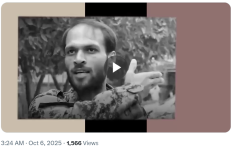
Zubair Ahmed Baloch, who presented himself in courts as a defender of youth and justice, was in fact a central figure of the BLF network and a key operator for India’s subversive agenda.
This Exposed how terrorism hides behind professions of respectability, how propaganda machines twist the truth, and how sacred institutions like law can be misused to mislead innocent people.
Behind the black coat of a lawyer, Zubair hid the dark face of a terrorist commander. He was seen as a practicing lawyer in Dalbandin, respected for his arguments in court. Yet, in reality, he operated as a trained BLF commander, running recruitment and terror planning under the cover of law.
In courtrooms he spoke of rights, but in the shadows he recruited youth for terror. Young men who trusted his speeches of justice were instead pushed into the mountains, where they were trapped in violence and extremism. His words in court were a mask for his actions in the field.
His killing in Exchange of Gunfire with security forces unmasked India’s hand in Dalbandin funding, guiding, and fueling insurgency.
Technical monitoring and intelligence revealed how foreign money and instructions flowed through Zubair’s network. His activities were not about rights, but about serving Fitna-e-Hindustan’s anti-Pakistan agenda.
The most painful betrayal was the misuse of law to poison trust and misguide society. The sacred profession of law is meant to defend justice, yet Zubair exploited it to give credibility to his lies. This betrayal shook trust, showing how dangerous it is when a noble role is corrupted.
Every speech of justice he made was a lie, his real agenda was bloodshed and fear.
He played the role of a defender in courts, but his real work was spreading fear in Mastung, Kalat, and Turbat. His legacy is not justice, it is chaos and destruction.
Social media propaganda tried to paint him as a ‘victim’, proving how online tools serve terror.
Within hours of his killing, BYC and Indian-backed propaganda networks launched campaigns to show him as an innocent lawyer. This digital smokescreen was aimed at confusing the public and weakening facts.
A single man’s deceit damaged the dignity of an entire profession, but cannot define it.
His betrayal has hurt the reputation of lawyers, but one individual cannot overshadow the integrity of thousands of honest practitioners who truly serve justice.
The legal community must stand tall, denouncing extremists, upholding justice, and restoring trust.
It is vital that bar councils and lawyer associations condemn individuals like Zubair. Only by rejecting extremists within can the profession protect its credibility and reassure the people.
Zubair’s story is a warning: beware of false faces, for terror often hides in plain sight.
The case of a lawyer turned terrorist is a reminder that not all who speak of justice practice it. Sometimes, the most dangerous enemies are those who hide behind respectability.
The truth is clear, terrorists are not defenders of rights, they are enemies of peace and justice.
Groups like BLF exploit narratives of deprivation, but their real work is bloodshed. Zubair’s unmasking proves once again that terrorists are not the voice of the people, they are the enemy of their peace.


 Failed attack on Jaffar Express reflects terrorists' frustration and security forces' successful strategy
 Yesterday in Kharan, ten to twelve terrorists from Fitna Al-Hindustan arrived in two vehicles, attacked the judicial complex, kidnapped Judge Qazi Muhammad Jan, who hails from Turbat, snatched a Surf vehicle from Kharan’s Baloch lawyer Salaam Shah, and fled.
 First, all the victims were Baloch, so the pretext of the Baloch cause does not hold.


