UN operations
It’s not widely known that Bangladesh has long been a main contributor to United Nations peacekeeping missions, a role in which all four services (air force, army, navy and police) take part with personnel as well as equipment.
The Bangladesh Army first deployed in 1988, followed by the BAF in September 1995 when one Bell 212 with 17 BAF personnel were sent to Kuwait for the UN Iraq- Kuwait Observation Mission (UNIKOM).
The BAF’s contribution to the mission lasted for almost eight years, ending only a few days after the outbreak of the Iraq War in March 2003. In its time in Kuwait the contingent expanded to 40 personnel and flew approximately 16,000 hours.
Beginning in October 2003 the air force took part in the UN Mission of Support in East Timor (UNMISET), with two Bell 212s, and in July 2003 deployed an Aviation Unit and an Airfield Support Unit to Bunia in the northeast of the Democratic Republic of Congo (DRC) for the UN Organization Mission in the Democratic Republic of the Congo (MONUC).
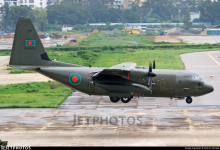
In June 2010 it sent a C-130B Hercules to the DRC where the BAF contingent also has five Mi-17s.
Three Bell 212s deployed to Chad in October 2010 as part of the UN Mission in Central African Republic and Chad (MINURCAT) before being redeployed to Ivory Coast nine months later, from where they operated until May 2015 under the UN Mission in Côte d’Ivoire (UNOCI).
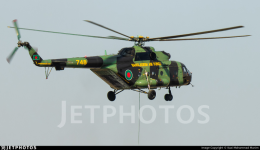
The BAF began its UN mission in Mali on June 11, 2013 and subsequently sent three Mi-171Sh helicopters to support the UN Multidimensional Integrated Stabilization Mission in Mali (MINUSMA) locally. More recently, in support of the UN Stabilization Mission in Haiti (MINUSTAH) in Haiti, it provided a Bangladesh Utility Aviation Unit contingent – comprising 110 personnel and three Mi-171Sh helicopters – in September 2015.
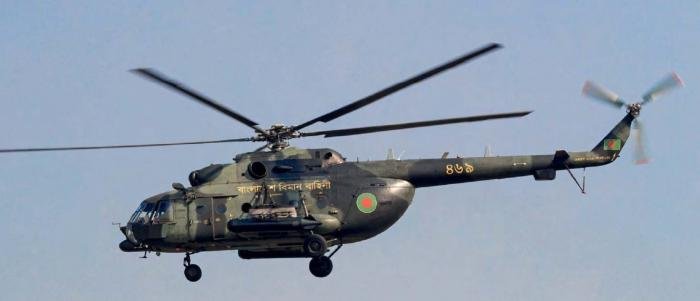
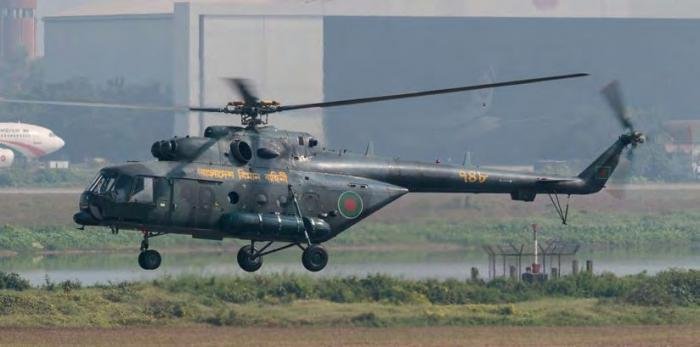
An initial pair of Mi-171Sh helicopters is believed to have been delivered in January 2012. In April 2014 Rosoboronexport announced an order for five more examples with deliveries believed to have begun during April the following year. An attrition loss occurred on May 13, 2015.
Four diff erent versions of the Mi-17 are operated, including the Mi-171, which can carry weapons. An initial batch of three examples is believed to have been delivered by May 2006, followed by a further three in 2012.
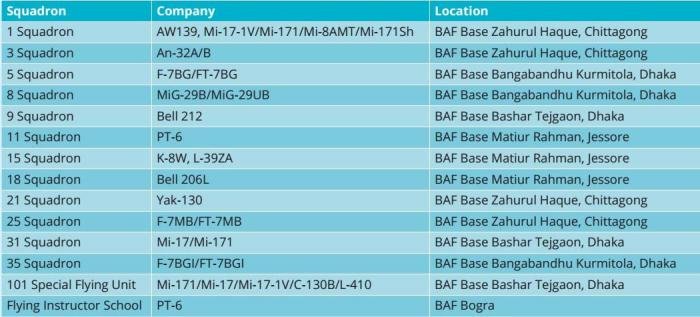
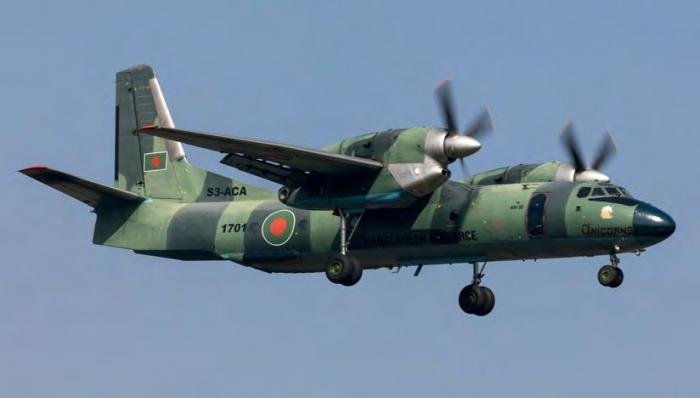
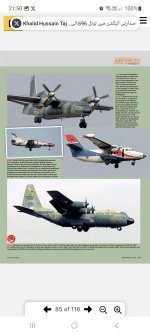
A long-term Antonov operator, 3 Squadron ‘Unicorns’ is the exclusive preserve of the ‘Cline’, including An-32A 1701 ‘S3-ACA’ (c/n 1701), one of three An-32s in service.
3 Squadron ‘Unicorns’
No 503 Squadron, which later became 3 Squadron, formed on December 30, 1971, equipped with the DHC-3 Otter. From 1973 it flew the An-24 and An-26.
The An-24 was withdrawn in 1977 and the An-26 soldiered on until 1989 when it was replaced by the An-32. The smallest BAF flying squadron, 3 Squadron originally operated two An-32s, followed in 1995 by a third.
Currently all three – two An-32As and an An-32B – are in use for transport duties including casualty evacuation (casevac) and medical evacuation (medevac). They also conduct maritime surveillance and patrol roles and, fitted with four hardpoints, can carry bombs.
The squadron assists in relief and disaster operations and was heavily involved in supporting the local population after major cyclones such as Cyclone Sidr in 2007 and Aila in 2009.
To get relief items to those who need them, the unit has developed small parachutes that can carry up to around 13lb (6kg), enough to support a family for several days.
9 Squadron ‘Scorpions’
Equipped with the Bell 212, 9 Squadron formed as 17 Squadron in November 1975 and assumed its current identity in 1982. It flew the Alouette III until the arrival of the first of ten Bell 212s in 1977, and later received three more in VIP/VVIP configuration and one equipped for SAR.
The squadron supports the army, navy and police, using the Bell 212 for transport, tactical reconnaissance and support of special forces, and the helicopters can carry sidemounted machine guns for the counter-insurgency role.
Also involved in disaster management and relief operations, 9 Squadron plays a role supporting communities during floods or in other emergencies and supports United Nations missions overseas.
31 Squadron ‘Beyond the Call of Duty’
Created in January 1981, 31 Squadron operated the Bell 212 until the arrival of 12 Mi-8s helicopters in 1983 (which it shared with 1 Squadron), the last being withdrawn in 1995.
By that time, the squadron had taken delivery of three Mi-17s, which entered service in 1991, and more have arrived since. Currently Mi-17s are operated in four different versions; the latest delivery comprised five Mi-171Sh helicopters in December 2015.
The Mi-17 is mainly used for tactical ground support, transport, reconnaissance, casevac and medevac. All Mi-171s can carry weapons but the Mi-171Sh is a dedicated combat-transport helicopter with more firepower, ideal for combat assault missions and combat search and rescue (CSAR).
It can carry a nose gun, three machine guns in its doors and a range of rockets and bombs.
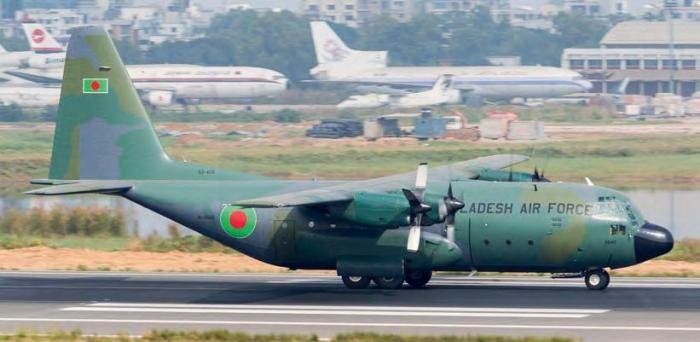
Four 1960- and 1961-built ex-US Air Force C-130Bs were delivered in January 2002. One example was stored before being repaired and overhauled by AIROD at its facility in Subang, Malaysia in spring 2013 and returned to service.
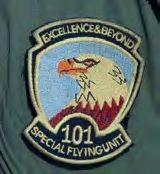
101 Special Flying Unit ‘Excellence and Beyond’
The only composite BAF unit is the 101 Special Flying Unit, based at Bashar with a mix of Mi-17s, four C-130B Hercules and three L-410s. It consists of two flying wings: a Helicopter Wing and a Transport Wing.
Established in April 2001, 101 SFU’s primary missions are to transport VIPs and VVIPs and carry out special operations. It was originally equipped with Mi-17 and Bell 212 helicopters and an An-32 twin-engined transport.
Of the Mi-171s currently with the unit, two are Ulan-Ude-built Mi-17-1Vs in VIP configuration, painted in a special blue/white livery. Delivered in March 2006, their sole task is (V) VIP flights. The other Mi-171s and the C-130Bs fulfil a dual role, and when used for the transportation of (V)VIPs are configured accordingly.
These old C-130Bs came from surplus USAF stocks, and although their wings have been modified to have the same structure as ‘H’ models, their engines are original. In addition to transport tasks, they are used for UN operations in Africa and play a key role in disaster management, locally and abroad.
International support missions have included flights to Pakistan after the October 2005 earthquake, flying a medical team and supplies to Burma (Myanmar) after Cyclone Nargis in May 2008, and transporting two Bell 212s to assist Sri Lanka and the Maldives shortly after a tsunami.
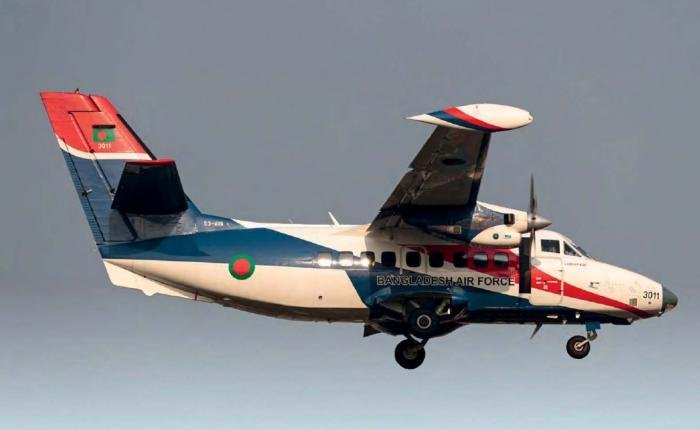
The unit’s three L-410UVP-E20 aircraft, delivered in 2015, are used for multi-engine conversion for the transport crews.
Flight cadet training
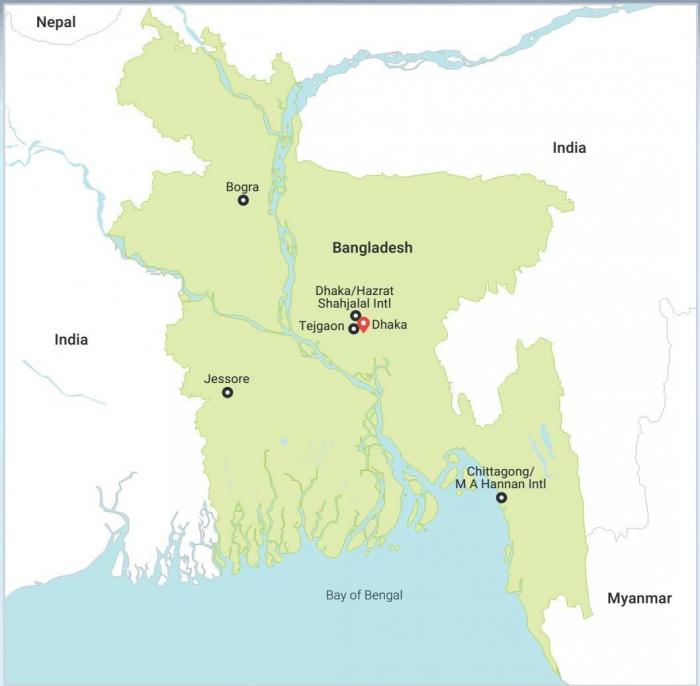
Aircrew training for the BAF began on December 4, 1974 with the creation of the Cadets Training Unit in Bashar. In 1977 it moved to Jessore as the Cadet Training Wing before becoming, in 1982, the Bangladesh Air Force Academy.
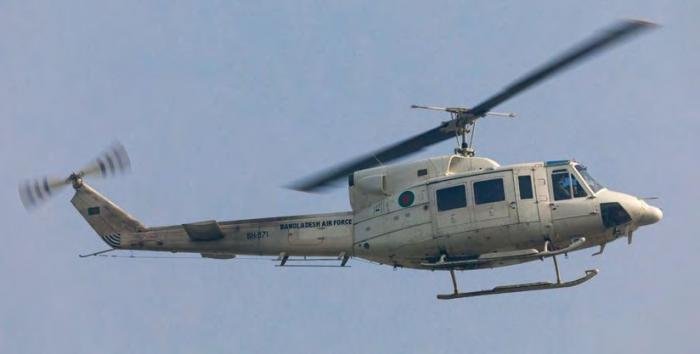
Of 16 examples of the Bell 212 delivered to the BAF from 1980, BH971 (c/n 30971) is one of perhaps six that remain in use with 9 Squadron. The aircraft have been widely deployed on UN and humanitarian duties, including to the Maldives after the 2004 Indian Ocean tsunami.
101 Special Flying Unit’s three L-410UVP-E20 aircraft are used to convert transport crews to multi-engine types. The first aircraft was delivered in April 2015; the second and third examples followed in May and June of the same year.
Potential cadets undergo military and academic training concurrently and later begin flying training. They take threeyear degree courses with a graduation curriculum set up by the National University.
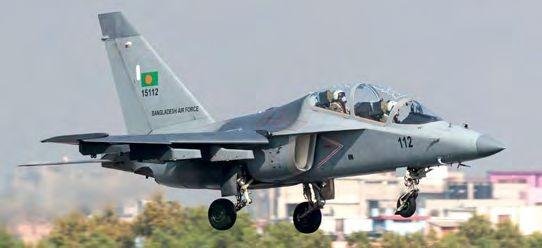
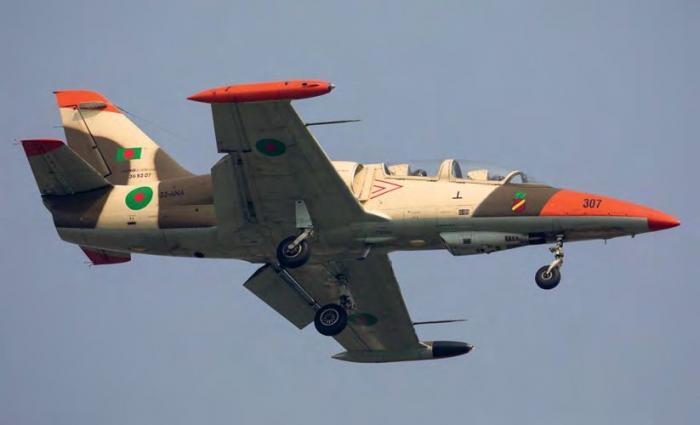
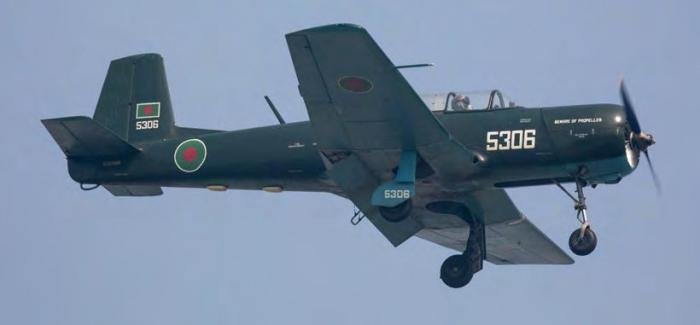
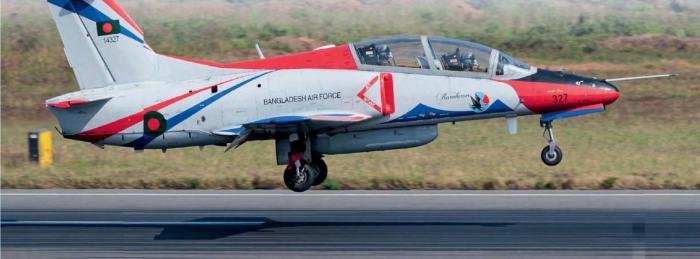
Flying training is delivered by the Flying Training Wing, which comprises three squadrons flying the Nanchang PT-6, the K-8W, L-39ZA; and, for helicopter conversion, the Bell 206L. The BAF’s first female pilots began training in the autumn of 2014.