Bangladesh Economy

To view this content we will need your consent to set third party cookies.
For more detailed information, see our cookies page.

Roadmap of New Bangladesh: 100 Days of Tarique Rahman’s Government Amid Dreams of Reform and a Trillion-Dollar Economy​

06.06.26 - Bangladesh - Pressenza বাংলাদেশ
Roadmap-1-820x447.png
Image created with the support of ai.
By G. M. Forhadul Mozumdar (Dhaka Bureau)

The new government of Bangladesh, led by Prime Minister Tarique Rahman, has completed its first 100 days in office. Embarking on its journey with an ambitious vision of state reconstruction and long-term reforms, the government’s initial actions are now under intense scrutiny both nationally and internationally. The government claims that this period was essentially a phase for repairing a fragile state apparatus and laying the foundation for a ‘New Bangladesh’.

Achievements of 100 Days: Administrative Reform and Public Welfare

In its first 100 days, the government has undertaken more than 200 projects and initiatives. Among these, administrative reform and digital services have been given the highest priority. To deliver benefits directly to the grassroots level, the government has launched two major card programs:

* Farmer’s Card: This digital system has been introduced to bring farmers under the coverage of direct subsidies, loans, and insurance benefits, which is expected to revolutionize agricultural production.

* Family Card: Efforts are underway to bring relief to public life by providing direct financial and food assistance to low-income families to strengthen social security.

The Trillion-Dollar Target and Economic Diplomacy

The biggest surprise from the Tarique Rahman government is the announcement to transform Bangladesh into a $1 trillion economy by 2034. Industrialization and Foreign Direct Investment (FDI) have been identified as the primary driving forces to achieve this massive goal.

To restore economic momentum, Bangladesh Bank has already announced a special incentive package of 600 billion BDT. Its primary objective is to revive closed factories and create new employment opportunities, thereby restoring investor confidence. Breaking away from traditional approaches, ‘economic diplomacy’ is being prioritized in foreign policy, serving as a strategy to turn Bangladesh into an emerging economic powerhouse in South Asia.

Corruption and Good Governance: Zero Tolerance Policy

One of the major challenges and commitments of the new government is to eradicate corruption and repatriate laundered money from abroad. The government has already initiated the process of asset identification and enhancing legal cooperation with international organizations. Analysts believe that recovering the laundered money would act as a major booster for the economy.

The Difficult Road Ahead: Challenges and Realities

Despite riding a wave of popularity, the government faces a mountain of challenges that must be addressed within the next 12 months:

1. Inflation Control: Keeping the market situation within the purchasing power of the common people is the toughest test for the government.

2. Rohingya Crisis: Declining international aid and a stalled repatriation process could trigger geopolitical instability.

3. Law & Order and Unemployment: Failing to restore a fragile law and order situation and failing to ensure employment for the educated youth poses a risk of social unrest.

Pressenza’s Analysis: A Government of Change or Just Another Political Chapter?

According to political analysts, Tarique Rahman’s government has started its work with strong public support. While the steps taken in the first 100 days reflect a genuine intent for reform, the actual outcomes will depend on the next one year.

The people of Bangladesh now demand qualitative changes in their daily lives, not just promises. If the government’s reform activities do not get bogged down in bureaucratic red tape and if economic growth reaches the doorsteps of ordinary citizens, only then will this government secure a permanent place in history as a “transformative government”. Otherwise, it will merely be remembered as another shift in political power.


View attachment 201094

@BananaRepublic Current talk is that by 2034 Bangladesh can become a $1 trillion economy, that would be a doubling in 8 years. So by 2042 we could become a $2 trillion economy.

If we had $2 trillion tomorrow we would be the 15th biggest economy in the world and the biggest economy in the Muslim world. Obviously that won't happen tomorrow and other countries will grow, but in the next 20 years it will be between us, Turkey and Indonesia as to who has the biggest economy in the world, but...

1. We have the biggest army in the world if you count standing army + reserves, biggest contributor to UN peacekeeping forces.

2. Biggest NGO in the world, BRAC.

3. Biggest/highest number of mosques per capita/density on the planet (spiritual blessings) more than even the Hejaz. We have rejected Jamaatism and extremism but need Muslim social values.

Looks like a puff piece.

Any tangible stuff?

I am used to: nuclear power stations, bridges, tunnels, roads, metros, airports, ports, EPZs, Submarines…

Anything of that magnitude?
 
To view this content we will need your consent to set third party cookies.
For more detailed information, see our cookies page.


To view this content we will need your consent to set third party cookies.
For more detailed information, see our cookies page.


Good to see the nationalists in power and that the nationalists are helping to stabilise the economy and making it grow. If we can restore our economy to its 6-7% annual economic growth rate we can become a $1 trillion economy in a decade or less.

Below is an image showing our economic growth:

View attachment 201063


Source: https://www.tbsnews.net/economy/bangladesh-economy-crosses-half-trillion-dollar-mark-1459061

Our economy, and the global economy, was hit by amongst other things:

1. The covid crisis.
2. Ukraine-Russia war

However if we can weather this storm we can hit a GDP of $1 trillion in the next few years.

@Nilgiri @BananaRepublic @Prince_ @SoulSpokesman

View attachment 201067


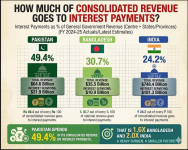
Bangladesh actual revenue for 2024-25 was $35bn and GDP $448bn.

Pakistan actual revenue for 2024-25 was $65bn and GDP $407bn.

Can anyone explain why Bangladesh cannot rise their revenue share of GDP and continue to present wild estimates for budget only to be corrected massively when actual data come? I though new govt will change it but looking at today budget doesn't seem to be the case.
 
@hydrabadi_arab

Hydra bro,

When you say that Pak's tax revenue was USD 65 billion, you mean both federal and states own tax revenues together, right?

I guess our Bangladeshi friends are even less inclined to pay taxes than either Indians or Pakistanis.

Regards
 
@hydrabadi_arab

Hydra bro,

When you say that Pak's tax revenue was USD 65 billion, you mean both federal and states own tax revenues together, right?

I guess our Bangladeshi friends are even less inclined to pay taxes than either Indians or Pakistanis.

Regards
That’s because unfortunately Bangladeshis are very corrupt people and lack civic sense or duty. The rich take loans from banks and launder that abroad while middle class and poor suffer.
 

Users who are viewing this thread

Pakistan Defence Latest

Latest Posts

Back
Top