Bangladesh Economy

The Economist is terrible reading, and it is a terrible fascination reading it. Its articles are always well-researched, its language is crisp and clear, but what it preaches is naked Anglo-Saxon capitalism. A liberal, to which vanishing and despised tribe I belong, can read it with pleasure at the quality of its presentation, while shaking his head at the bland dismissal of poverty, of removal of artificial barriers to individual development, of a state withdrawing into a gated community of millionaires.

অবাক হৈলা কেন?
Why the surprise?

I haven't thought of The Economist this way before.
 
So do you think it is accurate - my description?

It gave a new perspective. Now i have to think of it the way you described it to see. Frankly, I hadn't had any prior description in mind to agree or disagree, or pass a judgement. Just that it is a reputable paper.
 
It gave a new perspective. Now i have to think of it the way you described it to see. Frankly, I hadn't had any prior description in mind to agree or disagree, or pass a judgement. Just that it is a reputable paper.
Magazine.
 
So the source of this nugget is Godi media lol

Utter trash!
The source of the news may be trash, but it is only quoting a top bureaucrat of the Ministry of Textiles.

Outside Bangladesh, your country is still seen as having political turmoil and economic problems, both of which are not good for the smooth functioning of your industry. It is only normal that other textile exporting countries will be getting more enquiries. If we check Vietnam, they too should be having better than normal growth.
 
The Economist is terrible reading, and it is a terrible fascination reading it. Its articles are always well-researched, its language is crisp and clear, but what it preaches is naked Anglo-Saxon capitalism. A liberal, to which vanishing and despised tribe I belong, can read it with pleasure at the quality of its presentation, while shaking his head at the bland dismissal of poverty, of removal of artificial barriers to individual development, of a state withdrawing into a gated community of millionaires.

I quite understand your pleasure in reading it.

The Hindu was once an honoured and respected member of the Mount Road trio. It was/is a thoroughly Iyengar ownership (the name Malathi Parthasarathy is a dead give-away), and made no bones about it, and brought to its task that typical unconscious adherence to the highest standards of integrity that is a hallmark of that section. //I hope Nilgiri doesn't stumble across this post. If he does, I am toast. In such a case, no flowers please; just a small donation to Blue Cross//

You are right in pointing to south Indian publications as being superior. Though minnows in the ocean of which The Hindu is a cetacean, the Deccan Herald, of which my beloved aunt by marriage was once Deputy Editor, and the Deccan Chronicle, part of our daily reading, not to mention Malayalam Manorama, are still keen to maintain standards. That they sometimes falter is the greatest witness to their untiring spirit.

I hate Aroon Purie for his plastic-bottomed lack of integrity, and his nasty manipulation not only of the news but also of his employees. I have no animus against his daughter, who currently runs the publication founded by her grandfather, but there is nothing to show for the change of generations. Not yet.

You have to read the best rag of each side.

In my case, I will only read it if they have an impeccable record on facts.

I don’t care whether they take a capitalist stance or a social democratic stance.

My go to rags are the U.K. Guardian, Observer and the Economist.

I would love to read a far right and a far left version - unfortunately neither of those two sides can present their case without blatantly lying.

Internationally, Washington Post and NYT OPINION pieces are worth a read. But their general reporting is full of blatant lying.

Quality of Bangladeshi rags is extremely poor. From presentation, research to insight - collectively poor.

India used to be good but not any more. Except the few southern rags.
 
You have to read the best rag of each side.

In my case, I will only read it if they have an impeccable record on facts.

I don’t care whether they take a capitalist stance or a social democratic stance.

My go to rags are the U.K. Guardian, Observer and the Economist.

I would love to read a far right and a far left version - unfortunately neither of those two sides can present their case without blatantly lying.

Internationally, Washington Post and NYT OPINION pieces are worth a read. But their general reporting is full of blatant lying.

Quality of Bangladeshi rags is extremely poor. From presentation, research to insight - collectively poor.

India used to be good but not any more. Except the few southern rags.
LOL.

@Banana Republic

Read this quickly, as I will delete it in two hours' time.


It is difficult to react to that other than with a bitter laugh.

The Statesman was sold by the syndicate that owned and ran it to Palkhiwala's nephew, Cushrow Irani, author of "Bengal: The Communist Challenge", that contained a poem with the unforgettable lines, "Who will halt the clattering train". Cushrow won an international reputation for his defence of democracy; within The Statesman, he destroyed whatever journalism there was, and there was a lot. The paper exists like a pale, post-chemotherapy shadow of its former self.

No point in discussing at length the remaining Calcutta papers. We had the Amrita Bazar Patrika, printed in English, sarcastically claimed by the brown sahib as the best vade mecum to learning Bengali that existed; the Jugantar, that disappeared without trace; the Ananda Bajar Patrika, that earned the revenues to support the family's attempts to raise their profile through first, the Hindustan Standard, then The Telegraph, where a well-known Indian journalist frolicked with his helpless female internes, until everything-Da Rudrangshu ran it for a few days until called to higher office to snivel when the autocrats wanted Sabyasachi Das hounded out.

In Delhi, K. K. Birla, one of G. D.'s sons, ran the Hindustan Times. It remains independent run by a lady of his family, but is watery and vacillating due to the bullying of the government.

The Times of India was an institution to rival, even exceed The Statesman, but the present generation of owners are pimps who will do anything to retain their Sodomic life-style.

There are two others, The Pioneer of Lucknow, owned by the Thapars, and yielded, shall we say, to the Trotskyite campaign manager of Shashi Tharoor at their college elections who saw the true light and became a BJP pillar and the familiar of Advani, before shifting to The Pioneer, where Lalit Thapar saw that God had anointed an Editor through the hands of Lal Krishna, and surrendered the paper to Master Mitra. After acquiring the paper, his ethnicity re-asserted itself, he saw yet another true light and joined the Trinamool Congress. He, Swapan DasGupta and Paranjoy Guha Thakurta were the same batch (ISC 71) and were known to the awed population as 5-6-7, from the points that each got in his ISC; Chandan got his DPhil for a good thesis on the Indian Independence Movement, Swapan is an increasingly hag-ridden mouthpiece for the BJP, and Paranjoy was edged out of the EPW for daring to write against Adani, and now wages guerrilla war against a bemused Adani.

There is an astonishingly good paper printed from Chandigarh, that is not easy to get. I used to read it more than fifteen years ago, and do not know its present condition.
 
That's the one.
I do hope they have kept up their standards. They were such a surprising breath of fresh air. I think I actually know somebody connected to it.
Dada,

I suspect they have gotten away with it because they are too small in readership and BJP has no stake in Punjab.

Regards
 
You certainly seem to have a deep understanding of both Bangladesh's and India's socio-political landscapes, and I respect the time and thought you've put into reflecting on these issues. However, I would suggest that you focus your comments and energy more on India, which is currently ruled by a far-right-wing government. This government rose to power on a platform that included the destruction of the 500-year-old Babri Masjid, and now they continue their divisive agenda by attacking mosques and churches, lynching Muslims for allegedly eating beef, silencing opposition by shutting down internet in Kashmir and rigging elections to maintain their power.


Your insights on India—especially regarding the challenges with political parties, the need for reform, and the importance of human and social capital—are incredibly relevant and timely. The issues you raise are some of the same struggles India is facing today, and with your deep perspective on these matters, it seems your energy would be better channeled into fostering meaningful change and discourse within India, rather than continuing to engage in critiques of Bangladesh’s internal politics.


If you are truly invested in improving the political and social fabric of the subcontinent, perhaps it would be more productive to focus your attention on shaping India’s future political discourse. Given the situation in India, the need for secular alternatives like Congress (or even new coalitions) is more urgent than ever. This is where your efforts can have a real impact: by guiding people towards progressive, inclusive, and secular alternatives in Indian politics, you could help shift the direction of the country away from the deepening divisions and authoritarianism that threaten its democratic fabric.


Ultimately, both India and Bangladesh face immense challenges, but in my view, it’s more crucial right now to focus on India, ensuring you don't fall further into a cycle of extremism and intolerance.

The problems of India are vast and many and I grapple with them and try do my bit when I can to work on them far more than I do with BD's as yes ultimately BD'eshis are responsible and accountable for their country and no one else.

This is just my thoughts on the matter at large and folks can scale/apply to their context as they see relevant. i.e it's just food for thought and take it for what its worth. Ultimately I try to preach (the merits of) only that what I have personally practiced a long time and noticed the merit and reward from (either personally or collectively in its sustained cohesive application).
 
@LeonBlack08

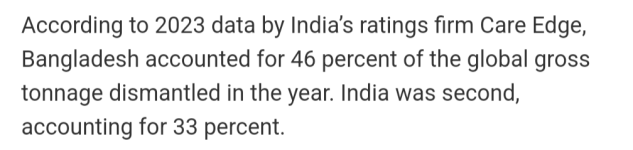
Honestly, shipbreaking is not the industry we should aspire to be leaders of! Rather we should try for leading role in shipbuilding.

Nonetheless, it will be great if India could seize a large share of the shipbreaking business by having green ecofriendly and more importantly worker friendly shipbreaking units.

There is another thing, I wonder. I dont know why these shipbreaking locations are not developed as larger all purpose recycling units which could recycle solar waste, electronic waste etc.

Regards
 

Users who are viewing this thread

Latest Posts

Back
Top