
Navigation
Install the app
How to install the app on iOS
Follow along with the video below to see how to install our site as a web app on your home screen.
Note: This feature may not be available in some browsers.
More options
Style variation
You are using an out of date browser. It may not display this or other websites correctly.
You should upgrade or use an alternative browser.
You should upgrade or use an alternative browser.
Bangladesh Economy
- Thread starter RΛIDEN
- Start date
More options
Who Replied?

UKBengali
Elite Member

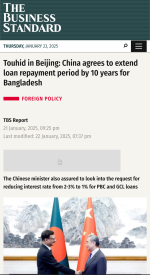
China is indeed a reliable partner for BD.
Hoepfully the interest rate is also reduced as it would save BD hundreds of millions of US dollars a year in interets payments on the billions of dollars of Chinese loans it has taken out.

Exclusive: Bangladesh's high growth under ousted PM Hasina was 'fake', interim head Yunus says
@LeonBlack08 @AbuShalehRumi @Bengal71 @Nilgiri @kambhakt et al.
BananaRepublic
Trusted Member
China is indeed a reliable partner for BD.
Hoepfully the interest rate is also reduced as it would save BD hundreds of millions of US dollars a year in interets payments on the billions of dollars of Chinese loans it has taken out.
Is this quid pro quo for kicking India out of the Teesta deal?
Giving India the Teesta deal was an idiotic and cowardly actions by Hasina!
Btw, Younus needs to put up or shut up with regards to “fake GDP” claims! Beginning to sound like Trump!

MNZGamerX
Trusted Member
Bangladesh sees forex reserves fall back again to $19 billion
Central bank officials attribute the drop to the $1.67 billion payment to settle import bills
bdnews24.com
Published : 24 Jan 2025
Bangladesh's foreign currency reserves have once again dipped below the $20 billion threshold, marking a recurring trend in decline within a span of a month.
According to the recent data released by the central bank on Thursday, the reserves stood at $19.93 billion - a figure calculated using the International Monetary Fund's BPM-6 methodology.
A significant contributor to this decline was the $1.67 billion payment made to the Asian Clearing Union, or ACU, for import bills accumulated over November and December.
Central bank officials have pointed to this payment as the primary reason behind the drop, noting that the reserves often hover near $20 billion before such payments are settled, only to dip below the threshold once the obligations are cleared.
In September and October of last year, reserves fell below $20 billion. By November, the figure rose back to $20 billion, but subsequent ACU bill payments led to a decrease, with reserves dropping to $19 billion by mid-December.
Following an increase in dollar purchases by Bangladesh Bank, the reserves briefly exceeded $20 billion on Dec 23, 2024, reaching $20.16 billion.
This figure peaked at $21.33 billion on Dec 29, 2024, the highest level since Jun 30, 2024, only to fall below $20 billion again three weeks later, after the ACU bill was paid.
The ACU is an inter-regional settlement system facilitating instant transactions between central banks in Asia. Member countries, including Bangladesh, India, Iran, Nepal, Pakistan, Sri Lanka, Myanmar, Bhutan, and the Maldives, rely on the system for import-export settlements.
The country's foreign exchange reserves had peaked to a record $48 billion during the height of the COVID-19 pandemic in 2020.
However, since the pandemic subsided, rising import costs, exacerbated by global fuel and food price surges and the ongoing war in Ukraine, have contributed to the steady decline of reserves, a trend that has persisted since 2022.
Just four days before the fall of the Awami League government, the central bank released its reserve figures, which stood at $20.48 billion on Jul 30, 2024. The same amount was recorded again on Aug 21, 2024.
 bdnews24.com
Central bank officials attribute the drop to the $1.67 billion payment to settle import bills
bdnews24.com
Published : 24 Jan 2025
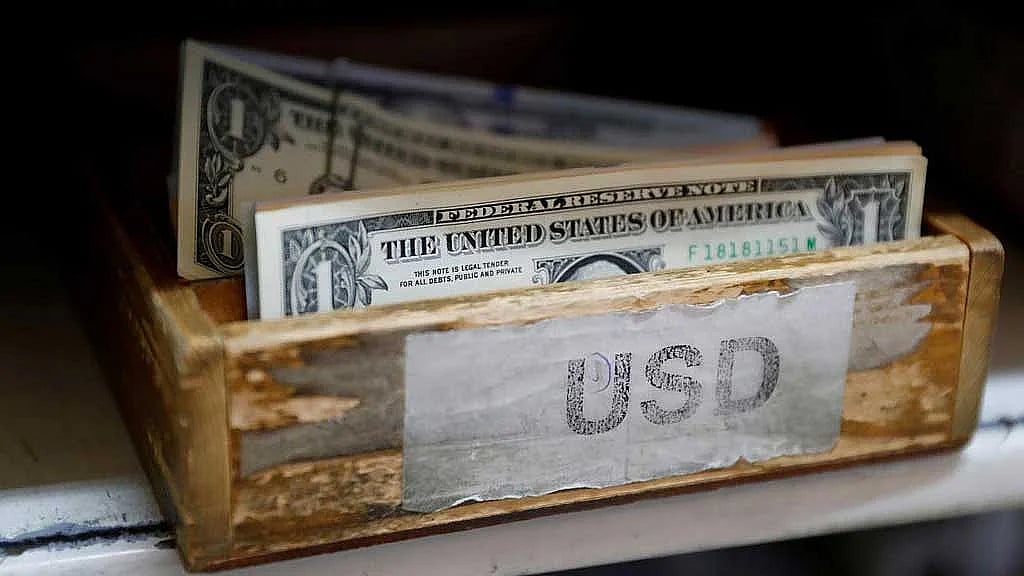
Bangladesh's foreign currency reserves have once again dipped below the $20 billion threshold, marking a recurring trend in decline within a span of a month.
According to the recent data released by the central bank on Thursday, the reserves stood at $19.93 billion - a figure calculated using the International Monetary Fund's BPM-6 methodology.
A significant contributor to this decline was the $1.67 billion payment made to the Asian Clearing Union, or ACU, for import bills accumulated over November and December.
Central bank officials have pointed to this payment as the primary reason behind the drop, noting that the reserves often hover near $20 billion before such payments are settled, only to dip below the threshold once the obligations are cleared.
In September and October of last year, reserves fell below $20 billion. By November, the figure rose back to $20 billion, but subsequent ACU bill payments led to a decrease, with reserves dropping to $19 billion by mid-December.
Following an increase in dollar purchases by Bangladesh Bank, the reserves briefly exceeded $20 billion on Dec 23, 2024, reaching $20.16 billion.
This figure peaked at $21.33 billion on Dec 29, 2024, the highest level since Jun 30, 2024, only to fall below $20 billion again three weeks later, after the ACU bill was paid.
The ACU is an inter-regional settlement system facilitating instant transactions between central banks in Asia. Member countries, including Bangladesh, India, Iran, Nepal, Pakistan, Sri Lanka, Myanmar, Bhutan, and the Maldives, rely on the system for import-export settlements.
The country's foreign exchange reserves had peaked to a record $48 billion during the height of the COVID-19 pandemic in 2020.
However, since the pandemic subsided, rising import costs, exacerbated by global fuel and food price surges and the ongoing war in Ukraine, have contributed to the steady decline of reserves, a trend that has persisted since 2022.
Just four days before the fall of the Awami League government, the central bank released its reserve figures, which stood at $20.48 billion on Jul 30, 2024. The same amount was recorded again on Aug 21, 2024.
Bangladesh sees forex reserves fall back again to $19 billion
Central bank officials attribute the drop to the $1.67 billion payment to settle import bills
bdnews24.com
MNZGamerX
Trusted Member
BIPPA warns of potential power disruptions in summer over unpaid bills
bdnews24.com
Published : 23 Jan 2025
The Bangladesh Independent Power Producers’ Association, or BIPPA, has called on the government to pay outstanding dues to private power plants, warning of severe electricity shortages in the looming summer if immediate action is not taken.
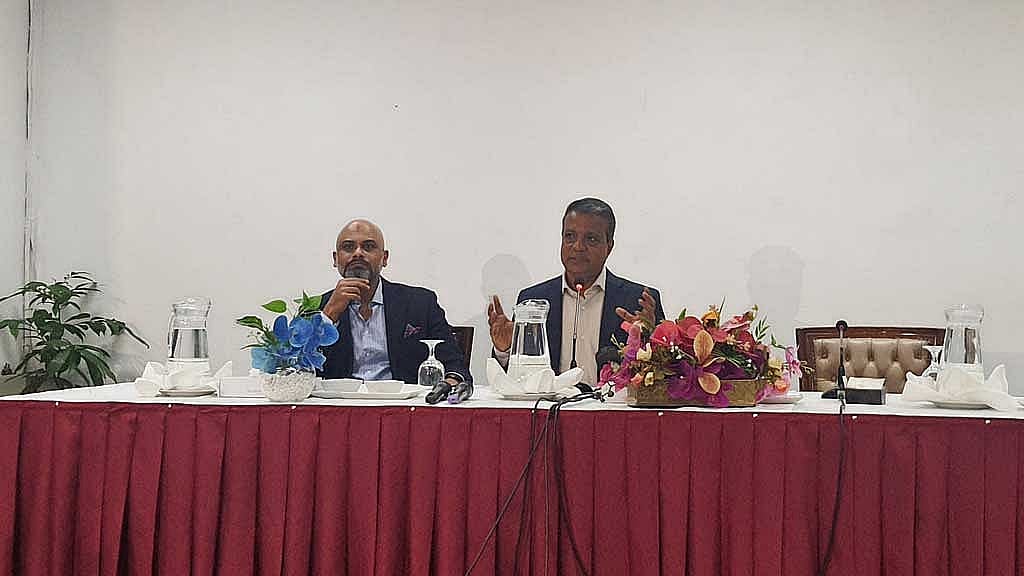
KM Rezaul Hasanat, the newly elected president of BIPPA, urged swift action during a discussion with journalists at the Sonargaon Hotel in Dhaka on Thursday.
In a brief presentation, former BIPPA president Imran Karim disclosed that private power producers are owed Tk 160 billion in arrears over the past four months. He noted that more than Tk 100 billion is owed to liquid fuel-based plants.
The power plants have faced prolonged arrears with the government since the onset of the COVID-19 pandemic in 2020. Despite contracts stipulating a maximum payment delay of 30 days, the Power Development Board, or PDB, has reportedly been defaulting on payments for 120 to 180 days, with delays extending to as long as 200 days in some cases.
During this protracted period of arrears, the BIPPA claimed to have suffered substantial financial setbacks. The association reported a loss of Tk 55 billion due to the depreciation of the taka against the dollar, alongside an additional loss of Tk 32 billion in interest on working capital.
Imran emphasised the urgency of opening letters of credit, or LCs, immediately to ensure the operation of oil-based power plants in the upcoming summer.
He noted that any delay in this process could jeopardise the country's power supply during the peak demand season.
“If the LC is opened today, the oil will reach the plants after 45 days,” he explained, underscoring the tight timeline.
“It is not possible for the companies to open LCs if the dues are not received,” he added.
Currently, Bangladesh is generating between 9,000 and 10,000 megawatts, or MW of electricity, with only 400 to 600 MW coming from liquid fuel-based power plants. However, as the summer season approaches, the demand from this sector is expected to surge, requiring at least 4,000 MW of electricity to be supplied from these plants.
Speakers at the event warned that the summer season could begin as early as March, underscoring the need for immediate action. They stressed that initiatives must be taken now to ensure liquid fuel-based power plants are fully operational in time to keep up with the increased demand.
“We have met with the government three times since December to convey our concerns,” Hasanat said.
“Now, I am informing journalists so the public understands the challenges we face and no blame is misplaced later.”
BIPPA warns of potential power disruptions in summer over unpaid bills
BIPPA officials claim that private power producers are owed Tk 160 billion in arrears from the government
bdnews24.com
UKBengali
Elite Member
BIPPA warns of potential power disruptions in summer over unpaid bills
bdnews24.com
Published : 23 Jan 2025
The Bangladesh Independent Power Producers’ Association, or BIPPA, has called on the government to pay outstanding dues to private power plants, warning of severe electricity shortages in the looming summer if immediate action is not taken.
KM Rezaul Hasanat, the newly elected president of BIPPA, urged swift action during a discussion with journalists at the Sonargaon Hotel in Dhaka on Thursday.
In a brief presentation, former BIPPA president Imran Karim disclosed that private power producers are owed Tk 160 billion in arrears over the past four months. He noted that more than Tk 100 billion is owed to liquid fuel-based plants.
The power plants have faced prolonged arrears with the government since the onset of the COVID-19 pandemic in 2020. Despite contracts stipulating a maximum payment delay of 30 days, the Power Development Board, or PDB, has reportedly been defaulting on payments for 120 to 180 days, with delays extending to as long as 200 days in some cases.
During this protracted period of arrears, the BIPPA claimed to have suffered substantial financial setbacks. The association reported a loss of Tk 55 billion due to the depreciation of the taka against the dollar, alongside an additional loss of Tk 32 billion in interest on working capital.
Imran emphasised the urgency of opening letters of credit, or LCs, immediately to ensure the operation of oil-based power plants in the upcoming summer.
He noted that any delay in this process could jeopardise the country's power supply during the peak demand season.
“If the LC is opened today, the oil will reach the plants after 45 days,” he explained, underscoring the tight timeline.
“It is not possible for the companies to open LCs if the dues are not received,” he added.
Currently, Bangladesh is generating between 9,000 and 10,000 megawatts, or MW of electricity, with only 400 to 600 MW coming from liquid fuel-based power plants. However, as the summer season approaches, the demand from this sector is expected to surge, requiring at least 4,000 MW of electricity to be supplied from these plants.
Speakers at the event warned that the summer season could begin as early as March, underscoring the need for immediate action. They stressed that initiatives must be taken now to ensure liquid fuel-based power plants are fully operational in time to keep up with the increased demand.
“We have met with the government three times since December to convey our concerns,” Hasanat said.
“Now, I am informing journalists so the public understands the challenges we face and no blame is misplaced later.”
BIPPA warns of potential power disruptions in summer over unpaid bills
BIPPA officials claim that private power producers are owed Tk 160 billion in arrears from the government
Pay them and get rid of them once Roopur comes online at the end of this year.
BananaRepublic
Trusted Member
Pay them and get rid of them once Roopur comes online at the end of this year.
Pay Adani and close these polluting and corrupt deshi outfits.
@SoulSpokesman
SoulSpokesman
Trusted Member

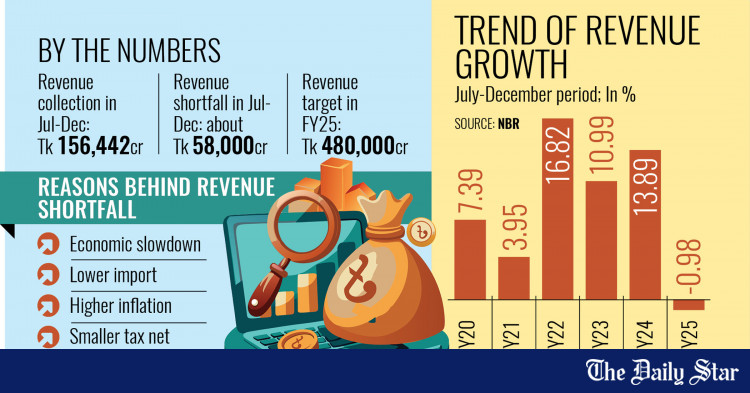
Economy slowing, negative revenue growth shows the sign
For Bangladesh, it is no longer the question of whether the economy is destined for a hard landing or a glide to a flat state; rather the question now is how deep the descent will be.
For Bangladesh, it is no longer the question of whether the economy is destined for a hard landing or a glide to a flat state; rather the question now is how deep the descent will be.
Roughly speaking, the collection turned negative in the first half of the current fiscal year (FY) 2024-25, which is a first since at least the pandemic era -- when markets shuttered, manufacturing units came to a grinding halt, supply chains collapsed, and life and livelihood endured unprecedented shockwaves.
But those days were long over.
Yet, in the July-December period of FY25, taxmen collected Tk 156,442 crore -- 0.98 percent down year-on-year, according to National Board of Revenue (NBR) data.
This negative growth in revenue collection itself is not the disease, according to economists and businesspeople. Rather, it is a symptom of a slowing economy and growing cracks on the macro frontier.
In FY25, major macro indicators like the growth of the gross domestic product (GDP) tumbled, high inflation continued its rampage without showing signs of stopping anytime soon, the exchange rate remained volatile, and development spending hit a four-year low.
All these fairly indicate a single message: the economy is slowing down, it is hurting and will continue to do so due to a lot of factors, including revenue mobilisation, according to economists.
They said NBR's struggle to mobilise revenue and meet targets is nothing new, but these newly emerged economic cracks have added to the collection inefficiency.
In the last 13 years, the revenue board has been consistent in failing to meet its collection targets.
Despite a 6.66 percent collection growth in December, the revenue administration's collection still fell short of its target by Tk 58,000 crore or 25 percent in the first half of FY25, with its end goal set at Tk 480,000 crore for the year.
Taxmen and policy analysts point the finger at the political and
economic shakeup stemming from the ouster of the Awami League government following a mass uprising on August 5 last year.
"The lower revenue growth is closely linked to the current economic slowdown, which also expedites the NBR's inefficiencies," said MA Razzaque, research director of the Policy Research Institute (PRI) of Bangladesh, a local think tank.
Prolonged inefficiencies, reduced imports, higher exemptions and inflationary pressure also contributed to the overall shortfall, the economist added.
The World Bank slashed its forecast for Bangladesh's economic growth by 1.7 percentage points to 4 percent for FY25 due to "significant uncertainties following recent political turmoil" and
"data unavailability".
But Razzaque said the country's actual GDP growth this year could be lower than the World Bank projection.
The country's US dollar stocks have been depleting fast since 2022, prompting the authorities to tighten the belt and restrict imports.
As per the BPM-6 method by the International Monetary Fund (IMF), Bangladesh forex reserves now hover around $20 billion, according to the latest Bangladesh Bank data.
Furthermore, the country's total imports decreased from $90 billion in 2021 to $70 billion in 2023.
"So, the NBR is not going to get enough tariffs from imports," Razzaque added.
Besides, inflationary pressure is also hurting revenue growth as people have been slashing their consumption for a couple of years.
Echoing similar views, Anwar-ul Alam Chowdhury (Parvez), president of the Bangladesh Chamber of Industries (BCI), said lower imports contributed to lower revenue collection.
"The reduction of the overall import volume has contributed to the lower revenue growth and lack of business expansion," he said.
Besides, sluggish implementation of the development budget, officially known as the annual development programme (ADP), is another reason for the lacklustre revenue collection.
The NBR is not getting value-added tax (VAT) and supplementary duties (SDs) from construction works, according to the business leader.
"The projects automatically generate revenue for the NBR," he said.
The implementation of the Annual Development Programme (ADP) in the first six months of fiscal year 2024-25 was down 19 percent year-on-year.
Development spending in the July-December period amounted to Tk 50,002 crore, according to the Implementation Monitoring and Evaluation Division (IMED) under the planning ministry.
"There is an interrelation between the reduction of development spending and lower manufacturing growth," said Parvez.
For example, he said, if there is an ongoing project, there would be demand for construction items and services.
When government spending slows, it badly hits production, including cement, rod and brick manufacturing, causing lower revenue collection, explained Parvez, also a former president of the Bangladesh Garment Manufacturers and Exporters Association.
He also criticised NBR for failing to expand the tax net.
"We don't see any major progress in expanding the tax net. Rather, the NBR is burdening existing taxpayers," he said.
Seeking anonymity, an NBR official acknowledged that the negative collection growth occurred due to the economic slowdown.
"We are facing hurdles in collecting revenue amid the government's lower public spending, higher inflation and slow private sector credit growth," the official said.
Prof Selim Raihan, executive director of the South Asian Network on Economic Modeling (Sanem), suggested exploring more diversified sectors for revenue generation, properly implementing the wealth tax, and expanding the tax net.
"The NBR should not take any ad-hoc decisions for tax hikes without consultation stakeholders," he said, referring to the revenue board's recent withdrawal of hiked VAT and SD on nine goods and services.
"It should be well researched and meticulously planned," he said.
Regards
SoulSpokesman
Trusted Member
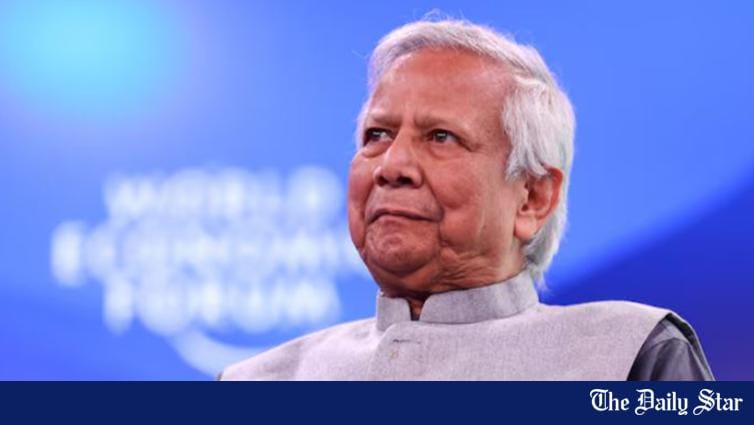
High growth under Hasina was ‘fake’
Chief Adviser Professor Muhammad Yunus yesterday said Bangladesh’s high growth under ousted prime minister Sheikh Hasina was “fake” and faulted the world for not questioning for her “corruption”.
Chief Adviser Professor Muhammad Yunus yesterday said Bangladesh's high growth under ousted prime minister Sheikh Hasina was "fake" and faulted the world for not questioning for her "corruption".
Yunus, 84, an economist and the 2006 Nobel Peace Prize winner, took charge of the South Asian country's interim government in August after Hasina was forced to flee to neighbouring India following weeks of violent protests.
Hasina has been credited with turning around the economy and the country's massive garments industry during her 15 years in power, although critics have accused her of human rights violations and suppressing free speech and dissent.
Hasina, who had ruled Bangladesh since 2009, is being investigated there on suspicion of crimes against humanity, genocide, murder, corruption and money laundering and Dhaka has asked New Delhi to extradite her.
Hasina and her party deny wrongdoing, while New Delhi has not responded to the extradition request.
"She was in Davos telling everybody how to run a country. Nobody questioned that," Yunus told Reuters in an interview on the sidelines of the World Economic Forum's annual meeting in the Swiss Alpine resort. "That's not a good world system at all."
"The whole world is responsible for making that happen. So that's a good lesson for the world," he said. "She said, our growth rate surpasses everybody else. Fake growth rate, completely."
Yunus did not elaborate on why he thought that growth was fake, but went on to stress the importance of broad-based and inclusive growth, and the need to reduce wealth inequality.
Annual growth in Bangladesh accelerated to nearly 8% in the financial year 2017/18, compared with about 5% when Hasina took over in 2009, before the impact of Covid-19 and the war in Ukraine pulled it down.
In 2023, the World Bank described Bangladesh as one of the world's fastest-growing economies.
"Since its independence in 1971, Bangladesh has transformed from one of the poorest countries to achieving lower-middle income status in 2015," it said.
The student-led movement in Bangladesh grew out of protests against quotas in government jobs that spiralled in July, provoking a violent crackdown that drew global criticism, although Hasina's government denied using excessive force.
The student protesters recommended Yunus as the chief adviser in the interim government tasked with holding fresh elections.
Yunus, who has promised to hold elections by the end of 2025 or early 2026, said he was not interested in running.
Known as the "banker to the poor", Yunus and the Grameen Bank he founded won the Nobel for helping lift millions from poverty with tiny loans of less than $100 offered to the rural poor, too poor to gain attention from traditional banks.
"For me, personally, I'm not very driven by growth rates," Yunus said. "I'm driven by the quality of life of the people at the very bottom level. So I would rather bring an economy which avoids the whole idea of wealth concentration."
Ties between Bangladesh and India, who have strong trade and cultural links, have become fraught since Hasina was ousted and she took refuge in New Delhi.
Yunus has demanded that India send Hasina back to Bangladesh so she can face trial for what it says are crimes against protesters and her opponents, and crimes she is accused of committing during her tenure.
Calling India's rival China a long-term friend of Bangladesh at this difficult time, Yunus said the strained relationship with New Delhi "hurts me a lot personally".
"Bangladesh-India relationship should be the strongest possible. You know, you cannot draw the map of India without drawing the map of Bangladesh," he said, referring to how Bangladesh's land border runs almost entirely alongside India's.
Regards
SoulSpokesman
Trusted Member
Takeaway from the above two posts
#1 Prof Yunus says that growth under SHW was fake but doesnt say why. If BD's reported GDP is fake, then it is his govts obligation to tell us what is the real GDP. Shouldn't be very difficult for the Central Bank and BBS.
#2 BD's economy has slowed down after SHW left- he must deliver on current performance and not blame his predecessor.
Regards
@BananaRepublic @UKBengali @Afif
#1 Prof Yunus says that growth under SHW was fake but doesnt say why. If BD's reported GDP is fake, then it is his govts obligation to tell us what is the real GDP. Shouldn't be very difficult for the Central Bank and BBS.
#2 BD's economy has slowed down after SHW left- he must deliver on current performance and not blame his predecessor.
Regards
@BananaRepublic @UKBengali @Afif
kambhakt
Registered Member
Will wait for actual figures before making a comment.Exclusive: Bangladesh's high growth under ousted PM Hasina was 'fake', interim head Yunus says
@LeonBlack08 @AbuShalehRumi @Bengal71 @Nilgiri @kambhakt et al.
In any case, countries like India or Bangladesh which have significant poverty, should first be looking at HDI figures rather than GDP figures. GDP is just the tool to help improve HDI.
SoulSpokesman
Trusted Member
@BananaRepublic
Pay Adani and close these polluting and corrupt deshi outfits.
If Barrister saheb's article is correct, oil-fired plants will be upto 4000 MW in the summer months. Makes no sense, best keep them closed and buy from Adani as much as possible.
Regards
Pay Adani and close these polluting and corrupt deshi outfits.
If Barrister saheb's article is correct, oil-fired plants will be upto 4000 MW in the summer months. Makes no sense, best keep them closed and buy from Adani as much as possible.
Regards

AbuShalehRumi
Trusted Member
Every Bangladeshi with 2 cent brain knows "why". If you want to know the reasons with proper paperwork's then you have to wait...#1 Prof Yunus says that growth under SHW was fake but doesnt say why.
Hasina left? She fled with tail behind her back.#2 BD's economy has slowed down after SHW left- he must deliver on current performance and not blame his predecessor.

LOL, he is doing damage control. He must flash hasina era corruption and mass scale looting to the public...
SoulSpokesman
Trusted Member
@AbuShalehRumi
If you want to know the reasons with proper paperwork's, then you have to wait...
Ok, will wait. I am in no great hurry.
Hasina left? She fled with tail behind her back
OK!
Regards
If you want to know the reasons with proper paperwork's, then you have to wait...
Ok, will wait. I am in no great hurry.
Hasina left? She fled with tail behind her back
OK!
Regards
Users who are viewing this thread
Total: 2 (members: 0, guests: 2)
Pakistan Defence Latest
-

-
 Federal cabinet gives nod to imposition of emergency in KP; summary sent to president (13 Viewers)
- Latest: Goenitz
-

-
-
US embassy drone in Dhaka raises intelligence surveillance suspicions (4 Viewers)
- Latest: SteppeWolff


