Bangladesh - Foreign Investment Discussion Thread

Well, if I want to compare two successive governments in Bangladesh, stats on FDI inflow will be the last indicator I would choose. FDI inflow has always been abysmally low, and whatever FDI we got in the last 15 years, it was mostly reinvestment by existing MNCs with next to zero greenfield investments, resulting in a lack of diversification of exports. This could have been improved, the way our peers like Vietnam did, but there has been no reforms at all in the last 15 years despite political stability. Instead, all the state institutions were destroyed serially.

There was high GDP growth during Hasina true but it was mostly due to exorbitant government spending on misplanned projects and that too with borrowed money and rising foreign debt.


^Just a few from thousands of such examples. Explains the jobless growth in Bangladesh where youth unemployment was peaking every year.

Anyone understanding ECON 101 would know that this economic growth is not just unsustainable but also pushing the country towards an inevitable default. One external shock and it's game over!

And the shock finally came with COVID and the Ukraine war. That's when all the banks started getting looted and money getting syphoned out of the country because those in power knew what was coming!

Trust on the financial system was at its lowest - people were recommending each other to withdraw their money from banks while expatriates were increasingly avoiding banking channels to send money. Foreign reserves, as expected, began depleting.

Now I don't expect Hasina to know and predict all this stuff, which is fine. What I expected, however, was that she would at least know who should be delegated what - this is a basic leadership quality which she lacked entirely. People with crooked background were installed everywhere, some say many of them were apppointed under India's direction. Bangladesh was effectively a kleptocracy with no future under Hasina.

Whatever benifits of doubts you could give to Hasina, in 2024 it was all clear that she was willing to stoop to the lowest to stay in power, be that by selling the country's sovereignty to India or by killing thousands of her own citizens.

Bangladesh under Yunus is surely not perfect but the way he has held the country together is almost like a miracle. I was honestly expecting a Libya-like situation given the massive disinformation campaign coming from India and Awami League's desperate efforts to destabilize the country. The thing I have found the most remarkable is that unlike before, people are now hopeful and confident about the country's future.
 
Exactly.

It's so ridiculous that people comparing a transitional government - whose job is to restore normalcy and hold elections - with an autocratic regime who were in power for 15 years and had the ability to do a lot more to bring in FDI with the level of political stability it enjoyed.

The fact that this summit raised this much positive buzz is a success in itself for a transitional government.
He did a marvelous job on this summit. He spent like $130,000 but got $150,000,00 worth of investments.
He was with HSBC in his previous position.

HSBC
Full-time · 5 yrs 4 mosFull-time · 5 yrs 4 mos
Associate Director, Infrastructure Finance Investment Banking

I am an inactive real estate agent. Real estate business needs a lot of marketing whether it is phone call, direct mail, email, and door knocking (as last resort!). This needs some folks smart as him to follow up on the attendee investors.

And it is not too early to start working on the next summit!!
 
@Prince_ You're yet to provide proof of your claims. Im waiting.

@LeonBlack08 You should start taking note of posters who are copy pasting fiction instead of facts. When challenged they're coming with more fiction.

In Bangladeshi context, being a fascist sympathizer is equivalent of being a Nazi sympathizer and denying fascists crimes against humanity is equivalent of holocaust denial...
I don't see the point in presenting any data in front of. U refuse to accept proven facts if they don't align with your misguided belief. Anyway,

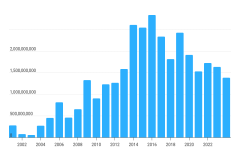
Bangladesh-Foreign-Direct-Investment-Inflows-US-2025-04-16-11-31.png
This is the revised version of total FDI inflow, where Bangladesh Bank, following IMF guidelines, has deducted the losses incurred by foreign investors from 2019 onwards.

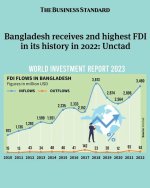
But, if we take the face value of the total FDI inflow, without the accounting revision then FDI inflow would be this
490020595_122153926478456192_116120576698323950_n.jpg
Now, go and compare the foreign investments made during the BNP-Jamaat period with the investment inflows during Sheikh Hasina's tenure. There is a reason why Bangladesh has progressed leaps and bounds under her leadership.
 
I don't see the point in presenting any data in front of
Good. Then don't spread fake news and propaganda. If you get challenged because of your claims, you must come up with proper data and facts to back them up...
U refuse to accept proven facts if they don't align with your misguided belief.
LOL, I will believe in facts not fictions. And till now you failed to present facts in every threads I challenged you.
Anyway,

Bangladesh-Foreign-Direct-Investment-Inflows-US-2025-04-16-11-31.png

This is the revised version of total FDI inflow, where Bangladesh Bank, following IMF guidelines, has deducted the losses incurred by foreign investors from 2019 onwards.

But, if we take the face value of the total FDI inflow, without the accounting revision then FDI inflow would be this
490020595_122153926478456192_116120576698323950_n.jpg
You're changing the goalpost here...

In this thread you were criticizing Yunus administrations investment summit as it only attracted 150+110 millions FDI. While claiming awami league era investment summit in 2023 attracted 3.48 billions.

I challenged you to provide verifiable proof of your claim about awami era 2023 investment summits 3.48 billions FDI sources and where they have invested. Just like Yunus administration did, 150 from Handa group and 110 FDI in shopUp. Simple...

Please don't expect us to believe any awami era data without proper proofs...
Now, go and compare the foreign investments made during the BNP-Jamaat period with the investment inflows during Sheikh Hasina's tenure.
Earlier you were comparing 8 months old post revolution interim Yunus administration. Now you want to compare BNP-Jamayat era which was in power almost 2 decades ago?

Awami league failed to attract FDI and companies like Samsung and Aramco who really wanted to invest huge amount didn't because of awami leagues corruption and lawlessness...
There is a reason why Bangladesh has progressed leaps and bounds under her leadership.
So called awami era growth was unsustainable growth, fuelled by public spending with bad foreign loans. This is why Bangladesh is yet to recover from Covid times economic shock and Russia-Ukraine war just made it worse. Awami league hated everything Pakistani except Pakistani economic model. LOL...
 
Last edited:
Bangladesh draws growing attention of foreign investors
Says Uber official in an interview with The Daily Star

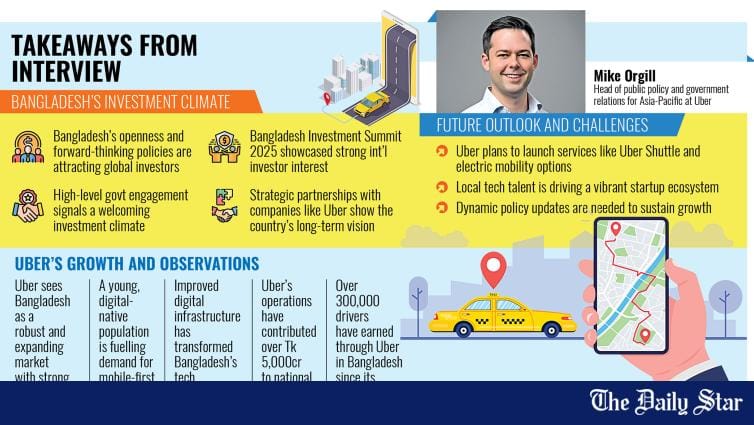
Bangladesh is increasingly attracting foreign investors, especially in the fields of technology and digital services, according to Mike Orgill, head of public policy and government relations for Asia-Pacific at Uber.


This rising interest reflects the openness of the government, its willingness to engage and efforts to maintain a policy dialogue with investors, strategic partners and global companies, said the top executive of the American multinational transportation company that provides ride-hailing services.

"These developments are helping boost investor confidence and opening up broader opportunities for innovation, growth, and long-term development," he said during an interview with The Daily Star.

On the sidelines of the recently concluded Bangladesh Investment Summit in Dhaka, Orgill said, "The government's active engagement with the international business community reflects a positive signal."


"It shows that Bangladesh is keen to welcome investment," he added.

According to the Bangladesh Investment Development Authority (Bida), the four-day summit, jointly organised by Bida and the Bangladesh Economic Zones Authority, received initial investment proposals worth Tk 3,100 crore.

The Uber executive pointed to recent meetings with the interim government as evidence of a policy direction aimed at building meaningful partnerships, especially with companies that have maintained a sustained presence in Bangladesh.


Such engagement is timely, he noted, as countries around the world are vying for foreign direct investment and striving to position themselves as centres for innovation.

He said that the government's attention to platforms like Uber was not merely symbolic but strategic. "These interactions show a willingness to embrace global best practices, consider policy reforms, and unlock new avenues for growth."

Orgill also welcomed the tone of recent public statements from government officials, noting that their focus on digitisation, inclusive growth, and youth employment closely aligns with Uber's mission and broader goals for a digital economy.

"It's very exciting to see how the government is focused on attracting international investment," he said after a meeting of US delegation with Commerce Adviser Sk Bashir Uddin.

"It's also very encouraging to see them spend time with companies like Uber that have been in the market for some time and continue to develop that partnership."

"I think it is a really important signal to investors like us. It was also exciting to hear -- I am not sure if you saw some of the speeches -- the forward-looking ideas the interim government presented. So yes, I was very happy to be here."

Beyond government relations, Uber's experience on the ground points to strong market fundamentals. Despite the evolving nature of urban mobility, demand for Uber's services in Bangladesh continues to rise, backed by an engaged and growing customer base.

"This momentum shows that the Bangladesh market is not only emerging, it is expanding," Orgill said.

He credited much of this growth to the country's youthful and tech-savvy population.

With a median age under 30, the country offers fertile ground for mobile-first services. There is a rising demand for digital platforms that improve daily convenience and connectivity -- ideal conditions for companies like Uber that depend on flexible workforces and digitally fluent users.

At the same time, key macroeconomic trends are also moving in the right direction. Urbanisation is accelerating, fuelling demand for accessible, reliable, and cost-effective transport.

From Uber's perspective, these are not future possibilities but present realities shaping operations and expanding the user base.

"We continue to have a strong business here," Orgill said. "Consumers are increasingly using the app. So, I see it as a robust market for us. And I think the macroeconomic conditions here are pretty inspiring."

"Look at the population growth, the age of the population. There is a really young, talented workforce. Digital penetration is growing. All these factors make Bangladesh a growing market for any industry. From Uber's perspective, there is a lot to be excited about."

He said another key enabler has been the improvement of digital infrastructure.

Read more

Bangladesh has significant investment potential: experts

A decade ago, limited smartphone use and patchy internet access made the adoption of digital services difficult. Today, widespread 4G coverage, affordable mobile data, and the growing use of digital wallets and apps have made it easier for Uber to connect with riders and drivers alike, according to the executive.

Orgill said Bangladesh is no longer just a consumer of global tech solutions; it is now cultivating a vibrant innovation ecosystem of its own.

He praised the growth of local tech talent, which is driving a new wave of start-ups and digital platforms tailored to local needs. "It is growing so fast, right? Everybody is on their phones. Internet connectivity is superfast these days."

"I have been coming to Bangladesh for over 10 years. Back then, internet penetration was very low. You could not get devices. And now, everyone has 4G smartphones. It is just a completely different ecosystem."

"And what is inspiring is the remarkable local tech talent. It is not just large foreign players anymore -- there is a robust, growing native ecosystem driven by Bangladeshi talent solving local problems."

Since launching in Bangladesh eight years ago, Uber says more than 300,000 drivers have earned income through its platform. In the past year alone, it estimates its economic contribution to be over Tk 5,000 crore, largely from driver earnings and related activities.

"That's a significant contribution to Bangladesh's economy, and it's growing. I am proud of that impact. Proud to be a part of it. And this is a market we are very committed to."

In the future, Uber plans to introduce new services such as Uber Shuttle and electric mobility options, aimed at further adapting to local needs and environmental priorities.


"The government's active engagement with the international business community reflects a positive signal," the Uber official said.
However, Orgill acknowledged that challenges remain, particularly regarding policy frameworks. Chief among them is the issue of fare caps, which have not been revised in over a decade.

Uber argues that this limits its ability to adjust pricing based on supply and demand, making it difficult to ensure consistent service and fair earnings for drivers.

Despite such hurdles and challenges, Orgill remains optimistic.

"This is a market with enormous potential," he said. "The signs are encouraging, and our commitment to Bangladesh is deep."


To view this content we will need your consent to set third party cookies.
For more detailed information, see our cookies page.
 
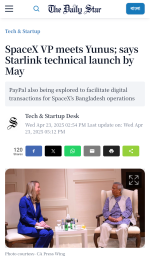
1000006999.png

 
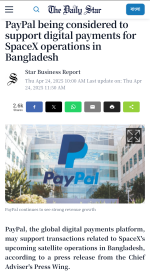
Paypal coming to Bangladesh will be a great boost to the growing freelancer community in Bangladesh. Will translate to more self employment and inflow of forex.
 
@uksyl @LeonBlack08

It is good that BD is attracting the interest of Starlink and other tech/digital service providers. However, it would be important that BD emerge as not only a consumer of tech (i.e. importer) but also exporter of tech services so that it doesn't result in cash outflows only.

Regards
 
@uksyl @LeonBlack08

It is good that BD is attracting the interest of Starlink and other tech/digital service providers. However, it would be important that BD emerge as not only a consumer of tech (i.e. importer) but also exporter of tech services so that it doesn't result in cash outflows only.

Regards

Local tech startups are still at infancy. But there are prospects as the skilled tech workforce has increased over the years. We need a success story like Infosys and other Indian tech giants.
 

Chinese internet giant Tencent wants to invest in Bangladesh

Chinese internet giant Tencent wants to invest in Bangladesh

Chinese information technology and internet giant Tencent has expressed its interest to invest in Bangladesh.


Faiz Ahmad Taiyeb, the special assistant to chief adviser on the Ministry of Posts, Telecommunications and Information Technology, said this in a status posted on his Facebook on Monday (April 28) night.


Faiz Ahmad Taiyeb wrote, “American giant Starlink has come to Bangladesh. The Chief Adviser has approved their licence application. A big tech giant has come to Bangladesh with the help of Chief Advisor Dr. Yunus Sir. Many more will come like this.”


He wrote, “Today, we officially sat with Chinese giant Tencent. They have also expressed their interest in coming to Bangladesh. We have assured them of policy support. Along with this, OSIRIS Group is coming to Bangladesh.


Bangladeshi data and cloud companies are bringing hyper-scalar clouds and data centers with the help of Jatra (at Kaliakair Hi-Tech Park). A world-class secured cloud is being setup here for big giants, where Meta, Google’s payload can come.”


He also wrote, “Dr. Muhammad Yunus is going to give all such unimaginable gifts to Bangladesh.”

 
I work in China for a large Chinese engineering company

We'd love to invest in Bangladesh, and even consider building some factories there. But BD needs to improve its skills base, and strengthen its institutional strength and credibility.

The last Bangladesh investment summit was quite positive in my opinion. It was well presented, no hype, no BS, just solid facts, highlighting the potential of BD. Rarely have I ever seen Bangladesh presented in such a professional, forward-looking way, with a clear idea of what future Bangladesh can look like.
BD, unlike a neighboring "suppapuwwa" never ceased assets of foreign companies. And the ROI is the highest in the region. They should use these strengths, along with (hopefully) improvements in local skills/competence
 
Translation:
While BIDA Executive Chairman is Flying High, Domestic and Foreign Investments are Declining

On May 25, 2024, from an altitude of 41,000 feet in a plane over Memphis, USA, Chowdhury Ashik Mahmud Bin Harun jumped out, holding the flag of Bangladesh. His skydiving made it to the Guinness World Records on July 1 of the previous year. A few months later, on September 12, Chowdhury Ashik was appointed as the Executive Chairman of the Bangladesh Investment Development Authority (BIDA) and the Bangladesh Economic Zones Authority (BEZA).


Confident Ashik Chowdhury took many promotional initiatives for attracting investment after assuming office. These included creating an investment heatmap, organizing investment summits, registering with Elon Musk's Starlink for satellite-based internet service, signing a contract with NASA for peaceful and civilian space exploration, and bringing all investment promotional agencies under one roof. The most recent addition was the investment of Denmark-based AP Moller Maersk to strengthen logistics infrastructure at the Port of Chittagong. Such new initiatives have caught the public’s attention, especially on social media, where there has been considerable buzz around him.


In the seven months since taking office, Ashik Chowdhury has initiated several activities to improve the country’s investment climate. However, the results of his promotional activities for building investment infrastructure are not yet visible in terms of actual investment attraction. The number of registered investment proposals at BIDA has been declining, and the net inflow of foreign direct investment (FDI), according to central bank data, has also decreased. Meanwhile, the import of capital machinery has also declined. Overall, while Ashik Chowdhury’s promotional activities for attracting investment are widely discussed, the real investment scenario is quite the opposite.


According to the balance of payments (BOP) statistics from Bangladesh Bank, the net inflow of FDI during the first nine months of the current fiscal year, from July to March, was USD 861 million. In comparison, the net FDI inflow in the same period of the 2023-24 fiscal year was USD 1.164 billion. This indicates a 26% decrease in the net FDI flow in the first nine months of the current fiscal year.


According to the central bank's weekly selected economic indicators, the payment for the import of capital machinery during the first nine months of the current fiscal year, from July to March, amounted to USD 1.521 billion. In the same period of the previous fiscal year, the payment was USD 2.133 billion. This means that capital machinery imports have decreased by 28.68%.


Efforts to get a statement from Ashik Mahmud Bin Harun regarding the investment situation were made on multiple occasions since Sunday, but no response was received until the report was written last night. The next attempt was made to reach Dr. Anisuzzaman Chowdhury, the special assistant to the chief adviser in the Ministry of Finance, in the capacity of a state minister. Speaking to the Daily Bonik Barta, he said, "Investment matters are dependent on the economy as a whole. This is a circular process. Objectively speaking, it can be seen that the level of foreign and domestic investment has always been low in Bangladesh. This investment situation is not new. Investment matters are always part of an ongoing process. It remains to be seen whether comparing the current investment situation with the past is valid. Long-term investment is a time-consuming process. Investors consider many factors before making decisions. Investment doesn’t suddenly increase. Recently, an investment summit was organized, where some commitments were made, but it will take time to implement them. There are various uncertainties at present, including a recent war and the issue of Rohingya refugees. We are going through a period of political instability. The government has recently taken several initiatives to improve the investment climate. It will take time to see how things unfold."


Four days after being appointed as the Executive Chairman of BIDA and BEZA on September 12, Ashik Mahmud Bin Harun met with representatives of the Foreign Investors Chamber of Commerce and Industry (FICCI). During the meeting, he said, "We hope to resolve the current challenges and obstacles to foreign investment very soon."


On October 30, Ashik Chowdhury inaugurated a webinar titled ‘State of Investment Climate’ for BIDA. In his concluding speech, he expressed his commitment to creating a fair and transparent business environment. He also presented a roadmap during his speech, stating that the main goal of the roadmap is to improve the ease of doing business and take effective measures against corruption.


On November 18, BIDA announced plans to create an FDI heatmap, identifying potential countries for investment, competitive sectors, and strategic investors to attract foreign direct investment. In the announcement, Ashik Chowdhury mentioned, "Until now, we lacked active engagement in investment promotion. Now, we want to conduct information-based strategic promotion to increase foreign investment. To this end, we have undertaken the creation of the FDI heatmap with the cooperation of various domestic and foreign expert institutions."


On January 19 of this year, BIDA published the FDI heatmap. During its publication, Ashik Chowdhury stated, "The FDI heatmap is not just a plan; it is a roadmap for our future investment efforts. We will base any roadshows, bilateral investment agreements, or policy support on this data-driven analysis."


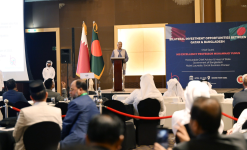
On March 23, Ashik Chowdhury announced the organization of an investment conference. The conference, held in April, was attended by representatives from 50 countries, with a total of 415 participants. At the end of the conference, Ashik Chowdhury reported that investment proposals worth BDT 310 billion had been received.


Ashik's smooth presentation at the investment conference caught the attention of many. Praise for his presentation spread through social media and other circles. By the end of the investment conference, several media outlets had referred to the expectations of significant investments in Bangladesh, dubbing it the "Ashik Magic." However, according to government statistics on investment, the actual impact of the "Ashik Magic" on real investments is yet to be seen.


Local investors have shared that there is no positive outlook for Bangladesh’s investment situation even in discussions with foreign ambassadors. One local investor, asking about the investment conference held in April, inquired with an ambassador from a foreign country, “Many investors from your country participated in the recently concluded investment conference. How long do you think it will take them to implement investments?” The ambassador replied by saying, “No investor will come to Bangladesh without a political government." Referring to the country’s law and order situation, the ambassador added, “The situation is still chaotic.”


Anwar-ul-Alam Chowdhury Parvez, president of the Bangladesh Chamber of Industries (BCI), told Bonik Barta, “Foreign investors are waiting for a political government to make the final investment decisions. Moreover, investment attraction depends on the types of proposals being offered. Even local investors are not showing interest in investing right now; in this scenario, how will foreign investors come?”


He further added, “The interest rate on bank loans in the country is now above 15%. Who will invest with such high-interest rates? In addition to high interest rates, our electricity, energy, and transportation costs are also higher compared to competitor countries. Let’s not even talk about bureaucratic complexities! In such a situation, why would foreign investors come here? Foreigners do not take loans from Bangladesh's banking sector. Local investors are the ones who borrow from the domestic sector. Foreign investors come only when local investors show interest in investing. Local investors are not showing interest right now for various reasons. If we don’t invest, how can we expect foreigners to be interested?"


Dr. Selim Raihan, executive director of the South Asian Network for Economic Modeling (SANEM), said to Bonik Barta, “The current executive chairman of BIDA is young, dynamic, and has international experience. Given these qualities, we want to remain hopeful. But I believe that overall, it is not possible for him alone to do everything. This is a collective institutional effort. Not just BIDA or BEZA, but the cooperation of other relevant institutions is necessary. The current executive chairman’s initiatives may be praiseworthy, but to turn them into reality, coordinated efforts are needed, and they must be implemented at the grassroots level. A long path lies ahead.”
 

Users who are viewing this thread

Pakistan Defence Latest

Latest Posts

Back
Top