Bangladesh - Hasina regime corruption

NASSA Group Chairman Nazrul siphoned off $3bn to USA: CID
BSS

October 2, 2024

naz.jpg

The Criminal Investigation Department (CID) has found that the detained NASSA Group Chairman Nazrul Islam Majumder has laundered three million US dollars to America through "trade based money laundering".

According to a press release of the CID, its preliminary inquiry has found that Nazrul siphoned off the money to the USA by exporting goods against 130 LCs/sales contracts in the name of Firoza Garments Ltd, a sister concern of NASSA Group, from the National Bank Ltd from 2020 to 2024.

The CID has claimed that they have proof in their hands that Nazrul earned 3 billion US dollars through exporting goods and did not bring back the money to the country despite the passage of the stipulated time aimed at laundering the amount.

The CID has also got an allegation that Nazrul purchased a house in the United Kingdom (UK) after his daughter Anika Islam's name by siphoning off money.

The CID release also said, Nazrul evaded taxes of crores of money by selling the raw materials which he imported from abroad under tax-free bond coverage and sold those in the country's open markets.

The release also said that Nazrul took loan of Tk 21,000 crore in favor of four organizations of NASSA Group and laundered hundreds of crores of money in different countries such as Dubai in UAE, the UK, Canada, Singapore and Thailand through under voicing and over voicing. under the guise of export and import.

Nazrul Islam Majumder, who was also chairman of the Exim Bank and President of Bankers Association of Bangladesh (BAB) was arrested from the city's Gulshan area by police on Tuesday night.

 
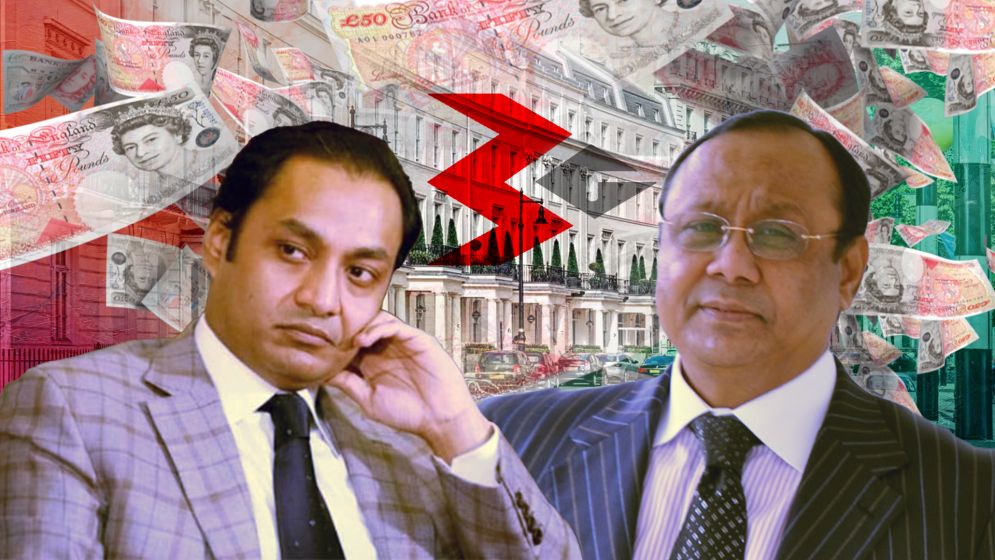
Bashundhara family's alleged money laundering fuels nearly 1000 crore taka (£62 million) UK property spree

Zulkarnain Saer
Publish: 03 Oct 2024

Photo_BO_En_02-Oct-66fea2146af02.jpg

When Sayem Sobhan Anvir, Managing Director of Bashundhara Group, was implicated in the rape and murder case of college student Mosarrat Jahan Munia in April 2021, it quickly became a hot topic on Bangladeshi social media.

One meme that circulated widely suggested, "If anything happens to Anvir, people will lose faith in the power of money."

However, the influence of money prevailed, as the Police Bureau of Investigation (PBI) submitted a probe report a year and a half later that sought Anvir's exoneration, claiming they found no connection between him and Munia's murder.

Bashundhara Group is among Bangladesh's largest business conglomerates, having entered the prestigious billion-dollar club in September last year, joining other major players like Square Group and Pran Group.

While its diverse portfolio spans from gold to bitumen production, Bashundhara's primary strength lies in real estate, a sector founded by Ahmed Akbar Sobhan in the late 1980s.

In just three decades, properties in Bashundhara-branded areas have become some of the most sought-after and expensive in Dhaka.

Despite numerous allegations of land grabbing and river encroachment against the group, similar to Anvir's case, Bashundhara has consistently avoided legal repercussions.

Following Sheikh Hasina's fall due to a mass uprising, the Criminal Investigation Department (CID) launched a comprehensive investigation into Bashundhara's alleged land grabbing and unlawful filling of public properties, including canals, wetlands, and cemeteries.

This CID inquiry also includes money laundering allegations against Bashundhara Group's Chairman Ahmed Akbar Sobhan and Managing Director Anvir, according to multiple sources within the CID who spoke to Bangla Outlook.

While no evidence of money laundering by Sobhan or Anvir has been made public, an investigation by Bangla Outlook uncovered a list of 26 properties valued at nearly 1000 crore taka (60 million pounds sterling) in the United Kingdom.

This raises questions for investigators regarding potential money laundering, especially since there is no record of such significant funds being transferred with central bank approval, and Bashundhara Group has no business interests outside Bangladesh.

Luxurious UK properties

The crown jewel of the Bashundhara scions' real estate portfolio is 14 Wycombe Square in central London, valued at approximately 158 crore taka (10 million pounds).

This freehold property – any estate which is free from the hold of any entity besides the owner – spans nearly 5,000 square feet and is owned outright, free from any encumbrances.

Acquired on November 21, 2018, through a company named Austino Limited—likely a shell company registered in the British Virgin Islands with an office in Dubai—the property is owned by Safwan Sobhan, the vice chairman of Bashundhara Group and the younger brother of Anvir .

The second most valuable property held by Bashundhara's scions is Wentwood on Wellington Avenue, Virginia Water, Surrey, UK. This freehold property was bought on August 9, 2021, for about 130 crore taka (8.34 million pounds).

This property was acquired through Golden Oak Venture Limited, another shell company registered in the British Virgin Islands, with a corresponding office at Suntec Tower in Singapore.

The registered owner is Shafiat Sobhan, another vice chairman of Bashundhara Group and son of Ahmed Akbar Sobhan.

The third most expensive holdings are two apartments on the 28th floor of 1 Waterfront Drive, a luxury building in central London. One apartment was purchased for nearly 105 crore taka (6.23 million pounds), while the other cost around 92 crore taka (5.61 million pounds).

Both apartments were bought through Foxglove Enterprises Ltd and Red Pine Trading Limited, registered in the British Virgin Islands with offices at Suntec Tower, Singapore. Shafiat Sobhan is the owner of both companies.

Next in line is Marbourne House, located at 56 Ennismore Gardens, London, another freehold property. This property was purchased on October 31, 2005, for about 78 crore taka (4.95 million pounds).

The registered owner of this property is Asimina Consulting Inc, also a British Virgin Islands company with an office in Suntec Tower, Singapore, owned by Sonia Ferdoushi Sobhan, wife of Sadat Sobhan Tanvir, the eldest son of Ahmed Akbar Sobhan.

Bangla Outlook discovered that over the past 15 years, 21 additional residential properties ranging from 8 crore to 50 crore taka have been acquired by various family members of the Bashundhara Group.

Why do these purchases indicate money laundering?

However, during this time, neither Bashundhara Group nor any of its family members have been reported to have filed for transferring significant amounts of money out of Bangladesh through legal channels, as confirmed by sources at Bangladesh Bank to Bangla Outlook.

A report from The Daily Star in early September cited an unnamed CID official who claimed that Bashundhara Group has borrowed over Tk 42,000 crore from various scheduled banks in the country by inflating the value of land purchases, presenting them as worth Tk 3 crore per katha instead. of the actual Tk 20-25 lakh per bigha.

The CID official also alleged that a significant portion of these funds has been laundered to Dubai, Singapore, Cyprus, London, Malaysia, and other countries.

Notably, Ahmed Akbar Sobhan's eldest son, Sadat Sobhan, manages the Bashundhara Group office in Singapore.

Meanwhile, property purchase records indicate that all members of the Bashundhara Group have listed other nationalities—Safwan Sobhan and Shafiat Sobhan have identified as Cypriots, while Sonia Sobhan has claimed nationality from Saint Kitts.

To obtain citizenship in Cyprus through investment, a minimum of two million euros must be invested in the country.

While Bangla Outlook could not verify the exact amounts spent by Safwan, Shafiat, or Sonia to acquire their foreign nationalities and passports, it did uncover that Sayem Sobhan Anvir and Director Yasha Sobhan invested 3 million and 2 million euros, respectively, to purchase passports for Slovakia and Cyprus.

The investigation found out that Anvir serves as a director of a Slovakian company named Wordera Corporation (ICO Number: 47955414), which was established on November 5, 2014. Sayem Sobhan Anvir and Sabrina Sobhan are partners in the company, which has a capital of 1 million euros.

Bangladesh Bank has confirmed that it does not permit any transactions for investments in foreign citizenship. There are no legitimate means to invest abroad without the bank's approval, leading to the conclusion that this situation may be classified as money laundering.

In July 2020, an Al Jazeera investigation revealed that four individuals, including the former president of Cyprus, were implicated in corruption related to the citizenship by investment program.

The report outlined how these individuals enabled the unlawful granting of citizenship to criminals from China and Russia, but it did not mention any Bangladeshi individuals.

Bangla Outlook attempted to reach several members of the Bashundhara family, including Ahmed Akbar Sobhan and Sayem Sobhan Anvir, but was unable to make contact or obtain their responses despite numerous attempts.

Global anti-graft body probes into Bashundhara

An internal memo titled “Suspicious funds related to Bangladeshi investors in the UK property market” of the Transparency International of the UK chapter indicates that they are probing Bashundhara's UK real estate and the portfolio's source of funds.

The memo said they have identified 26 properties in the UK belonging to the Bashindhara family, worth around £60 million, with the majority of these acquired during Sheikh Hasina's time as Prime Minister.

"All of these properties were bought using offshore companies, meaning they were owned secretly until the UK introduced transparency around the owners of overseas companies holding UK property," said the memo.

The anti-graft body's memo further stated that 15 of the properties have been financed with loans from Bendura Bank AG, based in Switzerland.

"The timings for some of these mortgages took place after the initial purchases of the properties, however due to the lack of transparency around company ownership it is unclear whether these represent the family remortgaging or mortgaging the properties for the first time after buying shares in the holding companies,” said the memo.

"All purchases took place during the time the family were being scrutinized for illegal land acquisition and corruption, meaning that the properties may represent the proceeds of crime," the memo added.

The memo also pointed out that Ahmed Akbar's children and daughter in law have all acquired alternative citizenship.

The memo stated that a leaked report on the acquisition of Cypriot citizenship by investment, authored by Myron Nicolatos, the chair of the Cypriot government inquiry into the scheme, highlights a suspicious transfer made by Sonia Ferdowshi Sobhan on behalf of herself and her husband, Sadat Sobhan, which bypassed banking checks.

Leaked documents from the citizenship by investment firm Henley and Partners reveal that Sonia and Sadat's application for citizenship was rejected. Additionally, Sonia's Companies House profile indicates Kittian citizenship, suggesting she may have also been rejected from the Cypriot scheme.

The ant-graft body's memo also reported that the Bashundhara group benefited significantly during the Sheikh Hasina government, voicing support for her and the Awami League.

"The Sobhan family were first investigated for amassing unexplained wealth in 2008 by Bangladesh's anti-corruption bureau. The allegations extended to bribery of public officials - specifically the then Home Office Minister - in relation to the murder investigation into a Bashundhara group official.”

This initially led to Ahmed Akbar Sobhan, along with Shafiat Sobhan Sanvir and Sadaat Sobhan, being charged with corruption. Ultimately, in 2011, they were acquitted of murder charges due to insufficient evidence. However, the memo noted that additional corruption allegations arose concerning this decision.

 
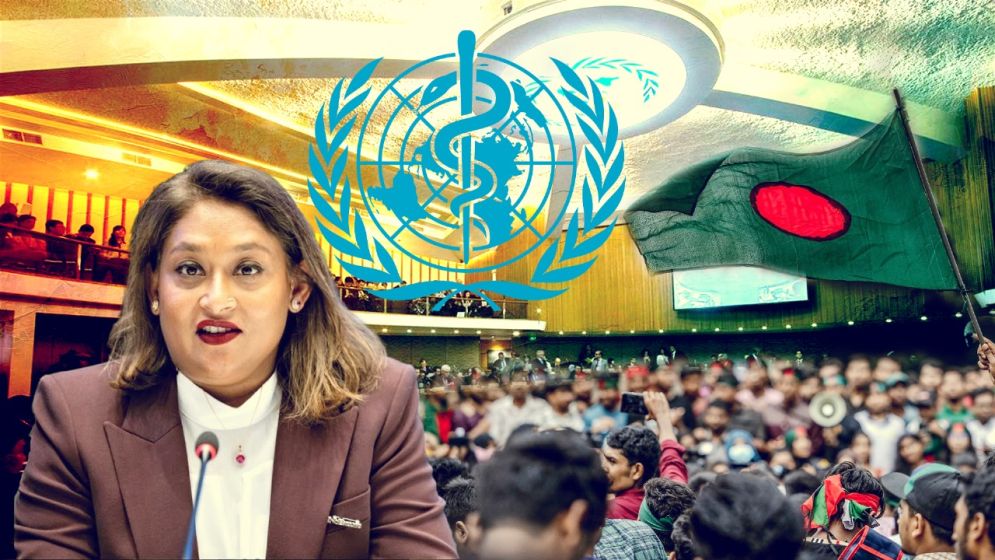
Abrupt venue change for WHO regional meeting casts spotlight on Putul's controversial appointment again

David Bergman
Publish: 06 Oct 2024

WhatsApp-Image-2024-10-06-at-12-6702422527cb3.jpeg

On August 5, 2024, following the collapse of the Awami League government and Prime Minister Sheikh Hasina's subsequent flight to India, an intriguing subplot emerged involving her daughter, Saima “Putul” Wazed.

Just seven months prior, in February 2024, Wazed had assumed the role of Regional Director for the World Health Organization’s South-East Asia region after being elected as Bangladesh’s nominee among the eleven member countries.

The Awami League government’s nomination of Wazed for the position of WHO Regional Director was seen, not just in Bangladesh but also internationally, as highly controversial as it was widely judged that she was completely unqualified for the job.

The respected medical journal the Lancet said that her nomination threatened “to delegitimize both the election process and the future credibility of elected WHO Regional Directors” as well as “damaging trust in the integrity of WHO’s leaders.”

The journal’s editorial stated, “Wazed’s highest academic qualification is an MSc in clinical psychology from Barry University” in Miami while “the 11 other candidates for the regional director positions are either medical doctors or have PhDs, or are medical doctors who also have PhDs.”

The Lancet quoted Kul Chandra Gautam, a former assistant UN secretary-general, as saying, “If she were not the daughter of the prime minister, I don’t think she would be a serious candidate.”

Initial criticism and the fall of the Hasina government

Despite widespread concerns over her qualifications, Sheikh Hasina, with crucial backing from the Indian government, worked diligently to secure the support of a majority of the 11 South-East Asian member countries for her daughter.

As a result, Wazed, described by The Lancet as an “unqualified school psychologist” with a “history of advocacy for autism,” was appointed as the WHO’s regional director.

Initially, when Wazed assumed the position in February, criticisms primarily focused on her lack of experience and the perception of nepotism in her appointment.

However, following the August 5th overthrow of the Awami League, new questions arose.

Could the daughter of Sheikh Hasina, now branded as a “dictator” and accused of being criminally complicit in the deaths of numerous students and protestors in the weeks leading up to her mother’s ousting, continue to hold her senior UN role, which was largely attributed to her family connections?

The Bangladesh government has yet to clarify whether it intends to maintain the status quo or seek Saima Wazed's removal from her position, a process that would necessitate support from other countries in the South-East Asia region.

However, more details about Wazed’s future may emerge next week as the WHO South-East Asia regional countries convene for their annual meeting on Monday, October 7.

Originally scheduled to take place in Dhaka, the meeting had drawn particular attention.

Sudden venue shifting amidst fear of repercussion

On July 11, 2024, just five days before the first law enforcement killings of student protestors in Bangladesh, Wazed was in Dhaka and tweeted about her discussions with officials from the Ministry of Health regarding the upcoming meeting: “We discussed the upcoming @WHOSEARO regional meeting in Dhaka…”

Up until August 26, WHO’s website continued to confirm that the meeting would be held in Dhaka.

However, the WHO's regional office abruptly changed the venue to New Delhi, and, perhaps seeking to downplay the implications of the change in location, made no public announcement.

The change in venue was clearly necessary. Saima Wazed could not travel to Dhaka given the hostile environment surrounding her mother and the Awami League, which Wazed has consistently supported.

The new government would likely also have been opposed to her presence in the country as the Regional WHO Director.

When asked about the venue change, the WHO’s regional office explained that it followed communication from the Government of Bangladesh indicating they would be unable to host the event.

Since late August, the situation has become even more critical, with numerous criminal cases filed against her mother. Wazed herself is under investigation for alleged offenses related to money laundering, and her bank accounts in Bangladesh, along with those of other family members, have been frozen.

Rahat Bin Zaman, the Director General for the United Nations at the Bangladesh Foreign Ministry told Bangla Outlook that a Senior Secretary from the Health Services Division is representing Bangladesh at the regional meeting and that he was “not aware of any decision taken by the government” on the question of Saima Wazed.

Regardless of how the new Bangladesh government chooses to address Wazed’s position, the WHO’s decision to change the meeting venue underscores the untenability of her remaining as Regional Director when she cannot visit one of the eleven member countries she oversees and may well face criminal charges if she were to enter Bangladesh.

 
TIB estimates up to Tk 51,000 cr corruption in RHD projects

Staff Correspondent 09 October, 2024

f4264f7fbd2176a4d1f9e38732374265.jpg

Tk 51,000 crore or estimated up to 40 per cent of the costs in the construction works carried out under the Roads and Highways Department development projects in the past 15 years was misused through corruption.

A Transparency International Bangladesh research report on Wednesday revealed the information.

‘In the roads and highways sector, development activities have been monopolised through tripartite collusion among politicians, high-ranking bureaucrats, and contractors, which has captured the policymaking process, procurement systems, and project implementation,’ read the report.

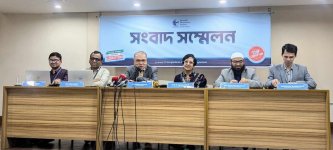
Blaming the three-party nexus for this massive embezzlement by violating laws, TIB executive director Iftekharuzzaman at a press conference, held at its office in the capital, said, ‘unless this nexus is busted, corruption will never be effectively controlled.’

In the context of the newly appointed interim government, he also said that overall some people were replaced by others in the new regime, but long-held institutional bad practices and mentality remained the same across sectors.

The TIB report shows that the estimated overall amount of corruption in the construction works of development projects implemented under the RHD from 2009–2010 to 2023–2024 fiscal years stood between Tk 29,230 crore and Tk 50,835 crore.

Percentage-wise, the report shows that the estimated corruption rate ranges from 23 per cent to 40 per cent of the total costs of the construction of roads and bridges in development projects implemented under the Annual Development Programme.

The corruption includes 11–14 per cent bribery in obtaining work orders and receiving bills by the contractors, 10–20 per cent corruption through collusion between politicians, contractors, and high-level officials, and 2–6 per cent corruption in areas, including renting tender licences, selling work orders, compromises and local political extortion.

Data for the research titled ‘Governance challenges in the implementation of Roads and Highways’ development projects’ was collected from June 2023 to September this year.

The development projects completed between 2017–18 and 2021–22 fiscals (initiated from 2010–11 to 2018–19) were included in the specific scope of this study.

Emphasis in the study was laid on the government-funded projects below Tk 1,000 crore, while mega projects funded by foreign donors were excluded due to differences in modalities of implementation, decision-making, and policy-making processes.

The overall observation on corruption in the research, however, was made on all the roads and highways department projects executed under both local and foreign funds in the past 15 years under the annual development programme, said TIB senior research fellow Md Julkarnayeen, who conducted the research with fellow research associate Md Mostafa Kamal.


In the past five years, 38.8 per cent of the completed projects took 4–5 years to finish, and 13.7 per cent took more than five years with the project costs increased by as much as 93 per cent compared with the original budget estimation, the research found.

The research outcomes also showed that these projects often failed to follow the laws and guidelines, skipped proper planning and feasibility studies, and also lacked coordination among different authorities.

Without in-depth feasibility assessments and environmental impact evaluations, including assessment for climate change impact and disaster risks, the projects lack sustainability.

While only 19 out of 25 completed projects under the scope of the research had evaluation reports prepared, only seven of these reports were published on the Implementation Monitoring and Evaluation Division website.

The RHD’s audit for the 2019–20 fiscal was completed in 2021, and the report was presented to the relevant parliamentary committee in the 2023–24 fiscal.

Over the past decade, 15 major contracting firms had established dominance by capturing the RHD tendering process through the internal settlement and collusion, the report said.

‘We thought that during this interim government period we would get information but we did not,’ Iftekharuzzaman alleged, adding that on Tuesday the RHD officials told them that they would give them the information.

He said that those involved in the three-party nexus should be brought under exemplary accountability in the changed scenario of the country.

To prevent personal gains, nepotism, irregularities and corruption in the implementation of roads and highways development projects, he also demanded a ‘conflict of interest law’ and its strict reflection in other relevant rules and regulations.

‘We believe that a scope has been created and the nation should take this opportunity,’ added the TIB chief.

The background of the research read that since the 2013–14 fiscal, the transport and communication sector had received the highest allocations in the annual development programme, while the total development expenditure for the RHD allocated from the ADP budget between 2009–2010 and 2023–2024 fiscals amounted to Tk 1,69,450 crore.

 
A report from The Daily Star in early September cited an unnamed CID official who claimed that Bashundhara Group has borrowed over Tk 42,000 crore from various scheduled banks in the country by inflating the value of land purchases, presenting them as worth Tk 3 crore per katha instead. of the actual Tk 20-25 lakh per bigha.

Inflating the value of collateral to secure bank loans is a common practice here in Bangladesh. This needs to change.

Bashundhara Group operates like a mafia. Ask anyone living in Bashundhara R/A.
 
200 crore rupees spent on foreign trips in five years

Muktadir Rashid
Published: 23 October 2024

WhatsApp-Image-2024-10-23-at-10-6719317877e0e.jpeg

Four decades ago, Imelda Marcos was the First Lady of Philippine dictator Ferdinand Marcos. The story of Imelda's thousands of pairs of shoes is heard. But beyond the elegance of clothes, he had a whim to travel abroad. Imelda's foreign travel was well received at the time. A candid photo of Imelda with Chinese Communist Party leader Mao Zedong fueled political debate when the Philippines was under a state of emergency to prevent power.

However, after nearly 21 years in power, the Philippine dictator and his wife Emaildar were forced to flee amid public outrage after disputed elections. Much like Sheikh Hasina, he fled the country and took refuge in the island of Hawaii in the United States.

The then Prime Minister Sheikh Hasina fled to India on August 5 to deal with the situation after the student uprising in Bangladesh. During her tenure, there was a controversy over the ousted Sheikh Hasina's large fleet of overseas trips. But due to the secrecy of the related expenses, it has never been possible to determine the amount of financial or state money spent there.

After leaving Bangladesh and taking political refuge in India, the issues kept coming up. When deposed Prime Minister Sheikh Hasina went on foreign trips, she used to hire Biman Bangladesh Airlines aircraft with government money. As per custom, the Ministry of External Affairs would have taken care of the matter, the aviation authority said. However, since assuming power in 2009 until July this year, complete information about where and how many times he has gone is not available. Earlier, when the airline was requested to provide information under the Right to Information Act, the request was rejected citing it as classified.

What is Biman Bangladesh Airlines saying?

Talking to various officials of Biman, it is known that the Prime Minister used to travel in Biman's Boeing 777, 787 series of state-of-the-art aircraft during his visits to different countries from Bangladesh. But sometimes Sheikh Hasina has come and gone on scheduled flights.

In addition to ensuring adequate facilities on behalf of Biman Bangladesh, the managing director of Biman himself and other senior officials used to travel on VVIP flights with the head of state or government as a protocol.

WhatsApp Image 2024-10-23 at 11-67193149c1076.jpeg

Sheikh Hasina used to go to different parts of the world with huge airplanes. A former Biman official said, 'They were taken to countries where regular airline flights or other aircraft could save a lot of money for the state if they went to those destinations as regular passengers.'

During his (Sheikh Hasina's) rule, he found only five years' worth of money spent on flying in airplanes.

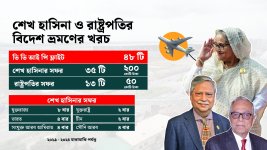
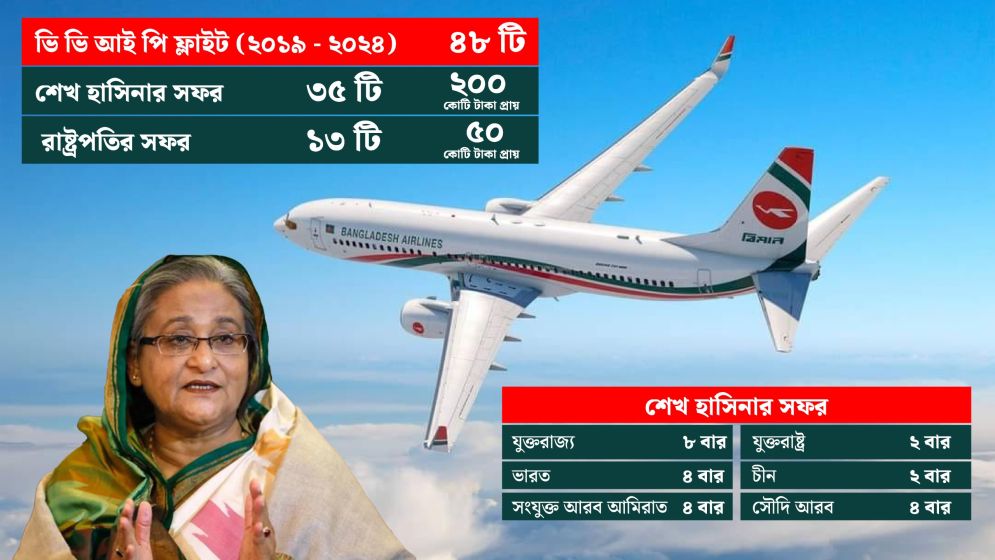
According to the investigation, in the last five years from 2019 to mid-2024, the state-owned airline has operated 48 VVIP flights at a cost of Tk 2.5 billion.

35 of these are related to Sheikh Hasina's visit. In the remaining 13 cases, the two presidents completed their trips by chartering aircraft on behalf of the government.

Sheikh Hasina spent about Tk 200 crore on these trips. And the remaining 50 crore rupees were spent by the then President Abdul Hamid and the current President Md. Sahabuddin Chappu.

During this period, Sheikh Hasina visited the UK at least eight times. Visited India at least four times. Sheikh Hasina visited the United Arab Emirates and Saudi Arabia four times and the United States and China twice.

Of these, the highest spending in 2023 was on visits to the Middle East and the United States. Around 23 crore rupees were spent then. All these bills are usually issued from the Foreign Office of Bangladesh. It was not possible to collect information regarding this from the Ministry of Foreign Affairs.

Meanwhile, the then President Abdul Hamid visited six countries 9 times from 2019 to 2022. It costs 25 million rupees. The current President Sahabuddin has spent 25.5 million taka by visiting six countries five times between 2023 and 24.

Biman's current managing director Mo Safiqur Rahman said that the government rents aircraft from Biman.

On the other hand, a senior official of Biman said, 'She (Sheikh Hasina) used to travel with a huge fleet. Every visit was very expensive.'

Another Biman official told Bangla Outlook, 'As the issue is very expensive, the government is requested by Biman to buy a relatively small size aircraft to be maintained or operated by state institutions.'

'We say that the aircraft will be under our supervision. Be ready to operate regular flights as well as special flights.' He added.

Although the government has been strict about foreign travel to deal with the economic recession after the corona epidemic, there was no special precedent for austerity in such a luxurious trip of the then Prime Minister Sheikh Hasina.

Dr. What did Yunus do?

It is alleged that former Prime Minister Sheikh Hasina takes a huge fleet every year while attending the United Nations General Assembly. There is also information on carrying one's extensive protocol while attending international conferences.

Nobel laureate professor Dr. Muhammad Yunus represented Bangladesh at the UN General Assembly session this year. He traveled to USA from Bangladesh using regular air. He has narrowed down the number of his traveling companions out of safety.

It was not possible to get any statement from Sheikh Hasina regarding this waste of state money. However, when contacted, his son Sajib Wazed Joy asked whether expenses could have been reduced by traveling on regular flights, he did not comment.

Badiul Alam Majumder, editor of Citizens for Good Governance (Sujan) said that such foreign trips are not desirable for a country like Bangladesh. In the name of development in Bangladesh, looting and corruption are the continuation of such luxury aircraft. Whichever government comes or runs the state should avoid such use of aircraft with public money.

Biman owes around Tk 50 crore to the government till 2023. The then Prime Minister Sheikh Hasina visited China last with a huge fleet in July. Was supposed to go on a longer tour. However, Sheikh Hasina canceled her latest foreign visit when the anti-discrimination student movement intensified from mid-July. And on the 5th, instead of a regular flight, Sheikh Hasina was forced to flee in a military aircraft of the Bangladesh Air Force.

 
AL govt created lawless economy - Debapriya Bhattacharya

Dr. Debapriya is a well renowned economist in BD.
 
AL govt created lawless economy - Debapriya Bhattacharya

Dr. Debapriya is a well renowned economist in BD.
Awami zombies love lawlessness.
 
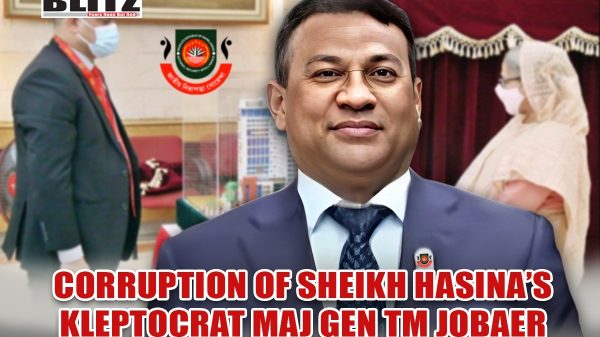
Unbelievable crimes and corruption of Sheikh Hasina’s Kleptocrat Maj Gen TM Jobaer

M A Hossain

Update Time : Sunday, November 3, 2024

View attachment 76649Unbelievable-crimes-and-corruption-of-Sheikh-Hasinas-Kleptocrat-Maj-Gen-TM-Jobaer-600x337.jpg

Major General (retired) TM Jobaer (full name Tariq Mohammed Jobaer), a bulbous figure within ousted Prime Minister Sheikh Hasina’s inner circle, has accumulated enormous wealth through questionable means, as evidenced by numerous documented allegations of corruption and abuse of power. Yet, it is evident that the present interim government is not in a position or mood to punish these sorts of corrupt individuals, but evidence must be exposed to the countrymen. We hope that the day will come when a people’s government will have the opportunity to hold all corrupt individuals accountable.

One of the most striking examples of TM Jobaer’s alleged abuse of authority involves a significant piece of property located on Road No. 84 (Lake road) in Gulshan-2 – one of the most expensive properties in Dhaka city. This residence, originally belonging to the National Security Intelligence (NSI), was reportedly grabbed by Jobaer through manipulation of the Public Works Department and transferred to a family member.

Jobaer also owns a range of properties in various prime locations across Bangladesh. In the capital city, he holds apartments in the affluent neighborhood of Uttara Sector 7, listed under his and his sister’s names. His assets further extend to multiple commercial shops in Uttara’s Rajlaxmi Complex (a commercial building), agricultural lands in Rangpur, and plots in the sought-after areas of Purbachal and Bashundhara areas in Dhaka. These acquisitions hint at substantial wealth, likely amassed through improper channels.

In addition to his properties in Dhaka, TM Jobaer owns an expansive resort in Sreepur, Gazipur, a multi-story commercial building in Gazipur Sadar, and a luxurious flat in Segun Bagicha, along with a property in the upscale Dhanmondi – road 7/A area. In Savar DOHS, he also possesses a 10-story building, a significant asset for any individual, let alone a government official. The sheer volume and distribution of Jobaer’s assets across different locations point towards the misuse of his official position for personal enrichment.

In January 2022, Jobaer made headlines with his acquisition of a luxury mansion in London, valued at £2.945 million, equivalent to approximately 350 million Bangladeshi Taka. The house, located at 7 Heath Croft, Wansunt Road, Bexley, in London, was registered under the names of TM Jobaer, his wife FahmidaMasud, and his son Mohammad S. IbnJobaer at London’s Croydon HR Land Registry Office. Remarkably, no loan was involved in this purchase; the entire sum was paid in cash, a highly unusual transaction for a public official. The deed for the property has been confirmed by the local council office, further substantiating the acquisition.

An examination of the London property’s documentation sheds further light on the murky transactions surrounding TM Jobaer’s assets. The property’s title, registered under SGL720092, highlights various rights and clauses in the title deeds, which were transferred through complex legal arrangements. These documents list multiple companies, such as Fort Knight Group Plc and Silverburn Properties Limited, in connection with the property’s purchase and its historical ownership.

The web of transactions linked to this property points toward a sophisticated legal setup likely designed to obscure the ownership trail. Additionally, the absence of any mortgage or lender suggests the purchase was indeed cash-based, reinforcing questions about the source of the funds and possible involvement in money laundering or financial fraud.

This transaction raises numerous questions regarding the sources of Jobaer’s wealth. As NSI Director General, Jobaer’s position grants him access to substantial, non-auditable funds under the agency’s control, which are often used for covert operations. These funds are neither audited nor transparently managed, providing ample opportunity for misappropriation.

Major General TM Jobaer is a seasoned officer of the Bangladesh Army, promoted to his current rank in 2018. Since then, he has been leading the NSI, an agency notorious for its involvement in enforced disappearances and extrajudicial actions, often targeting those who challenge the government. Jobaer’s name has repeatedly come up in connection with these operations, with allegations suggesting that he was instrumental in orchestrating several high-profile “enforced disappearances” and covert actions as part of the Sheikh Hasina’s repressive apparatus.

Beyond corruption, Jobaer’s alleged connections with criminal enterprises further complicate his image. His brother-in-law, Md. Kayyum, is implicated in operating a large-scale gold smuggling network through Dhaka’s Hazrat Shahjalal International Airport (HSIA). Leveraging Jobaer’s NSI connections, Kayyum managed to establish and maintain this lucrative smuggling syndicate, reportedly amassing significant wealth in the process.

At the airport, Additional Director of NSI Badrul Hasan Chowdhury, hailing from Gopalganj, reportedly provided vital support to Kayyum, facilitating smuggling activities under Jobaer’s implicit protection. Such deep-seated corruption within the NSI demonstrates how Jobaer’s position and influence have not only enabled personal wealth accumulation but have also created a safe haven for illegal activities. These allegations, if proven, indicate the entrenchment of Jbaer’s influence within both the formal and informal power structures of Bangladesh.

TM Jobaer’s rise within Sheikh Hasina’s administration, coupled with his wealth accumulation and criminal connections, reflects a troubling trend in Bangladesh’s governance structure. Through his actions, Jobaer has effectively showcased how individuals in positions of power can exploit their roles to accumulate enormous wealth without fear of accountability. In Jobaer’s case, his assets include multiple properties domestically and abroad, established networks in the criminal underworld, and a strong influence within the country’s intelligence and enforcement sectors.

This extensive corruption is particularly alarming given Bangladesh’s historical challenges with governance and institutional integrity. Jobaer’s actions serve as a microcosm of the issues plaguing Sheikh Hasina’s administration, where senior officials often operate with little transparency, manipulating power to benefit personally.

According to media reports, in August this year, a retired army officer lodged a complaint with the Anti-Corruption Commission (ACC) accusing Major General Jobayer of amassing illicit asset accumulation and money laundering. This former chief of NSI owns huge properties in the United Kingdom and other countries, while he has purchased citizenship in at least one Caribbean Island nation.

The charges include accusations of manipulating power for personal gain, such as facilitating business deals and securing political endorsements. Key allegations detail that Jobaer’s ill-gotten assets include a lavish house in Gulshan-2, a resort in Gazipur, multiple properties in Uttara and Savar, and a flat in Segun Bagicha.

In 2011, Joaber served as a Director of National Security Intelligence and earlier he was the Minister (Counselor) at the Bangladesh High Commission in the United Kingdom.

TM Jobaer has served as NSI director general from 2018 to April 2024 and was known as the “right-hand man” of Sheikh Hasina.

According to media report, TM Jobaer played vital role behind countrywide illegal casinos, while he was getting major segment of the income, which later was shared by him with some of the family members of Sheikh Hasina. When law enforcement agencies launched drive against illegal casinos, under the direct supervision of TM Jobaer, officials of NSI helped Nepalese staffs at various casinos in silently leaving Bangladesh.

The case of Major General TM Zobaer is a stark reminder of the pervasive corruption in Sheikh Hasina’s government. His assets, from prime real estate in Bangladesh to a luxury home in London, underscore his wealth and influence. His connection to gold smuggling and coercive government operations further illustrates the depth of his reach. This unchecked power not only damages the integrity of public institutions but also erodes trust in the governance of Bangladesh, highlighting the urgent need for accountability and transparency in positions of power.

 
How a Country’s Economy Was Siphoned Dry

Bangladesh’s currency was battered by what the new head of the central bank says was the looting of the banks under the deposed prime minister.

The New York Times – December 4, 2024

00bangladesh-plunder-02-jplh-superJumbo.webp


The new governor of Bangladesh’s central bank, Ahsan Mansur, calculates that about $17 billion was siphoned from the country’s financial system in the 15 years before the government of Sheikh Hasina collapsed in August.

Other economists guess that the true value looted during Ms. Hasina’s rule, before she fled the country, could exceed $30 billion. But no one can say for sure. Using a web of financial schemes, Mr. Mansur said, the perpetrators in the government and at some of the country’s biggest companies pulled off what was effectively the largest bank heist in the history of money. And they did incalculable damage to Bangladesh’s economy.

“The highest level of political authority realized that the banks are the best place to rob,” said Mr. Mansur, an appointee of an interim government in Bangladesh. For an inside job, that meant taking control of the central bank and the ownership of a clutch of private banks and their boards of directors. The banks then issued billions of dollars in loans to companies, some of them fictional, that would never be paid back. Much of that money was then transferred out of the country illegally.

“Whole boards were hijacked,” said Mr. Mansur, an economist who worked at the International Monetary Fund for 27 years. In that time, he never witnessed “any country where the highest level of the government, engineering with the help of some goons,” managed “the systematic robbing of the banks.”

In October, Mr. Mansur was in Washington to lobby the I.M.F. and other international lenders for financial help through the difficult period ahead. Like many members of the new government, led by the Nobel Prize-winning economist Muhammad Yunus, he is a seasoned technocrat.

Bangladesh, home to 170 million people, is still reeling from the cycle of vengeance, including mob violence, that came after a protest movement toppled Ms. Hasina, who persecuted her critics and used the power of the state to crush the political opposition. The economic storm is likely to worsen next year, Mr. Mansur reckons, before it clears.
Ms. Hasina escaped to India, her fate and fortune indeterminate. Bangladesh’s interim government said it would seek her extradition. One of her allies who fled the country, Saifuzzaman Chowdhury, a former lawmaker in her party from the port city of Chittagong, is under investigation by the interim government for money laundering, according to A.K.M. Ehsan, executive director of the Bangladesh Financial Intelligence Unit, the central bank’s investigation arm. Charges have not been filed. Mr. Chowdhury told Al Jazeera that he was the subject of a “witch hunt” against members of the Hasina government.

Attempts to reach Mr. Chowdhury, as well as Ms. Hasina, were unsuccessful. Their party’s office in Dhaka, the capital, is empty. Multiple calls and messages to its spokesmen, there and abroad, went unanswered.

The student movement that brought down Ms. Hasina started as a complaint about the lack of jobs and economic fairness. Before security forces fired at protesters, killing hundreds, it had gained momentum on the back of widespread misery. For two years, the country had been tipping into a full-blown financial crisis.

An offer he couldn’t refuse

It was a hectic but ordinary day when Mohammad Abdul Mannan, managing director of Islami Bank of Bangladesh, then the country’s biggest financial firm, set out to work on Jan. 5, 2017. His chauffeur was steering him through traffic in Dhaka to an early-morning board meeting. Then Mr. Mannan got a phone call. It was the head of Bangladesh’s military intelligence service, telling him to change course and come to the service’s headquarters.

In an interview in October, Mr. Mannan, safely back in Dhaka after eight years living abroad, told what happened next.

Military agents took his phone, watch and wallet. The intelligence chief began by summarizing Mr. Mannan’s long career, praising him for having brought banking to Bangladesh’s rural poor.

Mr. Mannan said he remembered starting to wonder whether his time was being wasted. But then he was told to sign a letter of resignation from Islami Bank, effective immediately. The order, the security chief told him, had come from “the highest authority in the country,” meaning the prime minister, Ms. Hasina.

He refused to sign. Mr. Mannan recalled thinking about the early Islamic caliph Usman, who was set upon by assassins in the seventh century and resisted until the end.

At this point, Mr. Mannan found his story difficult to tell. First, he said, his captors “tried to convince me verbally.” Then officers took him from the chief’s office to another location.

Even now, “because of my personality,” Mr. Mannan said, he did not want to describe the “indignities” that were forced on him. He said he had lost track of time and learned only subsequently that he had signed the resignation letter sometime before noon. He was released and spent the next eight years in effective exile. Today he is back running a bank.

According to Mr. Mannan and Mr. Mansur, the central bank chief, a conglomerate called the S. Alam Group took control of Islami Bank, as well as other banks.

S. Alam Group’s founder, Saiful Alam, began as a trader but expanded into many other fields, including energy and real estate, during Ms. Hasina’s reign. The central bank’s claim is that Mr. Alam’s company, among others, conspired with her government to empty out the banking sector.

Since the interim government took over, bank accounts held by Mr. Alam and his close associates have been frozen under a money-laundering prevention act, according to Mr. Ehsan of the central bank’s investigations unit.

Other companies were also able to take controlling interests in other banks, which became like money-printing machines. Without government oversight and with compliant executives and directors, they made loans to favored companies that were never likely to be repaid. Those loans, which are classified as nonperforming, now sit on the books of Bangladesh’s banks, Mr. Mansur said.

Through lawyers in London at the firm Quinn Emanuel, the S. Alam Group said in a statement that it had a controlling stake in only one bank, and that it was not Islami Bank. The company accused Mr. Mansur of waging a “persecutory” campaign against the group’s business empire that “has failed to respect even basic principles of due process,” according to the lawyers’ statement. The dispute revolves around questions about who owns the companies that came to own the controlling stake in Islami Bank.

Banks with nothing left

Some of Bangladesh’s banks are now on life support. All of them, even the healthy ones, are unable to provide much credit and can honor their depositors’ withdrawals only sporadically. Mr. Mansur has to figure out which ones are worth saving.

The law enforcement authorities in the new government are chasing the trail of money that has been spirited out of the country. Money-laundering cases, most involving mispriced exports or imports, have been filed against former members of Ms. Hasina’s party and the companies that worked with them, including several of the country’s biggest.

The schemes not only put ill-gotten gains in the pockets of exporters, but also undermined the Bangladeshi currency and the net worth of everyone who held it. The damage started to accumulate after 2014, when Ms. Hasina won re-election in a contest “marred by vote rigging, intimidation and violence,” in the words of the U.S. State Department. The economy’s problems piled up when the war in Ukraine put pressure on weaker currencies everywhere.
In 2022, the cost of Bangladesh’s most important imports started rising — fuel and food most of all. That made it harder for businesses to pay their bills. Energy plants were forced to impose power cuts.

Ordinary businesses and consumers have been left struggling to survive. With so many banks short on cash, some workers were unable to get more than a small portion of their money out, even on payday.

At Techno Drugs, a pharmaceutical manufacturer, laid-off workers have staged demonstrations. But it is the lowest-paid employees who are hurt the worst, according to Majedul Karim, an assistant general manager.

He said these workers were telling him, “The bank is not giving me my money.” So the company is instead paying them in cash and avoiding the bank, Mr. Karim said, adding that his own debit card does not work.

Nipa Khan has been shopping at Kawran Bazar, a sprawling hub of commerce in Dhaka with nearly 2,000 shops, for 20 years. She cares for two children and lives on money, or remittances, that her husband sends from Britain.

Her focus is on “survival first,” she said, adding that she skipped one or two meals a day to ensure that her school-age children stayed well fed.

Mr. Mansur, who took over the central bank in August, recounted what he had seen when he first surveyed the economy. “Everything was a disaster,” he said. Now he says he is “cautiously optimistic” that things are being stabilized.

This “is not the year for economic growth,” Mr. Mansur added. But inflation is coming down, and remittances are going up. “We have to be satisfied with that,” he said. He has said he is hopeful that the I.M.F. will provide $3 billion to support Bangladesh’s currency.

Ms. Khan, too, believes that the longer-term future looks brighter. “I need to be scrappy,” she said, because a lot more needs to be done before “I can live my life without feeling robbed.”


Bangladesh tells India it wants former PM Hasina back for ‘judicial process’

AFP | Reuters
December 23, 2024

Bangladesh has told India that it wants former prime minister Sheikh Hasina, who fled to New Delhi after being ousted in August, returned to the country for the “judicial process”, the acting head of the country’s foreign ministry said on Monday.

Additionally, Bangladesh’s anti-corruption commission said on Monday that it has launched a probe into allegations of $5 billion embezzlement by Hasina and her family in connection with a Russian-backed nuclear power plant.

“We sent a note verbale to the Indian government saying that the Bangladesh government wants her (Hasina) back here for [the] judicial process,” Touhid Hossain told reporters, referring to diplomatic correspondence between the two countries.

Hossain did not specify what the judicial process was connected to.

India’s foreign ministry and Hasina’s son, Sajeeb Wazed Joy, did not immediately respond to Reuters’ requests seeking comment.

Along with the ex-premier, those subject to the commission’s inquiry include Joy and Hasina’s niece, Tulip Siddiq, a British lawmaker and government minister.

The allegations were raised by a writ seeking an investigation filed in the high court by Hasina’s political opponent, Bobby Hajjaj, chairman of the Nationalist Democratic Movement party. “We seek justice through our court,” Hajjaj told AFP today.

Key allegations relate to the funding of the $12.65bn Rooppur nuclear plant, the first in a South Asian country. Moscow is bankrolling it with a 90 per cent loan.

A statement from the commission today said it had launched an inquiry into allegations that Hasina and family members had “embezzled $5bn” from the Rooppur plant via “various offshore bank accounts in Malaysia”.
 
It said its investigations were examining “questionable procurement practices related to the overpriced construction” of the plant.

“The claims of kickbacks, mismanagement, money laundering, and potential abuse of power raise significant concerns about the integrity of the project and the use of public funds,” the commission said. The graft allegations also include theft from a government building scheme for the homeless.

Hasina, 77, fled by helicopter on August 5 into exile in India, infuriating many Bangladeshis determined that she face trial for alleged “mass murder”.

It was not possible to contact Hasina for comment.

According to a statement from the British prime minister’s office, Siddiq has “denied any involvement in the claims” accusing her of embezzlement.

Joy, who is understood to be based in the United States, was also unavailable for comment to AFP.
 
Revealed: Tulip Siddiq, her ‘despot’ aunt and another freebie property

Gabriel Pogrund, Whitehall Editor | David Bergman

The Sunday Times – January 4, 2025

_methode_times_prod_web_bin_aa7d0a39-7b29-4e37-9fa7-9d7f9a3bdd56.jpg


The Treasury minister responsible for tackling financial crime and corruption lived in a property given to her family by an ally of her aunt’s deposed regime in Bangladesh.

The Labour MP and anti-corruption minister spent several years living in a Hampstead flat gifted to her family by an ally of Sheikh Hasina, the deposed Bangladeshi ruler. Tulip Siddiq, the economic secretary to the Treasury, used a flat on Finchley Road in Hampstead, north London, after it was given to her then teenage sister, Azmina, for free.

The sisters are the nieces of Sheikh Hasina, the authoritarian former prime minister of Bangladesh, who was removed from power last year after uprisings against her rule.

Hasina stands accused by the new administration in Dhaka of “massacres, killings and crimes against humanity”, including the deaths of at least 800 protesters. She is also accused of corruption and embezzlement. Siddiq, 42, is among several family members said to have benefited, although she denies wrongdoing. Sir Keir Starmer has said that she retains his confidence.

Land Registry documents state that the transfer was “not for money or anything that has a monetary value”. Azmina was 18 at the time and about to begin her studies at Oxford.

It is unclear exactly when Siddiq moved in to the flat, but, upon her appointment in December 2012 as a director of the Working Men’s College education institute, she listed the property as her address on Companies House. She did the same on becoming a trustee of the Camden Arts Centre charity in January 2014 and the Hampstead Wells and Campden Trust, another non-profit, in March 2014. Her husband, Christian Percy, listed it as his address as late as May 2016, by which time Siddiq was serving as Labour MP for Hampstead & Kilburn.

Azmina, whose career has included roles at Tony Blair’s Institute for Global Change and, more recently, at a children’s charity, sold the residence for £650,000 in 2021.

By then, Ghani, the prior owner, had spent years advising Bangladesh in international disputes. When Hasina’s government nominated him in 2021 for a role on a World Bank panel, he declared: “It was an honour for me to receive a personal note of congratulations and thanks from the honourable prime minister of Bangladesh, Sheikh Hasina.”

The Hampstead flat is distinct from a nearby apartment in King’s Cross that Siddiq was given in 2004 and which she still owns. The Financial Times revealed on Friday that it had been given to her by Abdul Motalif, another associate of senior Awami League members. Before Siddiq acquired it the flat was used by Ghani.

Siddiq declined to comment on the record. A source close to her said she had lived at her sister’s property for a period, adding that this was normal for many families. The source added that other family members’ housing arrangements were a matter for them, and that the political associations of others had “nothing” to do with Siddiq.

The disclosure is the latest example of allies of Hasina, and members of her party, the Awami League, gifting properties to her extended family.

They pose fresh difficulty for Siddiq, who, as economic secretary to the Treasury, is responsible for “financial sanctions and countering economic crime, money laundering and illicit finance”. She has faced scrutiny since Bangladesh’s anti-corruption commission said it would investigate claims that she brokered, and benefited from, a nuclear power deal Bangladesh signed with Russia in 2013. Siddiq says she is the victim of “trumped-up” charges.

The two north London properties — in Hampstead and King’s Cross — are not the only cases of Siddiq, or her immediate family, living in homes owned by or gifted to them by Awami League members.

The £2.1m mansion in Finchley

Siddiq lives in a £2.1 million property in Finchley, north London. It previously belonged to Lauren Pope, a reality TV star who appeared on The Only Way Is Essex, but was purchased two years ago by a company owned by Abdul Karim Nazim, a member of the Awami League’s UK executive who migrated to London in the 1970s. He spent most of his career at a curry business connected to allies of Hasina but has since expanded into property development.

Nazim started renting the house to Siddiq in 2022. The following year, he received audiences with Hasina and Mohammed Shahabuddin, the president of Bangladesh. He was also made a “commercially important person” — an honour conferred upon allies of the Bangladeshi government at the time — and appointed vice-chairman of a bank with close links to Hasina’s party.

In December 2022, he hosted his daughter’s wedding at an estate in Berkshire. Siddiq was among the guests. She was not present a few months later when he relaunched his curry house in Camden with a Labour fundraiser, although the local MP, Keir Starmer, was. Nazim has continued to back Labour and posed for pictures with Siddiq at an election celebration event last summer.

Since 2023, Nazim has had five companies forcibly dissolved after failing to file accounts on time or at all — a criminal offence. Even the company that owns the property Siddiq uses is currently in breach of its obligations.

Last year, Siddiq apologised to the parliamentary commissioner for standards after failing to disclose that, after moving into Nazim’s property, she rented out the family home she co-owns with her husband to a private tenant. She put it down to an “administrative oversight” and the authorities concluded it was inadvertent.

A source said Siddiq moved into Nazim’s home — where she continues to reside — due to security concerns. Her spokesman said that she and her husband “pay a rate consistent with market levels”.

The £1.2m house in Golders Green

Siddiq’s mother, Sheikh Rehana, lives in a property in Golders Green, north London. According to Netra News, an investigative website, it is owned through an offshore trust by Shayan Rahman, who is the son of a billionaire politician and adviser to Hasina. Rahman had his bank accounts frozen and was removed from the board of a bank after the fall of Hasina’s regime. His father is in custody, having sought to escape Bangladesh by boat.

The £500,000 flat in Hampstead

Siddiq’s sister and mother lived for a time in a property a stone’s throw away from the Hampstead flat. It was owned by Kazi Zafarullah, a member of the Awami League’s executive committee, who purchased it in 2007 and sold it for £499,000 in 2012.

Intriguingly, Ghani, the lawyer who gave Siddiq’s sister the flat, also listed this as his address for several years.

In 2007, the same year as the purchase, Zafarullah was jailed in Bangladesh for extortion. In 2016, he was identified as the beneficiary of a network of offshore trusts. He was arrested shortly after the fall of the Hasina regime and remains in prison, having been denied bail.

Relations with Hasina and Awami League

Before entering the Commons, Siddiq proudly spoke of her closeness to her aunt and her role within the Awami League.

In 2008, after Hasina was elected prime minister of Bangladesh for the second time, she wrote: “The Awami League have won the elections by a landslide! Sheikh Hasina is the Prime Minister elect! I am ecstatic!”, adding that she had spent the day with the newly elected premier.

She served on Hasina’s official delegation to the UN in 2011, described herself as part of the Awami League’s “UK and EU lobbying unit” and, in 2013, travelled to Moscow to see her aunt. It was then that she met and posed for photos with Vladimir Putin, who, moments earlier, had signed the nuclear deal with Bangladesh that is now under investigation.

Upon her election as MP for Hampstead & Kilburn in 2015, Siddiq told Awami League supporters that she could not have done it without their help.

However, since then, she has sought to distance herself from the regime. That year, she claimed she had ended up in Moscow for purely family reasons — in order to see her aunt, she said, whom she did not get to see regularly — but did not form part of any official delegation. She also said she was not aware of the the Awami League’s campaigning tactics in her constituency.

In 2017, Siddiq refused to speak to her aunt about the plight of a British-educated barrister who was forcibly “disappeared” by the regime and apologised after appearing to threaten a pregnant Channel 4 reporter who asked her about it. “I’m a British member of parliament. Be very careful,” she told the reporter — “I’m not Bangladeshi.” She added: “Hope you have a great birth because child labour is hard.”

Siddiq has separately said she does not “talk about politics” with her aunt.

The MP, whose constituency is now Hampstead & Highgate, has long been close to Starmer. She supported his selection as a parliamentary candidate in the neighbouring seat of Holborn & St Pancras in 2014 and is among a handful of MPs whom Starmer counts as a friend as well as a colleague. Their families have also spent time together.

To date, Starmer has stood by Siddiq, who has insisted she is the victim of a smear attempt and said as much last month to the Cabinet Office propriety and ethics team.

Even critics of Hasina have cast doubt on the credibility of the allegation that Siddiq benefited from the embezzlement of billions connected to the Russia deal. The claim first appeared on a US blog and has not been supported by any evidence so far. Siddiq says she has not been contacted by the anti-corruption commission.

Yet she has never provided a detailed account of how she and her family benefited financially from their ties to the Awami League. While she has recused herself from matters relating to Bangladesh, she still has a role overseeing attempts to stamp out financial crime.

Her sister did not respond to requests for comment via her employer.

On Thursday, Nazim said he could not speak as he was at a wedding. He then declined to respond to requests for comment.

Ghani did not respond to requests for comment.

 
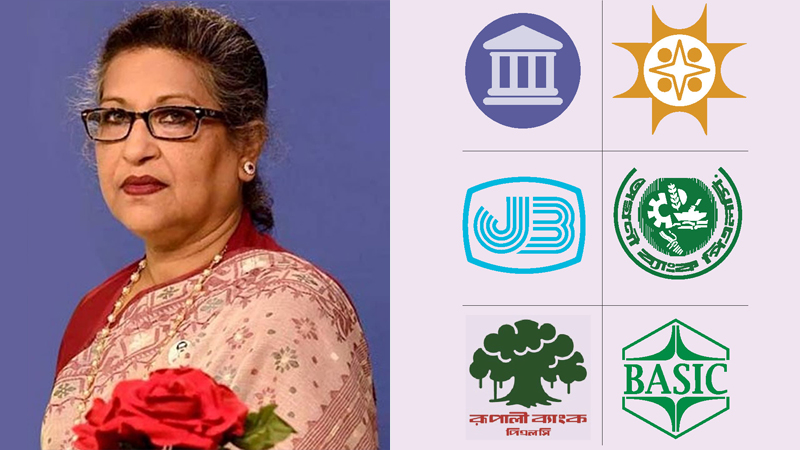
Sheikh Rehana controlled the state-owned banks behind the scene

Staff Correspondent
Publish: Sunday January 12 2025

1-lead_5jgs0O5.jpg

In addition to Sheikh Rehana, several instances have come to light regarding her son Radwan Mujib Siddiq, daughter Tulip Siddiq, and another daughter Azmina Siddiq.

Over the past decade and a half, one of the key figures behind the looting of state-owned banks has been Sheikh Abdul Hye Bachchu. He led the looting of Basic Bank during the three years following 2009. Despite severe criticism surrounding this scandal, Prime Minister Sheikh Hasina remained indifferent. Even though there was dissatisfaction within the then-government, Abdul Hye Bachchu remained untouchable. At that time, his strength was associated with ‘Choto Apa’ or Sheikh Rehana. Sheikh Rehana, the younger sister of the former Prime Minister Sheikh Hasina, was known as ‘Choto Apa’ among the Awami League leaders and workers, following the ousting of her sister during the mass uprising.

Not only Basic Bank, but the name of Sheikh Rehana also came up repeatedly in discussions about irregularities in other state-owned banks. However, for over a decade, no one within the Awami League had the courage to bring these matters into the open. Sheikh Rehana was the key decision-maker in the appointments of chairmen, directors, and managing directors in other state-owned commercial banks such as Sonali, Janata, Agrani, and Rupali. It was on her recommendation that Sheikh Hasina appointed people to key policy-making positions in these banks. In some cases, to secure promotions to positions like Deputy Managing Director (DMD) or General Manager (GM), the blessing of Sheikh Rehana was required, according to sources.

According to these sources, the irregularities in state-owned banks, such as those in Basic Bank, occurred under the supervision of Salman F Rahman and Chowdhury Nafeez Sarafat. Candidates seeking appointments as chairmen or MDs of these banks would lobby with these two individuals. In some cases, just one of their recommendations was enough to secure a position. In other cases, both of them had to give their collective approval. The final list of candidates would be sent to Sheikh Rehana, and after her recommendation, Sheikh Hasina would appoint the chairmen and MDs of the state-owned banks.

To inquire about this, over a dozen individuals who have held positions such as Chairman, Director, MD, and DMD of state-owned banks over the past one and a half decades were contacted. Almost all of them requested that their names remain confidential.

According to their statements, before the appointment of a chairman or MD at state-owned banks, large sums of money had to be paid as bribes, often through Salman F Rahman or Chowdhury Nafeez Sarafat. In many cases, large corporate groups or major borrowers would pay the bribes on behalf of the candidates. The condition was that after becoming the chairman or MD, the appointed individual would allow these groups to withdraw large sums of money from the bank in the form of loans. There were also two or three influential directors on the board, often political leaders or professionals associated with the Awami League, whose job was to control the board. If they approved a proposal for a large loan, they would receive a share of the bribe money. Directors appointed without lobbying had duties restricted to merely ensuring quorum at board meetings, and they had no chance to take a firm stand on any issue. This is how more than a hundred billion taka was siphoned off in the form of loans from state-owned banks.

According to data from Bangladesh Bank, in September of the previous year, the amount of non-performing loans (NPLs) in state-owned banks like Sonali, Janata, Agrani, Rupali, and Basic Bank amounted to nearly BDT 1.25 trillion. Nearly 40 percent of the loans distributed by these banks were non-performing. However, the situation worsened after September. By the end of December, the NPLs of these banks exceeded BDT 1.5 trillion. Besides these non-performing loans, at least BDT 500 billion worth of loans had become overdue. The impact of the non-performing loans has caused a severe capital shortfall in all five of these banks. If adequate provisions had been made, all of these banks would have been in losses.

After the Awami League came to power in January 2009, all state-owned banks appointed Chairmen, Directors, and MDs based on party considerations. The following appointments were made: Quazi Baharul Islam as Chairman of Sonali Bank; Abul Barkat as Chairman of Janata Bank; Khandaker Bazlul Haque as Chairman of Agrani Bank; Ahmed Al-Kabir as Chairman of Rupali Bank; and Sheikh Abdul Hye Bachchu as Chairman of Basic Bank.

In addition, several party members were appointed as directors of these banks, including Awami League leader Jannat Ara Henry from Sirajganj; Shaimum Sarwar Kamal from Cox’s Bazar; Subhash Singh Roy; Kashem Humayun, the Managing Editor of the Daily Sangbad; former Chhatra League leader Balaram Poddar, Nagibul Islam Dipu, and Shahjada Mohiuddin. Along with these positions, loyal party members were also appointed as MDs of state-owned banks. These politically motivated appointments led to a series of loan scandals at the banks.

From August 2016 to 2019, Md Obayed Ullah Al Masud served as the Managing Director of state-owned Sonali Bank. In 2019, he was transferred from Sonali Bank and appointed as MD of Rupali Bank for a three-year term. As of now, he is serving as the Chairman of the restructured board of Islami Bank Bangladesh PLC.

When asked about the appointments during that period, Obayed Ullah Al Masud told Bonik Barta yesterday (Saturday, January 11), “I was told that to get reappointed as the MD of Sonali Bank, I would have to pay a bribe of BDT 1 billion. I was informed that I wouldn’t have to pay a single taka; someone else would pay it on my behalf. But then, I would have to offer unethical favors to that group. I refused this offer, and despite my good performance, I was transferred to Rupali Bank as the MD.”

He added, “I have served as the MD in two banks. I never allowed anyone, including S Alam or Salman F Rahman, to take any unethical benefits from any bank. This is why they were displeased with me.”

Salman F Rahman himself benefited from facilitating the appointment of Chairmen and MDs at state-owned banks on behalf of Sheikh Rehana. His Beximco Group borrowed nearly BDT 350 billion from the four major state-owned banks alone. Of this amount, Beximco’s loan balance at Janata Bank alone has reached BDT 260 billion.

Sheikh Rehana resides in a house in Golders Green, North London. According to documents, the owner of the house is Salman F Rahman’s son, Ahmed Shayan Fazlur Rahman. The Bangladesh Financial Intelligence Unit (BFIU) froze the bank accounts of Shayan Rahman along with others after the fall of Sheikh Hasina's government. He was also removed from the board of directors of the IFIC Bank. And Salman F Rahman is now in prison after being arrested in a murder case.

In addition to Sheikh Rehana, several instances have come to light regarding her son Radwan Mujib Siddiq, daughter Tulip Siddiq, and another daughter Azmina Siddiq receiving houses as gifts from influential figures. Among them, Sheikh Rehana and her younger daughter Azmina had lived for some time in another flat worth 500,000 pounds in Hampstead. This flat was owned by Awami League leader Kazi Zafarullah.

The Anti-Corruption Commission (ACC) launched an investigation on December 17 against Sheikh Hasina, Sheikh Rehana, Sajeeb Wazed Joy, and Sheikh Rehana’s eldest daughter Tulip Siddiq, over allegations of irregularities and corruption amounting to BDT 800 billion in nine projects. Among these is the accusation that Tulip mediated the nuclear power plant construction agreement signed between Bangladesh and Russia in 2013. Following this announcement by the ACC, Tulip has come under investigation both in Bangladesh and the United Kingdom. However, she has denied the allegations, calling them false.

It has also been found that Tulip Siddiq received multiple apartments for free in the United Kingdom. A report by the British media outlet Financial Times on January 3 stated that in 2004, Tulip received an apartment near King’s Cross in London for free. The apartment was given to Tulip by a real estate businessman named Abdul Motalif. He is also known to be close to the Awami League and members of Tulip’s family.

Tulip Siddiq is now serving as the Economic Secretary to the Treasury in the United Kingdom. As a minister, she is responsible for tackling financial crimes and corruption in the country. However, she is now at risk of being dismissed from the cabinet due to corruption allegations.

Md Ataur Rahman Prodhan served as the Chief Executive Officer of Sonali Bank UK Limited for three years after 2012. It was during his tenure when various irregularities, corruption, and operational failures led to the closure of the Bangladesh-owned bank in the UK. Despite the collapse of the only Bangladesh-owned bank abroad, Ataur Rahman Prodhan was rewarded. In 2016, Sheikh Hasina appointed him as the MD of state-owned Rupali Bank. After serving in that position for three years, he was appointed the MD of Sonali Bank in August 2019. Following his retirement, he ran for the Lalmonirhat-1 constituency in the 12th National Parliament elections held on January 8 of 2024. Despite seeking the nomination from the Awami League, he later became a dummy candidate.

An insider close to Ataur Rahman Prodhan informed Bonik Barta that during his time as the CEO of Sonali Bank UK, he developed a close relationship with Sheikh Rehana. Allegations have been made that he helped Sheikh Rehana with money laundering activities during that period. Due to this relationship, he faced penalties from the Bank of England, but upon returning to Bangladesh, Ataur Rahman Pradhan was rewarded with the position of MD at Rupali Bank and later Sonali Bank.

Attempts to contact Ataur Rahman Prodhan for comments on this matter were unsuccessful. Since the fall of the Sheikh Hasina government on August 5, he has been on the run. His phone number was also found to be switched off as of yesterday.

Shortly after the Awami League came to power, the ‘Hallmark’ scandal at Sonali Bank caused a nationwide shock. The group had embezzled nearly BDT 40 billion from the state-owned bank. Besides Hallmark, there have been several other large and small loan scandals at the bank. But, available information suggests that Sonali Bank’s financial indicators at present are somewhat better compared to the other three state-owned banks. As of last September, the bank’s non-performing loans amounted to BDT 166.23 billion, which is approximately 16 percent of the loans distributed.

In contrast, documents from Agrani Bank reveal that by September 30 of last year, the bank’s total distributed loans were BDT 756.77 billion, with BDT 268.92 billion, or 35.53 percent, being non-performing. Agrani Bank also wrote off BDT 56.09 billion of bad loans by that time. Additionally, the bank had a capital shortfall of over BDT 46.06 billion. By December, its non-performing loans exceeded BDT 300 billion, accounting for nearly 40 percent of its distributed loans. Meanwhile, its provision and capital shortfall figures worsened, and the bank is now borrowing money from the market to meet daily transactions, a significant shift from the past when other banks used to borrow massive sums from it.

Once considered the best among the state-owned banks in the country, Janata Bank has been brought down due to extensive plundering over the past one and a half decades. As of September last year, the non-performing loans of Janata Bank amounted to BDT 604.89 billion, which accounts for nearly 61 percent of the bank’s total distributed loans. The situation is even worse than reported by the central bank. According to the information presented to the bank’s board, Janata Bank’s non-performing loans have now reached nearly BDT 740 billion, with more than 75 percent of its distributed loans now non-performing. The situation has deteriorated to the point where the bank could fall into CRR-SLR deficits at any moment.

According to Janata Bank’s own records, its total distributed loans stand at BDT 985.23 billion, with more than half of this amount or BDT 499.59 billion, being concentrated in the hands of just five business groups or families. Among them, the Beximco Group, owned by Salman F Rahman, has taken BDT 250.80 billion. Other recipients include S Alam Group with BDT 101.71 billion, AnonTex Group with BDT 77.74 billion, Crescent Group with BDT 38.07 billion, and Orion Group with BDT 30.11 billion.

Like other state-owned banks, Rupali Bank’s financial situation is also dire. As of September last year, the bank’s non-performing loans amounted to BDT 127.38 billion, which is 25.41 percent of the bank’s total distributed loans. By that time, Rupali Bank was also facing a capital deficit of BDT 29.32 billion. Since September, the bank’s financial condition has worsened further. According to sources, nearly 30 percent of Rupali Bank’s loans are now classified as non-performing.

Basic Bank, which has been looted since 2009, is still struggling in a state of crisis. In the past 11 years, the state-owned bank has incurred a net loss of nearly BDT 50 billion. During this period, the government injected BDT 33.90 billion in capital from the budget to save the bank. Despite receiving this huge amount, Basic Bank has failed to recover. On the contrary, the bank still faces a capital deficit of over BDT 30 billion. Currently, nearly 65 percent of the bank’s distributed loans are non-performing, amounting to about BDT 85 billion.

According to a responsible official, who spoke on condition of anonymity, about 15 to 20 percent of the funds withdrawn in the name of loans from these state-owned banks have been distributed as bribes. The official informed Bonik Barta, “A portion of anonymous loans directly benefited the Sheikh family. Additionally, 15–20 percent of the loans taken by businesspeople close to the Awami League were paid as bribes at various levels.”

However, former Managing Director of Agrani Bank, Md Shams-ul-Islam, has claimed, “During my tenure, I never yielded to any wrongdoing. I never had to pay bribes to become MD. The Anti-Corruption Commission (ACC) has investigated my case multiple times, but they found no evidence to support any allegations. I am still in the country, and I have no assets abroad. When I was promoted from GM to DMD, I was once removed from the position by the then Prime Minister’s office, branding me as a supporter of BNP. My father-in-law was a two-time Member of Parliament from BNP.”

Shams-ul-Islam served as the MD of Agrani Bank for seven consecutive years starting from August 2016. During his tenure, there were widespread allegations that he facilitated loans for influential clients in exchange for bribes. He became a trusted ally of Sheikh Rehana through the mediation of former Padma Bank Chairman and financial sector oligarch, Chowdhury Nafeez Sarafat. While serving as MD of Agrani Bank, he was the first to establish the ‘Mujib Corner’ in the bank. Later, he played a key role in setting up similar corners across various institutions in the country by informing Sheikh Hasina.

 
Bangladesh Probes Hasina’s Niece for Corruption in Russian Nuclear Power Deal

But are the allegations against the former British MP politically motivated? Is the Yunus-led interim government settling scores with Hasina?

By Mubashar Hasan
January 27, 2025


thediplomat_2025-01-27-114605.jpg

Tulip Siddiq, a British-Bangladeshi member of the British Parliament for the Labor Party and formerly a senior anti-corruption minister in Keir Starmer’s government, recently resigned from her ministerial position amid intense scrutiny and public pressure.

The niece of Bangladesh’s former authoritarian Prime Minister Sheikh Hasina, Siddiq faced widespread media scrutiny in the United Kingdom regarding the sources of funding for two properties linked to associates of the Awami League, the political party led by her aunt in Bangladesh. These properties, gifted in 2004 and 2009, were allegedly acquired over 20 years ago, with one currently owned by Siddiq.

In response to public concerns, Siddiq voluntarily referred herself to the U.K. government’s Independent Adviser on Ministerial Standards, Sir Laurie Magnus, to address potential conflicts of interest. After the investigation, Sir Laurie concluded that Siddiq had “inadvertently misled” the public regarding a flat gifted to her by an ally of Hasina, but he found no evidence of deliberate wrongdoing. However, the BBC reported criticism from Conservative leader Kemi Badenoch, who accused the prime minister of delaying action to protect Siddiq.

Around the same time, Bangladesh’s Anti-Corruption Commission (ACC) accused Siddiq and her family of embezzling billions of dollars in connection with the Rooppur Nuclear Power Plant deal signed between Bangladesh and Russia in 2013.

Although Siddiq denied involvement, a photograph from the signing ceremony — showing her alongside Hasina, her mother Sheikh Rehana, and other family members with Russian President Vladimir Putin — sparked speculation about her role in the deal.

Iftekharuzzaman, the executive director of Transparency International Bangladesh (TIB), told The Diplomat that Siddiq’s presence at the signing of the nuclear power deal warrants further investigation, given the allegations of significant kickbacks.

The ACC has filed criminal cases against Siddiq and her family, including allegations of acquiring government land through abuse of power. The investigation extends to Hasina, Rehana, and her siblings, Radwan Mujib Siddiq Bobby and Azmina Siddiq.

Referring to the case, Iftekharuzzaman of TIB believes the allegation indicates stronger evidence of wrongdoing in Tulip’s acquisition of government land alongside her family members, suggesting a “collusive abuse of power.”

Commentators like Salil Tripathi have argued that Siddiq’s case reflects the intersection of British and Bangladeshi politics.

However, it is worth pondering whether the allegations against Siddiq in Bangladesh are politically motivated.

Parallels are being drawn between the Muhammad Yunus-led interim government’s allegations against Siddiq and Hasina’s relentless harassment of Yunus when she was in power. Some believe that if Hasina had remained in power, Yunus would have likely faced imprisonment, making the current scrutiny of Siddiq appear as a retaliatory move during a politically opportune moment.
https://www.actirise.com/?utm_source=thediplomat.com&utm_campaign=intext
However, Shafiqul Alam, Yunus’ press secretary, rejected this argument. He told The Diplomat that the investigations into Siddiq are part of routine state procedures following evidence of anomalies. He dismissed claims of political motivation, emphasizing that the relevant institutions are acting on their findings.

Bobby Hajjaj, founder and chairman of the Nationalist Democratic Movement, was among the first to accuse Siddiq of involvement in the nuclear power plant deal. In an interview with The Diplomat, Hajjaj alleged that Siddiq served as a lobbyist to secure international legitimacy for Hasina’s authoritarian rule and acted as a conduit for transferring illicit funds to the United Kingdom. Hajjaj said that investigating Siddiq is critical to exposing Hasina’s alleged crimes and dismantling the networks that facilitated them.

Dismissing concerns about his political motivations, Hajjaj asserted that the overwhelming evidence against Siddiq outweighs any political considerations.

Bangladesh’s ACC has a questionable record. Its functioning in the past was not impartial, raising questions about its credibility. During Hasina’s rule, her regime used the ACC as a political tool to repress the opposition. For example, it carried out a shoddy investigation against Hasina’s rival and former Bangladesh Prime Minister Khaleda Zia of the opposition Bangladesh Nationalist Party. It also went after Tarique Rahman, BNP’s acting chairman and Zia’s son.

However, anti-corruption experts claim that the ACC is more independent now. According to Iftekharuzzaman, the ACC appears to be serious in pursuing investigations without fear or favor. Nevertheless, its long-term credibility and effectiveness remain uncertain, he said.

In conclusion, Tulip Siddiq’s case encapsulates the intricate intersection of politics, power, and accountability across borders. While the allegations against her raise valid concerns about transparency and ethical governance, they also highlight the complexities of political motivations, especially in the context of Bangladesh’s evolving political climate.

As investigations proceed in Bangladesh, the outcomes will likely influence public perceptions of Siddiq’s political career in the United Kingdom.


Users who are viewing this thread

Back
Top