Are Bangladesh and Pakistan Relations Moving Toward Rapprochement?
Following the ouster of Sheikh Hasina, Bangladesh and Pakistan appear to be on the path toward rapprochement.
By Muhammad Murad
December 24, 2024
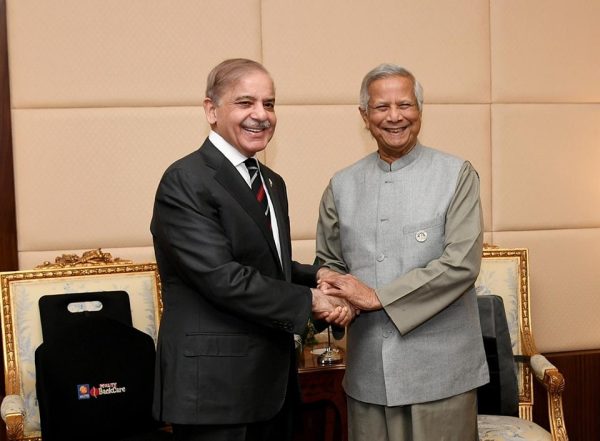
On December 19, Pakistan’s Prime Minister Shahbaz Sharif and Bangladesh’s Chief Advisor Dr. Muhammad Yunus held bilateral talks on the sidelines of the D-8 in Cairo, Egypt. This was the second meeting between the two after their meeting in September on the sidelines of the UNGA in New York. During the meeting in Cairo, both leaders
agreed to strengthen bilateral ties through increased trade and the exchange of cultural delegations and sports. They also expressed their interest in cooperation in the areas of sugar industry and management of dengue fever which
caused nearly a thousand deaths in Bangladesh in 2023 and has become an urgent public health emergency in Pakistan, especially since the floods of 2022.
While highlighting the historical, religious, and cultural connections between Pakistan and Bangladesh,
Sharif expressed, “Pakistan’s keen desire to enhance bilateral cooperation, particularly in the areas of trade, people-to-people contacts and cultural exchanges.” He also emphasized that there was a need to make joint efforts to explore new areas for economic cooperation and make the most of great potential to increase trade in various sectors including cement clinkers, leather goods, surgical goods, chemicals, and IT.
Besides bilateral ties, the leaders also discussed the revival of
the South Asian Association for Regional Cooperation (SAARC). Since taking charge of Bangladesh’s interim government, the revival of the SAARC has been a key foreign policy aim. During his meeting with Sharif, Yunus said reviving SAARC was his “top priority” and “I am a big fan of the idea of SAARC. I keep harping on the issue. I want a summit of SAARC leaders even if it is only for a photo session because that will carry a strong message.” In this context,
Sharif said that he would support the initiative and proposed that both nations should move step by step in order to revive the regional platform.
SAARC has yet to hold its biennial summit since 2014. The last summit was held in Nepal that year. The next summit, scheduled for 2016 in Pakistan, was never held after India, Bangladesh, Bhutan, and Afghanistan decided not to take part. If Yunus succeeds in reviving SAARC, it would be beneficial not only for Pakistan and Bangladesh but also for other member states of the regional organization.
In addition to discussions related to strengthening bilateral and multilateral ties, Yunus also urged Sharif to
settle the 1971 issue in order to help Bangladesh move forward with its relations with Pakistan. He said, “The issues have kept coming again and again. Let’s settle those issues for us to move forward.” He further said that it would be nice to resolve this issue, “once and for all for the future generations.” In his response to Yunus, Sharif said that the 1974 Tripartite Agreement signed by Bangladesh, India, and Pakistan settled the issues, but he would be happy to look, “if there are other outstanding issues” in this regard. The
tripartite agreement was signed in New Delhi, thus also known as the Delhi agreement, and dealt with the completion of the three-way process of repatriation involving Pakistani prisoners of war in India, Pakistanis in Bangladesh, and the citizens of Bangladesh in Pakistan.
Since the swearing-in of Yunus as the chief adviser of Bangladesh’s interim government in August 2024 after Sheikh Hasina fled the country following a student-led uprising which she failed to suppress with brute force,
Pakistan-Bangladesh relations seemed to move toward rapprochement.
Relations between the two countries touched new lows when Hasina’s government decided to
execute several leaders of the Jamaat-e-Islami Party on war crime charges for acts committed during the tragic events of 1971. However, Pakistan maintained that those executions were politically motivated, and the convictions were targeted those taking a pro-Pakistan stance during the war. In 2016, both
countries expelled diplomats.
During Hasina’s 15-year rule, Pakistan never had warm relations with Bangladesh given the grudge her family had against Pakistan’s ruling class. Moreover, she sought an official apology for the events of 1971 that was not forthcoming. Nonetheless, it was her proximity to India that soured Pakistan’s relations with Bangladesh most.
Hasina’s ouster and Yunus’ efforts to strengthen ties with Pakistan may engender deep concern in India.
Bangladesh enjoyed warm relations with India since the former’s establishment after the end of a war between Pakistan and India in 1971. These relations improved to an unprecedented level since Hasina’s return to power in 2009 with Dhaka and New Delhi creating a deep economic and security partnership.
With her ouster, along with the growing
“India Out” campaign in Bangladesh, there are geopolitical implications for New Delhi. In this context,
Michael Kugelman, Washington-based director for the Wilson Center’s South Asia Institute, said, “India has suffered a major geopolitical blow in Bangladesh. It’s dealing with something that’s close to a nightmare scenario.” He further said that India saw the Awami League and Hasina as the only viable option while considering any alternative unfavorable to its regional interests.
However, given the shared border, water resource collaboration, and strong trade ties between Bangladesh and India, New Delhi will continue to play a strategically important role for Dhaka. At the same time, post-Hasina relations between Dhaka and Islamabad seem to be on a path to rapprochement which will likely pave the way for better political and trade ties between the two.
Following the ouster of Sheikh Hasina, Bangladesh and Pakistan appear to be on the path toward rapprochement.
thediplomat.com


 www.india.com


