Bangladesh-Pakistan

I really don’t know what exactly effects their power generation for Pakistan but they lost their 2nd place to us because of this issue and even now when I see some YouTube vlogs, and accounts from my Pakistani friends… there’s often reports of loadsheddings lasting 24-48 hours on repetition.
Issue is not much with the power supply, its with the grid management and bill collection. In most of the well to do areas of major cities there is little to no loading shedding.
 
Issue is not much with the power supply, its with the grid management and bill collection. In most of the well to do areas of major cities there is little to no loading shedding.

Yes, that’s my understanding as well.

Trying to bring a county the size of Pakistan into the grid will require 10s of billions of dollars and decades.

99% of BD is now inside the grid - the next challenge is to build a smart grid - to reduce fraud and improve efficient use.
 
Pakistani High Commissioner Syed Ahmed Maroof on Evolving Bangladesh-Pakistan Relations

“The past is the past, and we don’t want to remain stuck there.”

By Saqlain Rizve
January 06, 2025
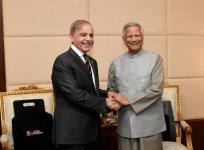
thediplomat_2025-01-06-064007.jpg

Given that the Awami League (AL) was the main political force that led the liberation struggle of East Pakistan — now Bangladesh — from West Pakistan in 1971, it’s no surprise that relations between Pakistan and Bangladesh have been strained for decades, particularly when the AL was in power in Bangladesh. However, with the fall of the AL regime on August 5 last year, and the Muhammad Yunus-led interim government taking charge in Bangladesh, Bangladesh-Pakistan relations are warming. Even so, Pakistan has yet to officially apologize for the 1971 genocide, which has left lingering resentment among many in Bangladesh.

In an interview with The Diplomat’s Bangladesh correspondent Saqlain Rizve, Pakistan’s High Commissioner to Bangladesh Syed Ahmed Maroof examined the evolving Pakistan-Bangladesh bilateral relationship. On the question of Pakistan apologizing to Bangladesh for the horrific bloodshed of 1971, Maroof said that Pakistan is looking to move beyond the past. “We aim for a fresh start,” he said.

How are you finding the new environment in Bangladesh, given your experience with both the Awami League regime and the current one?

The first noticeable change is that I’ve become busier than before. In the context of the new Bangladesh, I see a significant difference: while we were engaging previously, it wasn’t as frequent or intense as it is now. Nowadays, it feels like we have a meeting every other day, we’re reaching out and actively engaging with the government. In both the short and long term, I believe this increased interaction is a positive sign for the bilateral relations between the two countries.

Do you feel there was any negligence from the Bangladesh government toward the Pakistan High Commission before August 5?

I wouldn’t describe it as negligence, as different governments have their own policies. We were less involved in their approach, which seemed to prioritize limited engagement with the High Commission of Pakistan in general. However, we maintained frequent and substantive interactions in international forums, such as the United Nations and other multilateral organizations, where we supported each other as needed.

We were never completely out of touch; wherever our interests aligned, we engaged. The key difference now is that more and more of our interests are converging.

Recently, cultural exchanges between Pakistan and Bangladesh, like Rahat Fateh Ali Khan’s packed Qawwali performance and frequent Qawwali concerts in educational institutions, have gained popularity. What are your thoughts?

Culture transcends boundaries; it cannot be stopped or restricted. People naturally enjoy and embrace elements of each other’s cultures, choosing what resonates with them and leaving aside what doesn’t. Qawwali and ghazals, for example, are deeply rooted in South Asian traditions, introduced by Sufis who came to the subcontinent from Central Asia. Unfortunately, these art forms were sidelined during certain past regimes. However, Pakistani artists have preserved and modernized them, blending traditional melodies with contemporary instruments to create new genres.

It’s no surprise that South Asians, especially those who understand the language, are drawn to and deeply appreciate these performances. This cultural exchange is not only natural but also a positive and enriching experience.

How will the improving Bangladesh-Pakistan relations and India’s growing tension with Bangladesh since Sheikh Hasina’s fall impact South Asia’s geopolitics?

I don’t think it’s very complicated. Countries develop their bilateral relations based on mutual interests, not at the expense of a third party. For example, in trade and economics, if Bangladesh finds it advantageous to import goods from India or Pakistan, it’s entirely Bangladesh’s choice. The decision should be guided by what makes the most business sense. If importing certain goods from India is beneficial, that’s fine, and Pakistan shouldn’t be concerned. Similarly, if Bangladesh and Pakistan identify areas of mutual benefit, it shouldn’t be an issue for India either.

Ultimately, the three countries should pursue their bilateral relations independently, without allowing them to harm or antagonize a third party. This approach fosters healthy competition, where each country focuses on maximizing mutual benefits rather than creating conflicts. If all three nations adhere to this philosophy, they can maintain constructive and independent relationships. In this way, we avoid conducting bilateral relations at the expense of others, which would ultimately benefit everyone involved.

With the new direct shipping route between Pakistan and Bangladesh and talks of a Dhaka-Islamabad direct flight, what potential do you see for boosting trade and economic ties?

Given the geographical distance between Pakistan and Bangladesh, a direct shipping line plays a crucial role in enhancing bilateral economic relations. For distant countries, sea routes are the most efficient and cost-effective way to transport bulk goods. The establishment of this direct sea route between Pakistan and Bangladesh marks a significant step forward in boosting trade ties.

Notably, the second ship, which arrived in the last week of December, carried more than double the weight of the first shipment, signaling growing momentum. Previously, shipments had to pass through third ports like Sri Lanka or Singapore, which was both time-consuming and costly, taking up to 40 days. Now, goods arrive in just 10 to 12 days, significantly reducing time and expenses.

This development benefits businesses, importers, and exporters alike by streamlining trade and making it more efficient. The direct shipping line is undoubtedly a game-changer for strengthening economic relations between the two nations.

Which specific goods do you think will see the most growth in trade between the two countries?

Commodities like rice, onions, potatoes, sugar, and wheat are expected to dominate in terms of quantity in the coming days. However, in terms of value, items like RMG (ready-made garment) inputs and manufactured goods, such as Pakistan’s well-known ceiling fans, could take precedence. Motorbikes may also become a significant export in the near future.

Additionally, inputs for cement manufacturing, such as dolomite and clinker, have already been part of recent shipments. Dolomite, essential for glass manufacturing, was included in the first ship’s cargo, as confirmed by a port authority report. In the future, we may also see the import of stones, given Bangladesh’s shortage and Pakistan’s abundant supply.

Since taking charge, Muhammad Yunus has been actively advocating for the revival of SAARC. Is Pakistan genuinely committed to supporting this effort?

As you know, SAARC was originally a Bangladeshi initiative — essentially, it’s like a baby of Bangladesh. So, it holds a special place in the heart of Dr. Muhammad Yunus, who is deeply committed to its revival. The entire SAARC region owes Bangladesh gratitude for this visionary idea.

SAARC’s charter and concept are remarkable, and if it were fully revived, its potential could mirror the evolution of the European Union. There’s no reason why SAARC couldn’t follow a similar trajectory, fostering regional integration and collaboration.

As for Pakistan, we fully support Muhammad Yunus’ efforts to rejuvenate SAARC. Whenever and wherever he seeks our assistance, we are committed to providing our full support to help realize this vision.

Then why hasn’t it happened yet? Is it due to the India-Pakistan bilateral relationship?

In my view, bilateral issues should not hinder a regional body; they should be addressed separately, independent of the multilateral process. For example, Pakistan and India have their own issues, which should be resolved bilaterally, without impacting the SAARC process. The process should continue without becoming hostage to bilateral disputes.

So, it is possible to separate the SAARC process from bilateral issues. The challenge is that while all the countries are interested, India is not fully on board and often introduces additional complexities. Otherwise, the rest of the countries in the region are ready to move forward.

Are there any prospects for defense cooperation or joint initiatives between Pakistan and Bangladesh in the near future?

Defense cooperation under any regime should not pose an issue.

As of now, we have good training exchanges between the Pakistani and Bangladeshi armed forces. Pakistani officers have been undergoing training in various institutions in Bangladesh for a long time. Similarly, Bangladeshi officers also participate in training programs in Pakistan, including mid-level and high-level training sessions. This exchange fosters mutual understanding and cooperation.

In the future, if Bangladesh expresses interest in further defense collaboration, we will certainly consider it.

Are you meeting with Bangladeshi political parties?

It is natural for any diplomat to interact with all political parties. We engage with them because, ultimately, these are the entities that will govern the country. As such, we regularly reach out and meet with them.

Many claim that Pakistan has a soft corner for Bangladesh Jamaat-e-Islami. Is that true?

The reality is that different political parties have their own philosophies and priorities. Some people also claim that Pakistan has a soft corner for the BNP, but the truth is more practical. When the interests of two countries align, cooperation naturally develops in areas like culture, politics, economics, and trade.

When bilateral relations thrive, it’s often perceived as favoritism toward the ruling party. However, this does not mean that Pakistan or its High Commission has a preference for any particular party. It’s simply a matter of which political party is in power at a given time. For example, before August 5, a different party was in power with which our interests didn’t align as much, so bilateral development was limited. It’s about shared interests, not favoritism.

Some believe that stronger relations between Bangladesh and Pakistan could increase the risk of terrorism in the region. What are your thoughts on this?

I’m not sure why but whenever people hear about Pakistan, their reactions are often negative. This is very unfortunate and largely the result of persistent propaganda over the years. Such narratives have been promoted day in and day out, creating misconceptions.

In light of the events of 1971, how do you view the apology issue and the differing perspectives of the people of Pakistan and Bangladesh?

The past is the past, and we don’t want to remain stuck there. We aim for a fresh start. As a result, both countries are discussing ways to address the issue, although no final decision has been made yet.

 
1736271913437.png


FPCCI plans Bangladesh trip to boost trade

Aamir Shafaat Khan
January 8, 2025

KARACHI: With bilateral trade below $1 billion, the Federation of Pakistan Chambers of Commerce and Industry (FPCCI) is leading an exporters’ delegation to Bangladesh this week to enhance trade relations.

The delegation will meet Bangladesh Chief Adviser Dr Muhammad Yunus and Commerce Adviser Sheikh Bashir Uddin.

FPCCI President Atif Ikram Sheikh, who will lead more than 35 business people of diverse industries, said that the Pakistani business community could achieve substantive

milestones through economic diplomacy, which seems difficult vis-à-vis political diplomacy. “Countries and the regions come closer in today’s world through forging interdependencies that result in wealth creation and prosperity for their respective populations,” he remarked.

BD envoy hopes bilateral trade can easily be increased to $2-3bn

Deputy High Commissioner of Bangladesh Mahbubul Alam held talks with the FPCCI leadership on Tuesday and discussed the activities and scope of the delegation’s Bangladesh visit.

He extended his full support in expeditious visa issuance and facilitation to genuine Pakistani businessmen for trade promotion activities.

Mr Alam said that bilateral trade is a mere $800 million between the two countries, which can easily be increased to $2-3bn within years if both countries can explore and realise the respective untapped export potential.
 
Untapping export potential

In the last week of December 2024, Commerce Minister Jam Kamal stated that Bangladesh is also interested in Pakistani rice and vegetables, while flights between the two countries would also resume.

Commenting on this, Pakistan Fruits and Vegetables Merchants, Exporters and Importers Association Patron-in-Chief Waheed Ahmed told Dawn that after a political change, importers of Bangladesh have been continuously contacting local counterparts to enhance imports of Pakistani vegetables and fruits.

He stated that Bangladesh imports Indian onions when they are cheaper. “When the price of Indian onions rises, we anticipate receiving more export orders from Bangladesh,” he mentioned.

He recalled that Pakistani onions had found their way into Bangladesh in 2024 when India had imposed an export ban. Onion exports were also made in 2022, while no shipments were made in 2023. However, the volume of exports was low.

In fruits, he said low volumes of local kinno and apple shipments were also sent in 2024 and were previously shipped in little quantities.

Mr Waheed pointed out that kinno, apple, dates, mango, grapes and onion have vast export potential to Bangladesh.

“I have asked the government to lead an official delegation to Bangladesh and hold talks for boosting trade volume in vegetables, fruits, packed food items, fruit juices and spices,” he said, adding that it takes two to three weeks for local shipments to reach Bangladesh.

“I see a bright future of trade between the two countries in the current year if both the governments sit together and identify sectors of improving trade volume beneficial for each other,” Waheed said.

Rice Exporters Association of Pakistan chairman Malik Faisal Jahangir said that exports to Bangladesh could earn $200 million in foreign exchange annually.

“Bangladesh accounts for less than 2pc of our total rice exports,” he said, adding that efforts are being made to enhance the share.

He said some problems have emerged in the procurement of rice by Bangladesh from India. Previously, India provided rice to Bangladesh at competitive prices by road, while Bangladesh imported rice from Thailand.

He said the Trading Corporation of Pakistan had received around 11 bids for the supply of 50,000 tonnes long grain white rice (Irri 6 rice) to Bangladesh in response to a global tender issued on Dec 31, 2024.

“50,000 tonnes of Irri-6 rice will fetch $24-26m,” he said.

Published in Dawn, January 8th, 2025
 

Bangladesh eases visa restrictions for Pakistan​


Bangladesh has simplified visa requirements and now Pakistanis can apply visa online: Bangladesh’s Ambassador


News Desk
January 11, 2025

tribune


Bangladesh has eased visa restrictions for Pakistani citizens, making it easier for them to travel to the country.

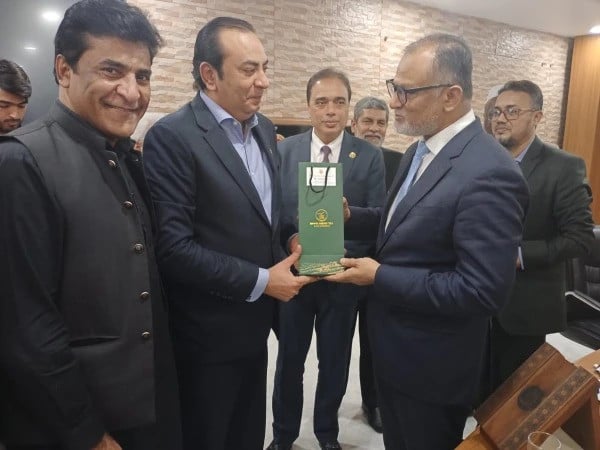
This announcement was made during a visit by Bangladesh’s Ambassador to Pakistan, Mohammad Iqbal Khan, to the Lahore Chamber of Commerce and Industry (LCCI), where he addressed business leaders.

In his speech, Ambassador Khan emphasised that Lahore’s rich culture and heritage do not need any introduction. He expressed that the people of Bangladesh have a deep bond of affection with the people of Pakistan and that strengthening bilateral cooperation between the two countries is essential.

"The Lahore Chamber of Commerce can play a crucial role in enhancing trade between Pakistan and Bangladesh," Khan stated. "The people of Bangladesh hold Pakistan in high regard, and it is vital for both nations to strengthen their economic and trade ties."

Regarding the visa changes, the ambassador said, "Bangladesh has simplified visa requirements for Pakistanis, and now citizens of Pakistan can apply for their visa online." This move is expected to facilitate business and cultural exchanges between the two countries.

Mian Abu Zar Shad, the president of Lahore Chamber of Commerce, responded positively to the ambassador’s remarks. He stated, "We are eager to increase trade with Bangladesh. Our delegations will soon visit Bangladesh to explore further opportunities."

This development highlights the growing economic ties and the willingness of both nations to enhance mutual cooperation in various sectors.
 

After 12-year hiatus, Pakistani trade delegation visits Bangladesh​


The visit emphasised enhancing bilateral economic relations and boosting investments between the two nations

News Desk
January 12, 2025

tribune


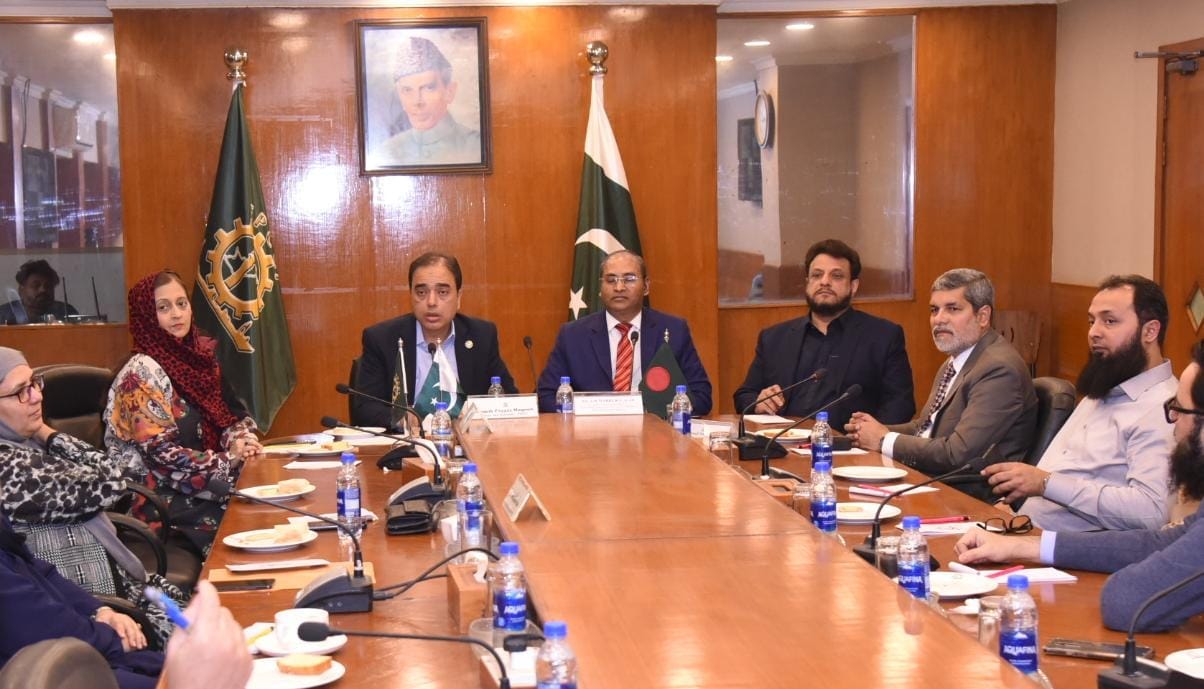
A Pakistani trade delegation, led by the President of the Federation of Pakistan Chambers of Commerce and Industry (FPCCI), Atif Ikram Sheikh, visited Bangladesh after a 12-year hiatus.

The visit emphasised enhancing bilateral economic relations and boosting investments between the two nations.

According to a statement from FPCCI, the delegation met with Sheikh Bashiruddin, Bangladesh's Minister for Commerce. The Pakistani representatives stressed the importance of increasing economic ties and investment opportunities between the two countries.

FPCCI President Atif Ikram Sheikh noted, "This is the beginning of a new era, and we will stand by Bangladesh at every turn." He also highlighted that Bangladesh’s Minister for Commerce had expressed a commitment to prioritising trade relations with Pakistan.

FPCCI Senior Vice President, Saqib Fyaz Magoo, welcomed the easing of visa conditions for Pakistanis by Bangladesh, urging the issuance of long-term visas to the Pakistani business community. He added that Pakistan had also relaxed visa restrictions for Bangladesh nationals.

Bangladesh’s Minister for Commerce, Sheikh Bashiruddin, emphasised, "We will work together to explore economic, industrial, business, and trade opportunities with Pakistan."

He also confirmed that both countries had agreed to increase mutual trade and that efforts would be made to encourage Pakistani businesses.

The meeting was also attended by Pakistan’s High Commissioner to Bangladesh, Syed Ahmed Maroof.
 

Pakistan, Bangladesh underscore ‘enduring partnership’ for resillience against external influences


APP
January 14, 2025


Chief of Army Staff General Asim Munir meets Lieutenant General S M Kamrul Hassan, principal staff officer of the Armed Forces Division of Bangladesh, at General Headquarters, Rawalpindi on Tuesday. — ISPR


Chief of Army Staff General Asim Munir meets Lieutenant General S M Kamrul Hassan, principal staff officer of the Armed Forces Division of Bangladesh, at General Headquarters, Rawalpindi on Tuesday. — ISPR

The militaries of Pakistan and Bangladesh stressed the need on Tuesday for the “enduring partnership” between the two countries to “remain resilient against external influences” amid a thaw in ties.

The two countries were once one nation but split following a bloody civil war, which saw the territory previously referred to as ‘East Pakistan’ seceding to form the independent nation of Bangladesh.

In the years since the split, Dhaka’s leaders — especially the recently ousted regime of Sheikh Hasina — stayed firmly in the Indian camp, preferring to maintain close ties with New Delhi and keeping Islamabad at arm’s length.

However, ever since a popular uprising that saw Hasina’s government toppled in August, there has been a thaw in ties between the two capitals, with trade and bilateral relations seeing a marked improvement.

A statement from the Inter Services Public Relations (ISPR) said that Lieutenant General S M Kamrul Hassan, principal staff officer (PSO) of the Armed Forces Division of Bangladesh, met Chief of Army Staff (COAS) General Asim Munir at the General Headquarters today during the former’s visit to Pakistan.

“The COAS and the PSO underscored the importance of a stronger defence relationship, emphasising that the enduring partnership between the two brotherly nations must remain resilient against external influences,” the ISPR said.

It added that both held extensive discussions on the evolving security dynamics in the region and explored further avenues for enhancing bilateral military cooperation.

COAS Munir reiterated the significance of joint efforts to promote peace and stability in South Asia and the broader region while ensuring that both nations continued to contribute to regional security through collaborative defence initiatives.

The Bangladeshi military official commended the Pakistan Army’s “exceptional professionalism” and acknowledged the “immense sacrifices” made by the armed forces in the fight against terrorism, noting that their efforts served as a “beacon of courage and determination”.

The ISPR said Gen Hassan also earlier met Chairman Joint Chiefs of Staff Committee (CJCSC) General Sahir Shamshad Mirza at the Joint Staff Headquarters.

It said their discussions focused on matters of mutual strategic interest and explored avenues for enhancing bilateral defence cooperation between the two nations.

“Both sides emphasised the importance of strengthening military ties and reaffirmed their commitment to insulating this partnership from any external disruptions,” the ISPR said, adding that the two agreed on the “critical need for continued collaboration” in promoting regional peace, security and stability.

The CJCSC reiterated that both countries shared a “common vision for a secure and prosperous future”, underpinned by robust defence cooperation.
 

Pakistan, Bangladesh underscore ‘enduring partnership’ for resillience against external influences


APP
January 14, 2025


Chief of Army Staff General Asim Munir meets Lieutenant General S M Kamrul Hassan, principal staff officer of the Armed Forces Division of Bangladesh, at General Headquarters, Rawalpindi on Tuesday. — ISPR


Chief of Army Staff General Asim Munir meets Lieutenant General S M Kamrul Hassan, principal staff officer of the Armed Forces Division of Bangladesh, at General Headquarters, Rawalpindi on Tuesday. — ISPR

The militaries of Pakistan and Bangladesh stressed the need on Tuesday for the “enduring partnership” between the two countries to “remain resilient against external influences” amid a thaw in ties.

The two countries were once one nation but split following a bloody civil war, which saw the territory previously referred to as ‘East Pakistan’ seceding to form the independent nation of Bangladesh.

In the years since the split, Dhaka’s leaders — especially the recently ousted regime of Sheikh Hasina — stayed firmly in the Indian camp, preferring to maintain close ties with New Delhi and keeping Islamabad at arm’s length.

However, ever since a popular uprising that saw Hasina’s government toppled in August, there has been a thaw in ties between the two capitals, with trade and bilateral relations seeing a marked improvement.

A statement from the Inter Services Public Relations (ISPR) said that Lieutenant General S M Kamrul Hassan, principal staff officer (PSO) of the Armed Forces Division of Bangladesh, met Chief of Army Staff (COAS) General Asim Munir at the General Headquarters today during the former’s visit to Pakistan.

“The COAS and the PSO underscored the importance of a stronger defence relationship, emphasising that the enduring partnership between the two brotherly nations must remain resilient against external influences,” the ISPR said.

It added that both held extensive discussions on the evolving security dynamics in the region and explored further avenues for enhancing bilateral military cooperation.

COAS Munir reiterated the significance of joint efforts to promote peace and stability in South Asia and the broader region while ensuring that both nations continued to contribute to regional security through collaborative defence initiatives.

The Bangladeshi military official commended the Pakistan Army’s “exceptional professionalism” and acknowledged the “immense sacrifices” made by the armed forces in the fight against terrorism, noting that their efforts served as a “beacon of courage and determination”.

The ISPR said Gen Hassan also earlier met Chairman Joint Chiefs of Staff Committee (CJCSC) General Sahir Shamshad Mirza at the Joint Staff Headquarters.

It said their discussions focused on matters of mutual strategic interest and explored avenues for enhancing bilateral defence cooperation between the two nations.

“Both sides emphasised the importance of strengthening military ties and reaffirmed their commitment to insulating this partnership from any external disruptions,” the ISPR said, adding that the two agreed on the “critical need for continued collaboration” in promoting regional peace, security and stability.

The CJCSC reiterated that both countries shared a “common vision for a secure and prosperous future”, underpinned by robust defence cooperation.

“immense sacrifices made by the armed forces in the fight against terrorism”

Is that what they are doing now?

Plus, isn’t that the job of the police?

Professional military should fight external enemies, no?
 
@BananaRepublic

Kola bhai,

Pak Fauj defends not only the physical frontiers of the country but also its ideological frontiers. In addition given the ( alleged) incompetence of civvie leaders it has to shoulder the onerous burden of governance as well.

Regards
 

Direct flights between Pakistan, Bangladesh on the horizon​


Tareq Ahmed, Bangladesh's new ambassador to the UAE, met with Pakistan's Faisal Niaz Tirmizi in Abu Dhabi.

News Desk
January 16, 2025

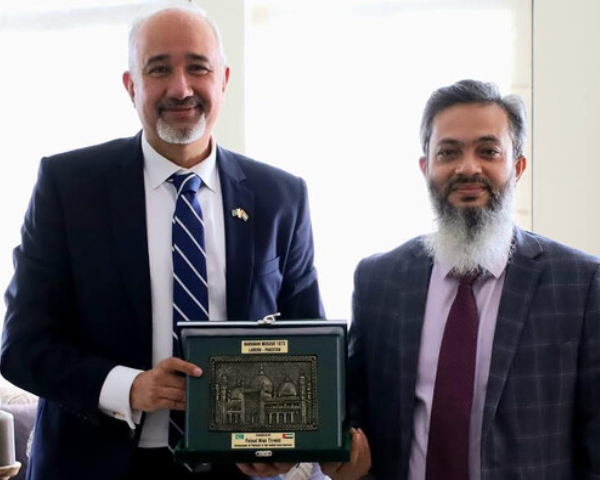
tareq ahmed right bangladesh s newly appointed ambassador to the uae poses for a photograph with pakistan s ambassador faisal niaz tirmizi at the pakistan house in abu dhabi on january 16 2025 photo pakistan embassy


Tareq Ahmed (right), Bangladesh's newly appointed Ambassador to the UAE, poses for a photograph with Pakistan's Ambassador Faisal Niaz Tirmizi at the Pakistan House in Abu Dhabi on January 16, 2025. Photo: Pakistan Embassy

Pakistan and Bangladesh discussed resuming direct flights between Islamabad, Karachi, and Dhaka in a meeting held in Abu Dhabi on Thursday, signaling a potential step toward closer bilateral ties.

The meeting took place between Tareq Ahmed, Bangladesh's newly appointed ambassador to the UAE, and Faisal Niaz Tirmizi, Pakistan's ambassador to the UAE.


The diplomats also discussed trade, investment cooperation, and ways to increase people-to-people contact, alongside the resumption of direct flights between the two countries. Both sides emphasized the importance of supporting their respective diasporas in the UAE.

The meeting reflects a shift in relations between Pakistan and Bangladesh, which were once a single nation before their split in 1971.

Historically, Bangladesh has maintained strong ties with India, Pakistan's arch-rival, but relations have warmed since the ouster of former Prime Minister Sheikh Hasina Wajid in 2024, marking a new phase of cooperation.

Ambassador Tirmizi highlighted the historical and cultural bonds between the nations and the untapped trade potential. Bangladesh's envoy reaffirmed the country's commitment to strengthening relations with Pakistan, emphasizing the need for dialogue on regional challenges.

In a further step to solidify ties, Pakistan’s Deputy Prime Minister Ishaq Dar is scheduled to visit Dhaka in early February.
 

Direct flights between Pakistan, Bangladesh on the horizon​


Tareq Ahmed, Bangladesh's new ambassador to the UAE, met with Pakistan's Faisal Niaz Tirmizi in Abu Dhabi.

News Desk
January 16, 2025

tareq ahmed right bangladesh s newly appointed ambassador to the uae poses for a photograph with pakistan s ambassador faisal niaz tirmizi at the pakistan house in abu dhabi on january 16 2025 photo pakistan embassy


Tareq Ahmed (right), Bangladesh's newly appointed Ambassador to the UAE, poses for a photograph with Pakistan's Ambassador Faisal Niaz Tirmizi at the Pakistan House in Abu Dhabi on January 16, 2025. Photo: Pakistan Embassy

Pakistan and Bangladesh discussed resuming direct flights between Islamabad, Karachi, and Dhaka in a meeting held in Abu Dhabi on Thursday, signaling a potential step toward closer bilateral ties.

The meeting took place between Tareq Ahmed, Bangladesh's newly appointed ambassador to the UAE, and Faisal Niaz Tirmizi, Pakistan's ambassador to the UAE.


The diplomats also discussed trade, investment cooperation, and ways to increase people-to-people contact, alongside the resumption of direct flights between the two countries. Both sides emphasized the importance of supporting their respective diasporas in the UAE.

The meeting reflects a shift in relations between Pakistan and Bangladesh, which were once a single nation before their split in 1971.

Historically, Bangladesh has maintained strong ties with India, Pakistan's arch-rival, but relations have warmed since the ouster of former Prime Minister Sheikh Hasina Wajid in 2024, marking a new phase of cooperation.

Ambassador Tirmizi highlighted the historical and cultural bonds between the nations and the untapped trade potential. Bangladesh's envoy reaffirmed the country's commitment to strengthening relations with Pakistan, emphasizing the need for dialogue on regional challenges.

In a further step to solidify ties, Pakistan’s Deputy Prime Minister Ishaq Dar is scheduled to visit Dhaka in early February.

Is that going to be financially viable?

Maybe as a stopover on the way to Gulf?
 
To view this content we will need your consent to set third party cookies.
For more detailed information, see our cookies page.
 

Because of Facebook this guy found his family after 54 years, return from Bangladesh to Pakistan​


To view this content we will need your consent to set third party cookies.
For more detailed information, see our cookies page.
 

Users who are viewing this thread

Back
Top