Saudi Arabia ranks first at International Nuclear Science Olympiad as students claim gold medals
August 9, 2026 | 02:28 PM
Saudi Gazette
Last Updated: August 9, 2026 | 02:51 PM
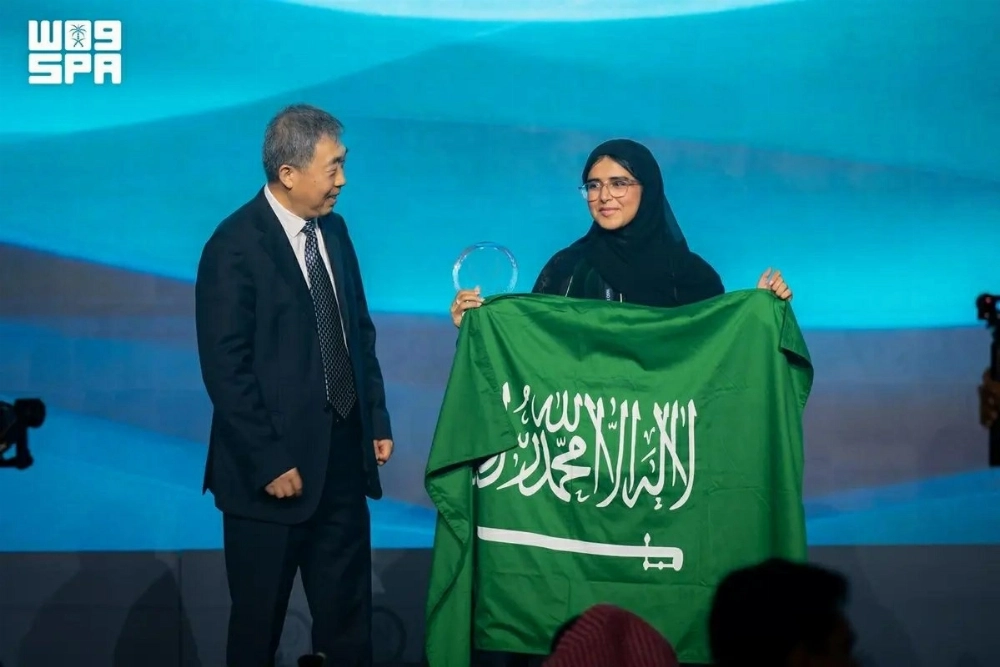
EDDAH — Saudi student Jana Al-Sabil’s gold medal and “Best Female Student” award at the third International Nuclear Science Olympiad 2026, along with Amjad Al-Darwish’s gold medal and “Nuclear Science Ambassador” title, helped Saudi Arabia rank first overall in the competition.
Jana Saleh Al-Sabil won the gold medal and “Best Female Student” award in recognition of her scientific excellence and performance in the competition.
Presented by the International Atomic Energy Agency (IAEA), the award was among the special prizes approved by the Olympiad’s International Council to honor female students for scientific excellence, highlight their contributions to nuclear science, and encourage their participation in specialized scientific fields.
Al-Sabil was selected following her outstanding performance in the Olympiad, which included two examinations — one theoretical and one practical — each lasting five hours.
The exams assessed participants’ knowledge and skills in nuclear science, as well as their abilities to conduct scientific analysis and experiments, interpret results, and solve advanced problems.
Saudi Arabia ranked first in the third edition of the Olympiad after Amjad Mahmoud Al-Darwish won a gold medal and the title of “Nuclear Science Ambassador” for achieving the highest combined score in the theoretical and practical examinations among all competitors.
In addition, Abdulaziz Abdulmohsen Al-Sharait won a silver medal, while Saleh Mubarak Dhaifallah Al-Harbi received a bronze medal.
The Olympiad, hosted by Saudi Arabia in Jeddah from August 2 to 9, brought together 120 students and scientific specialists representing 19 countries.
It was jointly organized by the Ministry of Education, the King Abdulaziz and His Companions Foundation for Giftedness and Creativity (Mawhiba), and King Abdullah City for Atomic and Renewable Energy, while King Abdulaziz University hosted the competitions and activities.
The International Nuclear Science Olympiad, approved by the IAEA in 2024, is an international scientific competition for secondary school students that aims to develop their knowledge and skills in nuclear science and its peaceful applications and encourage innovation and scientific research in the field.
Saudi student Jana Al-Sabil's gold medal and 'Best Female Student' award at the third International Nuclear Science Olympiad 2026, along with Amjad Al-Darwish's gold medal and 'Nuclear Science Ambassador' title, helped Saudi Arabia rank first overall in the competition.

saudigazette.com.sa
A very interesting article about the recently signed nuclear deal with the US.
No “Gold Standard,” No Israel Clause: What the Saudi Nuclear Deal Actually Says (MBN)
August 7, 2026
Articles,
Greater Middle East & Africa,
Missiles, Defenses, and Space,
Op-Eds & Blogs,
The Nonproliferation Regime
Two weeks ago, President Trump was about to send the Hill a U.S.-Saudi nuclear cooperative agreement. After a torrent of criticism from Fox News
, The Wall Street Journal, and
The New York Times, though, he changed his mind and insisted that the United States would not help Saudi Arabia make nuclear fuel and that the deal would not come into force until Saudi Arabia recognized Israel.
The question now is what’s next. Below is
an interview I granted to the U.S. government’s Middle East Broadcasting Network that takes a stab at where we’re headed.
First, if the deal proceeds as the U.S. Energy Department and the press have described it will provide the Saudis with a pathway to make nuclear fuel—the most difficult and essential step to making nuclear weapons. The problem here is that Israel and the United States have been bombing a variety of nuclear sites to throttle this very same activity in Iran.
In an attempt to avoid this contradiction, the Energy Department insists there will be no enrichment unless a two-year study concludes that Saudi nuclear fuel-making is economically sound and can be rendered safe. Yet, as I note below, the premise of conducting such a study—that the answer could be yes—is disingenuous. We already know the honest answer is no.
The second problem with the agreement is that it does not require Riyadh to adopt international nuclear inspections (known as Protocol I visits) that would allow the International Atomic Energy Agency (IAEA) to go anywhere, anytime outside declared nuclear sites. One hundred and forty four nations have already granted authority to the IAEA to conduct such inspections on their soil. Saudi Arabia has refused.
This suggests that Riyadh has something it wants to hide, possibly including a covert nuclear weapons program. Saudi officials are already on record that the Kingdom must get nuclear weapons if it believes Iran is acquiring them. Saudi Arabia also has tight connections to Pakistan, which has mastered both enrichment and nuclear weapons design.
Finally, by creating a pathway to dangerous nuclear weapons-related activities, it will set a precedent for Riyadh’s neighbors, including the United Arab Emirates, Turkey, and Egypt—nations pursuing large nuclear power programs.
The Energy Department’s rejoinder is that if the United States doesn’t help Saudi Arabia make nuclear fuel, Russia and China will with fewer controls. That gets things backwards. In fact, no country—not the United States, not China or Russia—during the last half-century has offered to transfer nuclear fuel-making technology to states lacking nuclear weapons. The last country to do that was the United States in the 1960s with India, which used the assistance to set off a “peaceful” nuclear explosion.
If, as proposed, the United States violates this sound standard by helping Saudi Arabia enrich uranium, the very thing our Energy Department says it is worried China and Russia might do, is what our violation of this standard will ensure.
The President has yet to send the Saudi nuclear agreement to Hill for review. As I argue in the attached interview, it would be best if it never left his inbox or, at least, our government renegotiated to include the very things President Trump now insists are necessary—no enrichment and Saudi Arabia’s recognition of Israel.
As always, I’m curious to get your take on the attached.
August 4, 2026
Henry Sokolski Interview with Middle East Broadcasting Networks

The Trump administration has yet to formally send to Congress the nuclear cooperation agreement it signed with Saudi Arabia last month.
Energy Secretary Chris Wright and Saudi Energy Minister Prince Abdulaziz bin Salman signed a Section 123 agreement – the legal step that allows American companies to share nuclear technology with another country – in Riyadh on July 22. The Department of Energy said at the time that the agreement would “now be transmitted to Congress for review.”
Until it is, the review clock cannot start. Once transmitted, the agreement takes effect “after 90 consecutive legislative days of sitting before Congress” – days Congress is actually in session, not calendar days – “which could be sometime before the end of this year,” said Henry Sokolski, who runs the Nonproliferation Policy Education Center and served as the Pentagon’s deputy for nonproliferation policy in the George H.W. Bush administration.
The administration has also complicated its own deal. A day after the signing, President Trump posted on Truth Social that Saudi Arabia would not be allowed to enrich uranium, and that the entire arrangement depended on Riyadh joining the Abraham Accords and establishing relations with Israel.
Those conditions do not appear in what the two governments actually signed, Sokolski told MBN.
“I’m with the Saudis on this. I think they’ve got it right, which is: you’ve got to be kidding. We signed documents. They didn’t have anything in it about these other conditions,” Sokolski said. “It is not part of the deal.”
Saudi Arabia has said repeatedly that it will not normalize relations with Israel unless Israel agrees to Palestinian statehood — a condition Prime Minister Benjamin Netanyahu has refused.
Sokolski noted that the president retains one lever regardless: even after the agreement takes effect, he can decline to approve nuclear exports to Saudi Arabia. “He has that power. But it’s not something that he’s legally bound to do. It’s something that’s executive discretion,” he said.
What the deal actually allows
A full assessment is still impossible. The text of the agreement has not been published, nor have two side letters that accompany it. “We haven’t seen them,” Sokolski said. “Of course, we haven’t even seen the 123 agreement yet.” Most of what is known comes from briefings the Energy Department has given reporters.
What is known is this: once in force, the deal defers the central question to a study. “There’ll be a two-year study on, well, is the making of nuclear fuel by enriching uranium really all that economical for Saudi Arabia,” Sokolski said.
If the study says yes, American firms would build an enrichment plant on Saudi soil, operating under U.S. oversight.
“If the conclusion of that is yes, then the United States would actually build a plant, an enrichment plant, that would bring the most sensitive technologies that we’re now currently bombing in Iran to Saudi Arabian soil,” Sokolski said, referring to the U.S. military campaign aimed at preventing Iran from obtaining nuclear weapons.
If the study says no, “the agreement somehow will bind the Saudis to not get enrichment from anyone else for 10 years,” Sokolski said, citing reporting on two side letters that have not been made public. A separate side agreement, he added, would limit Saudi reactor purchases to Westinghouse — a company headquartered in Pennsylvania but owned by two Canadian firms.
A departure from the “gold standard”
The agreement breaks with the terms Washington set for the United Arab Emirates in 2009 – an arrangement so strict it became known as the “gold standard.” Abu Dhabi made a legal commitment to forgo both uranium enrichment and the reprocessing of spent fuel, the two most direct pathways to a nuclear weapon. It also accepted the International Atomic Energy Agency’s Additional Protocol, an inspection regime that lets IAEA monitors examine nuclear-related sites a country has not formally declared.
Saudi Arabia has agreed to neither.
“In the case of Saudi Arabia, the forswearing did not occur at all,” Sokolski said. “Worse, they did not agree to the Additional Protocol — which raises the question: do they have something to hide, or do they think they will?”
“144 countries – almost all the countries in the world – have agreed to the Additional Protocol,” he added. “Not Saudi Arabia.”
Supporters of the deal argue that American oversight of a Saudi facility is better than pushing Riyadh toward Russia or China, which might offer looser terms. Sokolski is skeptical that American control would survive contact with reality.
“We have this expression in the United States: possession is 90 percent of the law. If you have something on your soil, you can always tell the Americans to leave. And there you go – you have it,” he said.
A declared facility, he added, does nothing to rule out a covert program – especially without the Additional Protocol, which exists precisely to let inspectors chase undeclared activity.
A history of finding out too late
Sokolski pointed to Saudi Arabia’s record of acquiring missile capabilities without Washington managing to stop it in advance. “The track record there is 100 percent consistent. Every time they’ve gotten a missile, it was too late for us to do anything to block it,” he said. The Washington Post has reported that Riyadh secretly bought Chinese ballistic missiles in the 1980s, and that Washington learned of the deal only after the missiles had arrived and construction of their bases had begun inside the kingdom.
The stakes are raised by the Saudi crown prince’s own words. In 2018, Mohammed bin Salman told CBS’s “60 Minutes” that if Iran builds a nuclear weapon, Saudi Arabia would “follow suit as soon as possible.”
“In the case of Saudi Arabia, they’ve been pretty clear that if they think Iran’s getting a bomb, they have to get one too,” Sokolski said.
The fight in Congress
The deal “hasn’t sat well with a lot of people on the Hill,” Sokolski said, including some staunch Trump supporters – among them Sen. John Kennedy of Louisiana, who has been “quite emphatic saying there’s no way he’s going to support this.”
Blocking it is hard, but not impossible. “You don’t need many Republican senators to join a whole lot of Democrats to pass a piece of legislation,” Sokolski said, especially if Democrats take the House next year. The president could veto such a bill – but, he added, “you do not, as a president, want to see that coming to your desk.”
He suggested two narrower options for Congress: bar the use of American funds to implement any part of the agreement that permits nuclear fuel production inside Saudi Arabia, or write in an explicit condition that cooperation cannot lead to an enrichment facility.
The regional echo
The consequences do not stop at Saudi Arabia’s borders. The U.S.-UAE agreement contains a consultation clause triggered if Washington gives another country in the region more generous terms – and granting Riyadh a future path to enrichment, Sokolski said, could prompt Abu Dhabi to demand a renegotiation of its own deal. Egypt and Turkey could invoke the Saudi precedent to press their own claims to a full nuclear fuel cycle on their territory.
“Folks assume the worst when someone says they’re going to do something and they have the means to do it,” he said.
Sokolski worries the agreement could unravel a policy Washington has held since India’s nuclear test in the 1970s: refusing to help non-nuclear-weapon states produce nuclear fuel. Russia and China have largely taken the same public position, he said — but an American exception for Saudi Arabia could invite others to make their own.
The argument that the United States must cooperate because someone else will anyway is, he said, “a self-fulfilling fallacy.”
“People say, well, if you’re going to do that, then we got to do that,” he said.
Not settled yet
For all his criticism, Sokolski stressed that nothing is final. The economic study has not begun, Congress has not reviewed the agreement, and the administration could still tighten its terms or attach conditions to implementation. The deal, he said, looked like “a trial balloon” whose drafters “may have been a little too clever by half, not knowing exactly what they were locking into.”
“I just don’t know how the story ends,” he said, “and it could end very badly.”