
Michael Corleone
Elite Member


The reasoning is range since we dont have tankerswhy 10 euro fighters , whats the need if you are getiing j10c and jf17s
Follow along with the video below to see how to install our site as a web app on your home screen.
Note: This feature may not be available in some browsers.
The reasoning is range since we dont have tankerswhy 10 euro fighters , whats the need if you are getiing j10c and jf17s
I agree. J10c and jf17 are more than enough. Just need 12 more j10c orders and 2 more jf17 squadrons to have an effective deterrent airforceI was holding off on posting about this since all the content I have read so far are pointing to one single souce (Kaler Kontho).
If Asif Mahmud's verified page is posting this, it is true.
One difference is, there is no mention of JF-17's here unlike what Kaler Kontho claimed.
I don't understand the rationale behind having three different fighter jets for such a small, cash strapped air force.
Having said that, I also don't agree with EFT procurement for financial and political reasons. They will end up becoming hanger queens.
Either go all J-10CE (my preference) or mix it up with JF-17's.
Decision to pursue T129 is absolutely bonkers - have we learnt nothing from Pakistan's experience?
According to a European source is came across the eft is being negotiated with a package of c27j transport aircraft and vip helicoptersDedicated maritime strike aircraft is a luxury for Bangladesh since we are yet to sort out basics, from artillery to air superiority.
64 fighter jets are not nearly enough to counter the threats Bangladesh faces - why would you complicate things further by bringing in incompatible systems?
There is opportunity to buy less critical defence systems (e.g.- A400 transport aircraft, transport helicopters, etc.) from Europe in order to keep them happy while benefitting from quality.

Poopjeets randia cow urine drinkers@Destranator
64 fighter jets are not nearly enough to counter the threats Bangladesh faces -
Who do you face a threat from?
Regards
So now interim government adviser is confirming bd is getting 10 eurofighter, 20 j10c and 16 jf17 along with 6 Turkish attack helicopters. All in all about 10 bil to be dropped before the end of the decade unless ofc some jackass government decides to suck upto India again
Bangladesh will Never get Eurofighters
How do you know?
Bangladesh Finalizes Talks to Buy 20 Chinese J-10CE Fighter Jets Worth $2.2 Billion
Dhaka’s plan to acquire 20 J-10CE fighters from China marks a major leap in its air defense modernization — and a move that could shift regional power dynamics.
October 11, 2025

According to multiple diplomatic and media reports, Bangladesh is preparing to purchase 20 J-10CE multi-role fighter jets from China in a deal estimated at $2.2 billion.
The move signals a major leap in the nation’s air defense modernization — and a bold geopolitical shift that could reshape South Asia’s military balance.
Talks Between Bangladesh and China Gain Pace
The negotiations reportedly accelerated during the visit of Interim Government Chief Adviser Professor Muhammad Yunus to China in March, where he met with Chinese President Xi Jinping. Sources within Yunus’s delegation confirmed that Bangladesh’s interest in the J-10CE was officially presented during those discussions.
Beyond the fighter jet deal, the meeting also touched on key infrastructure projects such as the Teesta River development and port connectivity initiatives. However, diplomatic insiders note that initial talks on the J-10C acquisition had begun even before the visit, with Beijing responding positively to Dhaka’s proposal.
Why the J-10CE? The “Vigorous Dragon” Advantage
The Chengdu J-10CE, also known as the “Vigorous Dragon,” is China’s most advanced export-grade 4.5-generation multi-role fighter. Designed to rival platforms like the F-16V and Gripen E, and even challenge aspects of the F-35, it offers Bangladesh an affordable yet powerful air combat solution.
Key Highlights of the J-10CE:
- KLJ-7A AESA Radar: Provides high situational awareness and advanced electronic warfare resistance.
- PL-15 Long-Range Missiles: Capable of engaging targets beyond 200 km, comparable to the U.S. AIM-120D AMRAAM.
- Multi-Role Flexibility: Performs air superiority, precision strike, and reconnaissance missions — and can coordinate with UAVs.
- Cost-Effective: Priced between $60–90 million per unit, including training, spare parts, and weapons — a strong value compared to Western alternatives.
Strategic and Geopolitical Implications
If finalized, the deal will mark Bangladesh’s biggest-ever fighter jet acquisition, dramatically upgrading its air force capabilities. Defense analysts say the addition of the J-10CE would place the Bangladesh Air Force (BAF) among the most modernized in South Asia.
However, this development is not without challenges. Western observers caution that closer military ties with Beijing could complicate Dhaka’s relations with the U.S. and European partners, who are wary of expanding Chinese influence in the Indo-Pacific.
While Western nations maintain strong trade relations with Bangladesh, a deepening defense partnership with China could invite diplomatic scrutiny. Experts advise Dhaka to balance its strategic ambitions with the geopolitical sensitivities of the region.
Regional Context and Global Demand
Bangladesh’s potential J-10CE purchase follows reports that Iran is also eyeing the same aircraft for its air force — possibly for future operations in the Middle East. The growing global demand for the “Vigorous Dragon” underlines its appeal as a cost-effective, high-performance alternative to Western jets, especially for nations seeking independent defense supply chains.
For Bangladesh, the acquisition represents more than a military upgrade — it’s a statement of strategic autonomy. By investing in advanced Chinese fighters, Dhaka signals its intent to modernize on its own terms, even as it navigates the complex web of global power politics.
In summary:
If this deal goes through, Bangladesh’s air force could soon field one of the most capable fighter fleets in South Asia — powered by China’s cutting-edge technology and reshaping the region’s aerial balance for years to come.

Bangladesh Finalizes Talks to Buy 20 Chinese J-10CE Fighter Jets Worth $2.2 Billion
Dhaka’s plan to acquire 20 J-10CE fighters from China marks a major leap in its air defense modernization — and a move that could shift regional power dynamics.jetlinemarvel.net

probably includes missiles and support infrastructures20 J-10CEs for $2.2 billion ? That is $110 million per J-10CE. Why is this deal this Kuch expensive ?
I know it will include support infrastructure and weapons as well. But even with that the per unit price shouldn't have increased from more than $80 million
Then they should get bloody tankers.The reasoning is range since we dont have tankers

Bangladesh plans $2.2b purchase of 20 Chinese J-10 fighter jets
Abul Kashem
07 October, 2025, 12:00 am
Last modified: 07 October, 2025, 12:11 am
Air Force now operates 212 aircraft, including 44 fighter jets, of which 36 are Chinese-made F-7s

Illustration: TBS
To modernise the Bangladesh Air Force and strengthen national air defence, the government is preparing to buy 20 Chinese-made J-10CE multirole fighter jets at an estimated cost of $2.20 billion (around Tk27,060 crore) by 2027.
The deal, which covers procurement, training, maintenance, and associated expenses, is expected to be executed during FY26 and FY27, either through a direct purchase or a government-to-government arrangement. Payments would be spread across 10 fiscal years, up to FY2035–36, according to official documents reviewed by The Business Standard.
The J-10CE is the export variant of China's J-10C, already in service with the Chinese air force. It recently drew global attention after reports claimed it had downed, possibly several, French-made Rafale of the Indian Airforce during the India–Pakistan clashes of May 2025 — an incident yet to be independently verified.
The price breakdown
The Chief Adviser's Office has estimated the base price of each aircraft at $60 million, or $1.2 billion (Tk14,760 crore) for the fleet. Training, equipment, and freight add another $820 million (Tk10,086 crore). With insurance, VAT, agency commissions, civil works, and ancillary costs, the total climbs to $2.20 billion.
The finance ministry will need to provide bulk allocations over a 10-year period till the 2035–36 fiscal year to pay for these jets.
In a statement issued in March, the press wing of the Chief Advisor's Office said that Chief Adviser Muhammad Yunus had discussed the purchase of multirole combat aircraft during his visit to China. The statement noted that China had responded positively to the proposal.
In April, the government formed an 11-member inter-ministerial committee, headed by the Chief of Air Staff of Bangladesh Air Force, Air Chief Marshal Hasan Mahmood Khan, to finalise an agreement through negotiations for purchasing the jets. The committee includes representatives from the Chief Advisor's Office, the Ministry of Defence, the Finance Division, the Economic Relations Division, the Ministry of Law, and other relevant ministries and agencies.
Committee's role in fighter jet purchase
The Air Chief-led committee will review the draft contract and assess whether it would be appropriate to procure the aircraft from the Chinese government or its designated agency under a g-to-g arrangement. The agreement will outline provisions for maintenance support, storage systems, training, spare parts management, and other related matters.
In addition, the committee will negotiate with Chinese representatives to determine the final price of the aircraft, finalise payment terms, prepare the draft contract, and complete all procedures related to finalising and signing the agreement.
Expert caution
Major General (Retd) ANM Muniruzzaman, president of the Bangladesh Institute of Peace and Security Studies, said the air force had long planned to acquire new fighters but stressed that the matter remains at the evaluation stage.
"A new kind of geopolitical divide has formed in the world today, so the geopolitical impact must be analysed before buying aircraft from any country," he said. "Especially now, there is tension between the United States and China. That has to be taken into account, though our need for fighter aircraft is undeniable."
Modernising the Air Force: Why the J-10 series matters
The Bayi Aerobatic Team of China transitioned to the J-10A and J-10S as their demonstration aircraft in 2009 and upgraded to the advanced J-10C fighters in 2023.
Leveraging the jets' high-performance features, the pilots' exceptional skills, and support from the YU-20 aerial tanker, the team has carried out repeated non-stop long-distance flights at international airshows. The J-10 series has thus become a flagship of China's aviation industry, frequently showcased at global defence exhibitions.
Bangladesh Air Force at a glance
According to warpowerbangladesh.com, the Bangladesh Air Force operates 212 aircraft, including 44 fighter jets, of which 36 are Chinese-made F-7s. The modern BAF comprises both fixed-wing and rotary-wing aircraft, blending Cold War-era and contemporary types. Its primary fighter mount remains the ageing F-7, while eight MiG-29B multirole fighters provide a more modern capability. A small fleet of Russian Yak-130 aircraft is used in the light attack role.
The Soviet-Russian Mil Mi-17 serves as both a troop transport and gunship, while the C-130J offers tactical transport capability. Advanced training is provided by the Chinese K-8, one of the most modern additions to the inventory.
The Army relies on the Mi-171 for medium-lift operations, and the Navy employs the Italian AW109 for medium support, along with four Do 228 aircraft for Maritime Patrol missions.

Bangladesh plans $2.2b purchase of 20 Chinese J-10 fighter jets
Air Force now operates 212 aircraft, including 44 fighter jets, of which 36 are Chinese-made F-7s.www.tbsnews.net


Once these are addressed, we can worry about maritime strike capabilities.
i remember your older post about this and i concurThen they should get bloody tankers.
Also, I have heard this argument before but I do not understand how developing maritime strike capabilities can become a priority when we do not have enough capable fighters to establish air superiority.
There are other pressing dediciencies to address too such as AEW&C, network integration for C4I, ballistic and cruise missiles, sufficient field artillery, long and medium range air defence, infantry modernisation, etc.
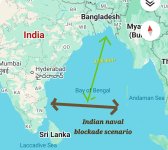
Once these are addressed, we can worry about maritime strike capabilities. I had presented the below analysis in the old forum - India can utilise it's military bases in South India and Andaman-Nicobar Islands to easily enforce a naval blockade against Bangladesh. The distance of this blockade would be 1200km+. Any attempt by BAF fighters and refuellers to engage the naval blockade can be thwarted by IAF and Indian Naval Air arm.
The only effective way to overcome such a blockade would be to deploy a combination of diesel-electric and nuclear submarines.
On the other hand, any coastal invasion can be prevented using a combination of frigates, destroyers, fast attack craft, multirole fighters supported by refuellers and coast-based cruise missiles.
All the above is to say that procuring dedicated maritime strike aircraft is an out-and-out luxury for Bangladesh that we cannot afford.
@LeonBlack08 @Arthur @AbuShalehRumi @Afif @Michael Corleone - thoughts?
View attachment 154777


