Banking Sector / Federal Board of Revenue

The recent State Bank of Pakistan (SBP) revisions to the Housing Finance Prudential Regulations (Circular No. 04 of 2026) are designed to make homeownership significantly more accessible. By relaxing income constraints, lowering upfront costs, and speeding up the approval process, the central bank is making it much easier for both salaried and non-salaried individuals to secure mortgages.

Here is a direct comparison of the new parameters against the previous standard regulations:

Feature / MetricPrevious SBP RegulationsNew Rule (Circular 04 of 2026)What This Means For You
Debt Burden Ratio (DBR)Max 50% of net disposable incomeUp to 65% of net disposable incomeLarger loan limits: You can dedicate a higher percentage of your monthly income to mortgage payments, qualifying you for a bigger loan on the same salary.
Loan-to-Value (LTV) RatioMaximum 85:15Up to 90:10Lower down payment: You now only need to provide 10% of the property's value upfront out of pocket, instead of 15%.
Maximum TenorUp to 25 yearsUp to 30 yearsLower monthly installments: Spreading the loan over an additional 5 years reduces the monthly payment burden, though you will pay more total interest over the life of the loan.
Turnaround TimeStandard banking timelines (often taking 30–45+ days)Target of 15 working daysFaster approvals: A streamlined timeline allows you to close on a property faster without losing out to cash buyers.
Property ValuationTraditional, strict multi-step assessmentStreamlined assessment and valuation processLess red tape: Reduces administrative delays during the property clearance phase.
Documentation & EquityRigid standard banking documentation and equity proofEnhanced flexibility & borrower-friendly docsEasier processing: Particularly helpful for business owners or non-salaried individuals who may have non-traditional ways of proving income or equity.
 
1787226460575.png

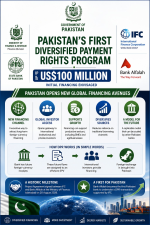
What is a Diversified Payment Rights (DPR) Programme?​

A Diversified Payment Rights (DPR) Programme is an innovative, structured financial mechanism that allows entities in emerging markets (such as Bank Alfalah) to secure long-term foreign-currency financing from international capital markets.

It works by leveraging future predictable cross-border payment flows—such as worker remittances, export receipts, or international card settlements—as a secure backing for foreign loans or bonds. Because these cash flows are generated outside the home country, it significantly lowers the perceived risk for international lenders.

How It Will Help Pakistan​

This landmark initiative between the International Finance Corporation (IFC) and Bank Alfalah brings several structural advantages to Pakistan's economy:

  • Mobilizes Foreign Capital: The initial framework unlocks up to US$100 million in foreign-currency financing, with the potential to attract broader international private capital.
  • Diversifies Funding Sources: It reduces the economy's reliance on traditional sovereign borrowing by opening a market-driven channel for private sector banks.
  • Supports Productive Investment: The incoming foreign exchange is channeled directly toward eligible corporate and commercial foreign currency requirements, backing sustainable economic growth.
  • Sets a Market Precedent: By successfully establishing this initial framework, it creates a viable blueprint that other financial institutions in the country can replicate, deepening Pakistan’s broader debt capital markets.
 

SBP mulls ending Rs10 note on rising costs

Mubarak Zeb Khan
August 26, 2026

1787838254839.png

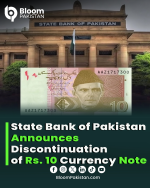
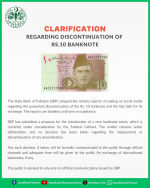
ISLAMABAD: The State Bank of Pakistan (SBP) is considering phasing out the Rs10 banknote due to rising printing costs, while a new design for the Rs5,000 note is being prepared to curb counterfeiting.

The disclosure came from Deputy Governor Dr Inayat Hussain, who briefed the Senate Standing Committee on Finance and Revenue.

He said the redesigned Rs5,000 note would help reduce the circulation of counterfeit currency.

The committee meeting, chaired by Senator Saleem Mandviwalla, also discussed currency security, the Pakistan Remittance Initiative, protection of foreign investments and complaints about fraudulent practices by companies.
 
Last edited:
SBP Plans new Rs5,000 note to curb counterfeiting

Dr Hussain said denomination changes could follow the introduction of new currency notes.

On counterfeit currency, Senator Mandviwalla told the deputy governor that he had submitted Rs5,000 notes to the SBP for verification nearly two years ago, but the bank’s response was still awaited.

Responding to the query, Dr Hussain said the existing Rs5,000 note was introduced in 2005 and advances in technology had made counterfeiting easier.

He said a tender had been floated under procurement rules for designing the new note.

“Four bidders participated in the process and the contract was awarded to a consultant firm, which is currently incorporating the required changes,” he said, adding that the design would subsequently require federal government approval.

Senator Mandviwalla directed the SBP to provide complete details of the bidding process for the redesigned Rs5,000 note, expressing concern over the circulation of counterfeit currency.

Dr Hussain informed the committee that it could take about a year to introduce the new notes into circulation. He added that printing a Rs5,000 note cost around Rs14.

During the meeting, Senator Anusha Rahman stressed the need to streamline the approval process for currency designs, warning against repeated referrals for minor amendments that caused unnecessary delays.

Earlier this year, the committee was told that new-design banknotes with enhanced security features had been finalised by the SBP and forwarded to the federal cabinet for approval.
 

ADB projects Pakistan's FY2027 growth at 3.7%, inflation at 8.3%​


Says govt consumption increased by 11.2%, while real exports rose 5.9% and real imports fell 6.8%

Web Desk
September 23, 2026

asian development bank adb photo reuters


Asian Development Bank ADB

Pakistan’s economic growth was projected to remain at 3.7 per cent in fiscal year 2027 while inflation was expected to rise to 8.3 per cent, the Asian Development Bank (ADB) said on Wednesday, warning that higher energy and import costs and prolonged geopolitical tensions could weigh on the outlook.

In its Asian Development Outlook (ADO) September 2026 edition, the flagship biannual publication – the bank retained its growth forecast for Pakistan at 3.7 per cent for FY2027, while projecting inflation above the State Bank of Pakistan’s medium-term target range of 5-7 per cent.

The bank said Pakistan’s economy had expanded by 3.7 per cent in FY2026, which ended on June 30, up from 3.2 per cent a year earlier, with the recovery supported by improving credit conditions and broad-based growth.

“Growth strengthened in fiscal year (FY) 2026, although the Middle East conflict curbed activity in the last quarter,” the ADB said.
 

Users who are viewing this thread

Pakistan Defence Latest

Country Watch Latest

Back
Top