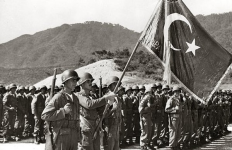
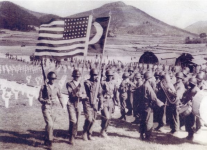
Battle of Kunu-ri 1950: The 5,000 Turks Sent Into the Hole Where a Corps Vanished

The Battles of Kunuri and Wawon in 3 days


Turkish Brigade : 767 loses (218 martyrs, 455 wounded, 94 missing)

Chinese Forces : over 3.000 loses


Because the Chinese Army was so numerous, the Turkish Brigade withdrew after successfully completing its mission.


----------------------------------------------------------------------

The Battle of Kumyangjang-ni, which took place in January 1951 , a few months after Kunuri was where the Turkish Brigade dealt its most significant blow to the Chinese forces. In that battle, Turkish soldiers suffered only 12 fatalities while neutralizing 474 Chinese troops through bayonet charges.

 
Last edited:
My Uncle was a veteran who fought in the Korean War, when they ran out of ammunition, Turkish soldiers fixed bayonets and launched an attack against the numerically superior Chinese Army


My Uncle was a very short-tempered, crazy and fearless man, and he spoke very little

May ALLAH have mercy on him
 
5,455 Turkish Soldiers ( Turkish Brigade ) saved the US Army 2nd Infatry Division ( 17.000 Soldiers ) from 100.000+ Chinese Forces during the Battles of Kunuri and Wawon in 1950


This is a historic turning point, as the extraordinary resistance displayed by the Turkish Brigade enabled the American 2nd Infantry Division and the U.S. 8th Army to break out of a Chinese encirclement and avoid total destruction.

The Turkish Brigade, codenamed North Star
1794246445745.png
 
American-Turkish Forces fought against the Chinese Forces


Turkish American who served as a United States Marine combat veteran in the Korean War of 1950-53. His Marine division fought alongside Turkish soldiers.
1794247408131.png

General Douglas MacArthur called the Turks “the bravest of the brave.”

------------------------------------------------------------------

In the Korean War, 22 countries participated in the United Nations coalition that defended South Korea from communism

Although the Turks were 4th in number of casualties.

Total of 14,936 Turkish troops served in the Korean War
 
K1: The Genetic Basis of East Asians and the Chinese

K2b: The Genetic Basis of Central Asians, Turks, and Western Eurasians


The Turks and Han Chinese are relatives

Approximately 45,000 years ago, the K1 branch descending from a common paternal ancestor migrated toward East Asia, forming the primary genetic backbone (haplogroup O) of modern Chinese and East Asian populations. Meanwhile, the K2b branch moved toward the steppes of Central Asia and Siberia, giving rise to the ancestral lineages (haplogroups Q and R) of Turkic peoples, Central Asian populations, and Europeans.

In other words, on the genetic tree, the distant ancestors of the Turks and the Chinese are like two full siblings who followed parallel paths.
 

Users who are viewing this thread

Back
Top