Follow along with the video below to see how to install our site as a web app on your home screen.
Note: This feature may not be available in some browsers.
There is no such thing as "String of Pearls" strategy around India's neck., but dreamed up by Indians, at least in the military sense. All those ports China is developing around the Indian ocean perimeter are for commercial purposes, there are no Chinese military bases there. It's unwise for Indonesia to get in bed with India esp militarily to block China's access to the strait of Malacca. But, one never know someone else's thinking, Indonesia has been very unfriendly with China on nickel processing and supplying chain lately, Chinese companies are withdrawing from the country. If India has other Idea of trying to block or choke China's energy and trade lines along the sea and ocean routes, China might strike India somewhere unexpected, not just confining to the routes.This is overwhelmingly aimed at China.
While both India and Indonesia publicly frame the project in terms of regional connectivity, economic growth, and maritime safety, geopolitical analysts universally agree that the primary objective is to counter Beijing's expanding military and economic footprint in the Indo-Pacific.
Here is why China is the central focus of this dual-port strategy:
Exploiting the "Malacca Dilemma"
The term "Malacca Dilemma" was coined by former Chinese President Hu Jintao to describe Beijing’s extreme vulnerability regarding the Strait of Malacca.
The Vulnerability: Approximately 80% of China’s oil imports and a massive share of its container trade pass through this narrow chokepoint.
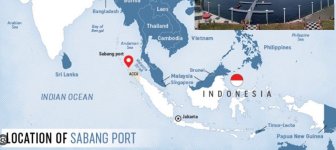
The Countermove: By positioning deep-water infrastructure at Sabang (Indonesia) and the Great Nicobar port (India), the two nations sit precisely at the western throat of the strait. In a geopolitical crisis or conflict, this gives India and its partners a significant strategic advantage—the capability to monitor, track, or even establish a naval blockade on Chinese energy supplies.
Pushing Back Against the "String of Pearls"
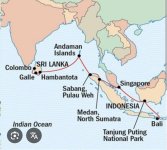
For years, China has been constructing a network of military and commercial facilities around India’s maritime perimeter—often referred to as the "String of Pearls." This includes significant investments in ports like Gwadar in Pakistan, Hambantota in Sri Lanka, and facilities in Myanmar and Djibouti.
The joint development of Sabang, coupled with India's own massive military-logistical hub at Galathea Bay (Great Nicobar), acts as a direct counter-encirclement. It signals that India and key ASEAN nations can project power right at the gateway where the Chinese People's Liberation Army Navy (PLAN) enters the Indian Ocean.
There is no such thing as "String of Pearls" strategy around India's neck., but dreamed up by Indians, at least in the military sense. All those ports China is developing around the Indian ocean perimeter are for commercial purposes, there are no Chinese military bases there. It's unwise for Indonesia to get in bed with India esp militarily to block China's access to the strait of Malacca. But, one never know someone else's thinking, Indonesia has been very unfriendly with China on nickel processing and supplying chain lately, Chinese companies are withdrawing from the country. If India has other Idea of trying to block or choke China's energy and trade lines along the sea and ocean routes, China might strike India somewhere unexpected, not just confining to the routes.
Yeah, the West insidiously pits India against China. The US wants India to be America's hitman against China's in the Indo-Pacific region. And Indians are more than happy to fill that glorious role of greater one containing or stopping China, lol.India is living under the delusion that it either matches or exceeds China. Western nations, and particularly the Americans, are the ones who embedded this idea in Indian minds. For decades, the Western bloc has been promoting India as the opposite pole to China. The architects of this Indian insanity are the Western nations. Of course, India doesn't and cannot match China. That doesn't take away the fact that China is taking countermeasures as it should be.
We use essential cookies to make this site work, and optional cookies to enhance your experience.