BRIN Pushes for Space Self-Reliance, Targets Faster Launch of National Rockets

Indos

INT'L MOD
Joined
Jul 25, 2013
Messages
31,810
Reaction score
26,237
Reputation
3,222.6
Country of Origin
Country of Residence

BRIN Pushes for Space Self-Reliance, Targets Faster Launch of National Rockets​


Indoraya Editorial Team

To view this content we will need your consent to set third party cookies.
For more detailed information, see our cookies page.


INDORAYA
— Indonesia’s National Research and Innovation Agency (BRIN) is accelerating the development of national space technology by optimizing the Biak Spaceport as Indonesia’s central hub for rocket and satellite launches.

BRIN Chairman Arif Satria emphasized that Indonesia’s long-standing target of achieving space self-reliance by 2040 could realistically be accelerated.

“If it can be achieved before 2040, why not sooner? The key lies in focus, time allocation, and productivity,” Arif said.

The statement was delivered during Arif’s working visit to the M. Ibnoe Subroto Science Area in Rancabungur on Wednesday (December 31). The visit addressed the readiness of space research facilities, preparations for the launch of Satellite A4, and the development of spaceport infrastructure as a foundation for national technological sovereignty.

1767619730578.png
Head of BRIN, Arif Satria. (Photo: BRIN Document)


Rika Andiarti
, Principal Research Engineer at BRIN’s Rocket Technology Research Center, explained that the development of a national spaceport is already included in Indonesia’s National Space Master Plan (Renduk) 2017–2040.

“The master plan is reviewed every five years. In the current context, several targets and strategies need to be redefined to become more adaptive and realistic,” she said on Wednesday (December 31), as quoted from BRIN’s official website.

Rika noted that Indonesia is targeted to be capable of independently launching satellites and rockets from its own territory by 2040. However, BRIN believes that acceleration is necessary to prevent Indonesia from falling behind global developments.

Beyond infrastructure development, Arif stressed the importance of governance and cross-agency coordination.

“We must not become trapped in overlapping authorities. What is needed is an integrated system,” he said.

Arif added that the effectiveness of space-related functions is more important than institutional structures.

“The priority is ensuring that space functions operate in an integrated and sustainable manner,” he explained.

He also encouraged researchers to improve research quality and take advantage of international funding opportunities.

“No country has succeeded in space exploration through half-hearted efforts. Success is a function of how time is utilized,” Arif stated.

BRIN reaffirmed that funding support and research incentives will continue to be strengthened to support the development of strategic national technologies.

 
Source:
Not Applicable

BRIN Targets Two-Stage Rocket Flight Test in 2029​


20/8/2026

To view this content we will need your consent to set third party cookies.
For more detailed information, see our cookies page.


Indonesia’s National Research and Innovation Agency (BRIN) is targeting a flight test of a two-stage rocket in 2029, with several key technologies — including the RX 450 rocket motor, separation system, control system and telemetry — being developed in stages to achieve the target.

Head of BRIN’s Rocket Technology Research Center (PRTR) Arif Nur Hakim said development of the two-stage rocket is being supported through the Strategic Invitational Research Program (PRIS). The program allows researchers to carry out research stages according to the established development roadmap.

“The presence of PRIS has been very helpful and has made our researchers even more enthusiastic about conducting their research. This support also provides researchers with greater room to focus on achieving key technologies,” Arif said in an official statement on Thursday (Aug. 20).

One of the technologies under development is the RX 450 rocket motor, which has a range of 100 kilometers. In 2026, BRIN aims to complete the overall design of the two-stage rocket as well as the design of its separation system.

The next stage in 2027 will include a Critical Design Review (CDR) of the two-stage rocket, static testing of a high-performance rocket motor, and a flight test of the separation system.

In 2028, BRIN plans to conduct separate flight tests of the rocket’s first and second stages. These tests will serve as a precursor to the flight test of the complete two-stage rocket in 2029.

Arif said adjustments to the development roadmap are being made based on evaluations of progress and the level of technological mastery achieved. This is intended to ensure that each stage is properly mastered before development proceeds to the next phase.

“The roadmap was developed based on assumptions and the level of technological mastery at the time. Following our evaluation, we need to ensure that each stage can be properly mastered, particularly to support the achievements and obtain the data required,” he said.

BRIN Accelerates Spaceport Development​

Alongside its rocket program, BRIN is also accelerating the development of an Indonesian spaceport. The agency is working with two strategic investor partners, with each focusing respectively on the large-rocket and small-rocket segments.

Consolidation of agreements between BRIN and the partners is still underway. BRIN aims to complete the spaceport’s basic design in 2026, followed by land fencing and construction of basic facilities in the following year.

Arif stressed that developing the spaceport requires careful cross-country consolidation, including resolving regulatory matters and cooperation agreements with partner countries.

Development of the two-stage rocket and spaceport forms part of BRIN’s efforts to strengthen Indonesia’s technological self-reliance in the space sector.


Indonesia's BRIN to Launch NEO-1 Satellite in January 2027​


July 9, 2026 | 11:05 am

1787405977971.png

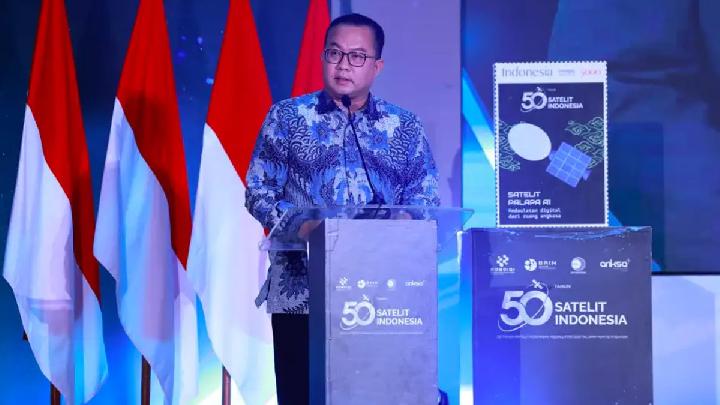
TEMPO.CO, Jakarta – The Indonesian National Research and Innovation Agency (BRIN) targets the launch of the Nusantara Earth Observation-1 (NEO-1) satellite in January 2027. BRIN Head Arif Satria stated that all NEO-1 assets are prepared relying on indigenous innovations, starting from mission design, system design, software testing, satellite operations, to ground station support.

The earth observation satellite is projected to become the first satellite developed through comprehensive national satellite technology mastery (end-to-end). The development of NEO-1, according to Arif, is part of the national strategy to build Indonesia's capability in mastering the entire satellite technology chain.

"The launch of NEO 1 will be an important milestone indicating that Indonesia is increasingly capable of mastering the entire satellite technology chain," said Arif in commemoration of 50 Years of Indonesian Satellites, quoted from a written statement on Wednesday, July 8, 2026.

According to Arif, NEO-1 is designed to provide national satellite image data that can be utilized for regional mapping, agricultural monitoring, forestry, marine monitoring, disaster mitigation, environmental monitoring, and ship activity monitoring through the Automatic Identification System (AIS). The presence of the satellite is expected to strengthen Indonesia's self-reliance in mastering satellite technology and remote sensing data.

He stated that Indonesia's vision does not stop at the development of earth observation satellites. Mastery of satellite telecommunications technology, the construction of a National Spaceport, and the development of the space industry also form part of the effort to build an aerospace ecosystem that can create added economic value while reducing dependence on foreign technology.

"We are laying the groundwork for Indonesia to not only be a user of space technology, but to become a technology producer, service provider, and a key player in the global space economy," he said.

Arif added that Indonesia has a strategic advantage being located in the equatorial region, allowing satellite launches to be carried out more efficiently. This geographical advantage, he said, needs to be optimized through strengthening research, innovation, human resources, and stakeholder collaboration to become a technological, economic, and geopolitical advantage.

Director General of Digital Infrastructure at the Ministry of Communication and Information Technology Wayan Toni Supriyanto stated that satellites are a strategic infrastructure connecting remote and underdeveloped regions, supporting education, health, disaster management, and national defense services.

"Satellite connectivity is not just a technical matter, but a matter of sovereignty. Whoever controls their own satellite infrastructure, controls the future of national information and communication resilience," he said.


Users who are viewing this thread

Pakistan Defence Latest

Back
Top