Pentagon Confirms China Supplied J-10C To Pakistan: How The Fighter Jets Are Changing South Asia’s Air Power Post Op Sindoor
A US defence report has confirmed long-suspected J-10C fighter deliveries to Pakistan, showing how Chinese aircraft and PL-15 missiles are changing South Asia’s air combat balance after Operation Sindoor.
By:
Tarique Anwar|Last Updated: Jan 13, 2026, 03:21 AM IST
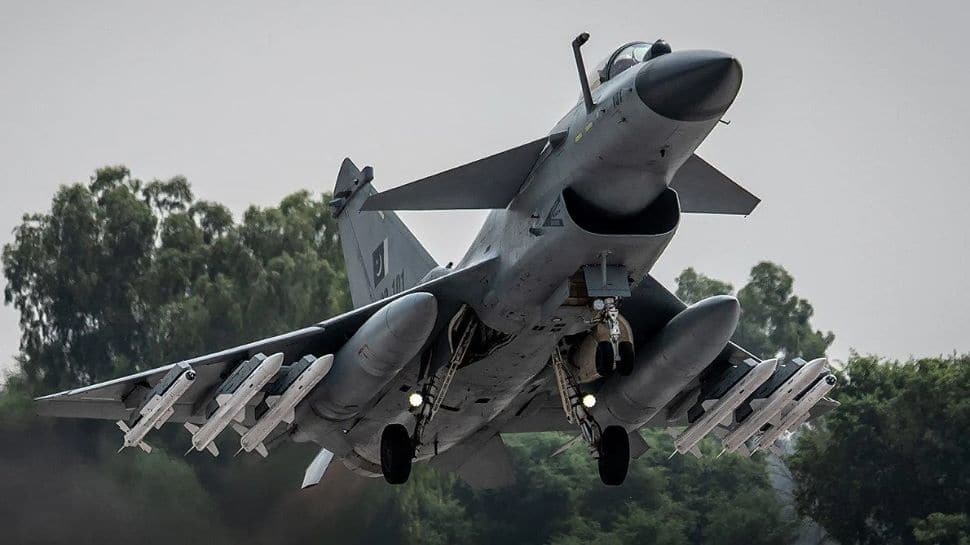
Pakistan Air Force J-10C fighter jet. (Photo: PAF)
New Delhi: The United States Department of Defense has officially confirmed that China supplied Pakistan with 36 Chengdu J-10C multirole fighter jets since 2020. The disclosure puts precise numbers on what had long circulated as informed speculation across military and security circles in South Asia.
The revelation was made by the Pentagon’s 2025 China Military Power Report, a congressionally mandated assessment submitted in December 2025. It has come at a time when regional air power equations are under scrutiny following the May 2025 India-Pakistan aerial confrontations, which were codenamed as Operation Sindoor.
The report states that by May 2025, Beijing had already delivered 20 J-10C aircraft to Islamabad under two separate orders placed since 2020. The remaining jets are scheduled for completion and delivery by early 2026. This effectively completes Pakistan’s first full J-10C fleet and establishes Islamabad as the only export operator of the aircraft anywhere in the world.
By formally acknowledging these transfers, the Pentagon has validated years of intelligence assessments and highlighted how Beijing’s defence exports have evolved into a strategic tool with direct geopolitical consequences. In South Asia, where air combat revolves around long-range missiles, sensor fusion and rapid engagement timelines, the arrival of the J-10C paired with the PL-15 beyond-visual-range missile has altered operational calculations along the Line of Control (LoC).
The report situates this development within the broader context of Operation Sindoor, during which Pakistan claimed that J-10C fighters armed with PL-15 missiles engaged Indian Air Force Rafale jets at extreme ranges. Regardless of competing narratives, these claims placed the Chinese platform under an international spotlight and led to fresh assessments across air forces from West Asia to Southeast Asia.
The Pentagon’s analysis also places the J-10C programme within China’s rise as the world’s fourth-largest arms exporter. It says that Beijing is increasingly offering aircraft that combine advanced avionics and long-range weapons at prices well below those of Western fighters, while avoiding the political conditions and export restrictions that often accompany US and European systems.
China’s decision to supply the J-10C only to Pakistan shows a deliberate approach in which Islamabad serves multiple roles at once. Pakistan serves as a close strategic partner and operates Chinese combat aviation technology in a high-risk environment. It also acts as a real-world demonstration platform, showing the capabilities of these aircraft under contested conditions.
The pairing of the J-10C with the PL-15 missile extends Pakistan’s engagement reach and compresses response times for opposing forces. This change reduces traditional warning margins and raises escalation risks in a region already prone to rapid military decision-making under pressure.
From an industrial standpoint, the Pentagon’s disclosure shows how China has moved beyond ad-hoc arms sales toward a more structured export model. That model relies on domestic supply chains, competitive pricing and platforms that have now entered real operational use rather than remaining purely theoretical offerings.
Taken together, the confirmed deliveries, the aircraft’s reported use during Operation Sindoor and the attention they have generated internationally point to a moment where Chinese fighter aircraft are being judged less on promise and more on perceived battlefield relevance.
Pakistan’s Role As The J-10C’s Primary Operator
Pakistan’s emergence as the sole operator of the J-10C shows a change in its air force doctrine. For the first time, the Pakistan Air Force (PAF) has fielded a fourth-generation-plus fighter designed around long-range and network-centric combat rather than traditional close-range engagements.
Developed by the Chengdu Aircraft Corporation, the J-10C is a single-engine delta-canard fighter equipped with an Active Electronically Scanned Array (AESA) radar, integrated electronic warfare systems and modern datalinks. The export version flown by Pakistan, designated J-10CE, uses the WS-10 Taihang turbofan engine, reducing reliance on Russian powerplants and improving overall fleet sustainability.
Pakistan’s decision to place orders for the aircraft in 2020 coincided with rising tensions with India after the Balakot crisis and India’s induction of the Rafale. The acquisition was aimed at narrowing qualitative gaps rather than competing on fleet size.
The first J-10C aircraft arrived in Pakistan in March 2022. Deliveries accelerated after 2023, and by mid-2025, the PAF had activated at least two frontline squadrons, positioning them across important sectors covering Punjab, Kashmir and approaches from the Arabian Sea.
The Pentagon’s report states that Pakistan has become the main recipient of Chinese combat aircraft and the only country operating the J-10C. This highlights Islamabad’s role as more than just a customer. It emphasises Pakistan’s position as an operational proving ground for China’s most advanced export-grade fighter.
Cost has also played a role in the platform’s appeal. The J-10C is widely assessed to cost between $40-50 million per unit, while India’s Rafale acquisitions have been valued at roughly $120 million per aircraft once weapons, support and lifecycle expenses are included.
Pakistan’s air leadership has described the J-10C as a strategic equaliser that bridges older fleets and future ambitions while supporting deterrence objectives focussed on maintaining parity rather than superiority. The programme has also strengthened wider Sino-Pakistani defence cooperation, complementing joint work on the JF-17 Thunder, unmanned systems and shared training plans.
J-10C Fighter Profile In Operational Terms
In its export J-10CE configuration, the Chengdu J-10C is a single-seat multirole combat aircraft designed for air superiority and precision strike missions. It measures roughly 15.7 metres in length, with a wingspan close to 9.75 metres and a height of about 4.78 metres. The aircraft has an empty weight of around 9,750 kilograms and a maximum take-off weight near 19,000 kilograms.
Using a WS-10 Taihang turbofan engine, the fighter is estimated to generate about 86 kilonewtons of thrust in dry mode and up to 113 kilonewtons with afterburner. It is capable of speeds exceeding Mach 2, with a combat radius of approximately 1,150 kilometres depending on mission profile and a ferry range of around 3,100 kilometres.
The aircraft operates at altitudes above 18,000 metres and features a high rate of climb estimated at roughly 254 metres per second. Its avionics suite centres on the KLJ-7A AESA radar, supported by an integrated digital datalink and internal electronic countermeasure systems.
The J-10C carries up to 11 hardpoints, supporting a payload of around 6,000 to 7,000 kilograms. Its air-to-air arsenal includes short-range infrared-guided missiles such as the PL-10 and the PL-15 active radar-guided missile for beyond-visual-range engagements. The aircraft also supports precision-guided bombs, anti-ship weapons and laser-guided munitions, along with an internal 23-millimetre cannon for close-range combat.
Defensive features include radar warning receivers, missile approach warning systems and chaff and flare dispensers, all managed through a digital fly-by-wire flight control system. The export configuration flown by Pakistan includes avionics and electronic warfare adjustments aligned with customer agreements.
The Pentagon confirmed that completing Pakistan’s J-10C fleet is more than a normal arms delivery. It shows a new way air power is being developed, sold and used in South Asia, with effects reaching far beyond the region.
A US defence report has confirmed long-suspected J-10C fighter deliveries to Pakistan, showing how Chinese aircraft and PL-15 missiles are changing South Asia’s air combat balance after Operation Sindoor.

zeenews.india.com


)




 agreed. Poor Rafale getting all the bad name. Nevertheless more orders coming from IAF so France will never mind about their downing of the jets.


