China Auto Thread


Seres acquires the Aito name from Huawei, gaining control in a surprise deal​


Reading Time: 2 minutes

Mark Andrews

July 3, 2024


0


News like this to your inbox or phone?​


Weekly summary to your inbox
I want this

Never miss and important news
Get Instant notification once the news is published.
Follow Us

Seres late yesterday announced it was spending 2.5 billion yuan (344 million USD) to buy the Aito trademark and patents from Huawei. Aito to date has been the most successful of Huawei’s various collaborations with automakers which are done on the basis of three different business models.

The most basic of the three models is where Huawei simply provides parts such as Lidar, electric motors, etc. Then there is Huawei Inside where Huawei provides an intelligent cockpit and intelligent driving solution but is not involved in the design, production or sales of vehicles. Aito though is part of the most involved HIMA (Harmony Intelligent Mobility Alliance) level where Huawei is also involved with other elements including the design, production, sales, after-sales and other stages of the vehicle but stops short of actually producing the car.
Aito was the first brand under the HIMA model, and was established in 2021. The deal announced yesterday covers 919 registered or pending trademark rights and 44 appearance patents held by Huawei.

Despite these assets being valued at 10.2 billion yuan in May 2024 the deal seems to simply concentrate on the changing ownership of them and not any change in the operations of Aito. It should also be noted that Huawei in May transferred the Stelato trademark to BAIC New Energy and last month the Luxeed name to Chery.
Aito however has been by far the most successful of the brands under HIMA and in June delivered 46,141 vehicles. Strangely in June the more expensive the model was the better the sales for Aito with the M9 selling 17,241, the M7 18,493 units but just 7,046 for the M5, the smallest and cheapest model.
Both Seres and Huawei have emphasized that it is business as normal and that there is no fundamental change in the operations of the brand. Huawei has been at pains since the establishment of HIMA to communicate that it does not make cars. There is some speculation that this is partly due to a desire to take these brands into international markets.

Source: Fast Technology
 

Xpeng Mona M03 unveiled in China with 620 km range and BYD battery​


Reading Time: 4 minutes

Mark Andrews

July 3, 2024


0


News like this to your inbox or phone?​


Weekly summary to your inbox
I want this

Never miss and important news
Get Instant notification once the news is published.
Follow Us

Today Xpeng unveiled the Mona M03 or at least the exterior of it. As we predicted the range is now being reported as 620 km which is far more in keeping with the claim of having the lowest drag coefficient among the world’s mass-produced fully electric hatchbacks at Cd 0.194.

At the launch, we learned that the M03 name gives homage to the Tesla Model 3 which has been the benchmark of EVs for the last six years. He Xiaopeng, Xpeng’s CEO, however when explaining the name said that MONA means Made of New AI (as on the M03 teaser poster), and that the last decade was of new energy but the next decade would be of AI.
He Xiaopeng introducing the Xpeng Mona M03
Mona is not a new brand but a new series under Xpeng and it still carries the Xpeng logo. The M03 is a compact pure electric car measuring in at 4780, 1896, and 1445 mm (l/w/h) and with a wheelbase of 2815 mm. As previously we learned the trunk space is 621 liters and today Xpeng emphasized that this was comparable to a mid-size SUV. Furthermore, the electric hatch opening is standard across the range and the opening angle can be set by users.

Joining He Xiaopeng on stage was JuanMa Lopez, Xpeng’s Vice President of the Styling Design Center. However, seeing as he only joined Xpeng last month it is highly unlikely he had much input into the Mona M03. Chinese media are keen to emphasize he was Head of Exterior Design at Ferrari. His career, though, spans 24 years and many brands, most recently since 2018 BYD and 2020 Changan. Unusually for a designer, he has worked on both interior and exterior designs.
JuanMa Lopez, Xpeng’s Vice President of the Styling Design
Lopez described the Mona M03 as a “a very beautiful car for young people.” The car adopts the “Smart Design AI quantitative aesthetics” design language. Xpeng call the light design 010. The spilt three-dimensional design is very recognizable and the has 300 LED lamp beads that can illuminate out to 150 meters.
As we have previously reported Xpeng paid particular attention to reducing drag on the car. To do so the Mona M03 underwent 10 wind tunnel tests of more than 100 hours each. During these, 15 key areas were optimized which shaved off Cd 0.085 from the wind resistance leading to a claimed 60 km range boost.

The biggest reduction comes from the standard active air intake (AGS) which Xpeng claims is a first for a production model. At nearly 1-meter long the system alone accounts for 0.023 Cd drag reduction and a 15.6 km increase in range.
Today’s unveil only showed the exterior. Fast Technology report that the Xpeng Mona M03 only has a large floating central infotainment unit and no instrument panel, a two-spoke steering wheel, and the option of a rear entertainment screen.
The car will come XNGP driving assistance and there will also be voice control for the functions of the car.
Few details beyond what we already knew were given for the powertrain and performance. There’s a choice of a 140 or 160 kW electric motor. Top speed is 155 km/h and it uses BYD blade lithium iron phosphate batteries. A 515 and a 620 km range version will be offered.
Mona M03 will be priced under 200,000 yuan (27,400 USD), according to Xpeng. The final price will be announced in August when the car will have an official launch. Xpeng also confirmed that Mona M03 will not have a taxi version.

Editor’s note:​

Xpeng’s Mona M03 seems to be the car that keeps on surprising in both good ways and bad. First, it was the low drag coefficient figure, then that it wasn’t unveiled when we expected in June. Next up was that the car was actually a hatchback with 621 liters trunk space. Today the surprise was that Xpeng only unveiled the exterior. Also today’s unveiling gave us very little in the way of information that we didn’t already know, except the ranges. While we know there are five colors for buyers to choose from we’ve still only seen two of them!
Sources: Autohome, Fast Technology
 

Jiyue 07 EV from Geely reached dealers as brand’s sales continue to disappoint​


Reading Time: 4 minutes

Denis Bobylev

July 3, 2024


0
jiyue 07 from geely baidu reached dealersJiyue 07 liftback reached dealers in China

News like this to your inbox or phone?​


Weekly summary to your inbox
I want this

Never miss and important news
Get Instant notification once the news is published.
Follow Us

The Jiyue 07 electric liftback from the joint venture between Geely and Baidu reached dealerships in China. It is the brand’s second model, aimed to improve Jiyue’s poor sales performance. The 07 liftback will make its market debut soon.

Jiyue’s bumpy ride in China​

Jiyue was initially established in 2021 as Jidu, a joint venture between Baidu and Geely, with “Chinese Google” holding the major stake. However, Jidu failed to obtain the sales license and was restructured to become Jiyue. Under the new name, Geely grabbed 65% of the JV, with Baidu holding the rest. In this JV, Geely takes care of manufacturing, while Baidu is responsible for the software.
Jiyue 01 SUV
The first Jiyue car modestly called Jiyue 01 (see specs) entered the domestic market in October 2023 with a starting price of 249,900 yuan (34,350 USD). Later, its price was sliced y 30,000 yuan (4,100 USD). It is an SUV based on Geely’s SEA modular architecture. The Jiyue 01 is being assembled at the same plant as the Zeekr 001 liftback. However, Jiyue’s sales volume is disappointing. From January to May 2024, the Geely&Baidu JV sold just 2,239 units.

So, Jiyue currently almost seems like a pointless brand. However, it hopes to improve its sales performance by launching its second model, the Jiyue 07 liftback. It successfully obtained a sales license in May. And now, a batch of Jiyue 07 has reached dealers in China.

Jiyue 07 arrived at dealers​

This week, Jiyue 07 liftbacks were spotted piling up at dealerships across China. Thanks to the photos, we can check the boy color options of this vehicle. The Jiyue 07 will be available in Gray, Blue, Black, White and Green colors.
The exterior of the 07 liftback stays in line with the variant shown by the Governmental regulator. It follows the design language of the Jiyue 01 SUV. The front end of the 07 adopts an LED strip that crosses the front end and two Y-shaped headlights. It also has a trapeze-shaped air intake in the front bumper. From the side, the Jiyue 07 has a sleek profile with a slanted roof and retractable door handle. The rear end of the actual car adopts an active spoiler and a single taillight unit.

Jiyue 07 interior was previously revealed in spy shots
Inside, the Jiyue 07 adopts a single screen that crosses the dashboard. This car has a steering yoke instead of the steering wheel. Back to the entertainment system of this electric car, it is powered by a Snapdragon 8295 chip from Qualcomm. Another feature of the Jiyue 07 is the Apollo autonomous driving system.

Jiyue 07 specs​

The Jiyue 07 boasts hefty dimensions of 4953/1989/1475 mm with a wheelbase of 3013 mm. Another feature of this liftback is a drag coefficient of 0.198 Cd. This number makes the Jiyue 07 one of the most aerodynamic mass-produced cars, together with Xpeng 03, Geely Galaxy E8, Xiaomi SU7, and Zeekr 007. It is worth noting that Jiyue 07 received the iF Design Award 2023 and was the Red Dot 2023 car design winner.
The Jiyue 07 stands on the SEA platform from Geely. The same architecture and its offshoots underpin every Zeekr-branded car, Smart #1, Smart #3, LEVC L380 minivan, Radar RD6 pickup truck, Geely Galaxy E8, Jiyue 01, etc. Back to the 07 liftback, it offers three powertrain variants:
  • RWD, 200 kW (268 hp), 71.4 kWh LFP battery, 660 km CLTC range
  • RWD, 200 kW (268 hp), 100 kWh ternary NMC battery, 880 km CLTC range
  • 4WD, 400 kW (536 hp), 100 kWh ternary NMC battery, 770 km CLTC range
The Jiyue 07 has already reached dealers. It means its sales will kick off soon. The starting price of this liftback is expected to be around 200,000 yuan (27,500 USD). It is a competitive price. However, Jiyue is a little-known brand in China. As a result, the Jiyue 07 has many competitors with higher credibility among Chinese buyers. It means the sales volume of this liftback won’t be high.
Source: WeChat
 

BYD’s Yangwang U8 convoy hits new 24 km long Shen-Zhong Channel in China​


Reading Time: 3 minutes

Adrian Leung

July 3, 2024


2


News like this to your inbox or phone?​


Weekly summary to your inbox
I want this

Never miss and important news
Get Instant notification once the news is published.
Follow Us

On June 30, the Shen-Zhong Channel (also known as the Shenzhong Link) began operations, a pivotal milestone in China’s Greater Bay Area. After overcoming seven years of technical challenges, it stretches 24 km, linking Shenzhen and Zhongshan (cities in Guangdong Province) with a sea-crossing link that will include a tunnel that ranks among the largest and widest immersed tunnels globally. This will cut the previous 120-minute traveling time to just 30 minutes. Costing approximately 50 billion yuan (6.87 billion USD).

BYD, headquartered in Shenzhen, gathered a convoy of 130 BYD Yangwang U8 (see specs) on the opening day of Shen-Zhong Channel. Over 80% of participants were entrepreneurs, partners, or senior executives, highlighting their role as supporters and peers in China’s manufacturing sector. The U8’s journey on the Shen-Zhong Channel symbolizes China’s resolve to overcome technological barriers in new energy vehicles.
The Yangwang U8, represents BYD’s 20 years of innovation, boasts advanced technologies. The e4 platform with DiSus suspension can execute tank turns and float on water. Its luxurious interior includes leather, a 70″ AR-HUD, and multiple screens, such as a 23.6-inch instrument panel and a 12.8-inch primary monitor.

Powered by a 4WD system with four motors delivering 880 kW (1,180 HP) and 1280 Nm torque, it accelerates from 0 to 100 km/h in 3.6 seconds. Equipped with a 49.05 kWh battery offering a 180 km CLTC range and a combined range of 1000 km, it charges from 30% to 80% in just 5 minutes. With 38 sensors, including lidars, radars, and onboard satellite communication, it ensures connectivity even in remote areas, featuring an optional drone docking station.
The U8, priced at 1,098,000 yuan (151,000 USD) with over 7,000 sales, is China’s most expensive mass-produced car, a testament to the industry’s advancement.
For the Shen-Zhong Channel, construction began with the Western Artificial Island in December 2016 and the Eastern Artificial Island in December 2017. Bridge and tunnel construction followed in subsequent years, achieving milestones like completing the E7 tube section and capping the Zhongshan Bridge tower by 2021. The project culminated in 2024 with the completion of paving, inspections, and the renaming of the Shen-Zhong Bridge.

Over 200,000 vehicles visited the Shen-Zhong Channel in its first two days of operation, underscoring its significance in showcasing China’s development. While, the U8 represents luxury and intelligence, embodying the courage to explore new frontiers.
 

BYD Indonesia delivers the first batch of 1,000 cars​


Reading Time: 2 minutes

Lawrence Ho

July 3, 2024


0


News like this to your inbox or phone?​


Weekly summary to your inbox
I want this

Never miss and important news
Get Instant notification once the news is published.
Follow Us

On July 1, BYD hosted a ceremony to deliver its first 1000 vehicles in Indonesia, with BYD Founder and CEO Wang Chuanfu personally handing over the cars to Indonesian customers. The launch featured the BYD Dolphin, Seal, and Atto 3, models that launched in Indonesia this past January.

At the launch event, Indonesia’s Coordinating Minister for Economic Affairs, Airlangga Hartarto, announced that BYD will invest 1.3 billion USD to build a car factory in Indonesia with a production capacity of 150,000 vehicles.
Eagle Zhao, President of BYD Indonesia, stated that the company plans to begin the construction of these facilities later this year and will establish up to 50 sales outlets nationwide by the end of 2024.

In April, BYD selected “Subang Smart City” as the site for its electric vehicle factory. The industrial park will cover 108 hectares and include a research and development center as well as training facilities with environmental protection technologies.
The Indonesian factory marks BYD’s second major production facility in Southeast Asia, following the already established Thailand facility. The Thailand factory began trial production earlier this spring and will start mass production on July 4, ramping up to eventually building 150,000 cars per year. BYD has also recently started the first batch of mass-produced vehicles at its Uzbekistan factory with an initial production volume of 50,000 cars.

EV market in Indonesia​

Indonesia has been actively courting EV manufacturers with various incentives such as eliminating import tariffs and offering tax-breaks for businesses that invest in local EV factories. BYD has put on hold its plans to build a Vietnam manufacturing plant. Instead, it focuses more on Indonesia and Thailand as its primary Southeast Asia manufacturing hubs. While BYD cars sold in Southeast Asia will initially be imported from China, in the future they will come from Thailand and Indonesia as production ramps up.

Domestically, Indonesia has set a target of 50,000 electric vehicle sales in 2024. The country has recorded 9,178 units in sales of electric vehicles so far in January-May 2024, with BYD occupying around 10% of sales. Data from the Indonesian Automotive Manufacturers Association shows Indonesian electric car sales in 2023 at 17,051 units.
Sources: Yiche
 

New BYD Song Pro DM-i spotted in China with 5-gen DM powertrain​


Reading Time: 3 minutes

Denis Bobylev

July 3, 2024


0
new Byd song pro dm-i coral spy shot camouflageThe updated BYD Song Pro DM-i with the fifth-gen DM powertrain spotted in China (image resolution enhanced by AI)

News like this to your inbox or phone?​


Weekly summary to your inbox
I want this

Never miss and important news
Get Instant notification once the news is published.
Follow Us

The new BYD Song Pro DM-i crossover was seen in China during road tests. It will enter the domestic market in August. According to BYD’s product planning, the updated Song Pro adopts the brand’s fifth-gen DM plug-in hybrid tech. It also can hit the market under Coral’s name.

BYD Song was initially a single model launched in 2015. Over time, it turned into an independent series. Nowadays, it comprises Song Plus DM-i, Song Plus EV, Song L EV, and Song Pro DM-i. Soon, the latter car will get an update as it was spotted in Chinese streets.

New BYD Song Pro DM-i​

The new BYD Song Pro DM-i (resolution enhanced by AI)
The new BYD Song Pro DM-i appeared in the streets wearing heavy camouflage. But we can distinguish this model by a recognizable body shape. The front end of the Song Pro DM-i follows BYD’s latest Dragon Face design language. It comprises two LED headlights joined by an element that represents dragon whiskers. The radiator grille of the spotted crossover looks smaller.

The rear end of the new BYD Song Pro DM-i (resolution enhanced by AI)
The updated Song Pro DM-i adopts real door handles, conventional side-view mirrors, and a sporty roof spoiler. Its rear end adopts a new taillight unit that surprisingly follows the Ocean series cars like the Seal 07 sedan. According to Chinese sources, the interior of the Song Pro DM-i follows the BYD’s signature design with a large floating screen and an updated gear shifter.
Updated Song Pro DM-i (resolution enhanced by AI)
The dimensions of the spotted crossover most likely remained similar to the existing model. The current Song Pro DM-i measures 4738/1860/1710 mm with a wheelbase of 2712 mm. What is more, the updated Song Pro DM-i adopts the fifth-gen DM powertrain technology, similar to the Qin L sedan. It comprises a 1.5-liter self-aspirated petrol engine for 74 kW (99 hp) and 126 Nm. The ICE is paired with an e-motor for 120 kW (161 hp). The mixed range of cars equipped with the fifth-gen DM tech is over 2000 km.

Will the Song Pro DM-i get a new name?​

In February 2024, the BYD’s product planning leaked online. It revealed the company initially scheduled the launch of the updated Song Pro DM-i for July. However, the launch was postponed by 1-2 months. It means the new Song Pro DM-i can enter the domestic market in August-September this year.

BYD product planning
There is a possibility the new can launch under the new name. The new Song Pro was also called “Coral” in the leaked product planning. It means this SUV can move from the Dynasty series into the Ocean series. Previously, BYD did the same to the Song Plus model. However, the spy photos of the updated Song Pro DM-i clearly show it still adopts the Dynasty series’ specific Dragon Face design language.
So, CarNewsChina thinks the Song Pro will retain the original name. However, it can enter overseas markets under the Coral name.
The current BYD Song Pro DM-i
In March 2024, BYD sliced the price of the Song Pro DM-i (see specs) by 15% as the Buffet-backed company wants to rival petrol-powered cars in the domestic market. The current price range of the BYD Song Pro DM-i is 109,800 – 139,800 yuan (15,100 – 19,200 USD). It seems that the new Song Pro DM-i can become even cheaper as BYD continues turning up the heat in the market.
Source: WeChat迪粉之家
 

Chery enforces an 896 culture and the employees are not happy about it​


Reading Time: 2 minutes

Mark Andrews

July 2, 2024


0
Chery iCar 03 EV concept SUV on display at the 2023 Shanghai Auto Show.

News like this to your inbox or phone?​


Weekly summary to your inbox
I want this

Never miss and important news
Get Instant notification once the news is published.
Follow Us

Chinese tech companies have become notorious for their 996 work culture, which Alibaba chairman Jack Ma glorifies. 996 means to work from 9 am until 9 pm each day for six days a week. However, it’s claimed some Chinese car companies are operating an 896 culture with graduate-level employees earning as little as 16 yuan an hour (about 2 USD).

Yiche reported that several employees had recently complained about the enforced working of overtime at Chery for no additional pay. Much of the allegations center around a fresh graduate who joined Chery last year. He said that in May he worked 120 hours of overtime in addition to his normal 174 hours. However, his salary for May was only 4,800 yuan (660 USD) which works out at just over 16 yuan (2 USD) an hour.
Another Chery employee said that in order to force overtime the company regularly scheduled meetings after 6 pm and sometimes even as late as 10 pm. Division-level meetings are held on Saturdays.

Chery has attempted to cover up the fact by simply changing the clock-in history for employees to show their hours as 8.30 to 17.00, despite it being otherwise. This has caused annoyance among many workers. However, some at Chery have made no secret of the company’s view about overtime. Last year the head of Chery’s Automotive Engineering Technology R&D department said “Saturday is a working day for strivers” in an internal email.
Chery Arizzo Star sedan concept showcasing possibly a forthcoming PHEV car on display at the 2023 Shanghai Auto Show.
The email apparently created a lot of internal discussion and Chery responded that the original intention was to learn from the Huawei spirit and let those who wanted, to work hard. Employees however generally felt that it meant Saturday work was expected of them.
Actions by the company back this interpretation up. Overtime hours are used as a way of ranking between departments and can lead to dismissal for workers who do not do overtime. It should be noted that the only compensation offered for overtime is 10 yuan (less than 1.50 USD) for meals. Furthermore, employees report it is very difficult to ask for leave and some departments ban paid leave.

Editor’s note:​

It is difficult to know how much of a problem this is not only within Chery but the Chinese car industry in general. One issue in China is the pervasiveness of WeChat where it is expected that a person can always be contactable and so it is common to be contacted about work related matters late at night.
Interestingly the complaints against Chery seem to relate more to the business and R&D sides rather than the actual production of cars. Back in May we reported on a strike at a BYD plant which was actually about the cancelling of overtime. The factory workers relied on overtime to boost their base salary of 2,490 yuan (345 USD) up to 5,000 to 6,500 yuan (690 to 897 USD). It should also be noted that this blue-collar wage, including overtime, is higher than the amount being earned by starting graduates at Chery.
Source: Yiche
 

July 4 is BYD Day – Thailand factory opening and 8 millionth NEV being produced​


Reading Time: 2 minutes

Mark Andrews

July 2, 2024


0
BYD Han and BYD Atto 3 electric vehicles displayed outside at the BYD brand evening event, part of the IAA Mobility 2023 event in Munich, Germany.

News like this to your inbox or phone?​


Weekly summary to your inbox
I want this

Never miss and important news
Get Instant notification once the news is published.
Follow Us

July 4 will be a dual celebration day for BYD. Firstly the new factory in Thailand will be completed, and secondly, the 8 millionth new energy vehicle will roll off the assembly line. This all comes days after production began at BYD’s Uzbekistan factory.

It took BYD 13 years to get to the first million new energy vehicles in 2021. From 7 to 8 million has taken less than 4 months, the 7 millionth was completed on March 25 this year. It is just under 11 months since BYD produced the 5 millionth which came off the assembly line on August 9, 2023.
It is not clear if car number 8 million will be coming off the Thai assembly line, or whether even production will be commencing there on July 4. The Thai plant is the brand’s first wholly-owned overseas plant, the Uzbek plant is a JV. Construction of the factory commenced in March 2023, and it’s situated in the Eastern Economic Corridor (EEC) special zone in Rayong province. This is the same area as the GAC Aion plant set to open later this month.

BYD Atto 3 electric SUV on display at the BYD stand at IAA Mobility 2023, Munich Germany.
Once production is ramped up the plant will produce 150,000 cars a year. Initially, cars produced will be to meet the needs of the Thai domestic market but will then extend to neighboring ASEAN countries and beyond. ASEAN consists of ten member states: Brunei, Cambodia, Indonesia, Laos, Malaysia, Myanmar, Philippines, Singapore, Vietnam, and Thailand. The factory will likely concentrate on producing right-hand drive models. Completion of the factory comes less than two years after BYD signed a contract in September 2022 with WHA Corporation for land purchase and construction of the plant.
BYD Seal electric sedan on display at the BYD stand at IAA Mobility 2023, Munich Germany.
BYD entered the Thai market in 2022 when it started selling the Atto 3 there. Thailand has a target for 30% of all vehicles produced there to be EVs by 2030. A growing number of Chinese companies have chosen to site factories in the country including Great Wall, SAIC, Neta, and the previously mentioned GAC Aion. BYD is also building car plants in Hungary and Brazil.
Sources: Fast Technology, Just Auto,
 

MG HS 2nd generation PHEV spied ahead of European debut on July 11​


Reading Time: 4 minutes

Mark Andrews

July 2, 2024


0


News like this to your inbox or phone?​


Weekly summary to your inbox
I want this

Never miss and important news
Get Instant notification once the news is published.
Follow Us

MG will officially debut the second generation HS on July 11 at the Goodwood Festival of Speed in the UK. The four-day event in Goodwood, West Sussex, has become a popular event for producers to showcase their latest cars. 2024 marks the centenary for the MG brand which has its origins in the UK. Along with the official teaser pictures which came out yesterday we have got hold of some undisguised spy shots.

It is very clear from the spy shots, as hinted by the teaser shots, just how much the new MG HS is based on the third-generation Roewe RX5 – D5X in PHEV form. Differences seem largely relegated to a new front and back along with traditional door handles. Both the MG and Roewe brands belong to SAIC.
At the front the second generation MG HS has a front similar to the second generation MG 3 supermini. A large grille and air intakes give the HS an aggressive look but the light clusters and hood look to be carried over from the RX5 without change. Seeing as the RX5 has concealed door handles it is quite surprising that the HS resorts to traditional pull handles and this might be a cost cutting exercise. The biggest difference at the rear seems to be the roof-mounted spoiler which is continuous on the HS rather than split on the RX5. In fact, the spoiler might be the same as on the Roewe D5X which also has a continuous spoiler.

An interior spy shot shows that inside the MG HS will be someway between the look of the D5X and the new MG 3. Although the steering wheel and air vents seem to be carried over from the supermini the continuous dual-screen setup is right out of the Roewe D5X and the gear selector is also very similar.
Although there are no dimensions yet for the second generation MG HS they are likely to be very similar to the third-generation Roewe RX5 which measures in at 4655, 1890 and 1664 (l/w/h) which a wheelbase of 2700 mm. It should be noted, though, that the heavily related Roewe D5X comes in at the slightly different 4700, 1890 and 1664 mm (l/w/h) and rides on a wheelbase of 2765 mm. However, given that the first generation HS has a length of 4574 mm and a wheelbase of 2720 mm we can expect the second generation to be a larger car.
Western media and Chinese media seem to be expecting different powertrains which could signify a difference between markets or simply that one of them is wrong! According to Western media at launch there will be a petrol powered version and a PHEV. The most likely petrol engine would be the 15FDE a 1.5T unit as used in the RX5 which provides power of 138 kW (188 hp) and maximum torque of 300 Nm. According to Auto Express, the PHEV version is likely to have an all-electric range of 70 miles. This means that it almost certainly uses SAIC’s fourth-generation DMH system as used by the D5X. It uses a 1.5 liter turbocharged hybrid 15FKE engine which has a maximum power of 110 kW. There is also a front-mounted electric motor with maximum power of 153 kW. As used by the Roewe D5X acceleration time for 0-100 km/h is 6.9 seconds and all-electric range is said to be 135 km CLTC with a combined range of 1,300 km.

Autohome claims a 113 km range for the PHEV version which probably means they just converted the 70 miles being said by British media! The difference between 113 and the 135 km claimed for the D5X is likely down to the latter being CLTC and the former WLTP along with slight differences in weight and aerodynamics. Where things get more interesting is that Autohome claims that the HS uses the same naturally aspirated 1.5 liter engine as the MG 3 with a maximum power of 143 kW and torque of 250 Nm! Car News China believes they are mistaken and have confused the powertrain with the hybrid (HEV) powertrain of the MG 3. It is believed that the HEV powertrain will be coming to the MG HS next year and it will likely be the combination of a 1.5 four-cylinder Atkinson cycle engine with a maximum power of 75kW and a thermal efficiency of up to 41% and a 100 kW electric motor for a combined power of 143 kW.
Sources: Autohome, Dongchedi, Auto Express
 

China EV registrations in W26: Xiaomi 3,200, Nio 6,800, Tesla 14,100, BYD 75,800​


Reading Time: 4 minutes

Jiri Opletal

July 2, 2024


0


News like this to your inbox or phone?​


Weekly summary to your inbox
I want this

Never miss and important news
Get Instant notification once the news is published.
Follow Us

In the last week of June, between June 24 and 30, which is week 26 of the year (W26), China’s EV market slightly slowed down from firm growth from the week before but mainly stayed up.

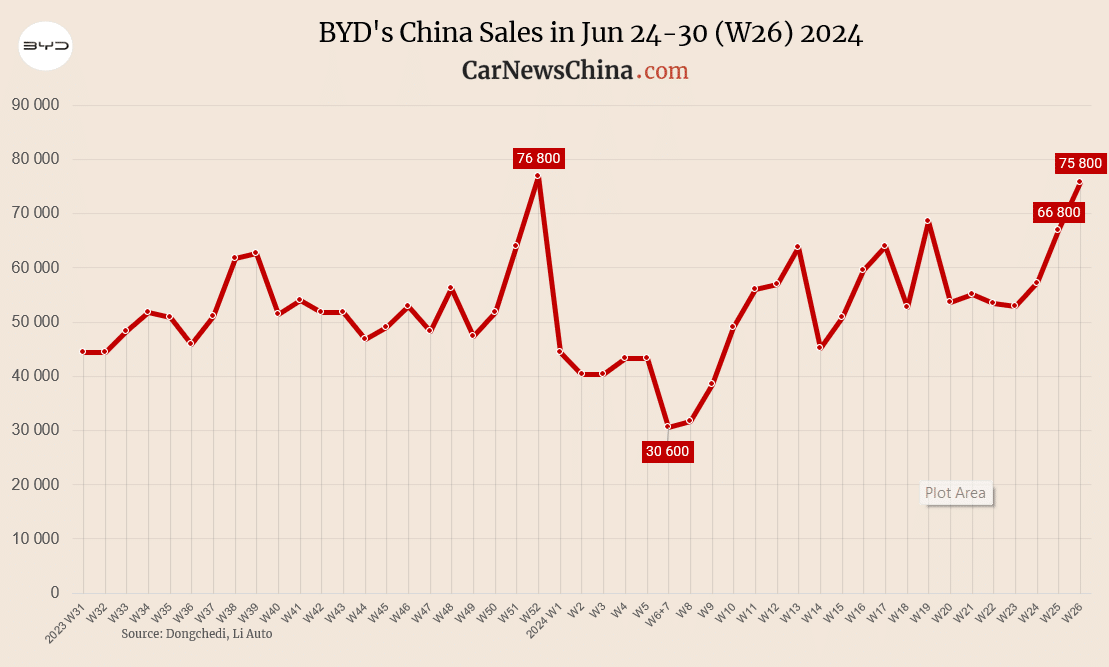
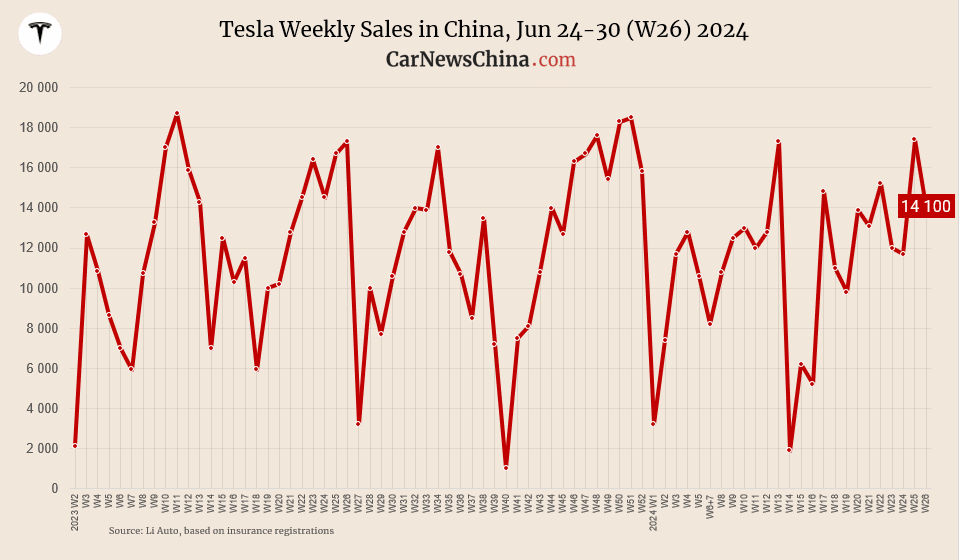
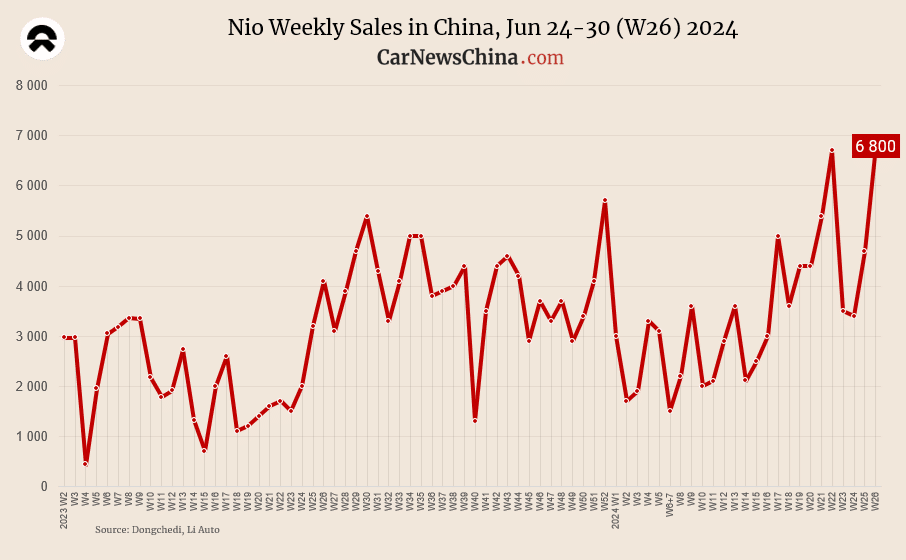
Xiaomi sales were 3% down, and Tesla sales were 20% down from the previous week. On the other hand, BYD sales were up 13%, and Nio sales were 45% up.
The weekly sales are published by Li Auto, and despite Li’s not explicitly saying it, they are based on insurance registration data. The numbers are rounded and present new energy vehicles (NEV) sales, the Chinese term for BEVs, PHEVs, and EREVs (range extenders). To be completely precise, it also includes hydrogen vehicles (FCEVs), but their sales are almost non-existent in China.

BYD secured the top position with 75,800 insurance registrations, up 13.47% from 66,800 units the week before and 40.37% from 54,000 the previous year. The week 26 of the previous year, used for YoY comparison, was between June 26 and July 2.
The 75,800 insured vehicles are near BYD’s all-time high, which was last week of 2023 when the company registered 76,800 vehicles in a single week during an end-of-year sales push.

Between June 3 and June 30, BYD registered 252,600 vehicles in China. Yesterday, BYD reported selling 341,658 vehicles in June.

Tesla reported 14,100 insurance registrations, which is a decrease of 18.97% from 17,400 units the week before and 18.50% from 17,300 the previous year. Between June 3 and June 30, Tesla registered 55,200 vehicles in China.

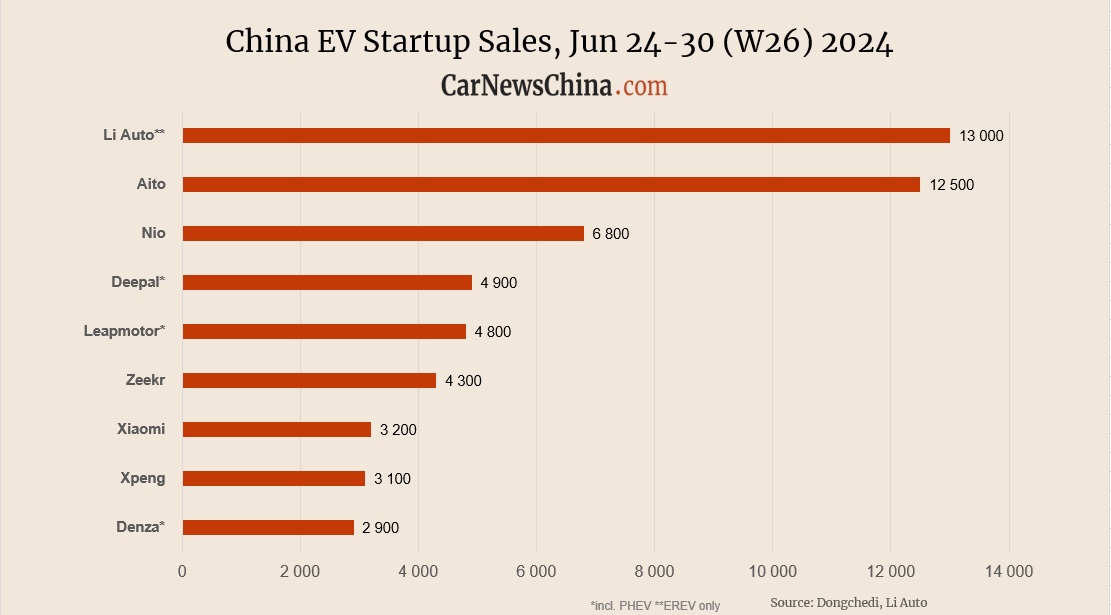
Li Auto saw 13,000 insurance registrations, an increase of 11.11% from 11,700 units the week before and a 100.00% increase from 6,500 the previous year. Between June 3 and June 30, Li Auto registered 46,100 vehicles in China. In June, the company reported selling 47,774 vehicles.

Aito had 12,500 insurance registrations, up 16.82% from 10,700 units the week before. No year-over-year comparison is available, as sales were too low to get into the top 10 EV sellers last year. Between June 3 and June 30, Aito registered 41,400 vehicles in China.
GAC Aion reported 8,200 EV insurance registrations down 9.89% from 9,100 the week before. There was a decrease of 29.31% from 11,600 EVs the previous year. Between June 3 and June 30, GAC Aion registered 21,600 EVs in China.
Wuling had 7,600 EV insurance registrations, down 6.17% from 8,100 the week before and a 24.59% increase from 6,100 units the previous year. Between June 3 and June 30, Wuling registered 20,200 EVs in China.
Nio saw a record-breaking 6,800 insurance registrations, an increase of 44.68% from 4,700 units the week before and 65.85% from 4,100 the previous year. Between June 3 and June 30, Nio registered 18,400 vehicles in China. In June, company reported selling 21,209 vehicles.
6,800 insured vehicles in a single week is an all-time high for Nio, breaking the record of 6,700 units from week 22.

Deepal reported 4,900 insurance registrations, an increase of 32.43% from 3,700 units the week before. No year-over-year comparison is available. Between June 3 and June 30, Deepal registered 14,200 vehicles in China.
Leapmotor had 4,800 insurance registrations, up 14.29% from 4,200 units the week before and 45.45% from 3,300 the previous year. Between June 3 and June 30, Leapmotor registered 16,200 vehicles in China. In June, company reported selling 20,116 vehicles.
Zeekr saw 4,300 insurance registrations, a decrease of 4.44% from 4,500 units the week before but an increase of 38.71% from 3,100 the previous year. Between June 3 and June 30, Zeekr registered 17,100 vehicles in China. In June, company reported selling 20,106 vehicles.
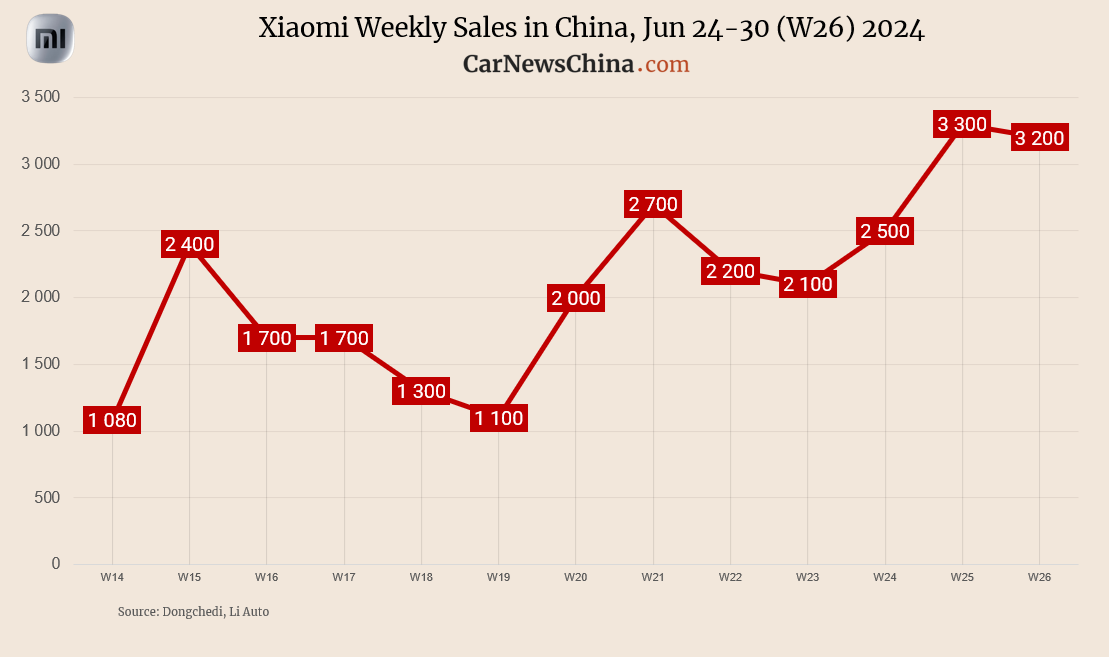
Xiaomi reported 3,200 insurance registrations of their only model, SU7, a slight decrease of 3.03% from 3,300 units the week before. No year-over-year comparison is available as the company started deliveries three months ago, in April. Between June 3 and June 30, Xiaomi registered 11,100 vehicles in China. In June, the company reported deliveries of “over 10,000” units of SU7.

Xpeng had 3,100 insurance registrations, up 24.00% from 2,500 units the week before and 19.23% from 2,600 the previous year. Between June 3 and June 30, Xpeng registered 9,500 vehicles in China. In June, they reported selling 10,668 vehicles.
Denza saw 2,900 insurance registrations, an increase of 16.00% from 2,500 units the week before. No year-over-year comparison is available. Between June 3 and June 30, Denza registered 9,500 vehicles in China.
 

Stelato S9 all-electric sedan, backed by Huawei, official interior images released in China​


Reading Time: 3 minutes

Dong Yi Chen

July 2, 2024


5


News like this to your inbox or phone?​


Weekly summary to your inbox
I want this

Never miss and important news
Get Instant notification once the news is published.
Follow Us

On July 2, the official interior images of Huawei and BAIC’s Stelato smart car brand called the Stelato S9 were released. Previously, the car has been opened for pre-sale, with an estimated price range of 450,000 – 550,000 yuan (62,000 – 76,000 USD). The launch is expected to be in August.

The interior adopts a beige color scheme and a four-seater layout. The cockpit features a three-spoke multi-function leather steering wheel, a large floating central control screen, and a full LCD instrument panel. The detailed dimension spec has not been revealed at this time. The operating vehicle will be supported by the Huawei HarmonyOS system.
The Huawei Sound system is also present.

The rear comes with zero-gravity seats, an armrest screen with entertainment capabilities and to adjust the seat functions as well as the air conditioner, and a wireless charging panel. All four windows are equipped with double-layer laminated soundproof glass and all four seats are equipped with ventilation, heating, and massage functions. After the co-pilot seat is folded down, it can form a flat bed with the rear seat.
Furthermore, the door trims are implanted with ambient light strips and speakers.
The Stelato S9 sits on the Huawei Tuling Intelligent Chassis, measuring 5160/1987/1486 mm with a 3050 mm wheelbase. It will also be the first car to use the Huawei’s Qiankun ADS 3.0 intelligent driving system.

From the side, the vehicle features digital external mirrors, hiddle door handles, and 20/21-inch multi-spoke rims.
In terms of power, the Stelato S9 will be available in single-motor and dual-motor variants. The single-motor variant outputs a maximum power of 227 kW (304 hp) and offers two battery type options: ternary lithium + lithium iron manganese phosphate and ternary lithium. The dual-motor model outputs 158 kW (212 hp) for the front motor and 227 kW for the rear motor, and paired with ternary lithium battery packs. So far, the declared trims offer battery packs with capacities of 79.9 kWh and 97.6 kWh, providing CLTC cruising ranges of 665 km, 672 km, 721 km, and 816 km.
Source: Yu Chengdong Weibo, DongCheDi
 

BYD launched five vehicles in Tunisia: 3 EVs and 2 PHEVs​


Reading Time: 2 minutes

Dong Yi Chen

July 2, 2024


0


News like this to your inbox or phone?​


Weekly summary to your inbox
I want this

Never miss and important news
Get Instant notification once the news is published.
Follow Us

On June 27, BYD officially launched three pure electric vehicles, namely, the BYD Tang, Dolphin, and Yuan Plus (also known as the BYD Atto 3); as well as two plug-in hybrid vehicles, namely, the BYD Song Plus DM-i and Destroyer 05 (also known as the BYD King locally) to the Tunisian market.

Launch Conference
At the launch conference, Huang Zhixue, General Manager of BYD Middle East and Africa Auto Sales Division said that BYD “strives to promote the transformation of automobile electrification in Tunisia and the entire African region.”
On July 1, BYD announced that it sold 341,658 vehicles in June, a year-on-year increase of 28.46%, bringing its annual cumulative sales to 1,613,000 vehicles. In particular, 145,200 pure electric vehicles were sold and 195,000 plug-in hybrid vehicles were sold. In addition, 27,000 new energy passenger vehicles were sold overseas in June. Furthermore, the BYD Dynasty and Ocean series sold a total of 324,838 vehicles in June, a year-on-year increase of 35%. In 2024, BYD targets to sell more than 4 million vehicles, with an export target of more than 500,000 vehicles.

In 2021, BYD announced its overseas expansion plan. In the past year, BYD’s passenger car business unit has covered 19 countries including the United Kingdom, France, Germany, Italy, and Spain, with a total of 250 stores opened, and successfully launched models such as the BYD Yuan Plus, Seal, Dolphin, and Song Plus EV. It is worth mentioning that the BYD Yuan Plus has been sold in more than 70 countries and has become the best-selling pure electric vehicle in countries including Sweden, New Zealand, Thailand, and Israel.
BYD at the Geneva Motor Show
Earlier this year on February 26, BYD unveiled eight new energy vehicles at the Geneva Motor Show, including the BYD Song Plus DM-i, which is called the BYD Seal U DM-i in the overseas market.
Source: BYD Weibo, 36kr
 

Huawei backed Aito uses diecasting to boost M9 production capacity​


Reading Time: 2 minutes

Mark Andrews

July 1, 2024


2


News like this to your inbox or phone?​


Weekly summary to your inbox
I want this

Never miss and important news
Get Instant notification once the news is published.
Follow Us

Aito is the latest Chinese brand to adopt diecasting. Set up in 2021 by Huawei and Seres it was the first brand under the Harmony Intelligent Mobility Alliance (HIMA) collaboration model where a car producer builds the car but Huawei provides full-stack intelligent vehicle solutions. According to reports at the end of last month, Seres started using diecasting for production of the Aito M9 model and the company claims that this is boosting production capacity.

Seres are using a Wencan IDRA9800T unit, which is a 10,000-ton class super diecasting unit. Installation of the unit began in February. The machine is being used to create one-piece diecast rear body units for the Aito M9 (see specs), although not confirmed this is most likely to be for the chassis. What this means is that the number of parts is reduced by nearly 80 and the number of solder joints is reduced by about 1,440. Seres claims it achieves the highest integration of diecasting parts and the torsional rigidity is increased by 23%. Overall it reduces the complexity of manufacturing, greatly improves production efficiency, and effectively improves vehicle endurance and energy-saving efficiency.
The diecasting machine will reportedly be used on the forthcoming Aito M8 as well, the M8 is a five-seat version of the M9. Currently, orders for the Aito M9 stand at over 100,000. Deliveries began earlier this year and so far just over half have been delivered. Seres is hoping that the diecasting machine can help boost monthly deliveries to over 15,000.

Large-scale diecasting was first used by Tesla, where it is known as the Giga Press. Since then a number of Chinese producers have started such machines to simplify production, reduce costs, and increase rigidity and thereby the safety of cars. Xpeng is currently using a 12,000T machine in the production of the X9 MPV and also uses diecasting for other models. Nio also uses the process, and two months ago we reported about Xiaomi using diecasting to produce the rear floor assembly of the Xiaomi SU7. Xiaomi’s 9100T machine reduces 72 parts that previously required stamping and welding down to just one die-cast part which can be produced in 100 seconds.
Sources: Fast Technology, Fast Technology,
 

2025 Zeekr X all-electric SUV launched, price starts at 27,500 USD​


Reading Time: 3 minutes

Dong Yi Chen

July 1, 2024


1


News like this to your inbox or phone?​


Weekly summary to your inbox
I want this

Never miss and important news
Get Instant notification once the news is published.
Follow Us

On July 1, Zeekr launched its 2025 Zeekr X in China, offering a 5-seater sports trim (AWD) and two 4-seater trims (RWD & AWD) at a price range of 200,000 – 220,000 yuan (27,500 – 30,200 USD).

Positioned as a compact SUV, the 2025 Zeekr X (see spec here) measures 4450/1836/1572 mm, and the wheelbase is 2750 mm.
As a facelift model, the 2025 Zeekr X follows the design style of the previous model. Seven exterior body colors are offered, namely, orange (newly added), beige, green, grey, purple, silver, and white. The car runs on 19-inch rims as the standard and offers optional electric doors (without door handles).

In terms of intelligent driving capabilities, the 2025 Zeekr X comes with the Zeekr AD advanced driving system realized via five cameras, five millimeter-wave radars, and 12 ultrasonic radars. The capabilities include adaptive cruise control, lane change assist, automatic parking assist, remote smart parking assist, forward collision warning, automatic emergency braking, lane keep assist, blind spot warning, door opening warning, traffic sign recognition (including speeding reminder), and front/rear cross-traffic alert.
The cockpit is minimalistic, equipped with a flat-bottom double-spoke multi-function steering wheel, an 8.8-inch rectangular instrument panel, a slideable 14.6-inch central control screen that can move 353 mm from the middle position to the co-pilot position, and a 24.3-inch HUD. In addition, the five-seater trim has a “magic center console”, which is a 7 L storage space and supports 50 W mobile phone wireless fast charging. It is worth mentioning that on the day of the launch press conference, the OS 5.2 OTA updates were released, including an HMI 3.0 interactive system featuring green wave control, traffic light countdown, HUD map, and 3D immersive navigation map. Furthermore, the sentry mode can be automatically activated in unfamiliar locations.
The 4D cloud zero-gravity seats support three-speed ventilation/heating, 22-way electric adjustment, and a default lying angle of 28°.

A 5.7 L on-vehicle refrigerator is also present, supporting triple temperature control modes: freezing, cooling, and heating, with a temperature range of -15° to 50°. Other configurations include a Qualcomm Snapdragon 8155 chip for the compute platform, 13 Yamaha speakers, and face ID recognition.
The 2025 Zeekr X is still equipped with 66 kWh ternary lithium battery packs as the standard and continues to be offered in single-motor rear-wheel drive and dual-motor four-wheel drive. The five-seater trim is powered by dual electric motors with a combined system maximum power of 315 kW (422 hp) and peak torque of 543 Nm. The 0 – 100 km/h acceleration time is 3.7 seconds and the CLTC cruising range is 512 km. The four-seater version is available in single-motor and an optional dual-motor trims:
  • Single-motor: 200 kW (268 hp)/343 Nm, 560 km cruising range (CLTC), 0 – 100 km/h acceleration time of 5.8 seconds
  • Dual-motor: 315 kW/543 Nm, 500 km cruising range (CLTC), 0 – 100 km/h acceleration time of 3.8 seconds
Source: Zeekr
 

GAC Aion Thai factory to open this month and 2nd generation Aion V to launch July 23​


Reading Time: 3 minutes

Mark Andrews

July 1, 2024


0


News like this to your inbox or phone?​


Weekly summary to your inbox
I want this

Never miss and important news
Get Instant notification once the news is published.
Follow Us

Today a GAC Aion official commented that the company’s factory in Thailand will be completed in mid-July and at the same time the second generation Aion V would be launched globally. It is not currently clear if there is a connection between these reports.

Previous reports indicated the Aion Y Plus would be the first model produced at the Thai plant, located in Rayong Province in the country’s Eastern Economic Corridor (EEC). GAC announced plans for the factory in November last year and broke ground on January 26, this year. Due for completion later this month is the first of two phases of the factory. Total investment in the plant is 2.3 billion Thai Baht (64.8 million USD), with a 50,000 car output. It will be GAC’s first plant outside China and will produce right-hand drive models. Judging from the investment and renderings of the site, the factory is unlikely to do much more than assemble CKDs.
Breaking ground at the Thai factory earlier this year
The new factory is part of plans for Aion which call for both production and sales of 1 million cars in 2025. At the 40th Thailand International Motor Expo last November, Aion showcased five vehicle models and EV technologies. The brand has also reportedly entered into distribution agreements with a number of Thai dealer groups and identified 34 possible sales centers. The Aion brand has been busy entering various Southeast Asian markets and is also building a factory in Indonesia.

Said to be launching on July 23 the second generation Aion V is the first GAC Aion car to be purposely designed as a global model This means that even if it is not the launch model for the Thai and Indonesian factories it will likely be produced at them later on.
Chinese prices are reported to start around 149,800 yuan (20,600 USD) and it measures in at 4605, 1854 and 1660 mm (l/w/h), with a 2775 mm wheelbase. Buyers can choose from either a 150 or a 165 kW electric motor. Although there is no news on battery capacity it’s known that range is up to 750 km. The platform is 400V but it applies silicon carbide for the first time. Using a lithium iron phosphate battery it has 3C fast charging. Thanks to the new technology it has shortened charging times by 60% meaning it can take on the equivalent of 370 km range in 15 minutes. The Aion V rides on the new self-developed AEP pure electric digital platform.

External power discharge is up to 7 kW. The center console storage compartment has 6.6 liters of space and can provide heating, cooling and freezing modes with temperatures reaching from -15°C for freezing up to 50°C for heating. GAC claims energy consumption for this is 0.5 kWh per day, The seats can fold down to make a bed and there is a 2.14 m² panoramic sunroof.
High-spec versions will come with a high degree of driving assistance through an Nvidia Orin X chip making sense of inputs from a high-thread Lidar unit, 5 millimeter wavelength radars, and 11 cameras. It will provide driving assistance (NDA) in urban areas as well as on highways without the need for high-precision mapping.
Sources: Autohome, Autohome
 

Users who are viewing this thread

Latest Posts

Back
Top